
In This Article
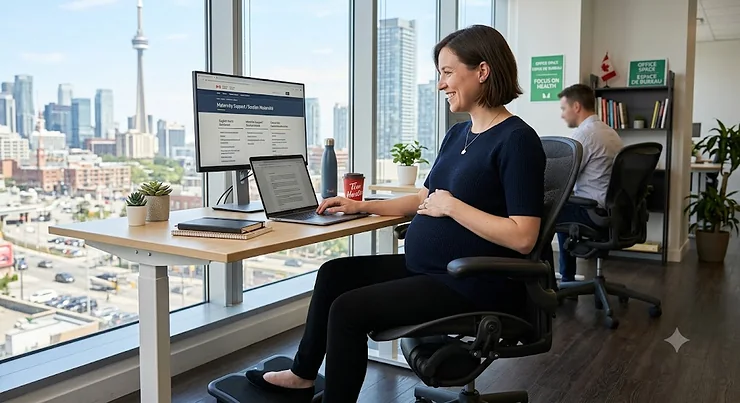
Somewhere around week 20, the chair that used to disappear underneath you starts staging a quiet rebellion. Your lower back complains by 2 p.m. Your hips feel like they’re auditioning for a new job description. And the seat that was “fine” for two years suddenly isn’t fine at all. That’s not in your head — it’s biomechanics. Pregnancy office chair support matters because your centre of gravity, ligament laxity, and spinal curvature are all shifting in real time, and most desk chairs were engineered for a body that isn’t doing any of that.
What is pregnancy office chair support? In short, it’s seating designed or adjusted to accommodate the postural and circulatory changes of pregnancy — typically through deeper, more adjustable lumbar support, a wider or depth-adjustable seat pan, breathable materials, and recline or footrest options that reduce pressure on the lower back, hips, and swollen feet. According to the Canadian Centre for Occupational Health and Safety, a workstation should allow a person to remain in a balanced, neutral body position, and pregnancy makes that balance noticeably harder to find without the right tools.
This guide breaks down seven real, currently available chairs across budget, mid-range, and premium tiers, with honest analysis of who each one actually suits — not just spec sheets copied from a listing. We’ll also walk through trimester-by-trimester setup, common mistakes, and the prenatal office ergonomics most people skip until their back forces the issue. Everything here is grounded in real product specifications and aggregated review sentiment; we’re not pretending to have personally tested every chair, but we have dug into the data so you don’t have to guess. Prices are shown as ranges in Canadian dollars, since exact pricing shifts constantly — always check the current listing before buying.
Quick Comparison Table: Pregnancy Office Chair Support at a Glance
| Chair | Price Range (CAD) | Standout Feature | Best For |
|---|---|---|---|
| Duramont Ergonomic Office Chair | C$230–C$280 | 4D lumbar adjustment on a budget | First-trimester budget shoppers |
| HON Ignition 2.0 | C$500–C$600 | Proven mid-back support, easy synchro-tilt | Office workers wanting reliability |
| Sihoo Doro C300 Pro | C$550–C$650 | Self-adapting dynamic lumbar that tracks recline | Anyone who reclines often |
| Ticova Executive with Footrest | C$400–C$480 | Built-in retractable footrest, 130–145° recline | Swollen feet, third-trimester breaks |
| Branch Ergonomic Chair Pro | C$650–C$750 | 14 points of adjustment, two-way lumbar | Long, full workdays at home |
| Steelcase Series 1 | C$600–C$750 | Weight-activated recline, 12-year warranty | Buyers who want brand-level durability |
| Herman Miller Aeron | C$1,800–C$2,300+ | PostureFit SL sacral support, 3 sizes | Long-term investment, postpartum use |
Looking at the spread above, the gap between the Duramont and the Aeron isn’t really about comfort alone — it’s about adjustability range and how long you expect to keep using the chair after the baby arrives. Budget chairs like the Duramont solve today’s problem cheaply, while something like the Branch Pro or Steelcase Series 1 earns its higher price by adapting as your body changes across all three trimesters. If swelling and the need for elevated feet are your dominant complaint, the Ticova’s built-in footrest does something none of the others on this list do natively, which is worth more than a few extra adjustment points.
💬 Just one click — help others make better buying decisions too!😊
✨ Don’t Miss These Picks!
💬 Tap any chair above to check current pricing on amazon.ca — your back will thank you by week 30.
Top 7 Pregnancy Office Chair Support Picks: Expert Analysis
This list spans budget to premium, mesh to leather, and recliner-style to fully ergonomic, because no single chair fits every body or every trimester. Affiliate disclosure: links below may earn us a small commission at no cost to you.
1. Duramont Ergonomic Office Chair
The Duramont’s headline feature is its 4D lumbar adjustment — moving up, down, in, and out — at a price point that usually buys you a single fixed lumbar bump. That matters during pregnancy specifically because your lumbar curve shifts week to week, and a chair that can’t move with you forces you to compensate with posture, not the other way around. Based on the spec comparison, this chair is built for users between roughly 5’5″ and 6’2″, with a breathable mesh back, thick memory foam seat, and an adjustable headrest that taller users particularly appreciate. Reviewers note the lumbar support is moderate rather than aggressive, and the chair lacks seat depth or seat tilt adjustment — which is the trade-off you make at this price tier. What most buyers overlook is that the recline lock holds at any angle rather than just two fixed positions, so you can dial in a gentle backward lean for second-trimester comfort without fully reclining.
✅ Pros: genuinely adjustable lumbar at a low price, breathable mesh back, holds recline at any angle
❌ Cons: shorter or petite users may find the seat depth doesn’t adjust to fit them; armrests are basic
Price range: around C$230–C$280. Value verdict: the strongest entry point for anyone who needs real lumbar adjustability before committing to a bigger spend.
2. HON Ignition 2.0
HON built its reputation on commercial-grade seating, and the Ignition 2.0 brings that pedigree into home offices without the four-figure price tag. Adjustable arms allow height changes for a tailored fit, while synchro-tilt control helps the chair accommodate both upright work and relaxed recline. For pregnancy specifically, the synchro-tilt matters because it lets your hips and torso move together rather than forcing a fixed angle, which reduces pressure on the pelvic girdle as your bump grows. The chair captures roughly 70% of premium ergonomic functionality at a fraction of premium pricing, according to independent reviewers who compared it directly against costlier alternatives. The seat slide mechanism — letting the cushion move forward or back — is a quietly useful feature for shorter-torso users who need the lumbar pad to land in the right spot.
Aggregated review sentiment consistently flags two things: the lumbar support upgrade (sold separately on some configurations) is worth paying for, and assembly takes longer than expected — budget 30–45 minutes and ideally a second pair of hands.
✅ Pros: commercial-grade build quality, true synchro-tilt, widely available parts and warranty support
❌ Cons: lumbar support may cost extra depending on configuration; assembly reportedly fiddly
Price range: C$500–C$600. Value verdict: a dependable mid-tier pick for six-to-eight-hour workdays.
3. Sihoo Doro C300 Pro
The Doro C300 Pro’s defining feature is dynamic lumbar support that physically tracks your spine as you recline, rather than staying fixed while your back moves away from it. This self-adaptive system slides downward with your centre of gravity during recline, which eliminates the sacrum gap that ruins comfort on most mesh chairs — a detail that matters enormously in the third trimester, when reclining briefly to take pressure off your lower back becomes a near-hourly habit. Seat depth adjusts roughly 16.8 to 17.8 inches, with a seat height range of about 18 to 22 inches and a 300-pound weight capacity. The 6D armrests adjust in nearly every direction imaginable, though reviewers consistently note they shift more easily than ideal and may need occasional readjustment after sitting down.
Here’s what the spec sheet won’t tell you: the seat depth adjustment is a genuine advantage for anyone whose proportions change as pregnancy progresses, since you can extend the seat pan to keep supporting your thighs evenly as your overall shape shifts.
✅ Pros: dynamic lumbar that follows recline, generous seat depth range, breathable dual-layer mesh
❌ Cons: armrests can feel loose; assembly is more involved than single-box chairs
Price range: C$550–C$650. Value verdict: arguably the best lumbar-tracking technology under C$700 right now.
4. Ticova Executive Office Chair with Footrest
This is the chair on the list built explicitly around recline-and-rest cycles rather than pure upright ergonomics, and that distinction is exactly why it earns a spot for third-trimester comfort. It offers a 140-degree recline and a retractable footrest sturdy enough to fully support your legs, plus a segmented backrest that provides support across three zones: lumbar, mid-back, and head. For anyone dealing with swollen ankles by late afternoon — a near-universal pregnancy complaint tied to fluid retention and reduced circulation — being able to elevate your feet without leaving your desk is a meaningfully different experience than a standard task chair.
Based on the spec comparison, the seat measures roughly 21.7 inches wide by 23.2 inches deep with a 300-pound capacity, comfortably accommodating a growing midsection through later pregnancy. The trade-off is that PU leather upholstery, while easy to wipe down, retains more heat than mesh — worth weighing if you run warm, which many pregnant people do due to increased blood volume.
✅ Pros: built-in footrest for swelling relief, deep recline, segmented back zones
❌ Cons: PU leather runs warmer than mesh; reclining mechanism tension can feel soft on some units
Price range: C$400–C$480. Value verdict: the single best pick if foot and leg swelling is your dominant third-trimester complaint.
5. Branch Ergonomic Chair Pro
The Branch Ergonomic Chair Pro packs 14 distinct points of adjustment into a chair that costs a fraction of premium competitors, and the two-way lumbar pad is the standout for pregnancy use. The lumbar pad adjusts in both height and depth, letting you dial in exactly where it sits and how firmly it presses — independent reviewers compare its sophistication favourably to the Steelcase Leap V2, generally considered a category benchmark. Forward tilt pitches the seat pan slightly downward, encouraging an open hip angle that reduces pressure on the lower back during focused, leaned-forward work, which suits anyone doing screen-heavy desk work through pregnancy.
What most buyers overlook about this model is the optional tall cylinder add-on: the standard height range tops out around 45 inches, fine for most users but worth the small upgrade if you’re above average height and want full leg extension during recline breaks. Reviewers also flag a minor rattling issue on some units, which is worth checking for during your return window.
✅ Pros: two-way lumbar depth and height control, forward tilt for active sitting, 7-year warranty
❌ Cons: some reported rattling noise; armrest pads can shift more than expected
Price range: C$650–C$750. Value verdict: near-premium ergonomics for a meaningfully lower investment than Steelcase or Herman Miller.
6. Steelcase Series 1
Steelcase built its name on commercial seating durability, and the Series 1 brings a simplified version of that engineering to home offices. Standard 4-dimensional arm support adjusts to preferred height, width, depth, and pivot, while height-adjustable lumbar support comes standard, and seat depth control allows users to set the extent of forward support to suit different postures and reduce lower back pressure. The weight-activated mechanism is the genuinely clever part: it responds to your body weight to provide appropriate back tension as you recline, with a “boost” option offering 20% additional tension for those who need it — useful as your overall weight shifts through pregnancy without requiring you to manually re-tune the chair every few weeks.
Reviewers are split on long-session comfort versus other chairs in this list, but consistently praise the warranty: Series 1 chairs support users up to 400 pounds and are backed by the Steelcase Limited Lifetime Warranty. That long-term backing matters if you intend to keep using the chair well past maternity leave.
✅ Pros: weight-activated tension that self-adjusts, genuinely adjustable lumbar and seat depth, lifetime warranty
❌ Cons: recline range is more limited than dedicated recliner-style chairs; armrests get mixed comfort feedback
Price range: C$600–C$750. Value verdict: a brand-backed mid-premium chair built to outlast pregnancy itself.
7. Herman Miller Aeron
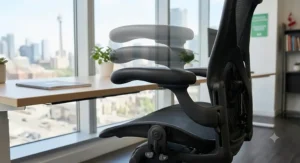
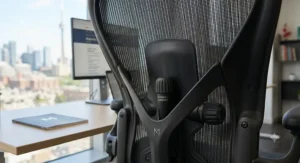
The Aeron is the chair most ergonomic recommendations eventually point toward, and for pregnancy specifically, its sizing system is the real differentiator. The Aeron comes in three sizes — A, B, and C — accommodating bodies from roughly 4’8″ to nearly 7′ tall, with weight capacities up to 350 pounds depending on size. PostureFit SL lumbar support promotes proper posture and helps mitigate back pain by supporting the sacral region rather than just the mid-back, which is precisely where pregnancy-related anterior pelvic tilt puts the most strain. The all-mesh build, made of 8Z Pellicle mesh tested at 200,000 double rubs, keeps you cool through hormonal temperature swings rather than trapping heat like padded alternatives.
Here’s the honest trade-off: this is a serious financial commitment for a chair you’ll use for roughly nine months of pregnancy specifically, though its 12-year warranty covering all parts means the real value calculation is about years of use after the baby arrives, not just the pregnancy itself.
✅ Pros: PostureFit SL sacral support, true size-matched fit, 12-year full warranty
❌ Cons: significant upfront cost; all-mesh design means no plush padding option
Price range: C$1,800–C$2,300+, depending on size and configuration. Value verdict: justified if you plan to use the chair for years beyond pregnancy, not just during it.
Practical Usage Guide: Setting Up Your Pregnancy Office Chair Support
Buying the right chair solves maybe half the problem; the other half is setup, and most people skip it entirely. Start with seat height: your knees should sit roughly level with or slightly below your hips, feet flat on the floor or a footrest, leaving a two-to-three-finger gap behind your knees. Next, position the lumbar support just above your beltline rather than centred on your whole back — as your belly grows, the natural curve you’re supporting shifts slightly lower than where most people instinctively place it.
A common first-30-days mistake is leaving the chair set to pre-pregnancy settings and just leaning forward to compensate, which defeats the entire purpose of the upgrade. Re-check your settings every few weeks, not just once at setup, since your proportions genuinely change. For maintenance, wipe mesh backs with a damp cloth monthly to prevent dust buildup in the weave, and check gas cylinder and tilt tension every couple of months — pregnancy-related weight changes can make a previously “locked” recline feel loose. One optimization trick worth knowing: pairing your pregnancy back support chair with a small rolled towel at the very base of the lumbar curve, in addition to the chair’s built-in support, often solves the “almost right but not quite” feeling many people report in months six through eight.
Real-World Scenarios: Matching Pregnancy Office Chair Support to Your Work Life
Consider three different situations. A first-trimester software developer working ten-hour days from a small home office, still mostly symptom-free but proactively setting up support before discomfort hits, is best served by something like the HON Ignition 2.0 or Steelcase Series 1 — reliable, professional-looking, and built to last through the full pregnancy and beyond without needing a second purchase.
A third-trimester customer service representative dealing with significant swelling and needing to elevate her feet between calls has a very different priority list. The Ticova Executive with Footrest directly answers that need in a way no amount of lumbar adjustability can substitute for — sometimes the practical fix beats the technically superior chair.
A freelance writer on a tight budget, working part-time hours from a shared kitchen table setup, doesn’t need C$2,000 of Herman Miller engineering. The Duramont’s adjustable lumbar at under C$300 solves the actual problem — back support — without overspending on features she’ll use for a few months. Matching the chair to the situation, not just the trimester, is what actually prevents buyer’s remorse.
Problem → Solution: Common Pregnancy Sitting Pain Points
Lower back ache by mid-afternoon is usually a lumbar positioning problem, not a strength problem — reposition the lumbar pad slightly lower than feels intuitive and recheck weekly. Swollen feet and ankles respond best to elevation above hip height for 15–20 minutes every couple of hours; a chair with a built-in footrest, like the Ticova, removes the friction of having to find and set up a separate ottoman. Numb or tingling thighs typically mean the seat edge is cutting into circulation behind your knees — look for a waterfall-edge seat design, present on most chairs in this list, which curves downward at the front to relieve that pressure point.
Overheating during work hours, common given pregnancy’s increased blood volume, is largely solved by switching from foam or leather seating to a breathable mesh option like the Sihoo or Herman Miller Aeron. Finally, the “can’t find a comfortable position” complaint that intensifies in month eight or nine is rarely fixed by a single adjustment — it usually means it’s time to alternate between sitting, standing, and brief reclining throughout the day, which the CSA Z412-17 standard explicitly recommends rather than holding any single posture for extended periods.
🔍 Ready to Upgrade Your Setup?
✨ Browse the full lineup above and find the pregnancy office chair support that matches your trimester and budget — your future self will thank you.
Best Office Chair for Pregnant Women: What Actually Matters
When narrowing down the best office chair for pregnant women, prioritize these criteria in order. First, adjustable lumbar support that moves in at least two directions — height and depth — since a fixed lumbar bump will eventually sit in the wrong place as your spine’s curve changes. Second, seat depth adjustment or a generously sized seat pan, because your sitting posture and weight distribution shift noticeably between first and third trimester. Third, breathable material; pregnancy hormones increase blood flow to the skin, making overheating a far more common complaint than most non-pregnant shoppers would anticipate.
Fourth, a genuine weight capacity buffer above your current weight, accounting for healthy pregnancy weight gain. Fifth, recline functionality that locks at multiple angles rather than just upright-or-fully-back, since brief reclining breaks become genuinely useful by the third trimester. Sixth — and most overlooked — assembly difficulty and the availability of professional assembly add-ons, since wrestling with hex keys and heavy chair components isn’t advisable in later pregnancy. Weighing these six factors against your specific trimester and work style narrows the seven picks above to one or two realistic finalists faster than scrolling through generic star ratings.
Pregnancy Back Support Chair Features That Actually Matter
Not every “ergonomic” label translates into meaningful pregnancy back support chair functionality. Dynamic or adaptive lumbar systems — like the Sihoo Doro C300 Pro’s recline-tracking pad — outperform static foam bumps because they continue supporting your spine even as you shift position throughout a workday, which matters more during pregnancy than almost any other life stage. Sacral support, the PostureFit SL approach used in the Herman Miller Aeron, targets the pelvis rather than just the mid-back, directly addressing the anterior pelvic tilt that develops as your centre of gravity moves forward.
Seat width matters more than most buyers expect; a narrow seat pan that felt fine pre-pregnancy can start to feel genuinely constrictive by month six. Tilt tension that’s easy to reach and adjust without standing up — rather than a knob tucked underneath the seat — saves real friction on a body that’s already working harder to bend and reach. Reviewers consistently note that chairs scoring poorly on “ease of micro-adjustment” get abandoned in favour of slouching within a few weeks, regardless of how impressive the spec sheet looked at purchase.
Maternity Office Chair Recommendations by Trimester
First trimester maternity office chair recommendations are mostly about proactive setup rather than reactive fixes — symptoms are often mild or absent, so this is the ideal window to dial in lumbar positioning and seat height before discomfort forces rushed decisions. A reliable mid-tier pick like the HON Ignition 2.0 or Duramont covers this stage well without overspending before you know how your specific pregnancy will progress.
Second trimester is when most people notice the shift: the belly is visibly growing, the centre of gravity is moving, and seat depth becomes genuinely important as you may need to sit slightly further from the desk. This is the point to revisit your chair’s seat depth and lumbar height settings, and to consider upgrading if your current chair lacks that adjustability. Third trimester maternity office chair recommendations lean heavily toward recline and footrest functionality — the Ticova Executive or any chair with a strong recline range earns its keep here, since brief reclining breaks genuinely reduce pelvic and lower back pressure in the final stretch. Postpartum, many people find their chair needs shift again, which is one reason investing in a chair with long-term adjustability, like the Branch Pro or Steelcase Series 1, pays off well beyond the pregnancy itself.
Office Chair Third Trimester: What Changes and Why
The third trimester brings the most significant physical changes of pregnancy, and your office chair third trimester needs reflect that. By this stage, the uterus has grown enough to noticeably compress circulation in the legs when seated for long stretches, making edema — visible swelling in the feet and ankles — far more common by late afternoon. A retractable footrest, like the one built into the Ticova Executive, addresses this directly by letting you elevate your legs above hip height without leaving your desk setup.
Recline angle becomes more valuable than upright posture alone during this stage; the weight of a full-term bump pressing forward makes brief reclining breaks genuinely relieving for the lower back and pelvic floor. Excessive time spent fully supine isn’t recommended in later pregnancy due to pressure on major blood vessels, so look for chairs that recline to a comfortable angle — generally 120 to 140 degrees — rather than fully flat. Seat width and depth adjustments also matter more here than earlier in pregnancy, since proportions have typically shifted the most by this point, and a seat that felt generously sized in month four can start to feel tight by month eight.
Prenatal Office Ergonomics: Setting Up the Whole Workstation
A great chair solves only part of the prenatal office ergonomics equation; the desk, monitor, and keyboard all need to move with it. Desk height matters more during pregnancy than most people realize — a desk that sits even a couple of inches too high forces the shoulders to hike upward to reach the keyboard, creating constant shoulder and neck strain over a workday. Monitor height should keep the top of the screen roughly at eye level so you’re not tilting your neck downward or craning upward, both of which compound lower back strain by changing how your spine carries weight.
Keep frequently used items — phone, water bottle, notebook — within easy reach to avoid repeated twisting and reaching motions, which become noticeably less comfortable as balance shifts in later pregnancy. Hands, wrists, and forearms should stay straight, in line, and roughly parallel to the floor regardless of how the rest of the setup changes. Finally, build in movement: even the best pregnancy office chair support can’t replace standing up and walking briefly every 30 to 45 minutes. UBC Human Resources’ ergonomics guidance for pregnant employees specifically notes that increased blood volume and venous compression during pregnancy can make prolonged static postures more tiring than before, recommending alternating positions and regular micro-breaks rather than holding any single posture for hours at a stretch.
Common Mistakes When Buying a Pregnancy Office Chair Support
The single most common mistake is buying based on price alone, either too low or unnecessarily high. Going too cheap often means sacrificing the lumbar adjustability that actually matters for pregnancy comfort, while overspending on a premium chair without checking it against your specific body type and trimester can mean paying for features you’ll never use. A second mistake: ignoring weight capacity ratings. Healthy pregnancy weight gain is normal and expected, and a chair rated near your current weight may not comfortably support you by month eight.
Third, skipping the trial or return window. Most retailers, including amazon.ca, offer return periods specifically because chair comfort is deeply personal — use that window rather than assuming you made the right call from a spec sheet alone. WorkSafeBC’s office ergonomics resources also offer a free self-assessment checklist that’s worth running through before finalizing any chair purchase, pregnant or not. Fourth, assembling the chair without reading instructions fully, which several reviewers across multiple models flag as leading to loose joints or squeaking down the line — not ideal when you’re also trying to avoid unnecessary physical strain in later pregnancy. Finally, buying a fully fixed, non-adjustable chair “for now” with the intention of upgrading later; in practice, most people don’t get around to the upgrade, and the discomfort compounds for months in the meantime.
Pregnancy Office Chair Support vs Standard Office Chairs
The core difference isn’t cosmetic — it’s adjustability range and how the chair responds to a changing body rather than a static one. A standard office chair is typically engineered around a single, fixed body shape with modest lumbar and height adjustment, fine for someone whose proportions stay consistent year-round. Pregnancy office chair support, by contrast, prioritizes seat depth adjustment, multi-directional lumbar movement, and often recline or footrest functionality specifically because the user’s body is changing on a roughly weekly basis across nine months.
Cost is the other major divide. A basic standard task chair might run C$100–C$150, noticeably cheaper than even the budget pregnancy-suitable option on this list. That said, the price gap reflects real functional differences: standard budget chairs rarely offer seat depth adjustment or genuinely repositionable lumbar support, both of which matter disproportionately during pregnancy. For someone planning to keep working at a desk long after the baby arrives, the better comparison isn’t pregnancy chair versus standard chair — it’s ergonomic chair versus non-ergonomic chair, with pregnancy simply being the moment that makes the difference impossible to ignore.
Long-Term Cost & Value: Is It Worth It After Baby?
Framing a pregnancy office chair purchase purely around nine months undersells the actual value most of these chairs provide. A mid-range pick like the Sihoo Doro C300 Pro or Branch Ergonomic Chair Pro, priced in the C$550–C$750 range, amortizes to a genuinely low cost-per-use if you continue working from the same desk for years afterward — postpartum back strain from lifting, feeding, and carrying a baby is its own well-documented ergonomic challenge, and a chair with strong lumbar adjustability keeps paying off long after delivery.
The premium tier, particularly the Herman Miller Aeron at C$1,800-plus, only makes financial sense when viewed across a multi-year horizon; its 12-year warranty effectively turns a steep upfront cost into a fraction of that per year of use. Budget chairs like the Duramont solve the immediate problem cheaply but may need replacing within two to three years based on aggregated review reports of cushion compression and reduced lumbar tension over time — a real trade-off worth factoring into your total cost of ownership calculation rather than just the sticker price.
Safety, Regulations & Canadian Workplace Ergonomics
If you’re working for an employer rather than freelancing from home, you may be entitled to a formal ergonomic assessment, and it’s worth asking for one explicitly once you’re pregnant, even if you’ve had one before. The CSA Standard Z412-17, Office Ergonomics, recommends alternating between sitting, standing, and varied postures such as reclining or forward tilting, noting there is no single uniquely correct working posture for an extended period — a principle that applies even more directly during pregnancy than in typical office life.
Research backs up how common this issue actually is: a pilot study published through the Journal of Obstetrics and Gynaecology Canada found that three-quarters of pregnant women experienced some form of pregnancy-related back pain, underscoring that proactive ergonomic support isn’t an overreaction — it’s addressing a near-universal experience. None of this is medical advice; if pain is severe, sudden, or accompanied by other symptoms, talk to your healthcare provider rather than relying on chair adjustments alone. For routine discomfort, though, proper Canadian workplace ergonomics — verified gas cylinders rated for safe use, weight capacities that match your current weight with margin, and properly adjusted lumbar support — go a long way toward making a full pregnancy at a desk genuinely manageable.

FAQ: Pregnancy Office Chair Support
❓ Is an ergonomic chair necessary during pregnancy?
❓ What is the best office chair for pregnant women on a budget?
❓ How should a pregnant woman sit at a desk?
❓ When should I switch to a pregnancy-specific office chair?
❓ Can I use a regular office chair during pregnancy?
Conclusion
Pregnancy office chair support isn’t about chasing the most expensive option on the shelf — it’s about matching adjustability, seat depth, and recline functionality to where you actually are in your pregnancy and how long you plan to keep using the chair. A first-trimester proactive upgrade looks different from a third-trimester swelling fix, and both look different again from someone planning to keep the same chair for years postpartum. Of the seven picks here, the Sihoo Doro C300 Pro and Branch Ergonomic Chair Pro offer the strongest overall balance of adjustability and price for most readers, while the Ticova earns its place specifically for footrest-dependent third-trimester comfort and the Herman Miller Aeron rewards anyone thinking in multi-year terms.
Whichever you choose, the setup steps matter as much as the purchase — re-checking lumbar position every few weeks, building in standing breaks, and adjusting the whole workstation rather than just the chair will do more for your comfort than any single spec upgrade alone.
✨ Found Your Match?
💬 Check current pricing on your favourite pick from the list above and start sitting comfortably today — you’ve earned it.
Recommended for You
- 7 Best Office Chairs for Tailbone Pain in Canada (2026)
- Best Office Chair for Tall Person 6’4: Top 7 Picks for Canada (2026)
- 7 Best Office Chair for Short Person Canada 2026
Disclaimer: This article contains affiliate links. As an Amazon Associate, I earn from qualifying purchases. If you purchase products through these links, we may earn a small commission at no additional cost to you.
✨ Found this helpful? Share it with a friend who’s expecting! 💬🤗
