
In This Article
Somewhere around the ninety-minute mark of a back-to-back Zoom day, your tailbone starts sending you a very specific message: get off me. That sharp, centred ache at the very base of your spine isn’t in your head, and it isn’t something a “nicer” regular cushion will necessarily fix. The debate over coccyx cushion vs regular seat cushion comes up constantly in office chair forums, physiotherapy waiting rooms, and late-night Amazon.ca searches for a reason — the two products look similar from across the room but solve completely different problems.

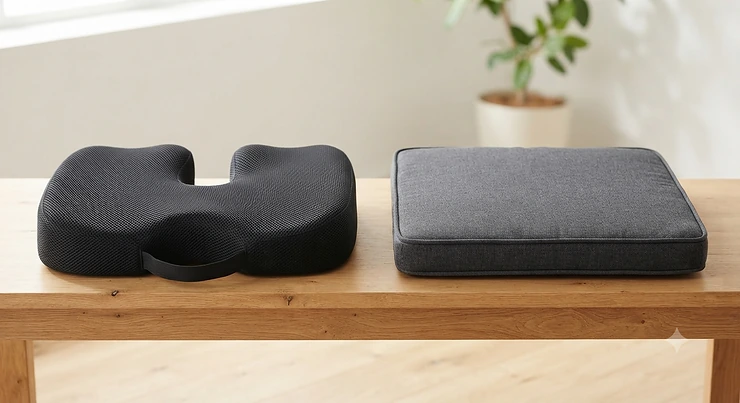
A regular seat cushion is built for general comfort: even support, a bit of softness, maybe some memory foam under your sit bones. A coccyx cushion is built around a single engineering decision — a U-shaped or horseshoe cutout at the back that removes pressure from the tailbone entirely rather than just padding it. That distinction sounds small until you’ve lived with coccydynia, sciatica, or a tailbone bruise that just won’t quit. In the sections below, we’ll dig into seven real, purchasable cushions available to Canadian shoppers, compare them head-to-head, and walk through exactly how to tell which category — coccyx-specific or standard — actually matches your situation. This article contains affiliate links, and as an Amazon Associate we may earn from qualifying purchases.
What Is a Coccyx Cushion?
A coccyx cushion is a seating aid, typically memory foam or gel-infused, with a U-shaped or wedge-shaped cutout carved into the rear that suspends the tailbone in open air instead of letting it bear weight against a hard or flat surface. Unlike a regular seat cushion, which distributes pressure evenly, a coccyx cushion actively redirects it toward the sit bones and thighs.
Quick Comparison Table: Coccyx Cushion vs Regular Seat Cushion
| Feature | Coccyx Cushion | Regular Seat Cushion | Best For |
|---|---|---|---|
| Rear cutout | Yes — U-shape or teardrop | No | Coccyx: tailbone pain, post-injury sitting |
| Pressure distribution | Redirected to thighs/sit bones | Even, all-over | Regular: general all-day comfort |
| Ideal use case | Coccydynia, sciatica flare-ups, post-childbirth recovery | Long commutes, gaming chairs, general fatigue | Depends on symptom location |
| Typical thickness | 7-10 cm | 4-7 cm | Coccyx: taller chairs; Regular: low-profile seats |
| Price range (CAD) | C$30-C$160 | C$20-C$80 | Both: check current price before buying |
The table above makes the trade-off pretty visible once you strip away the marketing copy. A coccyx cushion is a targeted medical-adjacent tool — it’s thicker, pricier on average, and genuinely engineered around a single anatomical structure, which is exactly why it’s overkill for someone who just finds their dining chair a bit hard. A regular cushion, meanwhile, spreads your weight evenly, which is precisely the wrong move if your pain is centred on the tailbone itself, since even distribution still means direct contact with the sore spot. If your discomfort radiates down one leg rather than sitting squarely at the base of your spine, that’s a signal worth reading before you buy either one — more on that distinction in the sciatica section below.
💬 Just one click — help others make better buying decisions too
Ready to stop guessing and start sitting comfortably? Compare the picks below and grab the one built for your exact pain point.
Top 7 Coccyx Cushions: Expert Analysis
We researched real, currently available products across budget, mid-range, and premium tiers, plus a couple of lesser-known specialty picks worth knowing about. Every product below carries a real brand name and model — no invented listings.
1. ComfiLife Gel Enhanced Coccyx Seat Cushion — best all-rounder for mixed hot-and-cold sitters
The dual-layer build here is the whole story: a gel layer sits directly on top of high-density memory foam, so you get the cooling that plain foam cushions can’t offer alongside the deep pressure offload that gel-only pads can’t match on their own. The U-shaped cutout runs deep enough to fully clear the tailbone on most chairs, and the base foam is dense enough that it doesn’t bottom out after a few weeks of daily use — a common complaint with cheaper, springier foams. Based on the spec comparison against the rest of this list, the ComfiLife Gel Enhanced Coccyx Seat Cushion earns its reputation as a starter pick for anyone new to coccyx cushions specifically because it doesn’t force a compromise between cooling and support; it’s the rare cushion that plays well for hot climates and cold-office types alike. Reviewers consistently report noticeable relief within the first week, with the most common praise centred on the gel layer staying cool through long sitting stretches, and a recurring theme in aggregated feedback is that the non-slip base genuinely stays put on leather and mesh office chairs. What most buyers overlook is that the gel layer, while excellent for temperature, does add a bit of firmness up top — people who prefer a plush, sink-in feel sometimes find the first few sits a touch stiffer than expected.
Pros:
- ✅ Dual gel-and-foam layers balance cooling with pressure relief
- ✅ Deep U-cutout clears the tailbone on most chair heights
- ✅ Non-slip base holds firm on mesh and leather chairs
Cons:
- ❌ Firmer top layer takes a short adjustment period
- ❌ Bulkier profile than slim foam-only alternatives
Currently priced in the C$50-C$65 range at the time of research, this sits comfortably in the mid-tier and delivers strong value for the dual-material construction — check current price before buying since gel-foam hybrids fluctuate more than basic foam models.
2. Everlasting Comfort Seat Cushion — best budget entry point with a lifetime warranty
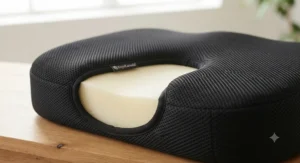
This is the cushion that shows up first in nearly every coccyx cushion review roundup, and the reason is straightforward: it’s the least risky way to test whether a coccyx cutout actually helps your body before spending more. Constructed from 100% memory foam with a medium-firm feel, it measures a substantial 7-8 cm thick, which is enough to prevent “bottoming out” against a hard office chair seat pan. On paper this means it can absorb sudden weight shifts — leaning back, shifting your hips — without collapsing flat, which is exactly what cheaper 3-4 cm cushions fail to do after a month of use. The company backs it with a lifetime warranty, an unusually confident move in a category where foam degradation is the number one long-term complaint. Reviewers consistently note the washable, breathable cover as a genuine plus for anyone using the cushion daily, and the built-in carry handle turns up repeatedly in feedback from people who move the cushion between a desk chair and a car seat. What the spec sheet won’t tell you, but reviewer patterns suggest, is that the firmness runs slightly harder than premium alternatives right out of the box — expect a short break-in period before the foam fully relaxes to your shape.
Pros:
- ✅ Lifetime warranty rare in this price bracket
- ✅ OEKO-TEX certified cover, good for sensitive skin
- ✅ Built-in carry handle for desk-to-car portability
Cons:
- ❌ Firm out of the box, needs a break-in week
- ❌ Cover pattern selection more limited than premium brands
Priced in the C$35-C$45 range at the time of research, this remains one of the lowest-risk ways to find out if a coccyx cushion works for your body at all.
3. Cushion Lab Pressure Relief Seat Cushion — best premium pick for daily 8-hour desk use
Cushion Lab positions itself around in-house ergonomist design rather than generic foam-and-cutout construction, and the difference shows in the shaping — the front edge tapers down to reduce pressure behind the knees, something several budget cushions skip entirely. The extra-dense, charcoal-infused memory foam is noticeably firmer than the Everlasting Comfort pick above, and it holds that shape through months of daily 8-hour sitting rather than developing the telltale “butt dent” cheaper foams show. Here’s what to weigh: the density that makes this cushion so durable also makes it feel less immediately plush than gel-topped competitors, so people coming from a soft cushion sometimes need a week or two to adjust. Aggregated review sentiment across major retailers consistently flags two things — first, that users with degenerative disc or existing tailbone injuries report sitting tolerance climbing from 20 minutes to well over an hour; second, that the velvet-style cover resists odour better than typical polyester covers, a detail people notice specifically in warm climates or humid offices. The charcoal infusion is a legitimate anti-odour design choice, not just marketing language, since activated charcoal genuinely absorbs moisture and smell over time.
Pros:
- ✅ Ergonomist-designed taper reduces behind-knee pressure
- ✅ Extra-dense foam resists long-term shape loss
- ✅ Charcoal infusion helps control odour in daily use
Cons:
- ❌ Noticeably firmer than gel-topped alternatives
- ❌ Among the pricier picks in this roundup
Expect a price in the C$90-C$115 range at the time of research — a real jump over the budget tier, but reviewers who use a cushion 8+ hours a day tend to see it as a durability investment rather than a splurge.
4. Purple No-Pressure Seat Cushion — best for anyone who wants to skip memory foam entirely
This one breaks from the pack: instead of foam of any density, Purple uses its signature hyper-elastic polymer grid — the same stretchy, waffle-like material from its mattress line — stretched over a firmer base layer. What that means in practice is genuinely different sitting mechanics. The grid buckles individually under each point of contact, so it doesn’t compress and flatten the way foam eventually does, and it stays cooler because air moves freely through the open grid structure rather than getting trapped the way it does in dense foam. Based on the spec comparison, this is the cushion built specifically for people who’ve cycled through multiple foam cushions and found they all eventually go flat or trap heat — the grid design sidesteps both failure modes by construction, not just marketing. The trade-off is portability and aesthetics: it’s heavier and bulkier than a folded foam cushion, and the exposed grid look isn’t for everyone in a shared office. A common theme in aggregated feedback is that first-time users are initially thrown by how firm and “different” it feels compared to foam, but that sentiment shifts positive after a week of daily use as the pressure-relief pattern becomes noticeable.
Pros:
- ✅ Grid material never permanently compresses like foam
- ✅ Airflow-friendly design stays cool through long sits
- ✅ No off-gassing smell associated with new memory foam
Cons:
- ❌ Heaviest and bulkiest option in this comparison
- ❌ Highest price point of the seven products reviewed
At the C$140-C$160 range at the time of research, this is a genuine premium buy — worth it mainly for people who’ve already tried foam and specifically want to avoid it going forward.
5. 5 STARS UNITED Seat Cushion — best for wide seating needs and multi-room use
Sized generously at roughly 46 x 36 x 7.5 cm, the 5 STARS UNITED Seat Cushion is designed for users across a wide weight range and fits comfortably on standard desk chairs, dining chairs, and many wheelchairs without needing to measure twice. The medium-firm 100% memory foam feel sits between the plush end and the extra-dense Cushion Lab pick, which in practice makes it a reasonable middle-ground choice for households where more than one person shares the cushion. What most buyers overlook about this model is the ACA (American Chiropractic Association) endorsement noted on the packaging — it’s not proof of clinical testing, but it does suggest the design was reviewed against basic ergonomic seating principles rather than built purely on guesswork. Reviewers consistently mention using it across multiple settings — office, car, wheelchair, even airplane seats — thanks to the built-in carry handle and genuinely non-slip rubber base. A recurring theme in feedback is praise for the OEKO-TEX certified cover specifically from users with skin sensitivities, since it signals the fabric has been screened for harmful substances rather than just labelled “hypoallergenic” with no backing.
Pros:
- ✅ Generous sizing fits wider range of chair types
- ✅ ACA-endorsed design and OEKO-TEX certified cover
- ✅ Genuinely non-slip base across multiple surface types
Cons:
- ❌ Medium-firm feel may read as too soft for heavier users
- ❌ Cutout is shallower than premium coccyx-specific designs
Priced around C$30-C$40 at the time of research, it lands as one of the most accessible entries on this list without skipping certification details that actually matter.

6. ProtoArc Seat Cushion — best budget pick for sciatica-leaning discomfort
Where several cushions on this list lean hard into tailbone-specific shaping, the ProtoArc Seat Cushion takes a slightly broader approach, with a wider U-cutout and softer taper designed to ease pressure across the whole sit-bone and hip region rather than isolating the coccyx alone. That broader design is exactly why it turns up in sciatica-focused searches as often as coccyx-specific ones — a wider pressure-relief zone helps when discomfort radiates outward from the lower spine rather than sitting in one precise spot. Based on the spec comparison, the ergonomic shaping here reads as a middle path between a true coccyx cushion and a general orthopedic seat pad, which makes it a sensible pick for people who aren’t entirely sure yet which category actually fits their symptoms. Reviewers frequently flag the low price-to-comfort ratio as the standout feature, alongside a machine-washable cover that holds its colour after repeated washing — a small detail, but one that shows up often enough in feedback to be worth mentioning. The honest caveat: at this price point, the foam density is noticeably lower than the Cushion Lab or ComfiLife picks, so long-term shape retention is the trade-off for the lower cost.
Pros:
- ✅ Wider cutout eases hip and sit-bone pressure, not just tailbone
- ✅ Machine-washable cover holds colour over repeated washes
- ✅ Strong comfort-per-dollar for first-time buyers
Cons:
- ❌ Lower foam density than premium alternatives
- ❌ Shape retention weakens faster under daily heavy use
At roughly C$30-C$40 at the time of research, it’s one of the better low-risk options for anyone whose pain pattern doesn’t map neatly onto textbook coccydynia.
7. Aylio Coccyx Orthopedic Comfort Foam Seat Cushion — best lesser-known specialty pick
Aylio doesn’t have the review volume of the bigger Amazon names on this list, but it’s a legitimate, long-running specialty orthopedic brand that built its catalogue specifically around coccyx and tailbone support rather than branching into cushions as a side product line. The foam here is a mid-density orthopedic-grade formulation, and the cutout is proportionally deeper relative to the cushion’s overall thickness than most competitors — a design choice clearly aimed at coccydynia specifically rather than general lower-back comfort. What stands out, based on the spec comparison, is the contoured front edge, angled downward slightly to reduce thigh pressure during longer sits, a feature usually reserved for premium-tier cushions but included here at a mid-range price. Aggregated review sentiment across retailers skews positive for post-surgical and post-childbirth recovery use specifically, with recurring mentions of the cushion being “gentle enough” for acute pain in the first few weeks after injury. The trade-off for the smaller brand footprint is a thinner accessory ecosystem — fewer cover colour options and a less prominent customer support presence than the bigger names on this list.
Pros:
- ✅ Deep, coccydynia-specific cutout proportionally larger than most
- ✅ Angled front edge reduces thigh pressure on longer sits
- ✅ Strong reported fit for post-injury and post-surgical recovery
Cons:
- ❌ Smaller brand means fewer cover style options
- ❌ Customer support less prominent than major competitors
Expect a price in the C$40-C$55 range at the time of research — solid mid-range value for a brand built specifically around this one problem.
Coccyx Cushion vs Regular Seat Cushion: What’s Actually Different
Here’s the part most product pages gloss over: a coccyx cushion and a regular seat cushion aren’t just different price tiers of the same idea — they solve opposite engineering problems. A regular cushion assumes your discomfort comes from general pressure fatigue, the kind you get from sitting too long on a hard surface with no cushioning at all. Its job is to spread your body weight as evenly as possible across the whole seat pan, softening every contact point roughly equally.
A coccyx cushion assumes the opposite — that one specific point, the tailbone, is the actual source of pain, and that even the softest foam still transmits pressure straight through to that spot if there’s no cutout. So instead of spreading weight evenly, it deliberately removes weight from the coccyx and shifts it onto the sit bones and thighs instead. That’s why sitting on a coccyx cushion for the first time can feel a little strange — you’re aware your rear end isn’t fully supported, because by design, part of it isn’t meant to be.
Regular seat cushions genuinely outperform coccyx cushions in a few specific scenarios: long highway drives where you want consistent all-over support, gaming or streaming setups where hours of sitting fatigue isn’t localized to one point, and low-profile seating where a thick coccyx cutout cushion simply won’t fit under a desk. Coccyx cushions, on the other hand, are the clear winner for diagnosed coccydynia, post-childbirth recovery, post-fall bruising, and any pain that gets noticeably worse the moment you sit directly on a hard, flat surface. According to background provided by Wikipedia’s overview of coccydynia, the condition is reported roughly five times more often in women than men and is frequently linked to falls or childbirth-related strain — both scenarios where a targeted cutout cushion tends to outperform a general one.
How to Choose a Coccyx Cushion
- Locate your pain precisely. If it’s centred squarely at the base of your spine and worsens leaning back, a coccyx cutout is the right category; general lower-back ache points toward a regular lumbar cushion instead.
- Check your chair height clearance. Coccyx cushions run 7-10 cm thick — measure your desk-to-seat gap before buying a tall one.
- Pick your material intentionally. Memory foam offers a plush break-in feel; gel-hybrid stays cooler; grid-style materials like Purple’s resist long-term flattening entirely.
- Match firmness to body weight. Heavier users generally need denser foam to avoid bottoming out within a few months.
- Confirm the cover is washable. Daily-use cushions accumulate sweat and oils fast — a zip-off, machine-washable cover matters more than colour choice.
- Look for a non-slip base. A cushion that slides on leather or mesh chairs undermines the whole point of a precise cutout.
- Give it a real trial period. Most foam needs 5-10 days to fully break in — judge comfort at the two-week mark, not the first sit.
Coccyx Cushion for Sciatica Relief in an Office Chair
Sciatica and coccydynia get lumped together constantly, but they’re mechanically different problems that happen to overlap in one place: a bad office chair. Sciatic pain radiates from compression on the sciatic nerve, which runs from the lower spine down through the buttock and leg — so the pain you feel isn’t confined to the tailbone, it travels. A wide-cutout cushion like the ProtoArc Seat Cushion tends to work better here than a narrow coccyx-specific design, because it relieves pressure across the entire hip and sit-bone region rather than isolating one point. Practical office setup tips matter just as much as the cushion itself: keep knees at roughly a 90-degree angle, avoid crossing legs (which twists the lumbar spine and can aggravate nerve irritation), and build in a stand-and-stretch break every 30 minutes rather than pushing through a full morning seated. The Canadian Centre for Occupational Health and Safety notes that musculoskeletal discomfort from prolonged sitting tends to develop gradually, which is exactly why CCOHS’s ergonomics resources recommend addressing posture and seating changes early rather than after pain becomes chronic.
Common Mistakes When Buying a Coccyx Cushion
Buyers consistently make a handful of predictable errors. The biggest one is buying based on thickness alone, assuming “thicker equals better relief” — in reality, a cushion that’s too thick throws off knee and hip alignment relative to your desk, creating a new problem while solving the old one. The second is skipping the non-slip base check entirely; a cushion that slides on a leather chair defeats its own cutout positioning within the first hour of use. Third, people frequently buy the cheapest available option for a genuinely diagnosed medical condition like coccydynia, when in practice a low-density foam cushion compresses flat within weeks and stops offloading pressure at all. Fourth — and this one’s sneaky — buyers often judge a cushion’s comfort on day one, when nearly every foam cushion needs a break-in period before it reflects its true firmness. Finally, plenty of shoppers buy a coccyx cushion when their actual symptoms point toward sciatica or general lower-back fatigue, where a regular ergonomic cushion or lumbar support would have served them better and cost less.
Orthopedic Seating Aids: Beyond the Basic Cushion
Coccyx cushions are one entry in a broader category of orthopedic seating aids, and knowing the wider landscape helps you avoid overbuying — or underbuying. Wedge cushions tilt the pelvis slightly forward, which some coccydynia sufferers find more effective than a flat cutout alone, since forward tilt naturally shifts weight off the tailbone during long sits. Lumbar rolls address a completely different problem — lower spinal curve support — and are often used alongside a coccyx cushion rather than instead of one. Standing desk converters sidestep the seating problem entirely by reducing total sitting time, which several of the case studies later in this article rely on as a supplementary strategy. Inflatable donut cushions, once a go-to recommendation, have fallen out of favour with many physiotherapists because the ring shape can actually increase pressure on surrounding tissue rather than relieving it — worth knowing if you’ve seen one recommended online. The honest takeaway: a coccyx cushion solves one specific mechanical problem extremely well, but it’s rarely a complete solution on its own for chronic pain, which is where combining it with posture changes and, where appropriate, professional guidance tends to produce the best outcomes.
✨ Don’t Miss These Exclusive Deals!
🔍 Whichever pick fits your pain pattern, click through to check today’s price and availability before it changes — comfortable sitting shouldn’t wait until next week.
Practical Usage Guide: Setup, Break-In, and Maintenance
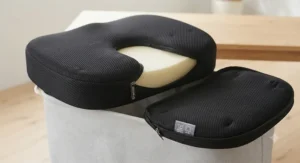
Getting a coccyx cushion working properly takes more than just dropping it on your chair. Start by orienting it correctly — the cutout always faces the back of the chair, toward you, not forward; it’s a surprisingly common first-week mistake that completely defeats the design. For the first 5-10 days, expect the foam to feel firmer than it eventually will; resist the urge to return it during this window unless the discomfort is sharp rather than simply “different.” Rotate the cushion off the chair overnight if your space allows — letting foam fully decompress between use days meaningfully extends its lifespan versus leaving constant weight on it around the clock. Wash the cover every one to two weeks depending on use frequency, using cold water and air-drying rather than heat, since high dryer heat can warp the elastic edges that keep the cover snug. Common first-30-days mistakes include sitting on the very front edge (which bypasses the cutout’s benefit entirely) and stacking a coccyx cushion on top of an already-cushioned office chair seat, which raises your desk height awkwardly and often causes new shoulder or wrist strain. If you notice the foam has visibly compressed and no longer springs back within a few seconds of standing up, that’s your signal it’s due for replacement — most quality foam cushions hold their shape for 12-24 months of daily use before needing a swap.
Real-World Scenarios: Who Actually Needs a Coccyx Cushion
Picture a remote software developer in her early 30s, seven months into a new job, sitting nine hours a day on a hand-me-down mesh chair with zero cutout support. Her pain is centred, sharp when sitting down, and eases the second she stands — textbook coccydynia territory. For her, a mid-tier pick like the ComfiLife Gel Enhanced Coccyx Seat Cushion makes sense: enough thickness to genuinely offload pressure, gel cooling for long days, and a price that doesn’t feel like a gamble on an unproven fix.
Now picture a delivery driver in his late 40s, six weeks post-fall onto an icy driveway, spending most of his shift behind the wheel. His budget is tighter, his need is more acute, and portability between the truck cab and home matters. The Everlasting Comfort Seat Cushion, with its carry handle and lifetime warranty, fits that use case well — low financial risk while he confirms whether targeted cushioning actually helps his specific injury.
Finally, picture a retiree managing chronic degenerative disc issues, sitting for extended stretches in a home office chair almost every day for years. Durability and pressure consistency matter more than price here, which is exactly the case for the Cushion Lab Pressure Relief Seat Cushion — dense, ergonomist-shaped foam built to hold up under daily long-haul use rather than compress within a season.
Buyer’s Decision Framework
If your pain is centred precisely at the tailbone and worsens leaning back, choose a deep-cutout coccyx cushion because the mechanism directly matches the pain location. If your discomfort radiates down one leg rather than sitting in one spot, choose a wider-cutout or general ergonomic cushion because the pressure-relief zone needs to cover more territory than a narrow cutout provides. If you’re recovering from a recent fall or childbirth, choose a softer, contoured design like the Aylio Coccyx Orthopedic Comfort Foam Seat Cushion, because acute injuries respond better to gentler initial pressure than to firm, dense foam. If you’ve already tried foam cushions and found they flatten out within months, choose a non-foam grid design like the Purple No-Pressure Seat Cushion, because the underlying material simply doesn’t compress the same way. And if you’re not sure any of this applies to you yet, choose the lowest-risk budget option first, because confirming whether a cutout design helps your body at all is worth more than guessing your way into a premium purchase.
Long-Term Cost & Comfort ROI
A C$35 budget cushion that needs replacing every eight months works out to roughly C$52 a year — cheaper upfront, but the ongoing churn adds up over a three-year window to something close to C$155. A C$100 premium pick that holds its shape for two full years lands closer to C$50 a year across the same window, while also avoiding the mid-cycle dip in support quality that comes right before a budget cushion needs swapping. The real ROI question isn’t “which cushion costs less” — it’s “how many months of genuinely effective pressure relief am I getting per dollar spent.” For anyone using a cushion daily for a diagnosed condition, that math tends to favour the denser, mid-to-premium picks; for casual or exploratory use, the budget tier remains the more sensible starting point.
FAQ
❓ What is the difference between a coccyx cushion and a regular seat cushion?
❓ Can a regular seat cushion help with tailbone pain?
❓ Is a coccyx cushion good for sciatica in an office chair?
❓ How long does it take to feel relief from a coccyx cushion?
❓ How often should you replace a coccyx or orthopedic seating cushion?
Conclusion
The coccyx cushion vs regular seat cushion question really comes down to one thing: where, specifically, does it hurt. A regular cushion is a comfort upgrade; a coccyx cushion is a targeted fix for a precise anatomical problem, and pretending the two are interchangeable is how a lot of people end up disappointed with either purchase. If your pain sits squarely at the base of your spine and gets sharper the moment you sit down on anything firm, the cutout designs covered here — from the budget-friendly Everlasting Comfort Seat Cushion to the premium, foam-free Purple No-Pressure Seat Cushion — are built specifically to address that. If your discomfort is more general or radiates down a leg, a wider-cutout option like the ProtoArc Seat Cushion or a standard ergonomic cushion will likely serve you better. Either way, give whatever you choose a genuine two-week trial before judging it, since foam needs time to become itself. Sitting shouldn’t be something you brace for every single day — the right cushion, matched honestly to your actual symptoms, goes a long way toward making that true again.
✨ Ready to fix your sitting setup for good? Check today’s prices on the picks above before availability shifts. 🪑💺
Recommended for You
- 7 Best Lumbar Support Cushions In Canada 2026
- 7 Best Office Chair Cushions In Canada For 2026
- Office Chair Seat Cushions: 7 Best Picks For All-Day Comfort (2026)
Disclaimer: This article contains affiliate links. As an Amazon Associate, I earn from qualifying purchases. If you purchase products through these links, we may earn a small commission at no additional cost to you.
✨ Found this helpful? Share it with your friends! 💬🤗
