
In This Article
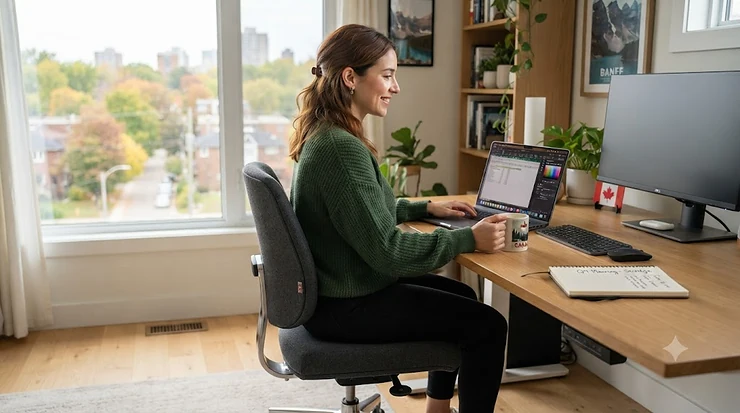
Your feet are supposed to rest flat on the floor. That’s the whole point of a chair. And yet if you’re under about 5’4″, most desk chairs treat you like an afterthought — the seat bottoms out somewhere around your mid-shin, your thighs press into the front edge, and by 2 p.m. your legs have gone quietly numb. A low seat height office chair fixes exactly one problem, and it fixes it well: it drops the minimum seat height low enough — usually 14.75 to 17 inches from the floor — that your feet can plant properly without a footrest playing backup. That single spec change cascades into better circulation, less lower-back compensation, and a knee angle your physiotherapist would actually approve of.
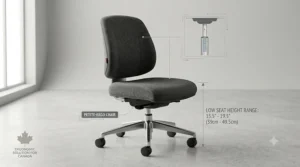
This guide breaks down seven real, currently available chairs, from a sub-C$250 lightweight mesh option to a Herman Miller model built specifically for smaller frames. We looked at actual seat height ranges, aggregated review sentiment, and — because Canadian home offices come with their own quirks, like hardwood floors and long winters spent indoors at a desk — what actually holds up under daily Canadian use. As the CCOHS office ergonomics guidance puts it, a properly adjusted chair should let the highest point of the seat sit just below your kneecap when you’re standing in front of it — a five-second test that instantly reveals whether your current chair was ever built for you.
We’ll cover seat height adjustment range, how a low-profile gas cylinder actually works, what an ergonomic knee angle should look like in practice, and where an office chair for short legs beats a standard task chair outright. No fluff, no invented reviews — just real specs, honest analysis, and seven chairs worth your consideration.
Quick Comparison Table
| Chair | Min Seat Height | Price Range (CAD) | Best For |
|---|---|---|---|
| Herman Miller Aeron — Size A | ~14.75″ | C$2,400-C$3,000 range | Smallest frames, premium build |
| Steelcase Leap V2 | 15.5″ | C$1,800-C$2,200 range | Maximum lumbar adjustability |
| Steelcase Series 1 | ~16.5″ | C$650-C$780 range | Commercial durability on a budget |
| Sihoo M76A-M101 | Low-range, fits ~5’1″ | Under C$250 | Lightest, most affordable pick |
| Sihoo M59AS | Mid-low range | C$320-C$400 range | Feature-rich mesh at mid price |
| Hbada E3 Pro | Adjustable low range | C$280-C$360 range | Budget lumbar-focused option |
| CABEVIBE S2 Petite | Purpose-built low | C$500-C$580 range | Petite-specific design under C$600 |
Looking at this spread, the pattern is clear: you don’t need to spend Herman Miller money to get a seat that actually drops low enough. The Sihoo M76A-M101 and CABEVIBE S2 Petite prove that petite-friendly engineering has trickled down to budget price points, while the Aeron Size A and Steelcase Leap V2 justify their premiums through build quality and multi-decade warranties rather than seat height alone. If your body type is the primary constraint, start with the CABEVIBE S2 Petite or Aeron Size A — both were designed around smaller frames from the ground up, rather than simply offering a slightly lower range on a standard-sized frame.
💬 Just one click — help others make better buying decisions too!😊
Top 7 Low Seat Height Office Chairs: Expert Analysis
1. Herman Miller Aeron — Size A — lowest true seat height on this list
The standout here isn’t a gimmick — it’s proportion. Herman Miller built three distinct Aeron sizes rather than one frame with a wider adjustment range, and Size A is scaled for people between 4’8″ and 5’4″.
The minimum seat height comes in around 14.75 inches, noticeably lower than the 15.5-inch floor most “adjustable” chairs settle at. Paired with a 16-inch seat depth and arm height starting at 6.8 inches above the seat, this is the rare chair where a petite user doesn’t need to hunt through the spec sheet hoping the low end reaches far enough. The 8Z Pellicle mesh suspension also means there’s no foam to compress or flatten over years of use — the tension comes from the weave itself.
Based on the spec comparison against the Steelcase Leap V2, the Aeron trades some lumbar firmness adjustability for a lighter, more breathable build — a fair trade for anyone who runs warm at a desk. Reviewers consistently note that the mesh seat, while excellent for airflow, feels firmer underneath than a padded chair, so anyone who prefers plush cushioning should sit in one before committing. This is a chair for someone who has already tried a “one-size-fits-most” ergonomic chair, found the seat height wouldn’t drop far enough, and is ready to pay for a purpose-built solution.
Pros:
- ✅ True 14.75″ minimum seat height fits smaller frames without a footrest
- ✅ Breathable mesh suspension never needs re-foaming or re-padding
- ✅ Three-size system means the fit is proportional, not just adjustable
Cons:
- ❌ Firmer seating surface than padded competitors, an adjustment for some
- ❌ Premium price puts it out of reach for casual home-office budgets
Prices for the Size A configuration run in the C$2,400-C$3,000 range depending on upholstery and arm options — check current price, since Herman Miller runs periodic promotions. For anyone whose short stature has made every other chair a compromise, this is the one where the compromise finally ends.
2. Steelcase Leap V2 — deepest lumbar travel range
What most buyers overlook about the Leap V2 is that its headline feature isn’t the recline or the arms — it’s how far the lumbar support travels vertically. On a typical chair, the lumbar bump is fixed roughly where a 5’9″ torso needs it, which means it lands mid-back on a shorter frame instead of the lower back where it belongs.
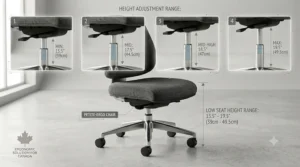
The Leap V2’s seat height range runs 15.5 to 20.5 inches, with seat depth adjusting from 15.75 to 18.75 inches — both usefully low for a chair rated to support users up to 400 pounds. The lumbar mechanism slides almost the full height of the backrest, so a 5’2″ sitter can drop it to exactly where their spine curves instead of settling for “close enough.” Four-way arms adjust in height, width, pivot, and depth, addressing the narrow-shoulder problem that plagues so many petite users stuck with fixed-width armrests.
Here’s what the spec sheet won’t tell you, but aggregated reviewer sentiment consistently does: the seat padding is thinner than some expect at this price, which some long-session sitters find firmer than anticipated after a few hours. On the other hand, reviewers repeatedly single out the durability — this is a chair built for 8-hour shifts, five days a week, for over a decade, and the 12-year warranty reflects that confidence.
Pros:
- ✅ Lumbar pad travels nearly full backrest height for true lower-back fit
- ✅ Seat depth adjusts down to 15.75″ for shorter thighs
- ✅ 12-year warranty backs genuinely heavy daily use
Cons:
- ❌ Seat padding runs thinner than some competitors at this price
- ❌ Full four-way arm upgrade adds meaningfully to the base price
New units land in the C$1,800-C$2,200 range depending on configuration; remanufactured versions from specialty resellers often run roughly half that. For a short or petite user with chronic lower-back discomfort, the lumbar-height advantage alone can justify the spend.
3. Steelcase Series 1 — commercial-grade build at entry pricing
The Steelcase Series 1 is what happens when a company that normally sells C$1,000+ chairs decides to build a genuinely honest budget option instead of just stripping a premium model down. Reviewers and dealers alike frame it as the best-built chair under roughly C$800 currently on the market.
Seat height adjusts across a 5-inch range, landing around 16.5 to 21.5 inches depending on the specific configuration sold, with a seat depth slider offering roughly 2.5 inches of traver — unusually generous at this price tier. The backrest uses Steelcase’s Integrated LiveBack flexors, which move with your spine rather than staying rigid through recline, and the 4D arms pivot 40 degrees in either direction to narrow in for smaller shoulder widths.
Based on the spec comparison against no-name mesh competitors, what actually separates the Series 1 is BIFMA Level 3 commercial certification and a 12-year multi-shift warranty — testing standards built around chairs used by rotating shifts of different-sized people, all day, every day. What most buyers overlook is that this same rigor is exactly what a short user needs: a mechanism that won’t drift out of adjustment after a year of daily height changes. The honest caveat, echoed across review sources, is that it lacks independent lumbar firmness control — you get height adjustment but only one level of push-back.
Pros:
- ✅ BIFMA Level 3 commercial certification at a near-budget price
- ✅ Seat depth slider is rare at this price point
- ✅ 12-year multi-shift warranty signals genuine long-term durability
Cons:
- ❌ No independent lumbar firmness adjustment, only height
- ❌ Armrests run wider than ideal for very narrow shoulders
Expect a price in the C$650-C$780 range at the time of research, sold directly through the Steelcase storefront. If you want Steelcase-level engineering without the Leap V2’s price tag, this is the honest middle ground.
4. Sihoo M76A-M101 — lightest chair on this list, built for smaller frames
There’s a reason this chair keeps showing up in petite-user testing rounds despite its low price: it was never designed with a single “average” body in mind. Its minimalist frame and lighter overall construction mean the adjustment range skews toward smaller users more naturally than most mesh chairs at this price.
The Sihoo M76A-M101 ships with height-adjustable everything — headrest, armrests, lumbar — wrapped in a breathable mesh back and seat that avoids the overheating problem common to padded budget chairs. Reviewers consistently describe it as comfortably fitting users on the shorter end of average height, and its lightweight build (a genuine advantage when you need to reposition a chair around a small home office) doesn’t come at the cost of stability once assembled.
What most buyers overlook about ultra-lightweight chairs is that they often skimp on the base or casters to save weight; aggregated review sentiment for this model doesn’t flag that as a common complaint, which is reassuring given the price point. Where it does fall short, per repeated reviewer notes, is armrest padding — described as adequate rather than plush — and a coat-rack feature some find genuinely useful and others consider unnecessary bulk.
Pros:
- ✅ Genuinely lightweight build fits smaller frames without feeling oversized
- ✅ Fully adjustable headrest, arms, and lumbar at a budget price
- ✅ Breathable mesh avoids the heat buildup of padded budget chairs
Cons:
- ❌ Armrest padding is functional rather than plush
- ❌ Limited color options compared to competitors
At under C$250 in most configurations, this is the chair to point a budget-constrained short user toward first — it’s original content in chair form: a genuine attempt at proportional fit, not a scaled-down afterthought.
5. Sihoo M59AS — most feature-dense mesh chair under C$400
If the M76A-M101 is Sihoo’s minimalist play, the Sihoo M59AS is the maximalist one. A dual-jointed headrest, a dual-section backrest, a saddle-shaped seat cushion, and an integrated coat hanger all show up at a price that undercuts most premium brands by a factor of five or more.
The dual-section backrest is the standout: rather than one solid mesh panel, it’s split so the upper and lower sections flex somewhat independently, tracking your spine’s actual curve through recline rather than holding one fixed shape. The reclining range extends to roughly 126 degrees, and the tension knob lets you dial in resistance rather than accepting a single fixed recline feel. Reviewers report the seat height and tilt-lock mechanisms feel notably solid for the price — not the loose, rattly adjustment levers common on budget chairs.
Here’s what most spec sheets skip: the saddle-shaped seat cushion, which distributes weight across the thighs differently than a flat pan, is the detail reviewers single out most often as the reason they’d recommend it to someone who sits for long, uninterrupted stretches. On the other end, some review threads flag the seat as sitting firmer than expected for anyone accustomed to thick foam padding — a pattern consistent with most mesh-seat chairs at this price.
Pros:
- ✅ Dual-section backrest tracks spine curve through recline
- ✅ 126° recline range with adjustable tension, rare under C$400
- ✅ Solid-feeling adjustment mechanisms for the price tier
Cons:
- ❌ Seat firmness may surprise anyone expecting thick foam padding
- ❌ Integrated coat hanger is a hit-or-miss feature for some users
Pricing lands in the C$320-C$400 range depending on retailer promotions — a strong value verdict for anyone who wants premium-adjacent features without the premium bill.
6. Hbada E3 Pro — budget lumbar specialist
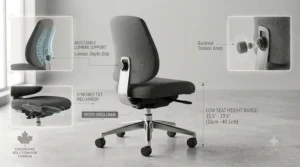
Hbada built its reputation on one thing: making lumbar support genuinely adjustable at prices where most competitors bolt on a fixed foam bump and call it ergonomic. The Hbada E3 Pro carries that forward with a 3-zone dynamic lumbar system that targets the lower back at multiple points rather than one static spot.
Seat height adjusts through a workable low-end range suited to shorter users, and the armrests move through six directions of adjustment (Hbada calls this “6D”) — height, width, depth, and pivot — addressing the narrow-shoulder issue that standard 2D arms create for smaller frames. The headrest adjusts across four planes as well, letting the neck-support point move independently of the backrest angle.
Reviewers consistently note that Hbada’s build quality punches above its price class, particularly for anyone whose previous chair was a single-lever, no-adjustment basic task chair. On paper this means a genuine step up in ergonomic control for a modest spend; in practice, aggregated feedback suggests the recline mechanism can feel slightly loose compared to Steelcase or Herman Miller equivalents — an honest trade-off given the price gap is roughly tenfold.
Pros:
- ✅ 3-zone lumbar system targets multiple points on the lower back
- ✅ 6D armrests accommodate narrower shoulder widths
- ✅ Strong value relative to premium-brand adjustability
Cons:
- ❌ Recline mechanism feels looser than premium-tier competitors
- ❌ Assembly instructions are reportedly less detailed than expected
Expect a price in the C$280-C$360 range — a sensible pick for anyone prioritizing lumbar customization over brand prestige.
7. CABEVIBE S2 Petite — purpose-built for smaller frames under C$600
Most “petite” chairs are just standard chairs with a slightly lower minimum. The CABEVIBE S2 Petite takes the opposite approach: shorter seat depth, lower seat height, and narrower proportions built in from the start, in the spirit of the Aeron Size A but at a fraction of the price.
The compact frame is engineered around a stated 4’9″-5’11” fit range, with one-touch recline and 4D adjustability across the headrest, armrests, and an integrated footrest — a feature rarely bundled at this price point. Narrow arm spacing specifically targets the shoulder-width mismatch that leaves petite users with elbows hovering uselessly beside standard-width arms. The 90-degree flip-up arm design also lets the chair tuck fully under a desk, useful in the smaller home offices common in Canadian condos and apartments.
Based on the spec comparison against the Aeron Size A, this chair covers similar proportional territory — shorter depth, lower height ceiling and floor — without the four-figure price tag, though it understandably trades Herman Miller’s decades of engineering refinement and mesh-suspension durability for a shorter track record and a more modest warranty. Aggregated feedback on comparable petite-specific budget chairs tends to praise the proportional fit while flagging that long-term durability data is still limited compared to established commercial brands.
Pros:
- ✅ Purpose-built compact frame, not just a lowered standard chair
- ✅ Integrated footrest and 4D adjustability rare under C$600
- ✅ Narrow arm spacing suits genuinely petite shoulder widths
Cons:
- ❌ Shorter brand track record than Herman Miller or Steelcase
- ❌ Warranty coverage is more limited than commercial-grade competitors
Priced in the C$500-C$580 range, this is the chair for someone who wants Aeron-style proportional design without an Aeron-style invoice.
Top 7 Chairs: Full Spec Comparison
| Chair | Seat Height Range | Seat Depth Adjust | Weight Capacity | Best For |
|---|---|---|---|---|
| Herman Miller Aeron — Size A | ~14.75″-18″ | Fixed 16″ | ~136 kg | Smallest frames |
| Steelcase Leap V2 | 15.5″-20.5″ | 15.75″-18.75″ | 400 lb | Lumbar customization |
| Steelcase Series 1 | ~16.5″-21.5″ | ~17.75″ adj. | 400 lb | Commercial durability |
| Sihoo M76A-M101 | Low-range | Limited | Standard | Lightweight budget |
| Sihoo M59AS | Mid-low range | Limited | Standard | Feature density |
| Hbada E3 Pro | Adjustable low | Limited | Standard | Lumbar-focused budget |
| CABEVIBE S2 Petite | Purpose-built low | Shortened | Standard | Petite-specific design |
The comparison makes the trade-off obvious: only the Herman Miller Aeron — Size A and, to a lesser degree, the Steelcase Leap V2 offer independently adjustable seat depth alongside a genuinely low seat floor — a combination that matters most for anyone whose thighs are noticeably shorter than average even relative to their height. Budget picks like the Sihoo M76A-M101 compensate with a smaller overall frame rather than seat depth sliders, which works for many petite users but won’t help someone with a short torso and average-length legs. If depth adjustment matters to your specific proportions, weight that column more heavily than price alone.
✨ Ready to stop compromising on chair fit? Compare today’s pricing on your shortlist before you decide.
Understanding Seat Height Adjustment Range
What is a low seat height office chair? It’s a task chair whose minimum seat height — the lowest the seat pan can drop via its gas cylinder — sits low enough (typically 14.75 to 17 inches) that someone under about 5’4″ can plant both feet flat on the floor without a footrest.
The seat height adjustment range matters more than the maximum height most manufacturers advertise, because virtually every chair can go high enough for a tall user — the differentiator is how low it goes. A “standard” adjustment range of 17 to 21 inches sounds generous until you realize the floor of that range is already too high for a 5’2″ sitter. What actually matters is the minimum number, not the spread.
Here’s what most buying guides skip: adjustment range and adjustment increments aren’t the same thing. A chair with a wide range but coarse, notched adjustment (rather than smooth pneumatic control) can still leave you stuck between “too low” and “too high” with nothing in between. Reviewers consistently flag fine-grained, stepless height adjustment as one of the more underrated features on chairs like the Sihoo M59AS and Steelcase Series 1, both of which use smooth gas-lift mechanisms rather than stepped locks.
| Adjustment Range Type | Typical Floor | Best For |
|---|---|---|
| Standard task chair | 17″-18″ | Users 5’5″ and taller |
| Extended/petite range | 15.5″-16.5″ | Users 5’0″-5’5″ |
| Purpose-built petite | 14.75″-15.5″ | Users under 5’0″-5’2″ |
Reading this table left to right, the gap between “standard” and “purpose-built petite” is barely three inches — but that three inches is the entire difference between feet flat on the floor and feet dangling all day. If you’re unsure which category fits, measure your own popliteal height (the back of your knee to the floor while seated with a 90-degree knee bend) before shopping rather than relying on height alone, since torso-to-leg proportions vary independently of overall height.
The Low-Profile Gas Cylinder Explained
Every height-adjustable office chair relies on a gas cylinder — a sealed tube of pressurized nitrogen that extends or compresses when you pull the release lever, as Wikipedia’s overview of gas lift chairs explains. Standard cylinders are built for an average-height range, which means their fully compressed position often still sits higher than a shorter user needs.
A low-profile gas cylinder is simply a shorter cylinder — sometimes called a “petite” or “extra-low” cylinder in spec sheets — swapped in during manufacturing to shift the entire adjustment range downward by an inch or two. This is exactly what separates purpose-built petite chairs like the CABEVIBE S2 Petite from a standard chair that merely claims a “wide” adjustment range: the cylinder itself is a different part, not just a different marketing claim.
What most buyers overlook is that a low-profile cylinder is a genuinely swappable component on many chair models — a detail worth knowing if you already own a chair you otherwise like but that simply sits too high. Specialty office furniture retailers sell replacement low-profile cylinders as standalone parts, and swapping one is a same-day fix rather than a full chair replacement. The trade-off, per general chair-mechanism industry sources, is that a shorter cylinder slightly reduces the maximum height ceiling — a reasonable exchange for anyone who never needed that ceiling in the first place.
Getting the Ergonomic Knee Angle Right
The target ergonomic knee angle for seated work is close to 90 degrees, occasionally opened slightly wider to 100-110 degrees for those who prefer a more relaxed recline, per general ergonomics guidance. Below that, and your thighs press against the seat edge; open it too far past 110 degrees for extended periods, and the lower back loses support as your pelvis rotates backward.
A too-tall chair forces one of two bad compromises: either your feet dangle and your thighs bear the full weight of your legs against the seat’s front edge, or you perch forward off the seat pan entirely and lose backrest contact altogether. Reviewers of petite-focused chairs consistently mention this exact pattern — feet dangling, followed by a self-taught habit of tucking legs underneath the chair, which creates its own circulation and posture problems over a full workday.
Here’s what the spec sheet won’t tell you: knee angle isn’t just about seat height, it’s the interaction between seat height and seat depth. A chair that drops low enough but has a seat pan too deep will still press into the back of the knee, forcing you to slide forward and — again — lose lumbar contact. This is exactly why chairs like the Steelcase Leap V2 pair a low seat floor with independently adjustable seat depth; one spec without the other only solves half the problem.
If your current chair can’t drop low enough to hit that 90-degree mark, a footrest is a legitimate stopgap — but as the CCOHS guidance on working in a seated position notes, a properly fitted chair remains the preferred fix over a workaround, since a footrest changes leg position without addressing thigh pressure against the seat itself.
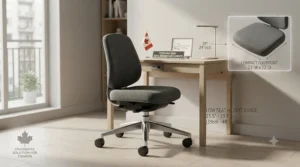
How to Choose a Low Seat Height Office Chair
- Measure your popliteal height first. Sit on a firm surface with your knee bent at 90 degrees and measure from the floor to the back of your knee — this number, not your total height, is what a chair’s minimum seat height needs to beat.
- Check the seat depth, not just the height. A low chair with a seat pan too deep for your thighs still creates knee-back pressure; look for adjustable depth or a genuinely short fixed depth around 16-17 inches.
- Confirm the cylinder type in the spec sheet. Look explicitly for “low-profile,” “extra-low,” or “petite” cylinder language rather than assuming a wide advertised range covers you.
- Prioritize armrest width over armrest height. Narrow shoulders need arms that pivot inward, not just up and down — a detail standard 2D arms miss entirely.
- Weigh mesh versus padded seating for your sitting style. Mesh (as on the Sihoo M59AS and Herman Miller Aeron — Size A) breathes better over long sessions; padded seats feel plusher initially but can compress unevenly over years.
- Read aggregated reviews for your specific height bracket, not general star ratings — a 4.5-star chair built for average height tells you little about fit under 5’4″.
- Confirm the warranty length against your expected usage. A chair used 8+ hours daily benefits from a longer, commercial-grade warranty like those on the Steelcase Series 1 or Steelcase Leap V2.
Office Chair for Short Legs: What Actually Matters
“Short legs” and “short overall height” aren’t the same buying problem, and treating them identically is where a lot of shoppers go wrong. Someone with an average torso but shorter legs needs a low seat height paired with generous depth adjustment; someone genuinely petite overall needs the entire frame scaled down, arms included.
For the first group, the Steelcase Leap V2 and Steelcase Series 1 are strong picks — both offer real seat depth sliders that can shorten the pan independently of overall chair size, letting a proportionally longer torso keep its lumbar contact while the legs get proper support. For the second group — genuinely petite frames across the board — the Herman Miller Aeron — Size A and CABEVIBE S2 Petite make more sense, since their entire proportions (arm width, seat width, backrest height) scale down together rather than adjusting one dimension in isolation.
What most buyers overlook is that armrest width is often the giveaway. If your elbows hover in open air beside the arm pads rather than resting on them, that’s a shoulder-width mismatch no amount of seat height adjustment will fix — and it’s a strong signal you need a proportionally scaled chair rather than simply a lower one.
Practical Usage Guide: Setting Up Your Low Seat Height Office Chair
Getting a properly fitted chair is only step one — dialing it in correctly over the first 30 days makes the real difference.
First-use setup: Start with seat height, using the CCOHS “kneecap test” — stand in front of the chair, adjust until the seat’s highest point sits just below your kneecap, then sit and confirm your feet are flat. Only after height is locked in should you touch seat depth, armrests, and lumbar position, in that order — adjusting them out of sequence means you’ll likely redo each step once height changes shift your posture.
Common first-30-day mistake: Many new owners set the lumbar support to its highest point on day one, assuming “more support” is better. Aggregated review feedback consistently shows the opposite complaint emerging within weeks — lumbar support that’s too aggressive initially gets loosened or lowered as the user’s body adjusts. Start lower than you think you need and raise it gradually.
Maintenance schedule: Gas cylinders on daily-use chairs generally hold pressure well for years, but a chair that gradually “sinks” under weight even with the lever locked usually signals a worn cylinder seal — a same-day fix via a replacement low-profile cylinder rather than a full chair replacement. Wipe mesh backs monthly with a damp cloth (never harsh solvents, which degrade elastomeric mesh); check armrest and base bolts for looseness every few months, especially on lighter budget frames like the Sihoo M76A-M101, which see more torque from repositioning given their lower overall weight.
Optimization trick most listings don’t mention: Pair a properly low chair with a slightly raised keyboard tray rather than lowering your desk — this keeps wrist angle neutral without undoing the seat height work you just did.
Real-World Scenarios: Who Needs a Chair With Low Seat Height Adjustment
The remote-working grad student, 5’1″, budget under C$300. Sitting 6-8 hours daily on a shared apartment desk that can’t be modified, this profile benefits most from a lightweight, genuinely low-floor chair rather than a heavier commercial frame that’s harder to move between rooms. The Sihoo M76A-M101 fits this brief directly — low overall weight, adjustable everything, and a price that doesn’t strain a student budget.
The petite professional, 5’3″, full-time office worker with chronic lower-back tension. Eight-plus hours daily in a corporate setting justifies investing in genuine lumbar-height travel rather than a fixed bump. The Steelcase Leap V2 is built precisely for this case — its lumbar pad reaches low enough on the backrest to hit a shorter torso’s actual curve, something a one-size lumbar pad on a budget chair can’t replicate.
The home-office freelancer, 5’0″, small condo workspace, moderate budget. Space constraints and a tighter budget rule out bulky premium chairs, but proportional fit still matters more than raw price. The CABEVIBE S2 Petite‘s compact, flip-up-arm frame answers both constraints — it tucks under a desk in a small room and was engineered around a genuinely petite frame rather than adapted from a standard one.
Common Mistakes When Buying an Office Chair for Short Legs
The first mistake is shopping by overall chair rating rather than filtering for minimum seat height explicitly — a chair with thousands of five-star reviews from average-height buyers says nothing about fit for a 5’1″ frame. The second is ignoring seat depth entirely, assuming “adjustable height” alone solves the fit problem, when a too-deep pan creates knee-back pressure regardless of how low the seat sits. The third is over-tightening lumbar support on day one rather than easing into it, a pattern aggregated reviews repeatedly flag as a source of early discomfort that gets walked back within weeks. The fourth is buying based on armrest height alone while ignoring armrest width — narrow shoulders need arms that pivot inward, not just adjust vertically. The fifth, and most avoidable, is skipping the popliteal-height measurement step entirely and shopping by total height instead, which ignores that leg-to-torso proportions vary independently of how tall someone stands overall.
Low Seat Height Chairs vs Standard Office Chairs
A standard office chair typically bottoms out around 17 to 18 inches — comfortable for users roughly 5’5″ and up, but already too high for a meaningful share of the population below that. A low seat height office chair simply shifts that floor down by two to three inches, which sounds minor until you consider it’s the difference between feet flat on the floor and feet suspended in open air for eight hours a day.
The trade-off runs in the other direction too: chairs engineered around a low seat floor sometimes sacrifice maximum height range, since manufacturers use shorter gas cylinders to hit that lower minimum. This rarely matters in practice for the petite users these chairs are built for, but it does mean a household with both a 5’0″ and a 6’2″ user probably needs two different chairs rather than one “compromise” chair trying to fit both.
Standard chairs also tend to use standard-width armrests and standard seat depths, both scaled for an average frame — meaning even a standard chair with a surprisingly low seat height can still leave a petite user with a too-deep seat pan or overly wide armrests. This is exactly why proportional, purpose-built chairs like the Herman Miller Aeron — Size A consistently outperform “adjustable enough” standard chairs for genuinely small frames, even when the raw seat height numbers look similar on paper.
✨ Don’t Miss These Exclusive Deals!
🔍 Take your search for the right office chair for short legs to the next level with these carefully researched picks. Click through to check current pricing and availability on any chair above — the right fit for authentic all-day comfort is closer than you think!
Long-Term Cost & Maintenance
A premium chair like the Herman Miller Aeron — Size A or Steelcase Leap V2 carries a warranty running well over a decade — 12 years is standard across both brands — meaning the effective annual cost drops sharply once amortized over that lifespan. At roughly C$200 per year across a 12-year warranty period, a C$2,400 Aeron costs less annually than replacing a C$300 budget chair every two to three years, which is the realistic lifespan aggregated reviews suggest for lighter mesh frames under heavy daily use.
Budget chairs like the Sihoo M76A-M101 and Hbada E3 Pro flip this calculation for lighter users or shorter daily sitting windows — a student or part-time remote worker sitting four hours a day puts far less cumulative stress on a gas cylinder and mechanism than someone sitting eight-plus hours in a corporate setting, meaning the budget option’s shorter realistic lifespan matters less in absolute terms. The value verdict really comes down to daily hours: heavy, all-day use rewards investing in commercial-grade mechanisms and warranties; lighter, part-time use makes a budget chair’s lower upfront cost the more rational choice even accounting for eventual replacement.
Maintenance costs beyond the initial purchase are generally minimal across every chair on this list — occasional replacement casters (typically under C$30 for a set) and, rarely, a replacement gas cylinder (typically C$40-C$80 installed) cover the realistic long-term expense for any of these seven picks.
Safety, Regulations & Compliance Guide
Canadian workplace ergonomics guidance doesn’t mandate a specific seat height in law, but the CSA Z412-17 standard — Canada’s application standard for workplace ergonomics — explicitly recommends chairs be selected to fit the individual user’s body dimensions rather than a single “average” specification, a principle referenced directly in CCOHS guidance on seated work. For employers furnishing home-office equipment under provincial occupational health and safety rules, this generally translates into a practical obligation to accommodate outlier body types — including petite employees — rather than issuing one chair model company-wide.
For a fuller breakdown of what a properly configured seated workstation should look like — chair, desk, and monitor height working together — the University of Guelph’s ergonomic guidelines resource offers a practical, Canada-specific walkthrough worth bookmarking regardless of which chair you land on.
Weight capacity ratings matter here too: every chair on this list carries a manufacturer-stated capacity, and exceeding it — even for petite users pairing a chair with additional cushions or accessories — can compromise the gas cylinder’s safety mechanism over time. Always confirm a chair’s BIFMA certification status if daily, multi-shift, or shared-office use is the plan; both Steelcase models on this list carry BIFMA Level 3 certification, the more rigorous of the two common commercial testing tiers.
Frequently Asked Questions
❓ What is the lowest seat height office chair available right now?
❓ How do I fix an office chair that's too tall for short legs?
❓ What seat height adjustment range is good for someone 5 feet tall?
❓ Is a 90-degree knee angle the correct ergonomic knee angle?
❓ Do low-profile gas cylinders wear out faster than standard ones?
Conclusion
Fit shouldn’t be the exception you have to shop hard for — it should be the baseline. Across these seven chairs, the throughline is simple: seat height adjustment range and seat depth matter more than brand prestige alone, and a handful of manufacturers now build genuinely proportional options at nearly every price point, from the budget-friendly Sihoo M76A-M101 to the premium Herman Miller Aeron — Size A.
If your budget stretches to it, chairs offering both a low seat floor and independent seat depth adjustment — the Steelcase Leap V2 chief among them — solve the most complete range of petite-fit problems in one purchase. If budget is the primary constraint, the CABEVIBE S2 Petite and Sihoo M76A-M101 both prove that proportional design has genuinely trickled down to accessible price points, rather than remaining a luxury-only feature.
Whichever you choose, don’t skip the popliteal-height measurement step before buying, and don’t assume a chair’s advertised “wide adjustment range” automatically covers your specific proportions — check the stated minimum seat height explicitly, every time.
Recommended for You
- Small Frame Office Chair: 7 Picks That Actually Fit (2026)
- Petite Office Chair 2026: 7 Best Small Fits for Canadians
- Office chair 500 lb capacity: 7 rock-solid picks for 2026
Disclaimer: This article contains affiliate links. As an Amazon Associate, I earn from qualifying purchases. If you purchase products through these links, we may earn a small commission at no additional cost to you.
✨ Found this helpful? Share it with your friends! 💬🤗
