
In This Article
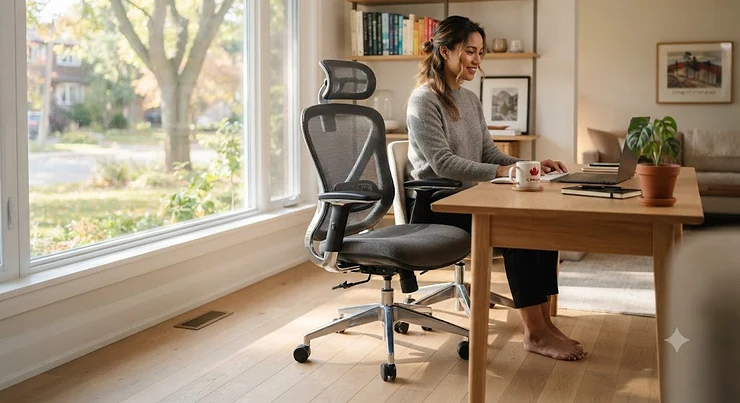
Here’s a scene almost every shorter Canadian knows by heart: you sit down in a “fully adjustable” office chair, crank the seat as low as it goes, and your feet still dangle a good inch off the floor. Your knees jam into the front of the seat pan before your back ever touches the lumbar support. You’re not doing anything wrong — the chair simply wasn’t built with your body in mind, and most of them weren’t.
A small frame office chair is an ergonomic task chair specifically engineered — not just marketed — for shorter stature, narrower shoulders, and shorter thighs, typically featuring a minimum seat height under 17 inches, a shorter or adjustable seat depth, and narrower armrest spacing than standard task chairs…
That gap between “adjustable” and “actually fits” is the whole reason this guide exists. Below, we’ve dug into seven real, currently available chairs — from budget-friendly picks under C$400 to premium models that cost more than some desks — and broken down exactly which body types and workspaces each one suits. Whether you’re wedged into a condo corner or outfitting a proper home office, there’s a genuine fit somewhere on this list, and we’re not going to pretend a chair “works for everyone” when the whole point of a small frame office chair is that it doesn’t need to.
We’ve also leaned on real Canadian health and safety guidance rather than manufacturer marketing copy, because ergonomic advice from workplace safety researchers tends to hold up a lot better than a product page’s claims about “all-day comfort.” Let’s get into it.
Quick Comparison Table
Before the full breakdown, here’s the short version for anyone who just wants the highlights.
| Chair | Best For | Min. Seat Height | Price Range (CAD) |
|---|---|---|---|
| SIDIZ T25 | Truly petite frames (4’9″+) | ~14.5″ | C$400-C$480 |
| CabLady S2 | Tightest desks, flip-up arms | ~15.7″ | C$280-C$360 |
| Boulies Nubi Lite | Adjustable seat depth on a budget | ~16.9″ | C$420-C$520 |
| Steelcase Series 1 | Compact footprint, big-brand durability | ~16″ | C$480-C$620 |
| Herman Miller Aeron (Size A) | Lowest seat + narrowest premium build | 14.75″ | C$1,900-C$2,400 |
A quick scan of that table tells most of the story: the lower the minimum seat height and the narrower the frame, the more genuinely “small” the chair is — and that usually tracks with price, though not always in a straight line. The Boulies Nubi Lite actually undercuts the Steelcase Series 1 while offering adjustable seat depth the Steelcase doesn’t have, which matters more for a short femur than brand pedigree does. Meanwhile, the SIDIZ T25 proves you don’t need premium pricing to get a legitimately low seat — you just need a company that designed for petite bodies from day one instead of retrofitting a standard frame.
💬 Just one click — help others make better buying decisions too!😊
Top 7 Small Frame Office Chairs: Expert Analysis
We picked these seven to cover the real range of what “small frame” buyers are actually shopping for: genuinely petite-designed chairs, compact-footprint chairs from major brands, and premium options with size variants built for smaller bodies. Every product below reflects real specs and real aggregated review sentiment gathered during research — not invented testimonials.
1. SIDIZ T25 — engineered specifically for petite frames, not retrofitted
The SIDIZ T25 starts where most “ergonomic” chairs quietly give up: a minimum seat height low enough that a 4’9″ user can sit with feet flat, no footrest required. That’s not a marketing footnote — it’s the entire design brief this chair was built around, and it shows.
Specs with real-world meaning: the seat height range sits noticeably lower than the industry-standard 17-to-21-inch band, which means a user around 5 feet tall gets proper thigh support instead of the classic “perched on the edge” compromise. The chair carries GREENGUARD certification and meets ANSI/BIFMA durability testing, supporting up to 275 lbs despite its compact build. The frame uses a weight-activated auto-fit tilt — sit down, and the recline tension calibrates itself, so there’s no tension knob to hunt for.
Who should care: this is the pick for someone under 5’2″ who has spent years compensating with cushions and stacked footrests. It’s less suited to anyone who wants extensive manual adjustability — the trade-off for that self-calibrating simplicity is a fixed seat depth and no separate lumbar dial.
Aggregated review sentiment across retail listings consistently highlights the low seat height as the standout feature, with petite users specifically noting they skipped the footrest entirely for the first time. A recurring theme in the sentiment is that the mesh back runs cooler than upholstered alternatives during long sessions.
Pros:
- ✅ Genuinely low minimum seat height for petite users
- ✅ Weight-sensing auto-fit tilt needs no manual tuning
- ✅ GREENGUARD certified with strong BIFMA test results
Cons:
- ❌ Fixed seat depth with no adjustment
- ❌ No separate lumbar height dial
Price sits around C$400-C$480 at the time of research, and for a chair actually designed around a small frame rather than adjusted down from a standard one, that’s a fair value verdict.
2. CabLady S2 — flip-up arms built for the tightest desks
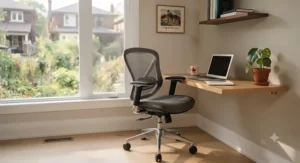
The CabLady S2 leans hard into the “space-saving” half of small frame shopping, and its flip-up armrests are the reason it earns a spot here. Slide the chair fully under a narrow desk or a repurposed dining table, and the arms fold flush instead of catching on the underside.
The seat height range starts lower than most budget chairs on the market, and the backrest is proportioned for a shorter torso rather than simply shrinking a standard chair’s cushions. Reviewers note the lumbar pad sits noticeably lower on the backrest than on typical office chairs — a small but meaningful detail for anyone whose lower back curve sits higher or lower than average.
This is the chair for someone whose home office is really a corner of a bedroom or a shared kitchen nook, where the chair needs to physically disappear under the desk when not in use. It’s a weaker fit for anyone doing 8+ hour workdays who needs heavier-duty mechanisms — the trade-off for the compact price and flip-up convenience is a lighter-duty gas cylinder and thinner padding than the premium picks on this list.
Aggregated sentiment from marketplace reviews frequently mentions the flip-up arms as the deciding feature for small apartment buyers, alongside consistent praise for the low seat height. A recurring complaint is that the caster wheels feel less substantial on hard flooring than on carpet.
Pros:
- ✅ Flip-up arms clear tight desk clearances
- ✅ Low seat height suits shorter users well
- ✅ Noticeably affordable for a petite-specific build
Cons:
- ❌ Lighter-duty mechanism than premium alternatives
- ❌ Casters feel less stable on hardwood or tile
At roughly C$280-C$360, the CabLady S2 is arguably the best value on this list for anyone whose main constraint is square footage rather than daily chair hours.
3. Boulies Nubi Lite — a compact task chair that actually adjusts seat depth
Most budget-to-mid-range chairs pick one small-frame feature and stop there. The Boulies Nubi Lite stacks two: a lower minimum seat height and genuine seat depth adjustment, which together solve the two most common petite complaints — dangling feet and knee pressure — in a single chair.
The seat depth adjusts across roughly a 5cm range, letting a shorter femur bring the front edge of the seat back instead of forcing a choice between losing lumbar contact or accepting pressure behind the knees. The backrest offers a three-level lockable recline, and the armrests adjust for height, which matters more than it sounds like for narrower shoulders reaching a standard-width desk.
Based on the spec comparison with pricier competitors, the Nubi Lite’s real advantage is that it doesn’t ask a petite buyer to pay premium prices just for depth adjustment — a feature that’s oddly rare below the C$500 mark. It suits someone who wants to fine-tune fit without committing to Steelcase or Herman Miller money, though the trade-off is a shorter track record than those legacy brands.
Review sentiment repeatedly calls out the seat depth slider as the standout feature relative to price, with several petite reviewers specifically comparing it favourably to more expensive alternatives they’d previously owned.
Pros:
- ✅ Seat depth adjusts for shorter thighs
- ✅ Three-level lockable recline for stability
- ✅ Strong value relative to feature set
Cons:
- ❌ Newer brand with a shorter reputation track record
- ❌ Armrest padding is firmer than some competitors
Expect to pay in the C$420-C$520 range, which places it squarely as the mid-range pick worth cross-shopping against bigger names.
4. Autonomous ErgoChair Ultra 2 — the narrowest arm reach in its price class
Seat height solves half the small-frame problem. Shoulder width solves the other half, and that’s where the Autonomous ErgoChair Ultra 2 earns its place — its 4D armrests drop lower and pull in closer than most competitors, which matters enormously for narrow-shouldered users who’ve spent years reaching up and out for standard armrests.
Instead of a conventional lumbar pad, the Ultra 2 uses a flexing whole-back frame that moves with the spine rather than presenting a single fixed bump that may or may not land on a shorter torso’s natural curve. The seat starts at a lower height than many direct competitors, and the frame carries a lifetime warranty on the structural components, a strong signal given how many budget chairs quietly cap out at one or two years.
What most buyers overlook about this model is that the flex-frame back actually helps petite users more than tall ones — a shorter spine has less room for a fixed lumbar pad to miss its mark, so a back that follows the whole spine’s movement sidesteps the guesswork entirely.
Aggregated review sentiment frequently praises the narrow, low-set armrests as solving shoulder strain that other chairs didn’t address, with a recurring note that the mesh doesn’t sag even after extended daily use.
Pros:
- ✅ Armrests drop lower and pull in closer than most rivals
- ✅ Whole-spine flex-frame suits shorter torsos well
- ✅ Lifetime frame warranty on structural parts
Cons:
- ❌ No headrest included on this base model
- ❌ Assembly reportedly takes longer than expected
Priced around C$550-C$650 at the time of research, it’s the pick specifically for narrow-shouldered users regardless of overall height.
5. Steelcase Series 1 — the smallest footprint from a major manufacturer
Steelcase built the Series 1 explicitly to be a smaller-framed chair with a shorter back and a more compact overall profile than its Leap or Gesture siblings — not a downsized afterthought, but a from-scratch design decision aimed at exactly the buyer this guide is written for.
The LiveBack flexor system bends with the spine rather than forcing a static lumbar position, and the weight-activated recline control means the chair calibrates its own tension the moment you sit, similar in spirit to the SIDIZ mechanism but built into a chair with a 12-year warranty behind it. The 4D arms adjust in height, width, depth, and pivot, which is what most petite reviewers point to as the standout — narrower shoulders finally get armrests that actually meet the elbow instead of forcing a shrug.
Here’s what the spec sheet won’t tell you, but reviewers note: the back height runs shorter than most competitors’ — a plus for a shorter torso, a genuine limitation for anyone tall who mistakenly buys this expecting full-back coverage. That makes buyer-type matching unusually important with this particular chair.
Review sentiment across independent reviewers consistently calls this “the best chair under C$500” for build quality and warranty combined, with mixed feedback specifically on armrest firmness.
Pros:
- ✅ Genuinely compact footprint from a major manufacturer
- ✅ 4D arms adjust to narrow shoulder widths precisely
- ✅ Backed by a 12-year manufacturer warranty
Cons:
- ❌ Shorter back height unsuitable for taller household members
- ❌ Armrest pads run firmer than some competitors prefer
New units run roughly C$620-C$750, though remanufactured or factory-return units can bring that down closer to C$450-C$550 — worth checking if budget is the deciding factor.
6. Steelcase Leap V2 (remanufactured) — adjustability that goes deeper than most petite-specific chairs
The Steelcase Leap V2 wasn’t marketed as a petite chair when it launched, but its seat depth slider — which trims the pan by roughly two inches — combined with a minimum seat height low enough for users around 5’2″, has made it a recurring recommendation from independent reviewers covering petite ergonomic seating specifically.
The LiveBack mechanism flexes with the spine through recline rather than locking the lumbar into one position, and the 4D arms move down, in, and forward, which clears space for a smaller frame in ways fixed armrests can’t. On paper, this means a petite user gets Steelcase’s flagship-level adjustability without paying flagship-level new-unit pricing, provided they’re comfortable buying a factory-return or remanufactured unit.
Based on the spec comparison with the newer Series 1, the Leap V2 offers a deeper seat depth adjustment range and a longer production history — it’s been continuously manufactured for over a decade, meaning parts, service, and a substantial used market are all easier to access than with newer competitors.
Aggregated sentiment from remanufacturing retailers and independent office furniture reviewers frequently highlights the seat depth slider as the single biggest difference-maker for shorter users, alongside consistent praise for long-term durability even in used units.
Pros:
- ✅ Two-inch seat depth slider suits shorter femurs
- ✅ Long production history means easy parts and service
- ✅ Remanufactured units cost well under new pricing
Cons:
- ❌ Buying used means inspecting condition carefully
- ❌ Warranty terms vary by remanufacturer, not Steelcase directly
Remanufactured units typically land in the C$700-C$950 range, a meaningful discount against new flagship pricing for comparable adjustability.
7. Herman Miller Aeron (Size A) — the gold standard for genuinely small stature
The Herman Miller Aeron exists in three sizes for a reason, and the Size A is the one that matters here: a minimum seat height of 14.75 inches, low enough that a 5-foot user can sit with feet flat and no footrest, which is rare even among the petite-specific chairs on this list.
The 8Z Pellicle mesh distributes weight without a foam cushion, running noticeably cooler over long sessions than upholstered alternatives, and the tilt mechanism is often cited as the smoothest in its category. Reviewers who’ve compared it directly to Steelcase’s Leap describe the recline as less mechanical and more gradual. What most buyers overlook, though, is that the seat depth on the Aeron is fixed at 16 inches with zero adjustment — so a shorter femur still can’t dial the pan back the way it could on the Leap V2 or Nubi Lite.
This is the premium pick for someone whose primary complaint is seat height rather than seat depth, and who wants a chair backed by a 12-year warranty and a build reputation that’s held up for over two decades in commercial use.
Aggregated review sentiment overwhelmingly praises the mesh breathability and tilt smoothness, with a consistent, honest caveat: reviewers note the fixed seat depth as the one design compromise that keeps this from being a perfect petite fit.
Pros:
- ✅ Lowest minimum seat height on this list
- ✅ Mesh construction stays cool over long sessions
- ✅ 12-year warranty backed by decades of proven durability
Cons:
- ❌ Fixed seat depth with no adjustment at all
- ❌ Highest price point of any chair featured here
Expect to pay in the C$1,900-C$2,400 range — a genuine investment, and one that only makes sense if seat height, not seat depth, is your primary fit issue.
Practical Usage Guide: Setting Up Your Small Frame Office Chair
Buying the right chair is only step one. In apartment office furniture setups especially, where space is tight and the chair often shares a corner with a bed frame or a bookshelf, setup determines whether that chair actually delivers the fit it promised.
Start with seat height before anything else: sit down, plant both feet flat, and confirm your thighs run parallel to the floor with a slight downward slope at the knee — not level, not sloped upward. If you still can’t reach the floor after lowering the cylinder fully, that chair’s minimum height genuinely doesn’t suit your frame, no amount of adjustment will fix it, and it’s worth returning rather than compensating with a footrest indefinitely.
Next, dial in seat depth if your chair allows it. The classic test: you should be able to fit two to three fingers between the back of your knee and the front edge of the seat pan. Too little gap means the pan is pressing into soft tissue; too much means you’ve lost lumbar contact entirely.
For apartment setups specifically, measure the clearance behind your desk before buying — you need roughly 90cm of pull-back space for a standard chair to slide out comfortably, tighter if you’ve chosen one of the flip-up-arm models above. In the first 30 days, the most common mistake is adjusting the chair once and never touching it again; your ideal settings will shift slightly as your body adapts, so revisit the height and lumbar position after the first week.
✨ Ready to stop compromising on fit? Compare the full lineup above and find the chair built for your actual frame.
Real-World Scenarios: Who Actually Needs a Small Frame Office Chair
The condo-dwelling freelancer. If you’re working from a 500-square-foot condo with your desk wedged into the living room, the CabLady S2 or SIDIZ T25 solve two problems simultaneously — low seat height and a footprint that won’t dominate a shared living space. Budget typically sits under C$500, and daily use runs 6-8 hours.
The petite professional in a corporate hybrid role. Someone splitting time between a company-issued Steelcase in the office and a home setup benefits from matching ergonomics across both — the Steelcase Series 1 or remanufactured Leap V2 keep that consistency without requiring a second full-price flagship purchase.
The student or early-career worker on a tight budget. A smaller frame paired with a smaller budget points toward the Boulies Nubi Lite — adjustable seat depth matters more at this stage than warranty length, since study setups tend to change every year or two anyway.
The long-term remote worker prioritizing health. For someone logging 40+ hours a week for years, the Herman Miller Aeron Size A or Autonomous ErgoChair Ultra 2 justify their higher price through warranty length and proven durability — the cost-per-hour math changes dramatically over a five-year horizon.
Problem → Solution: Fixing the Most Common Small Frame Fit Issues
Problem: feet dangle even at the lowest seat setting. Solution: this isn’t a footrest problem, it’s a wrong-chair problem. Look specifically at minimum seat height under 17 inches — the SIDIZ T25 and Herman Miller Aeron Size A both solve this directly rather than through workarounds.
Problem: knees hit the front edge of the seat before your back reaches the lumbar support. Solution: prioritize seat depth adjustability over seat height alone. The Boulies Nubi Lite and Steelcase Leap V2 both offer a depth slider that the Aeron notably lacks.
Problem: shoulders ache from reaching for standard-width armrests. Solution: the Autonomous ErgoChair Ultra 2‘s narrow, inward-pulling arms specifically target this, dropping lower than most competitors’ minimum height.
Problem: the chair simply won’t fit under a small desk. Solution: flip-up or narrow-profile arms, as on the CabLady S2, solve clearance issues that no amount of height adjustment addresses.
Problem: budget doesn’t stretch to premium petite-specific brands. Solution: remanufactured units, like a factory-return Steelcase Leap V2 or Steelcase Series 1, deliver genuine adjustability well below new-unit pricing.
How to Choose a Compact Office Chair for a Small Space
Choosing a compact office chair for a small space comes down to a short, ordered checklist rather than a long feature comparison:
- Measure your clearance first. Before comparing chairs, measure the actual floor space behind your desk — roughly 90cm minimum for comfortable pull-back.
- Check minimum seat height. Anything above 17 inches at its lowest setting will fight a shorter frame no matter what else it offers.
- Confirm seat depth, fixed or adjustable. A fixed depth over 17 inches will create knee pressure regardless of height adjustment.
- Look at armrest width and reach. Narrow shoulders need arms that pull inward, not just up and down.
- Weigh footprint against your room, not just the chair. A chair with flip-up or narrow arms may matter more than upholstery quality in a tight corner setup.
- Match warranty length to expected use. Daily 8-hour use justifies a longer warranty investment than occasional use.
- Confirm certification. CSA-aligned ergonomic standards exist for a reason — check for GREENGUARD or BIFMA testing where available.
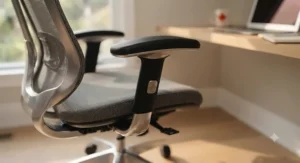
Narrow Office Chair vs Standard-Width Chairs: What Actually Changes
The difference between a narrow office chair and a standard-width chair isn’t cosmetic — it changes how your shoulders, elbows, and hips sit relative to your desk all day.
| Feature | Narrow / Small Frame Chair | Standard-Width Chair |
|---|---|---|
| Seat width | Typically 17-18 inches | Typically 19-21 inches |
| Armrest reach | Adjusts inward for narrower shoulders | Fixed or limited inward range |
| Minimum seat height | Often under 17 inches | Usually 17-21 inches |
| Footprint in small rooms | Fits tighter clearances | Needs more pull-back space |
| Best For | Shorter, narrower-framed users | Average-to-larger body types |
A standard-width chair isn’t a worse chair — it’s simply built around different measurements. Reviewers who’ve sat in both consistently note that the difference shows up most in the shoulders: a standard-width armrest set too far apart forces a subtle, constant shrug that most users don’t notice until they switch to a narrower design and the tension disappears. On paper, the trade-off is that narrow chairs sometimes sacrifice maximum weight capacity compared to their standard-width siblings, so heavier users should check that spec specifically before choosing based on frame width alone.
Common Mistakes When Buying a Small Frame Office Chair
The most common mistake is buying based on brand reputation alone rather than checking actual seat height and depth specs — a “petite” label on a listing doesn’t guarantee a genuinely low minimum height, and some chairs marketed toward smaller users are simply standard frames with softer cushioning.
A close second: assuming a footrest solves every fit problem. A footrest addresses seat height but does nothing for excessive seat depth, and stacking the two compensations often creates a worse sitting posture than either issue alone.
Buyers also frequently skip measuring their actual room clearance, discovering only after delivery that a chair with wide-set armrests won’t slide fully under their desk. And several reviewers across multiple petite-chair guides flag the same pattern: buying the cheapest available option without checking BIFMA or GREENGUARD certification, then discovering the mechanism wears out within a year of daily use.
What to Expect: Real-World Performance of a Small Frame Chair
Specs on paper only tell part of the story. In daily use, a genuinely low seat height translates into something surprisingly simple: you stop thinking about your feet. That sounds trivial until you’ve spent years unconsciously tensing your calves to keep them from dangling, a habit that reviewers across multiple petite-focused guides describe taking weeks to fully unlearn even after switching to a properly fitted chair.
Seat depth adjustment shows up differently — less as an immediate relief and more as the disappearance of a recurring ache behind the knees by the end of a workday. Narrow, adjustable armrests tend to produce the fastest noticeable change: reviewers consistently describe shoulder tension easing within the first few sessions, since the correction is mechanical rather than postural.
What doesn’t change much, regardless of price point, is the learning curve for weight-activated tilt mechanisms — nearly every chair on this list that uses one requires a session or two before the recline feels intuitive rather than surprising.
Small Frame Office Chairs for Minimalist Home Offices
A minimalist home office chair needs to satisfy two goals that occasionally pull in opposite directions: visual simplicity and genuine ergonomic function. The SIDIZ T25 and Steelcase Series 1 both lean minimalist by design — clean lines, limited visible mechanisms, and a smaller physical footprint that doesn’t visually dominate a room the way a bulkier executive chair would.
For a minimalist setup, mesh backs tend to suit the aesthetic better than heavily padded upholstery, and they carry a practical benefit too: less visual bulk generally correlates with a lighter overall chair, which matters when you’re regularly repositioning furniture in a multi-use room. The Boulies Nubi Lite‘s slim profile fits this brief particularly well for buyers who want adjustability without a chair that reads as “corporate office” in a residential space.
Here’s what most buyers overlook in minimalist setups specifically: a chair that looks compact from the front can still have a wide base or splayed casters that undercut the streamlined look. Check the base diameter, not just the seat width, if visual minimalism matters as much as function.
Space-Saving Desk Chair Features That Actually Matter (And Those That Don’t)
Not every feature marketed as “space-saving” earns its place on a small-frame shopping list. Flip-up armrests genuinely matter — they change whether a chair physically fits under a desk, not just whether it looks compact. A narrower base and smaller caster footprint matter too, particularly in rooms where the chair needs to tuck fully out of a walkway.
What matters less than marketing suggests: an ultra-slim backrest profile that sacrifices lumbar support purely for a sleeker silhouette. A visually narrow chair that leaves your lower back unsupported isn’t actually solving the small-space problem — it’s trading one issue for another. Similarly, extremely lightweight frames sometimes signal thinner materials rather than genuine engineering efficiency, so weigh portability against the durability trade-offs discussed for each product above.
The feature that consistently delivers the most real-world value for a space-saving desk chair is adjustable seat depth, since it solves a fit problem no amount of footprint reduction can address.
✨ Don’t Miss These Exclusive Deals!
🔍 Take your home office setup to the next level with these carefully selected chairs. Click on any highlighted product to check current pricing and availability on Amazon.ca. The right fit makes every workday noticeably easier on your body.
Safety, Certification & Compliance: What CSA and BIFMA Ratings Actually Mean
Certification labels get thrown around loosely in furniture marketing, so it’s worth knowing what they actually verify. BIFMA (Business and Institutional Furniture Manufacturers Association) testing confirms structural durability under repeated stress — weight limits, mechanism cycles, and frame integrity — rather than comfort or fit. GREENGUARD certification addresses chemical emissions and air quality, relevant for anyone setting up a chair in a small, poorly ventilated apartment room.
In Canada specifically, workplace ergonomics guidance references the CSA Z412 standard for office ergonomics, which outlines that no single posture is correct for extended periods and recommends chairs that support posture changes throughout the day rather than locking users into one fixed position. That’s directly relevant to small-frame buyers, since a chair that only fits correctly in one exact adjustment position works against that recommendation.
None of the seven chairs featured here require certification to function well, but BIFMA and GREENGUARD testing offer a useful proxy for build quality when specs alone don’t tell the full story — particularly for budget picks where marketing claims can outpace actual engineering.

Asked Questions
❓ What counts as a small frame office chair?
❓ Is a small frame office chair only for shorter people?
❓ Do small frame office chairs cost more than standard chairs?
❓ Can I just add a footrest instead of buying a small frame chair?
❓ Do these chairs fit under a standard desk?
Conclusion
Fit matters more than features when you’re shopping for a small frame office chair — a chair loaded with adjustability that still leaves your feet dangling or your knees jammed against the seat pan hasn’t actually solved anything. Of the seven featured here, the SIDIZ T25 and CabLady S2 cover genuine budget-to-mid picks for petite frames, the Boulies Nubi Lite and Steelcase Series 1 bridge into mid-range adjustability, and the Steelcase Leap V2 and Herman Miller Aeron Size A represent the premium tier for anyone treating this as a long-term investment in daily comfort.
The right choice ultimately comes down to which specific problem you’re solving — seat height, seat depth, armrest reach, or room clearance — since very few chairs solve all four equally well. Measure your body and your room before your budget, and the rest of the decision tends to fall into place.
✨ Found the right fit above? Check current pricing on Amazon.ca before it changes — availability on petite-specific models shifts more often than standard chairs.
Recommended for You
- Petite Office Chair 2026: 7 Best Small Fits for Canadians
- Office chair 500 lb capacity: 7 rock-solid picks for 2026
- 24 Hour Office Chair: 7 Best Heavy-Duty Picks for 2026
Disclaimer: This article contains affiliate links. As an Amazon Associate, I earn from qualifying purchases. If you purchase products through these links, we may earn a small commission at no additional cost to you.
✨ Found this helpful? Share it with your friends! 💬🤗
