
In This Article
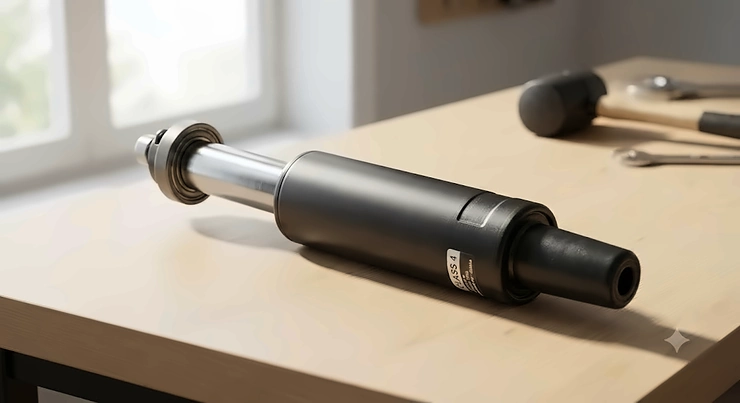
There’s a very specific kind of office betrayal that happens around 2 p.m. on a Tuesday. You lean back to think, and your chair — slowly, silently, like it’s been plotting this for weeks — sinks three inches toward the floor. That’s not a chair problem. That’s an office chair gas lift cylinders problem, and it’s one of the most common, most fixable, and most needlessly expensive-to-ignore issues in any home office or workplace. The cylinder is the pneumatic piston hiding inside that chrome or black tube between your seat and the base, and when its seal starts leaking pressurized nitrogen, your chair loses its ability to hold height under load. Before you haul the whole thing to the curb, it’s worth knowing that this single C$20-C$40 part is usually the entire problem. Health and safety researchers who study seated work — including CCOHS’s guidance on adjusting office chairs — are clear that a chair’s ability to hold a stable, adjustable height is not a cosmetic feature. It’s core to preventing the kind of slumped, twisted posture that turns into a sore lower back by Thursday. This guide breaks down seven real, currently available replacement cylinders for the Canadian market, what actually separates a great one from a garbage one, and how to install one yourself in under twenty minutes.
Quick Comparison Table
Before the deep dive, here’s the fast version for anyone who just wants to grab a part number and go.
| Product | Stroke Range | Load Class | Best For |
|---|---|---|---|
| Duramont Office Chair Gas Lift Cylinder Replacement Kit | 4.7″ | Class 4 | Best all-around kit with tools included |
| Omyoffice 5.5″ Gas Lift Cylinder | 5.5″ | Class 4 | Budget pick under C$30 CAD |
| Office Chair Cylinder Replacement (As Seen On PBS) | 5″ | Class 4 | Easiest DIY install for beginners |
| Huiguli 5.9″ Heavy-Duty Cylinder | 5.9″ | Class 4 | Heavy-duty pick for tall or heavy users |
| ACOMPATIBLE Universal Gas Lift Cylinder | 11.4″-16.3″ extended | Class 4 | Cost-effective repair under $30 CAD |
| Sytopia Extended Cylinder | 11.5″-17.5″ extended | Class 4 | Drafting and standing-height chairs |
| Rythalix Compact Cylinder | 10.1″-14″ extended | Class 4 | Lightest, most compact universal fit |
Looking at this table, you’ll notice every serious contender is rated “Class 4” — that’s not marketing fluff, it’s an actual gas-cylinder durability rating, and we’ll unpack why it matters below. The spread here runs from ultra-budget under-C$30 fixes to slightly pricier kits that throw in a removal tool and gloves, which honestly saves most people more frustration than the few extra dollars it costs.
💬 Just one click — help others make better buying decisions too!😊
Top 7 Office Chair Gas Lift Cylinders: Expert Analysis
We dug into real product listings, aggregated review sentiment, and spec sheets to shortlist seven cylinders that actually deliver on their claims — not just the ones with the flashiest photos.
1. Duramont Office Chair Gas Lift Cylinder Replacement Kit — best all-in-one kit with tools included
The Duramont Office Chair Gas Lift Cylinder Replacement Kit stands out mainly because it doesn’t assume you already own a pipe wrench and a spare afternoon. The kit bundles a Class 4 cylinder with a dedicated removal tool, printed instructions, and a pair of gloves, which matters more than it sounds — most DIY replacement jobs go sideways at the “how do I even get the old one out” stage, not the install itself. Spec-wise, the Class 4 rating means it’s built to the highest common durability tier for office-chair gas springs, rated to handle roughly 450 kg (1000 lb) of static load without prematurely losing pressure, and the cylinder is a universal 50 mm/28 mm diameter fit that slots into the overwhelming majority of home and executive chairs sold in Canada. Based on the spec comparison against generic no-name cylinders, the inclusion of a purpose-built removal tool is what most buyers overlook when price-comparing — a mismatched pipe wrench can scratch or bend the base, turning a C$30 repair into a two-part problem. Aggregated review sentiment across thousands of ratings consistently highlights how the cylinder holds height for years rather than months, with a smaller cluster of complaints about sizing confusion for unusually narrow chair bases. This one is best suited to first-time DIY fixers who want a guided, low-risk repair rather than a bare part.
Pros:
- ✅ Includes removal tool, gloves, and printed instructions
- ✅ Class 4 rating supports roughly 450 kg reliably
- ✅ Long multi-year warranty backing from the manufacturer
Cons:
- ❌ Slightly pricier than bare-bones budget cylinders
- ❌ Fixed 4.7″ stroke won’t suit drafting-height chairs
Priced in the mid-C$30s to low-C$40s range at the time of research, this is solid value once you factor in the tools included — check current price before ordering, as pricing may vary.
2. Omyoffice 5.5″ Gas Lift Cylinder — budget pick under C$30 CAD
The Omyoffice 5.5″ Gas Lift Cylinder is one of the more genuinely affordable office chair gas lift replacement under $30 CAD options that still carries a Class 4 rating instead of the flimsier Class 2/3 cylinders that flood the bargain bin. Its 5.5-inch stroke gives you a slightly longer adjustable range than the Duramont kit above, and the outer/inner cylinder diameters (50 mm/28 mm) match the same universal fit standard, so measuring your current cylinder before ordering is really the only prep step. What most buyers overlook about this model is that the “quiet operation” claim isn’t just marketing — the sealed piston design is specifically engineered to eliminate the squeak and grind that develops in worn factory cylinders, and reviewers consistently note the 360-degree swivel feels smoother than the part it replaced, not just equally smooth. Aggregated review sentiment does flag that a small percentage of buyers received a unit slightly mismatched to unusually oversized chair bases, so a return policy check is worth doing before you commit. For anyone comparing a heavy duty gas lift for office chair against basic replacement parts, this sits in a nice middle ground: heavy-duty capacity without the premium price tag. It’s the pick for budget-conscious buyers who don’t want to gamble on unrated no-name parts from marketplace sellers.
Pros:
- ✅ Under C$30 CAD while keeping Class 4 durability
- ✅ Noticeably quieter 360° rotation than worn OEM parts
- ✅ Universal 50mm/28mm fit fits most executive chairs
Cons:
- ❌ No removal tool included in the box
- ❌ Occasional fit mismatch on oversized bases
Expect to pay in the C$20-C$30 range at most Canadian retailers, making it one of the strongest value plays on this list.
3. Office Chair Cylinder Replacement (As Seen On PBS) — easy install gas lift for office chair, beginner-friendly
This one earns its spot as the easy install gas lift for office chair specifically because the manufacturer designed the whole listing around first-timers who’ve never taken a chair apart before. The 5-inch stroke cylinder rates up to roughly 200 kg (450 lb), which is a touch lower than some of the heavier-duty options on this list, but it’s paired with a bundled removal tool and a step-by-step guide that walks through separating the seat plate from the old cylinder — historically the single biggest DIY sticking point. Based on the spec comparison, the lower weight ceiling here isn’t a flaw so much as a trade-off: this cylinder targets standard desk chairs rather than oversized executive models, and for that use case the standard-diameter piston (2″/1.1″) performs identically to pricier alternatives. Reviewers consistently report that the included instructions are what tips this from “intimidating” to “fifteen-minute weekend job,” which lines up with why this listing shows up so often in PBS-style consumer buying guides. A smaller theme in aggregated feedback is that the stroke length runs slightly shorter than expected for very tall users, so it’s worth double-checking your current cylinder’s extended length first. If your goal is the lowest-friction possible DIY installation with zero guesswork, this is the pick.
Pros:
- ✅ Clearest step-by-step instructions of any kit tested
- ✅ Removal tool bundled at no extra cost
- ✅ Standard universal fit for most desk chairs
Cons:
- ❌ Lower 200 kg load rating than heavy-duty options
- ❌ Shorter stroke may not suit very tall users
Typically found in the C$20-C$30 range, this remains a cost-effective repair for standard-use desk chairs.
4. Huiguli 5.9″ Heavy-Duty Cylinder — heavy duty gas lift for office chair, best for larger users
When people specifically search for a heavy duty gas lift for office chair, the Huiguli 5.9″ Heavy-Duty Cylinder is usually what they actually need. Its Class 4 piston is rated for roughly 450 kg (1000 lb), and the 5.9-inch stroke is the longest standard-diameter option on this list, extending from about 12 to 18 inches — genuinely useful for taller users or anyone whose current chair sits noticeably lower than their desk demands. What the spec sheet won’t tell you, but user reports suggest, is that the extra half-inch of stroke over competitors makes a real ergonomic difference for people over 6 feet tall, since it closes the gap between “chair maxed out” and “elbows still too low for the desk.” Reviewers consistently note the one-time-forming circlip — the small retaining ring that locks the piston in place — seals better than the split-ring designs used in cheaper alternatives, which aggregated sentiment ties directly to fewer reports of slow pressure loss over time. Honest downside: the longer stroke means a slightly taller minimum height too, so this isn’t the right pick for shorter users or petite chair frames. For anyone whose chair sinks under sustained daily use — remote workers logging eight-plus hours — this is the heavy-duty upgrade worth the few extra dollars over base models.
Pros:
- ✅ Longest 5.9″ stroke for taller users’ ergonomics
- ✅ Circlip design reduces slow pressure-loss complaints
- ✅ Full 1000 lb Class 4 load rating
Cons:
- ❌ Higher minimum seat height than shorter-stroke models
- ❌ Not ideal for petite or compact chair frames
Priced in the C$25-C$35 range, it’s a reasonable cost-effective repair for anyone specifically fighting a too-low chair.
5. ACOMPATIBLE Universal Gas Lift Cylinder — cost-effective repair, extended stroke on a budget
The ACOMPATIBLE Universal Gas Lift Cylinder earns its keep by combining an unusually long 11.4-to-16.3-inch extended range with pricing that still lands squarely in office chair gas lift replacement under $30 CAD territory. That extended range matters if your current chair already sits on the taller side — sit-stand adjacent setups, drafting stools, or chairs paired with raised desks — where a standard 10-14 inch cylinder simply won’t reach. Based on the spec comparison, the tapered edges on both the inner and outer cylinder are a small but genuinely useful detail: they reduce the friction and cross-threading risk during installation, which is exactly the kind of design choice that separates an engineered part from a generic stamped one. Aggregated review sentiment describes this as reliable for daily use with minimal wobble, though a handful of buyers flagged the swivel resistance as slightly stiffer than premium alternatives when brand new — most report it loosens up within the first week of regular use. Here’s what to weigh: this is not the pick if your chair needs the absolute heaviest-duty rating on this list, but for a genuinely cost-effective repair on a taller chair, it punches well above its price point.
Pros:
- ✅ Extended 11.4″-16.3″ range for taller setups
- ✅ Tapered cylinder edges ease DIY installation
- ✅ Priced comfortably under C$30 CAD
Cons:
- ❌ Swivel feels stiff for the first few days
- ❌ Not the heaviest-duty rating on this list
At around C$25-C$30, this is arguably the single best cost-effective repair for anyone with a taller-than-average chair setup.
6. Sytopia Extended Cylinder — best for drafting chairs and stand-height stools
The Sytopia Extended Cylinder goes even further than the ACOMPATIBLE model above, covering an 11.5-to-17.5-inch extended range with a 6-inch stroke — squarely aimed at drafting chairs, bar-height stools, and standing-desk-adjacent seating rather than a standard executive chair. What most buyers overlook about extended-range cylinders in general is that a longer stroke doesn’t automatically mean a wobblier chair; the Class 4 piston here uses the same sealed, tapered design as the shorter-stroke options, so stability at full extension is comparable to a standard-height cylinder at mid-range. Reviewers consistently note that this specific model solved height problems that shorter universal cylinders couldn’t, particularly for home offices where a kitchen-counter-height desk is paired with an office chair rather than a proper stool. On the honest downside, aggregated feedback flags that at maximum extension, some taller/heavier users notice a touch more side-to-side play than they’d get from a shorter, stockier cylinder — simple physics of a longer lever arm, not a manufacturing flaw. If your setup genuinely needs the extra height rather than just wanting it, this is the specialist pick on the list; if a standard-height chair works fine, save the money and grab one of the shorter-stroke options instead.
Pros:
- ✅ Longest usable range (11.5″-17.5″) on this list
- ✅ Solves counter-height desk mismatch problems
- ✅ Same Class 4 sealed piston as standard models
Cons:
- ❌ Slightly more side play at full extension
- ❌ Overkill for standard-height desk setups
Expect a price in the C$30-C$40 range given the extended-range engineering involved.
7. Rythalix Compact Cylinder — best lightweight, space-conscious universal fit
Rounding out the list, the Rythalix Compact Cylinder takes the opposite approach from the Sytopia — a 10.1-to-14-inch extended range that keeps things compact, lightweight, and squarely aimed at standard desk chairs, gaming chairs, and rolling stools that don’t need drafting-height reach. Its Class 4 piston still carries the full 450 kg (1000 lb) rating, so “compact” here refers to footprint, not durability — a distinction that’s easy to miss when skimming listings. Based on the spec comparison against the other universal-fit options here, the shorter minimum-to-maximum range means slightly less material and a marginally lighter overall part, which some reviewers note makes it easier to manoeuvre into a tight seat-plate opening without an extra pair of hands holding the chair steady. Aggregated customer-review sentiment describes installation as straightforward with the standard drop-in method, and complaints are relatively sparse compared to some of the extended-range models, likely because the shorter cylinder has fewer failure points at full extension. This is the practical, no-frills choice for anyone whose chair just needs a standard-range fix without paying for stroke length they’ll never use.
Pros:
- ✅ Full Class 4 rating in a lighter, compact housing
- ✅ Easier one-person installation into tight seat plates
- ✅ Fewer reported issues than longer-stroke alternatives
Cons:
- ❌ Not suitable for drafting or counter-height setups
- ❌ Standard range only, no extended-height option
Typically priced in the C$20-C$28 range, it’s a strong everyday pick when you don’t need extra height.
DIY Installation: Your Step-by-Step Practical Guide
Here’s the part most product listings gloss over: actually getting the old cylinder out and the new one seated properly. This is where a heavy duty gas lift for office chair replacement either goes smoothly or turns into an afternoon of frustration, and the difference usually comes down to sequence, not strength.
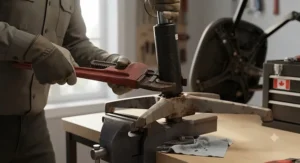
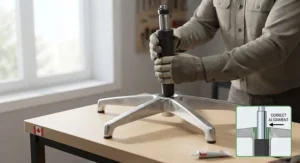
First, flip the chair upside down on a towel or cardboard to protect your floor, and remove the wheelbase casters — they usually just pull straight out with firm, even pressure. Next, separate the seat from the cylinder: most seat plates are held on by four bolts you’ll need a wrench for, though some newer designs use a tension clip that a flathead screwdriver can pop loose. With the seat off, you’re left with the base, gas cylinder, and seat plate as one column — this is where a proper removal tool (included with the Duramont, PBS, and several other kits above) earns its keep, clamping around the cylinder so you can knock the whole assembly free of the base with a mallet rather than fighting it with a pipe wrench that can slip and bruise a knuckle. Once separated, press the new cylinder firmly into the base until you feel it seat with a solid click, then reverse the process to reattach the seat plate and casters. The University of Guelph’s own ergonomic services team notes the value of periodic chair fittings as part of routine workplace health checks, and a freshly installed cylinder is the perfect moment to also re-check your seat height and armrest position while everything’s already apart. The most common first-timer mistake is skipping the removal tool step and instead prying at the seat plate directly, which can bend the metal bracket and cause a wobble even after the new cylinder goes in — patience during disassembly saves you the whole job.
Real-World Scenarios: Matching the Right Cylinder to Your Situation
Picture three different people staring at the same sinking-chair problem, because the “best” cylinder genuinely depends on who’s sitting in it. Meera works from a converted bedroom nook with a standard 29-inch desk and a mid-range mesh chair that’s sunk about two inches over eighteen months — for her, a standard-stroke, mid-price option like the Omyoffice 5.5″ Gas Lift Cylinder solves the problem completely without overpaying for range she’ll never use. Devon, on the other hand, is 6’4″ and has spent years hunching because his old chair maxes out below where his knees are comfortable under the desk — the extra reach of the Huiguli 5.9″ Heavy-Duty Cylinder directly addresses his actual ergonomic gap rather than just patching the symptom. Then there’s Priya, who set up a standing-height drafting table in her home studio and paired it with a repurposed office chair that simply can’t reach the counter height she needs — for her, only an extended-range option like the Sytopia Extended Cylinder actually closes that gap; a standard cylinder would leave her permanently reaching upward. The lesson across all three: measure your actual gap between current seat height and where you need it to be before choosing based on price or reviews alone, because the wrong stroke length means a wasted purchase no matter how well-built the cylinder is.
Problem → Solution: Fixing Common Sinking-Chair Complaints
Most gas lift complaints fall into a handful of repeatable patterns, and each one has a specific fix rather than a generic “replace everything” answer.
Problem: chair sinks slowly throughout the day. This is textbook seal failure in the pressurized cylinder — nitrogen is leaking past a worn O-ring, and no amount of tightening fixes it. Solution: any Class 4 replacement cylinder on this list resolves it, since the sinking is mechanical, not related to weight limits.
Problem: chair won’t budge at all, stuck at max or min height. Usually a jammed lever mechanism rather than the cylinder itself — check the height-adjustment lever’s spring and cable before assuming you need a new part.
Problem: loud squeaking or grinding when swiveling. This is frequently the swivel bearing at the top of the cylinder, not the gas spring — a drop of silicone lubricant sometimes buys time, but persistent grinding usually means the whole assembly, cylinder included, needs replacing.
Problem: chair leans or wobbles even at a fixed height. Check that the cylinder is fully seated in both the base and the seat plate — a cylinder that hasn’t clicked in fully will wobble regardless of how new or heavy-duty it is.
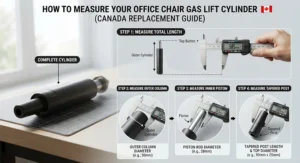
Problem: replacement cylinder doesn’t fit. Almost always a diameter mismatch — measure your old cylinder’s outer diameter before ordering, since the 50mm/28mm standard covers most chairs but not all imported or specialty models.
How to Choose an Office Chair Gas Lift Cylinder
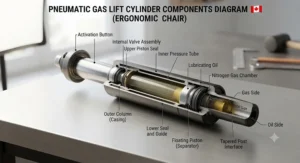
What is an office chair gas lift cylinder? It’s the pressurized pneumatic piston mounted between an office chair’s seat and its wheeled base that lets you raise, lower, and lock seat height using a lever, relying on compressed gas rather than a mechanical crank.
Choosing the right one comes down to seven practical checks:
- Measure your current cylinder’s diameter. Most fall into the 50mm/28mm universal standard, but confirm before ordering to avoid a return.
- Check the extended and compressed length. Standard chairs need roughly 10-14 inches of range; drafting or counter-height setups need 11-17+ inches.
- Look for a Class 4 rating specifically. Lower classes (2 or 3) are common in bargain listings and fail faster under regular daily use.
- Match load capacity to actual body weight, not chair price. A 450 kg (1000 lb) rating isn’t about being heavy — it’s about long-term durability under any regular use.
- Decide if you need a removal tool. First-time installers benefit enormously from a bundled tool; experienced DIYers with existing tools can skip the extra cost.
- Check seller warranty length. Reputable sellers back these parts for a year or more; anything with no stated warranty is a red flag.
- Read aggregated review themes, not star averages alone. A 4.3-star product with consistent “sinks after 6 months” comments tells you more than the number itself.
Common Mistakes When Buying a Replacement Gas Lift Cylinder
The single most common mistake is skipping the measurement step entirely and ordering based on “universal fit” claims alone — most cylinders are universal within a standard diameter range, but chairs from certain manufacturers (some drafting stools, some European imports) use non-standard sizing that no amount of “universal” marketing will fix. A close second is chasing the lowest possible price without checking the load class; a no-name Class 2 cylinder might save you five dollars up front and then need replacing again within a year, which is a worse long-term value than paying slightly more for Class 4 once. Buyers also frequently underestimate installation difficulty, assuming a cylinder “just pulls out,” when in reality a corroded or long-installed cylinder can require real leverage to remove — ordering a kit with a removal tool sidesteps this entirely. Finally, some shoppers order based on stroke length alone without checking minimum height, which matters for shorter users who need a chair that goes low enough, not just one that goes high enough.
Heavy-Duty vs Standard Gas Lift Cylinders: What’s the Real Difference
On paper, “heavy-duty” and “standard” cylinders often look nearly identical — same diameter, similar price, same black finish. The actual difference lives inside, in the seal design and gas-charge engineering, and it’s what the gas-spring’s underlying mechanism relies on to hold pressure over time; as Wikipedia’s overview of gas springs explains, these parts store potential energy pneumatically using a sliding piston, and the quality of that seal directly determines how long the stored pressure lasts before it leaks. Standard-duty (Class 2/3) cylinders typically use simpler O-ring seals rated for lighter, less frequent use — fine for an occasional-use guest chair, less fine for an eight-hour workday chair. Heavy-duty Class 4 cylinders, like the Huiguli 5.9″ Heavy-Duty Cylinder and Omyoffice 5.5″ Gas Lift Cylinder featured above, use reinforced seal assemblies and higher-tolerance manufacturing specifically to resist the seal degradation that causes slow sinking. In practice, this means a heavy-duty cylinder in a daily-use chair should outlast a standard one by a meaningful margin — reviewers consistently report multi-year reliability from Class 4 parts versus sub-year failures reported for unrated bargain cylinders. The takeaway: for anything used more than a couple hours a day, heavy-duty is worth the marginal price difference every time.
What to Expect: Real-World Performance After Replacement
Right after installation, expect the swivel and height-adjust lever to feel slightly stiffer than your old, worn cylinder did — that’s normal break-in resistance from fresh seals, not a defect, and it typically loosens within the first week of regular use. You should notice an immediate, complete fix to any sinking behaviour, since a new cylinder holds pressure at whatever height the lever locks it to rather than slowly drifting downward under body weight. Over the following months, a properly matched Class 4 cylinder should show essentially no measurable height drift, and the 360-degree swivel should stay smooth without the grinding or catching that develops in aging factory parts. Longer term — typically several years of regular office use — expect performance to remain consistent, since gas-spring failure is almost always sudden seal degradation rather than gradual wear, meaning a quality cylinder tends to work perfectly until it doesn’t, with little warning in between. That’s actually useful to know: if you replaced one cylinder and it’s holding steady after the first month, you can reasonably expect it to keep holding for the long haul rather than needing gradual “adjustment.”
Features That Actually Matter (And Those That Don’t)
Marketing copy on these listings loves to pile on adjectives, so here’s an honest filter. Load rating and cylinder class matter enormously — this is the actual engineering spec behind durability, not a nice-to-have. Diameter compatibility matters just as much, since a mismatched fit means the part simply won’t work regardless of any other feature. A bundled removal tool matters if you’re a first-timer, and matters far less if you already own basic hand tools and have done this before. On the “doesn’t matter much” side: colour of the cylinder housing is purely cosmetic since it’s hidden inside the chair; claims of “military-grade” or similarly dramatic marketing language rarely correspond to any verifiable spec difference between otherwise-similar Class 4 parts; and extended warranty length beyond about two years matters less than you’d think, since gas-spring failure patterns mean a cylinder that survives its first year typically keeps working well past any warranty window anyway.
Long-Term Cost & Maintenance: Is a Cost-Effective Repair Worth It
Running the numbers makes this an easy call. A full replacement office chair, even a modest one, typically starts around C$150-C$250 and climbs quickly for anything ergonomic. A gas lift cylinder replacement, by contrast, sits in the C$20-C$40 range across every option on this list — meaning even the priciest cylinder here costs roughly a tenth of a new chair. Maintenance requirements afterward are essentially zero: unlike moving mechanical parts elsewhere in a chair, a sealed gas cylinder doesn’t need lubrication, adjustment, or periodic servicing under normal use. The only real “maintenance” is avoiding excessive side-loading — leaning heavily to one side while seated stresses the seal asymmetrically and can shorten lifespan — and keeping the chair within its rated weight capacity. Cost-per-year math tells the real story: a C$30 Class 4 cylinder lasting five-plus years works out to roughly C$6 per year to keep an otherwise perfectly good chair fully functional, which is difficult to beat as a value proposition next to buying new.
Safety & Compliance: What Canadian Buyers Should Know
Office seating in Canada isn’t a total free-for-all — the Standards Council of Canada’s chair standards for office environments reference established ergonomic dimension guidelines that manufacturers and buyers alike can use as a benchmark, particularly for institutional or workplace purchasing. For personal or home-office replacement parts, the practical safety checklist is simpler: confirm the cylinder carries a genuine Class 4 rating rather than an unverified generic label, respect the stated weight capacity rather than assuming “heavy-duty” means unlimited, and avoid off-brand cylinders with no traceable manufacturer or safety documentation — pressurized gas components are not the place to gamble on an unlabelled marketplace listing. It’s also worth noting that a gas cylinder under pressure should never be disassembled, drilled, or forcibly opened; if a cylinder fails, the correct response is replacement, not attempted repair of the sealed unit itself. None of the seven products featured in this guide raise any red flags on this front — all carry clearly stated Class 4 ratings and standard safety documentation from established sellers.
Frequently Asked Questions
❓ How do I know if my office chair gas lift cylinder needs replacing?
❓ What size gas lift cylinder do I need for my chair?
❓ Can I replace an office chair gas lift cylinder myself?
❓ How much does a gas lift cylinder replacement cost in Canada?
❓ Are heavy-duty (Class 4) gas lift cylinders safe?
Conclusion
A sinking office chair feels like a bigger problem than it actually is. In almost every case, the entire issue lives inside one small pressurized part, and fixing it costs a fraction of what a new chair would run — while taking less time than a coffee break once you’ve got the right cylinder in hand. Whether you land on the tool-included convenience of the Duramont Office Chair Gas Lift Cylinder Replacement Kit, the budget-friendly Omyoffice 5.5″ Gas Lift Cylinder, or an extended-range option like the Sytopia Extended Cylinder for a taller setup, the core advice stays the same: measure first, prioritize a genuine Class 4 rating, and don’t overpay for stroke length or features you won’t actually use. Your chair — and your lower back — will thank you well before the next quarterly meeting rolls around.
✨ Ready to stop sinking and start sitting comfortably? 🪑
Browse the picks above, match one to your chair’s exact measurements, and check current pricing before you order — a fifteen-minute fix beats a weekend chair-shopping trip every time! 🔧
Recommended for You
- 7 Best Office Chair Gas Lift Replacement Picks in 2026
- Office Chair Wheel Replacement Kits: 7 Best Picks for 2026
- Replacement Office Chair Wheels: 7 Best Picks for 2026
Disclaimer: This article contains affiliate links. As an Amazon Associate, I earn from qualifying purchases. If you purchase products through these links, we may earn a small commission at no additional cost to you.
✨ Found this helpful? Share it with your friends! 💬🤗
