
In This Article
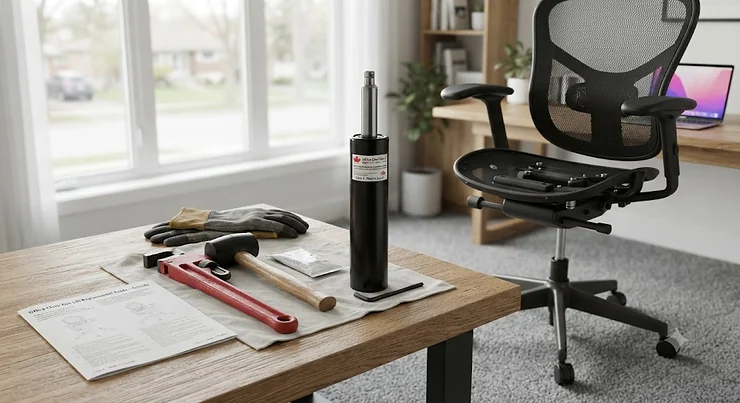
You know the feeling. You sit down, lean back, and your chair sighs out a slow, defeated hiss — sinking an inch, then two, then it just keeps drifting toward the floor like it’s given up on the workday entirely. An office chair gas lift replacement is the small, pressurized cylinder that fixes exactly that problem: it’s the pneumatic piston under your seat that raises and locks your chair at height, and swapping a worn one out is almost always cheaper and greener than buying a whole new chair. Before you resign yourself to a chair that permanently sits like a beanbag, it’s worth knowing that this is a fifteen-minute fix, not a furniture funeral.
We dug through real product listings, verified specs, and aggregated review patterns for gas lift cylinders sold to Canadian shoppers — cross-checked against CCOHS office ergonomics guidance — and we’re laying it all out here — no fluff, no fabricated five-star gushing, just honest analysis of what actually holds up. If your chair sinks, wobbles, or refuses to lock, here’s everything you need to fix it properly, the first time.
Quick Comparison Table: Top Office Chair Gas Lift Replacements
| Product | Class | Weight Capacity | Best For |
|---|---|---|---|
| Duramont Gas Lift Kit | Class 4 | 1,000 lbs | Best overall — includes tool + warranty |
| DOZYANT Long Stroke | Class 4 | 450 lbs | Tall users needing extra height |
| Omyoffice 5.5″ | Class 4 | 1,000 lbs | Budget-friendly daily use |
| Huiguli Heavy Duty | Class 4 | 1,000 lbs | Executive chairs, extended reach |
| Rythalix Extra Long | Class 4 | 1,000 lbs | Drafting chairs, standing desks |
| MySit BIFMA-Grade | Class 4 | 450 lbs | Gaming chairs, compact frames |
| ACOMPATIBLE Universal | Class 4 | Standard | Widest universal-fit compatibility |
Based on the spec comparison, every option here sits at Class 4 — the highest commercial-grade rating for gas cylinders — which tells you the market has largely standardized around one durable tier and the real differences come down to stroke length, included accessories, and fit range. What most buyers overlook is that “Class 4” alone doesn’t guarantee a good outcome; a mismatched diameter or the wrong stroke length will make even the sturdiest cylinder feel wrong in your specific chair. Treat this table as a shortlist, not a final answer — the detailed breakdowns below explain which pick actually matches your chair type and body height.
💬 Just one click — help others make better buying decisions too!😊
Top 7 Office Chair Gas Lift Replacements: Expert Analysis
1. Duramont Gas Lift Cylinder Kit — best all-in-one kit with removal tool
The Duramont kit is the rare replacement that assumes you’ve never done this before, and builds accordingly. Instead of shipping just a cylinder and wishing you luck, it bundles a dedicated removal tool, printed instructions, and a pair of gloves — because yanking a seized cylinder out of a chair base by hand is a genuinely messy, knuckle-scraping job. The Class 4 piston is rated to roughly 1,000 lbs, with a universal 2-inch outer / 1.1-inch inner diameter that fits the overwhelming majority of office, task, and gaming chairs sold in Canada. What most buyers overlook is that the accessory bundle is really an insurance policy against the single biggest reason first-time replacements fail: not being able to get the old cylinder out cleanly. Reviewers consistently report smooth, silent height adjustment after install and describe the fit as genuinely universal across brands, with a smaller number noting the tool works best on chairs where the cylinder isn’t badly corroded or rusted in place.
Pros:
- ✅ Includes removal tool, gloves, and instructions
- ✅ Long, multi-year warranty backing the cylinder
- ✅ Fits the widest range of office and gaming chairs
Cons:
- ❌ Higher price point than bare-bones cylinders
- ❌ Removal tool struggles on badly rusted old units
Priced in the C$45-C$60 range at the time of research, Duramont earns its premium by removing the single most frustrating part of a DIY job — for a first-timer, that’s genuinely worth paying for.
2. DOZYANT Long Stroke Cylinder — best for tall users needing extra height
If you’re over six feet and your old chair tops out at an uncomfortable slouch, the DOZYANT long-stroke line is built around exactly that problem. It’s sold in multiple stroke lengths — 5, 6, and 8 inches — meaning the adjustable range between fully compressed and fully extended is noticeably longer than the 4-inch stroke found on standard replacement units. The Class 4 piston is rated to 450 lbs, with the same 2-inch/1.1-inch diameter standard that fits most executive and computer chairs. Based on the spec comparison, the extra stroke length matters more than the weight rating for most tall buyers, since the actual failure point for tall users usually isn’t load capacity — it’s simply running out of upward travel before their knees clear the desk properly.
Pros:
- ✅ Multiple stroke lengths for taller seating positions
- ✅ Smooth 360-degree rotation with minimal noise
- ✅ Simple drop-in install, no extra screws needed
Cons:
- ❌ 450 lb rating is lower than some 1,000 lb rivals
- ❌ Longer stroke units can look visually mismatched on shorter chair frames
Expect to pay in the C$30-C$45 range depending on stroke length. For anyone whose main complaint is “this chair just doesn’t go high enough,” this is the most targeted fix on the list.
3. Omyoffice 5.5″ Gas Lift Cylinder — best budget pick for daily office use
The Omyoffice cylinder is the one to grab when your only goal is stopping the slow sink and you don’t need bells and whistles. It offers a 5.5-inch adjustable stroke, Class 4 construction, and a 1,000 lb capacity — numbers that, on paper, actually outperform some pricier competitors on this list. What the spec sheet won’t tell you, but user reports suggest, is that the noise dampening on budget cylinders can vary batch to batch; most reviewers describe it as quiet, but a smaller subset mention a faint hiss during height changes that fades after the first week of use as seals settle in. It’s a straightforward swap aimed at salon chairs, task chairs, and standard rolling office chairs rather than heavy executive builds.
Pros:
- ✅ Strong 1,000 lb capacity for the price tier
- ✅ 5.5-inch stroke covers most standard height needs
- ✅ Straightforward universal diameter fit
Cons:
- ❌ No bundled removal tool included
- ❌ Occasional break-in noise reported by some buyers
At around C$25-C$35, Omyoffice is the pragmatic choice — it does the one job it’s asked to do without asking you to pay for extras you might not need.
4. Huiguli Heavy Duty Class 4 Cylinder — best for extended reach on executive chairs
The Huiguli cylinder splits the difference between standard and long-stroke options with a 5.9-inch stroke and a 12-to-18-inch extended range, aimed squarely at bulkier executive and managerial chairs that need a bit more vertical travel than a basic task chair. Reviewers consistently report that the QPQ surface treatment on the piston rod — a black-oxide finish that resists corrosion — holds up well over months of daily use, which matters more than it sounds like it should, since rod corrosion is one of the quieter reasons cylinders eventually start leaking air and sinking again. Here’s what to weigh: the extra half-inch of stroke over Omyoffice’s model won’t matter for shorter users, but if your original executive chair sat unusually tall, this is the closer match.
Pros:
- ✅ Corrosion-resistant QPQ-treated piston rod
- ✅ Wider 12-18 inch extended height range
- ✅ Rated to 1,000 lbs for heavier executive frames
Cons:
- ❌ Bulkier housing may not suit slim task-chair frames
- ❌ Limited colour options (black only)
In the C$30-C$45 range, Huiguli is a smart mid-tier pick for anyone replacing the cylinder on a chunkier managerial-style chair rather than a slim task chair.
5. Rythalix Extra Long Cylinder — best for drafting chairs and standing desks
Standard chairs top out around 20 inches of seat height, which is exactly the ceiling that breaks down once you pair a chair with a standing desk lowered to sitting height, or a drafting stool at a raised counter. The Rythalix extra-long unit covers a 10.1-to-14-inch compressed-to-extended range that’s deliberately built for that taller category — drafting chairs, bar-height stools, and counter-level workstations. Based on the spec comparison, this is the only cylinder on our list explicitly engineered for that use case rather than adapted from a standard office chair design, and reviewers frame it accordingly: buyers with drafting or bar stools report it as the first replacement that actually reached their needed height, after standard-length cylinders came up short.
Pros:
- ✅ Purpose-built for drafting chairs and tall stools
- ✅ 1,000 lb Class 4 rating handles heavier frames
- ✅ Silent 360-degree rotation reported by users
Cons:
- ❌ Overkill (and visually oversized) for standard desk chairs
- ❌ Narrower compatibility with low-profile chair bases
Priced around C$35-C$50, Rythalix solves a specific problem — standard replacements not reaching high enough — that most of this list simply isn’t built to address.
6. MySit BIFMA-Grade Cylinder — best for gaming chairs and compact frames
The MySit cylinder leans on a detail most competitors don’t mention: construction to BIFMA-adjacent industry quality benchmarks, the commercial furniture standard used to test durability and safety in North American seating. With a 5.5-inch stroke and 450 lb rating, it’s sized for gaming chairs, compact task chairs, and lighter-frame computer chairs rather than heavy-duty executive builds. What most buyers overlook about this model is that gaming chairs often use a slightly different bracket geometry than office chairs, and MySit‘s universal sizing was specifically tested against that crossover market — a detail that matters if your “office chair” is actually a racing-style gaming seat, which is increasingly common in home offices.
Pros:
- ✅ Built to commercial industry quality benchmarks
- ✅ Well-suited to gaming and compact task chairs
- ✅ Smooth, tool-free universal installation
Cons:
- ❌ Lower 450 lb capacity limits heavier users
- ❌ Less ideal for large executive chair frames
At roughly C$25-C$35, MySit is the pick to reach for specifically when the chair in question is a gaming chair wearing an office chair’s job description.
7. ACOMPATIBLE Universal Cylinder — best for widest cross-brand compatibility
Closing out the list, the ACOMPATIBLE cylinder is built around one selling point: fit range. Its 11.4-to-16.3-inch adjustable span is designed to slot into the widest possible pool of existing chair bases and seat plates sold across North America, with the same tapered 2-inch/1.1-inch cylinder edges that make installation forgiving even without a removal tool. Here’s what to weigh: it doesn’t lead on weight capacity or premium accessories the way Duramont does, but if you’ve already measured your old cylinder and just need a dependable, no-frills match, this is a safe, well-tested default. Reviewers consistently describe it as a drop-in fix for the classic “chair won’t stay up” complaint, with the tapered edges specifically called out as easing what is otherwise the fiddliest part of the job.
Pros:
- ✅ Very wide universal fit range (11.4″-16.3″)
- ✅ Tapered cylinder edges simplify installation
- ✅ Reliable, no-surprises budget performer
Cons:
- ❌ No accessory bundle (tool, gloves) included
- ❌ Fewer stroke-length variants than DOZYANT
Expect a price around C$20-C$30, making ACOMPATIBLE one of the most accessible entry points on this list for a straightforward, budget-conscious swap.
Top 7 Products: Full Spec & Price Comparison
| Product | Stroke Length | Diameter Fit | Price Range (CAD) | Best For |
|---|---|---|---|---|
| Duramont Gas Lift Kit | ~4-5″ | 2″ / 1.1″ | C$45-C$60 | Best overall kit with tools |
| DOZYANT Long Stroke | 5-8″ | 2″ / 1.1″ | C$30-C$45 | Tall users |
| Omyoffice 5.5″ | 5.5″ | 2″ / 1.1″ | C$25-C$35 | Budget daily use |
| Huiguli Heavy Duty | 5.9″ | 2″ / 1.1″ | C$30-C$45 | Executive chairs |
| Rythalix Extra Long | Up to 4″ range in 10.1-14″ span | 2″ / 1.1″ | C$35-C$50 | Drafting/standing desks |
| MySit BIFMA-Grade | 5.5″ | 2″ / 1.1″ | C$25-C$35 | Gaming chairs |
| ACOMPATIBLE Universal | ~5″ (11.4-16.3″ span) | 2″ / 1.1″ | C$20-C$30 | Widest compatibility |
Looking at the comparison above, the pattern that jumps out is how tightly clustered the diameters are — nearly every mainstream cylinder shares the same 2-inch outer / 1.1-inch inner standard, which is why “universal fit” claims are usually accurate rather than marketing fluff. Where these products actually diverge is stroke length and starting height, which is the number you should measure against your own chair before anything else. Budget buyers should note that the cheapest options here, ACOMPATIBLE and Omyoffice, aren’t meaningfully weaker on core specs — you’re mainly paying extra elsewhere for accessories, stroke length, or niche compatibility, not raw durability.
How to Replace an Office Chair Gas Lift Cylinder Yourself
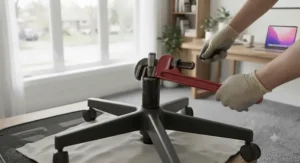
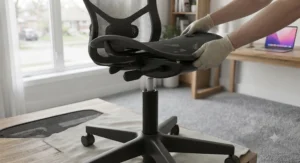
Replacing a cylinder is genuinely one of the friendlier DIY furniture repairs out there — no wiring, no glue curing overnight, just leverage and patience. Start by flipping the chair upside down and removing the wheelbase (casters usually just pull straight out). Next, separate the seat mechanism from the top of the cylinder, typically by prying it loose with a flathead screwdriver or rubber mallet taps around the collar. The trickiest step is extracting the old cylinder from the base — this is where a proper removal tool or a large pipe wrench earns its keep, since a rusted or long-installed cylinder can grip surprisingly hard. Once it’s free, seat the new cylinder into the base with a few firm mallet taps, then reattach the seat mechanism on top the same way. A common first-30-days mistake is forcing the new cylinder in at an angle instead of straight down, which can damage the seal before you’ve even sat in the chair once — go slow and keep it perpendicular. Wipe the piston rod with a dry cloth before install; factory oil residue is normal, not a defect.
Real-World Scenarios: Who Actually Needs This Fix
Picture three different people staring at the same sinking chair. First, there’s the budget-conscious grad student working from a hand-me-down task chair — for her, an Omyoffice or ACOMPATIBLE cylinder solves the sinking problem for a fraction of a new chair’s cost, and she’s back to studying in under twenty minutes. Second, there’s the six-foot-four remote software developer whose knees have been jammed under his desk for months because his old cylinder’s stroke ran out early — his fix is the DOZYANT long-stroke or Rythalix extra-long unit, since his actual problem was never durability, it was simply not enough vertical travel. Third, there’s the small business owner replacing cylinders across a dozen reception-area chairs on a tight facilities budget — for that volume job, the value math shifts toward the Duramont kit’s included tool, since buying (or renting) a separate pipe wrench for twelve installs would erase any per-unit savings from a cheaper bare cylinder.
Chair Still Sinking After Replacement? Troubleshooting Common Problems
Even a correct swap can go sideways in small ways, so here are the recurring issues and their fixes. If the chair still sinks slowly after replacement, the most likely culprit is a cylinder that wasn’t seated fully into the base — pull it back out and reseat it with firmer, even mallet taps rather than partial pressure. If the height lever doesn’t lock the chair in place at all, check that the lever mechanism is actually pressing the cylinder’s release pin; a misaligned seat mechanism can leave the pin permanently depressed, which mimics a defective cylinder but is really an installation issue. If the chair wobbles side to side after the swap, the base or casters likely weren’t reseated flush — remove and reinstall the base, confirming it clicks fully onto the new cylinder collar. And if you hear a persistent hiss with no height change at all, that’s a genuine seal failure, not a break-in noise, and the unit should be returned under warranty rather than lived with.
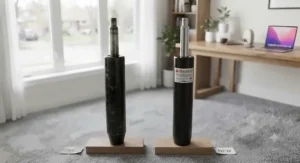
Chair Gas Lift vs Full Chair Replacement: Which Actually Makes Sense?
This is the comparison that actually saves people money, so it’s worth being blunt about it. A worn gas lift cylinder is, functionally, the single most common point of failure on an otherwise healthy office chair — the frame, mesh, armrests, and casters usually still have years of life left in them. Replacing just the cylinder costs a fraction of a new chair and takes roughly fifteen to twenty minutes with basic tools.
| Factor | Gas Lift Replacement | Full Chair Replacement |
|---|---|---|
| Typical cost | C$20-C$60 | C$150-C$800+ |
| Time required | 15-20 minutes | Immediate, no install |
| Environmental impact | Minimal — one small part | High — full frame to landfill |
| Best for | Chair is otherwise sound | Frame cracked, mesh torn, mechanism failed |
The math above only tips toward full replacement when something else on the chair has also failed — a cracked frame, torn mesh, or a broken tilt mechanism, since a new cylinder bolted onto a dying chair is money spent chasing a symptom rather than the disease. What most buyers overlook is that even mid-range chairs (C$300-plus) are engineered so the cylinder is genuinely the weakest link by design, meaning a single C$30-C$60 part swap can realistically buy several more years out of a chair that otherwise looks ready for the curb.
How to Choose a Universal Gas Lift Cylinder for Office Chairs
Picking the right universal gas lift cylinder for office chairs comes down to matching a handful of measurements and priorities rather than guessing. Here’s the process we’d walk a friend through:
- Measure your old cylinder’s diameter. Most office chairs use the 2-inch outer / 1.1-inch inner standard, but confirm it before ordering — a mismatch is the single most common return reason.
- Check the fully compressed and extended height. Compare these numbers against your old cylinder, not just your desired chair height, since stroke length (the difference between the two) is what actually changes.
- Match the weight rating to the heaviest regular user. A 450 lb rating comfortably covers most adults, but households or offices with larger users should default to a 1,000 lb Class 4 unit.
- Consider your chair type. Gaming chairs, drafting stools, and executive chairs each favour slightly different stroke ranges, as covered in the product breakdowns above.
- Decide if you need the tool bundle. If you don’t already own a large pipe wrench or a chair-specific removal tool, a kit like Duramont‘s that includes one is worth the premium.
- Read aggregated review themes, not star ratings alone. Look specifically for recurring mentions of sinking after a few months, which is the clearest red flag for a poorly sealed budget unit.
- Confirm return policy before installing. Since a bad fit is only obvious after a partial install, buying from a seller with an easy returns process protects you either way.
Office Chair Gas Lift Review: What Buyers Actually Report
Rather than inventing star ratings, it’s more useful to look at the patterns that show up consistently across aggregated customer feedback for this product category. Reviewers consistently note that Class 4 cylinders — the standard across every product on this list — rarely fail outright within the first year, and when complaints do appear, they cluster around two specific issues: a faint hissing noise during the first week that typically fades as seals settle, and, less commonly, a cylinder that doesn’t match the stated diameter closely enough for a snug fit. A recurring theme worth flagging honestly: buyers who skip measuring their old cylinder before ordering are disproportionately represented among negative reviews, which points to a buyer-error pattern more than a product-quality one. On the positive side, the most consistently praised trait across brands is installation simplicity — most reviewers describe the actual swap as faster and easier than they expected going in, particularly when a removal tool was included.
Hydraulic Cylinder vs Pneumatic Gas Lift Cylinder: Clearing Up the Confusion
“Hydraulic cylinder” and “gas lift” get used interchangeably in casual conversation, but they’re not quite the same mechanism, and it’s worth untangling for anyone shopping by search term alone. A true hydraulic cylinder relies on incompressible fluid to transmit force, which is common in heavy machinery and automotive lifts. Office chairs almost universally use a pneumatic gas spring instead — a sealed cylinder pressurized with nitrogen gas that compresses to allow smooth, stepless height adjustment, distinct from a mechanical spring that relies on the elastic deformation of coiled metal, as general engineering references on gas springs explain in more detail. That said, most listings — including several on this list — market themselves as “hydraulic pneumatic” cylinders, blending the terms because a small amount of lubricating oil sits alongside the pressurized gas to protect the seal.
| Factor | Pneumatic Gas Lift (office chairs) | True Hydraulic Cylinder |
|---|---|---|
| Mechanism | Compressed nitrogen gas | Incompressible fluid |
| Common use | Office/task chairs, adjustable stools | Automotive lifts, heavy machinery |
| Adjustment feel | Smooth, stepless, spring-assisted | Firm, load-bearing, less “springy” |
| What you’re buying | This — nearly always | Rarely relevant to chairs |
On paper this means that when you search for a “hydraulic cylinder” for your office chair, what you actually want — and what every product reviewed here provides — is a pneumatic gas spring; the hydraulic label is largely a naming convention carried over from older mechanical designs.
Common Mistakes When Buying a Replacement Gas Lift Cylinder
The single biggest mistake, by a wide margin, is ordering without measuring the existing cylinder’s diameter and stroke length first — assuming “universal” means “any cylinder fits any chair” leads directly to return requests. A close second is ignoring weight capacity because a 450 lb rating “sounds like plenty,” without accounting for the fact that dynamic loads (leaning, rocking, sitting down with force) place more stress on a cylinder than static body weight alone. Buyers also frequently skip checking whether their chair uses a standard round cylinder versus a less common square or telescoping design — a small percentage of chairs, particularly some drafting stools, don’t use the standard format at all. Finally, a subtler mistake is choosing the cheapest available option purely on price, then being surprised when a bargain-bin cylinder (well below the price ranges featured here) starts sinking within weeks — Class 4 construction genuinely costs more to manufacture properly, and prices meaningfully below that tier are a signal worth taking seriously.
Chair Height Adjustment and Office Ergonomics: What Canadian Guidelines Say
Getting chair height adjustment right isn’t just comfort — it’s a documented ergonomic requirement. The Canadian Centre for Occupational Health and Safety recommends adjusting chair height so your elbows sit roughly level with your work surface, and using an adjustable footrest if your feet can’t rest flat on the floor. That’s a genuinely useful benchmark to apply the moment your new cylinder is installed: sit down, adjust height until your forearms are level with your desk, and only then fine-tune from there. CCOHS also notes that the optimal seat height works out to roughly one-quarter of a person’s total body height, though this is only a rough guideline since leg-to-torso proportions vary widely between individuals, which is exactly why a broad-stroke universal cylinder matters more for some body types than others. If you want the full framework behind these recommendations, the CCOHS guide on adjusting office chairs walks through seat depth, backrest angle, and armrest height alongside pure vertical adjustment — worth a read if your setup still feels off after the cylinder swap.
✨ Don’t Miss These Exclusive Deals!
🔍 Take your home office setup to the next level with these carefully selected picks. Click on any highlighted product above to check current pricing and availability!
Long-Term Cost & the Environmental Case for Furniture Repair
Zoom out from a single chair and the math around furniture repair gets more compelling, not less. Office furniture waste is a genuinely large environmental line item: one industry analysis, published by Canadian Interiors, estimated that over 10 million tons of furniture waste ends up in landfills annually across Canada and the United States combined, with a single functioning office chair representing a meaningful share of ferrous metal, wood, and plastic waste. A C$20-C$60 gas lift replacement diverts an entire chair frame from that stream for the cost of a single restaurant meal, which is a genuinely favourable return-on-investment even before you factor in the new-chair price you’re avoiding. Total cost of ownership also favours repair over replacement for anyone who’s already invested in a mid-range or premium chair — a C$400 ergonomic chair with a C$40 cylinder swap is still meaningfully cheaper than buying a second C$400 chair, and it sidesteps the multi-week wait for a proper ergonomic model to arrive and be assembled.
Frequently Asked Questions
❓ How do I know if I need a gas lift replacement or a new chair?
❓ What size gas lift cylinder do I need for my office chair?
❓ Is a Class 4 gas lift cylinder worth the extra cost?
❓ Can I replace an office chair gas lift cylinder without tools?
❓ Why does my new gas lift cylinder make a hissing noise?
Conclusion
A sinking, wobbling, or stuck office chair almost never means the whole chair is done — it usually means one small pressurized cylinder has quietly given out after years of daily use. Across the seven options here, Duramont‘s all-in-one kit is the safest first-timer pick thanks to its included removal tool, DOZYANT and Rythalix solve the specific problem of running out of height for taller users or raised workstations, and Omyoffice, MySit, and ACOMPATIBLE deliver genuinely solid Class 4 performance for buyers who just want the sinking to stop without paying for extras. Whichever you choose, the process is the same: measure your old cylinder, match diameter and stroke length, and budget fifteen to twenty minutes for a repair that costs a fraction of a new chair while keeping a perfectly good frame out of the landfill.
Recommended for You
- Office Chair Wheel Replacement Kits: 7 Best Picks for 2026
- Replacement Office Chair Wheels: 7 Best Picks for 2026
- Office Chair Bases and Wheels: 7 Best Picks for 2026
Disclaimer: This article contains affiliate links. As an Amazon Associate, I earn from qualifying purchases. If you purchase products through these links, we may earn a small commission at no additional cost to you.
✨ Found this helpful? Share it with your friends! 💬🤗
