
In This Article
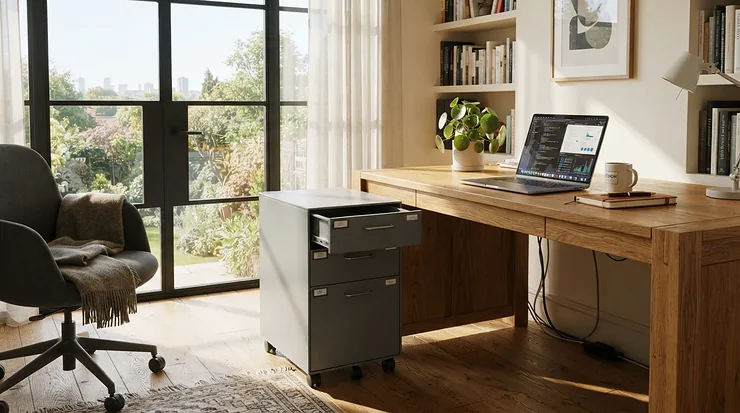
Picture it: you’re pulling a file from a bottom drawer, the whole cabinet glides two centimetres away from you, and your coffee wobbles on the desk. Or the opposite. You’ve bolted yourself into a fixed pedestal, and now the desk can never leave its corner. Welcome to the mobile pedestal vs fixed pedestal debate, which sounds trivial until you’ve lived with the wrong answer for three years.
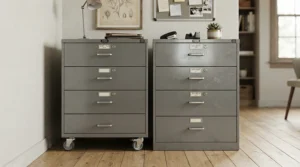
Here’s the short version. A fixed pedestal is part of the desk structure. It doesn’t roll, and it can’t be removed without taking the workstation apart. A mobile pedestal is a freestanding storage unit on casters. It rolls under the desk, beside your chair, or into another room. Mobile units give you flexibility. Fixed units give you a cleaner look and a slightly more planted feel.
That’s the trade, and everything else is detail. The detail matters, though. It covers whether you need a wheeled vs stationary pedestal, whether a pedestal with casters or without suits your flooring, how stability under load changes when a drawer is open, and which floor type considerations keep you from gouging your hardwood or fighting a thick carpet.
Most of the buying advice online comes from sellers describing their own catalogues. This guide takes a different route. It compares real specs, interprets what they mean in a Canadian home office or workplace, and points you to CCOHS guidance on purchasing ergonomic office furniture for the bigger picture. Seven real models follow, from budget to premium. A quick note on that: fixed pedestals usually come with the desk itself, so the products below are mobile units. Several can be run stationary on glides, so they work for both camps.
Quick Comparison: Mobile Pedestal vs Fixed Pedestal
| Factor | Mobile Pedestal | Fixed Pedestal | Best For |
|---|---|---|---|
| Movement | Rolls anywhere | Stays put with the desk | Mobile: shared or changing spaces |
| Stability feel | Good with locking casters; depends on anti-tilt design | Excellent; tied to desk frame | Fixed: heavy daily filing |
| Layout changes | Easy | Requires desk disassembly | Mobile: hot-desking, small homes |
| Look | Separate unit, may mismatch | Unified, built-in appearance | Fixed: executive-style setups |
| Replacing or upgrading | Swap in minutes | Harder to replace independently | Mobile: growing needs |
| Typical cost route | Bought separately | Included with or specified with desk | Depends on desk choice |
Read the table as a decision about what your room will do over the next five years, not just today. If your office layout is likely to change (new roommate, standing desk, a move across town), the mobile pedestal’s independence is worth far more than the slightly cleaner look of an integrated unit. If your desk is a permanent installation in a dedicated study, the fixed pedestal’s rigidity and tidy lines make a strong case. Both approaches store paper well. They differ in how they live in your space.
💬 Just one click — help others make better buying decisions too!😊
What Is a Mobile Pedestal vs Fixed Pedestal?
A mobile pedestal is a self-contained, freestanding drawer unit on casters, usually about 15–18 inches (38–46 cm) wide, 20–24 inches (51–61 cm) deep and 27–28 inches (about 69–71 cm) tall with casters fitted. A fixed pedestal is built into or attached to the desk structure, has no wheels, and moves only when the whole desk does. Mobile units suit flexible layouts, while fixed units suit permanent workstations.
That’s the definition. The practical reality has one more wrinkle: many mobile pedestals can be converted. Commercial units often use standard stem casters that can be swapped for fixed glides, which turns a rolling cabinet into a stationary one. Some products (like the Desky 3 Drawer Mobile Filing Cabinet, covered below) are even sold with optional levelling glides for exactly this reason.
Think of it as a spectrum, not a binary. A rolling unit with locked casters sits near the “fixed” end. A glide-mounted unit with no wheels sits almost on it. The real question is how much freedom you want to keep in reserve. For additional Canadian context on how furniture choices connect to workplace health, the Government of Canada’s ergonomics overview explains how departments approach it.
Top 7 Mobile Pedestals: Expert Analysis
Seven real models are covered below, spanning budget, mid-range and premium. Prices are shown as ranges in Canadian dollars at the time of research. Check current prices and availability before you buy, since listings change often. Review sentiment is summarized only where it could be verified, and I’ve said so where it couldn’t.
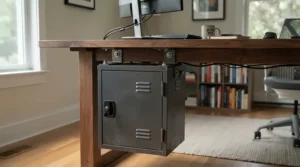
1. Mount-It! Slim 3-Drawer Mobile File Cabinet — slimmest fit for tight desks
Its narrow profile is the whole pitch. If your knee space is limited (a leaning desk or a compact home-office table), a slim body leaves you more room for legs and chair wheels. It’s built for under-desk storage with a lock and three drawers, sized for legal documents.
In practice, slim cabinets trade some capacity for fit, and that trade is usually worth it for personal storage. Think pens, a handful of files and a charger drawer, not a full archive. Verified reviewer comments (some of which were collected as part of a promotion, so weigh them accordingly) describe it as well made, tidy under a desk and easy to match with a modern look.
Pros:
- ✅ Slim body saves knee and chair room
- ✅ Locking drawers for basic privacy
- ✅ Modern look blends with light desks
Cons:
- ❌ Lower capacity than full-depth units
- ❌ Limited long-term review data
Price: roughly in the C$100–C$250 range depending on retailer. Value verdict: a smart pick if space is your bottleneck.
2. Desky 3 Drawer Mobile Filing Cabinet — five-wheel base with optional glides
The five-wheel design is the headline. A fifth support wheel in the centre spreads weight and resists tipping when a drawer is hauled open. That matters more than any cosmetic feature on this list. It also ships with a soft-close top drawer, rounded corners (kind to shins) and a single key for all three drawers.
Desky states that the unit can run on casters or sit stationary using optional levelling glides, which makes it the cleanest answer to the pedestal with casters or without question. Sellers describe a high-strength steel frame and a five-year warranty. I could not verify a large pool of independent buyer reviews, so treat feel-based claims as the manufacturer’s.
Pros:
- ✅ Five-wheel base for steadier drawer pulls
- ✅ Casters or glides in one product
- ✅ Soft-close top drawer, rounded edges
Cons:
- ❌ Fewer independent reviews to cross-check
- ❌ Steel build adds weight when moving
Price: around the C$300–C$350 range at the time of research. Value verdict: strong mid-range value if you want flexibility.
3. Bowery Hill 3 Drawer Mobile Pedestal — laminate look to match many desks
Laminate pedestals exist to match a desk, and this one comes in a mocha cherry finish designed to sit under a coordinating desk shell. The file drawer takes letter, legal or A4 files on full-extension ball-bearing slides, and one lock secures the bottom two drawers.
Full extension is underrated. It lets you reach the back of a deep drawer without leaning in and awkwardly reaching around the lip, which is where files get crumpled. The two box drawers use three-quarter-extension slides, so they won’t open fully, which is fine for pens and sticky notes. The retailer listing I found carried a modest seller rating, and I couldn’t find enough product-specific reviews to summarize.
Pros:
- ✅ Full-extension file drawer reaches the back
- ✅ Single lock secures the bottom two drawers
- ✅ Matches wood-toned desks
Cons:
- ❌ Box drawers only three-quarter extension
- ❌ Particleboard-style laminate is heavier on humidity
Price: roughly the C$200–C$350 range. Value verdict: good for aesthetics-first buyers.
4. Scranton & Co 3 Drawer Mobile Pedestal — dual-wheel hooded casters
The distinctive part is the dual-wheeled, hooded casters. Hooding keeps hair and threads from wrapping the axle, a quiet maintenance win in a home with pets. The drawer layout repeats the familiar pattern: two box drawers on top, a full-extension file drawer below, and one lock for the bottom two.
It’s offered in several finishes, including mahogany and natural cherry, and the thermally fused laminate over engineered wood is typical for this category. Reading the spec honestly, this is a “match the desk” model rather than a “carry heavy loads” model. For a household that files occasionally, that’s perfect.
Pros:
- ✅ Hooded dual-wheel casters resist debris
- ✅ Several finish options
- ✅ Accepts letter, legal and A4 files
Cons:
- ❌ Engineered wood is less rugged than steel
- ❌ Independent review volume wasn’t verifiable
Price: roughly C$250–C$450. Value verdict: a sensible middle-of-the-road pick.
5. Flash Furniture HZ-CHPL01W Modern 3-Drawer Mobile Filing Cabinet — fully assembled steel unit
This one ships fully assembled, which is a bigger deal than it sounds. Flat-pack pedestals live or die by how carefully you tighten the corner hardware. A factory-assembled body removes that variable.
The listing shows about 54 lb (roughly 24.5 kg), a 21-inch (53 cm) depth, letter and legal compatibility, and a five-year limited warranty. Weight helps stability under load. A heavier base resists tipping when you pull a loaded drawer fully out. The trade-off is that you’ll feel that heft when it’s time to move it.
Pros:
- ✅ Arrives assembled and ready to use
- ✅ Heavier body improves planted feel
- ✅ Five-year limited warranty
Cons:
- ❌ Not fire-resistant
- ❌ Heavy to lift on stairs
Price: around the C$500–C$650 range at the time of research. Value verdict: pricey, but defensible for a daily-use office.

6. Flash Furniture HZ-AP53501BK Ergonomic 3-Drawer Mobile Filing Cabinet — inset handles and an anti-tilt design
This model’s ergonomic pitch is inset handles (no snagged sleeves, no loosening handle screws) paired with a stated anti-tilt mechanism in one variant. Anti-tilt matters because it limits how many drawers open at once, which is the main way a loaded cabinet gets dangerous.
Specs from the retailer listing include about 16 inches wide by 21 deep by 24 high (roughly 41 × 53 × 61 cm) and about 52 lb (23.6 kg), with a vertical, lockable three-drawer layout. A 61 cm height slides under most standard desks, which commonly sit 73–76 cm off the floor, though always measure your own clearance with casters fitted.
Pros:
- ✅ Anti-tilt design on the specified variant
- ✅ Inset handles won’t snag clothing
- ✅ Compact height fits most desks
Cons:
- ❌ Premium pricing for the category
- ❌ Limited independent review data
Price: roughly the C$550–C$750 range. Value verdict: worth it if safety and daily filing top your list.
7. Safco Medina Mobile Pedestal MNBBFLDC — premium commercial-style build
Safco’s Medina pedestal sits at the premium end. Listed dimensions are about 26.8 inches high, 15.5 inches wide and 18 inches deep (roughly 68 × 39 × 46 cm), with three drawers (box, box, file) and rolling casters, plus a lifetime limited warranty per the retailer listing.
A lifetime warranty won’t change how the cabinet feels today, but it signals that the maker expects commercial-grade abuse. This is the one to consider for a shared workspace where drawers get opened hundreds of times a month. Availability looked inconsistent on the listing I found, so confirm stock before planning around it.
Pros:
- ✅ Lifetime limited warranty
- ✅ Commercial-style construction
- ✅ Compact footprint for the capacity
Cons:
- ❌ Highest price on this list
- ❌ Stock can be inconsistent
Price: around the C$700–C$800 range. Value verdict: a long-haul purchase, not a casual one.
Top 7 at a Glance
| Product | Key Spec | Approx. Price Range | Best For |
|---|---|---|---|
| Mount-It! Slim 3-Drawer | Slim body, locking | C$100–C$250 | Tight desks |
| Desky 3 Drawer Mobile | Five wheels, optional glides | C$300–C$350 | Flexible setups |
| Bowery Hill 3 Drawer | Full-extension file drawer | C$200–C$350 | Matching wood desks |
| Scranton & Co 3 Drawer | Hooded dual-wheel casters | C$250–C$450 | Households with pets |
| Flash Furniture HZ-CHPL01W | Fully assembled, ~24.5 kg | C$500–C$650 | Daily office use |
| Flash Furniture HZ-AP53501BK | Anti-tilt, inset handles | C$550–C$750 | Heavy filers |
| Safco Medina MNBBFLDC | Lifetime limited warranty | C$700–C$800 | Shared workspaces |
The pattern in the table is clear: you’re paying for mass, warranty and anti-tilt engineering as you climb the price ladder, not for extra drawers. The Desky 3 Drawer Mobile Filing Cabinet stands out for versatility, since it covers both mobile and stationary use. For a budget buyer, Mount-It! Slim 3-Drawer wins on space efficiency, though its capacity is limited. If you file heavily every day, the Flash Furniture HZ-AP53501BK and Safco Medina MNBBFLDC justify the premium.
Wheeled vs Stationary Pedestal: What Changes Day to Day
The wheeled vs stationary pedestal choice is really a question about how often your world moves. Wheels give you access: slide the cabinet beside your chair for a filing session, then tuck it away. Stationary placement gives you certainty: it won’t roll when you lean on it, and it never creeps away from the desk.
On paper, a wheeled unit with two locking casters behaves like a stationary one once parked. Industry guidance suggests at least two of the four casters should lock. The catch is that you have to remember to lock them. Many people don’t.
Stationary pedestals earn their keep in two situations: high-traffic areas where something might get bumped, and permanent workstations where a unified look matters. A rolling pedestal earns its keep in rented apartments, shared offices and any room that doubles as something else.
Here’s a counterintuitive point. Rolling units are often better for ergonomics, because you can position the drawers to match how you work instead of how the desk was designed. That’s the kind of fit the CSA Z412 office ergonomics standard is built around, even though the document focuses on chair setup.

Pedestal With Casters or Without: The Deciding Questions
Choosing a pedestal with casters or without comes down to four questions.
- Will the desk move? If yes, choose casters.
- Do you share the space? If yes, casters let you reclaim floor.
- Do you worry about tip-overs? Casters aren’t the problem, but a poorly designed base is. Look for anti-tilt features or a five-wheel base.
- Is your floor delicate? Hardwood and vinyl dislike hard plastic wheels. Rubber or soft-tread casters help, and glides with felt pads are safer still.
If you answered “no” to most of the first two and “yes” to the last, go without casters, either through a fixed pedestal or a mobile one fitted with glides. If you answered “yes” to the first two, stay on wheels and add caster cups or a mat for protection.
One more option many buyers overlook: swap the casters afterward. Replacing stem casters with glides is a common conversion on commercial units. It takes a few minutes and a wrench, and it lets one cabinet serve two different jobs across its life.
Stability Under Load: What the Spec Sheet Won’t Tell You
Stability under load is where pedestals separate into “fine” and “frightening.” A cabinet with a heavy file drawer pulled fully open shifts its centre of gravity forward. If the base is narrow, light or on soft casters, it can tip.
Fixed pedestals sidestep this. Because they’re tied into the desk frame, their weight is shared with the whole workstation. Mobile pedestals have to solve it on their own, through mass, base width, anti-tilt mechanisms or a fifth stabilizing wheel.
Look at how the models above address this. The Desky 3 Drawer Mobile Filing Cabinet uses a five-wheel base. The Flash Furniture HZ-AP53501BK lists an anti-tilt mechanism. The Flash Furniture HZ-CHPL01W relies on its roughly 24.5 kg mass. The Mount-It! Slim 3-Drawer has the least inherent stability due to its slim body, so keep the bottom drawer light.
Practical rule: load heavy items (binders, reams of paper) in the bottom drawer, keep the top drawer for light supplies, and never open two file drawers at once on a unit without interlocks. If you’re buying for a workplace, consult your provincial occupational health and safety rules and your employer’s policy, and check any Canadian certification marks listed on the product. WorkSafe Saskatchewan’s office ergonomics resource is a decent starting point for the safety side.
Floor Type Considerations
Floor type considerations get ignored until the first scratch appears. Here’s how the main surfaces behave.
- Hardwood and laminate: hard plastic casters can scratch finishes. Choose soft-tread casters, a chair mat, or glides with felt.
- Low-pile carpet: most casters roll well. Check that locks still bite on soft surfaces.
- High-pile or thick carpet: wheels sink, and rolling feels like dragging. Glides or a rigid mat underneath helps.
- Vinyl and tile: smooth rolling, but hard casters can leave marks over time.
- Uneven concrete or basement floors: levelling glides matter more than wheels, because a wobbling cabinet is a tipping cabinet.
Which is better, mobile or fixed? On soft or uneven floors, fixed or glide-mounted usually wins. On hard, flat floors, wheels shine.
Another point: caster quality varies. Commercial-grade casters tend to be more durable than residential ones, and hooded designs such as the Scranton & Co 3 Drawer Mobile Pedestal collect less debris. If you have pets, long hair or thick rugs, that hooding earns its keep.
How to Choose Between a Mobile Pedestal and a Fixed Pedestal
Here’s a decision path you can follow in a few minutes.
- Measure the knee space. Note the height under your desk with room for casters (typically a few centimetres of clearance).
- Define your use. Occasional filing? Daily filing? Shared storage?
- Decide on mobility. Will the cabinet need to move? If not, a fixed pedestal or glides fit.
- Check the floor. Match casters or glides to your surface.
- Check load and stability. Prefer anti-tilt features or a five-wheel base for heavy files.
- Check security. A single lock securing the bottom drawers is common. Confirm it covers what you need.
- Review warranty and returns. Longer warranties signal stronger construction.
Each step narrows the field. Once you’ve got your answers, the choice usually becomes obvious. Check current prices before purchase and read recent reviews on the retailer page, because specs and availability change.
Practical Usage Guide: Setup and First-30-Days Tips
A pedestal is easy to set up and easy to set up badly. Here’s a quick routine.
Setup: Measure again before you unpack. Fit the casters or glides, level the unit on your actual floor, and test that it slides under the desk with the chair in position. Lock the casters. Open each drawer on its own to feel the slide action.
First-use tips: Load bottom-up. Heavy files go in the file drawer, light supplies in the top. Test the lock with the key before you rely on it, and store the spare key somewhere other than the lock itself.
Maintenance schedule:
- Monthly: Wipe the slides and casters, check for debris.
- Quarterly: Tighten hardware, check lock operation.
- Yearly: Inspect casters for wear, replace if cracked or flat-spotted.
Common mistakes in the first 30 days: overloading the top drawer, forgetting to lock the casters, and skipping the levelling step on an uneven floor. All are cheap to avoid and annoying to fix later.
Real-World Scenario: Three Buyers, Three Answers
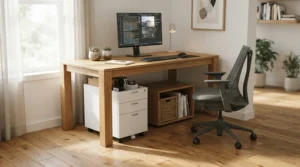
The condo remote worker (small room, hardwood floor, light filing). A compact desk and a rented space call for flexibility. The Mount-It! Slim 3-Drawer or the Desky 3 Drawer Mobile Filing Cabinet with glides suits this person. Budget around C$100–C$350, and use felt pads to protect the floor.
The home-based consultant (daily filing, carpeted study, permanent desk). Here, stability under load matters. The Flash Furniture HZ-AP53501BK with its anti-tilt mechanism or the Flash Furniture HZ-CHPL01W with its heavier body fits. A fixed pedestal built into the desk is also a legitimate answer, since the desk won’t move.
The shared studio (multiple users, frequent rearranging). Wheels are non-negotiable. The Safco Medina MNBBFLDC is the durable pick, and the Scranton & Co 3 Drawer Mobile Pedestal is the budget-friendly alternative with debris-resistant casters.
Three people, three setups, three different answers. That’s why a single “best” pedestal doesn’t exist.
Problem → Solution Guide
Problem: the pedestal drifts away when I pull a drawer. Lock at least two casters, or switch to glides. If the unit still shifts, check that the floor is level.
Problem: it scratches my hardwood. Replace hard casters with soft-tread ones, or use a chair mat beneath the desk area.
Problem: it doesn’t fit under my desk. Measure clearance with casters installed. Swapping casters for glides can recover a few centimetres.
Problem: drawers jam or stick. Check the load, clean the slides and make sure the unit is level. A twisted base binds slides.
Problem: it feels tippy when loaded. Move heavy items to the bottom drawer, avoid opening multiple drawers at once, and consider a model with a five-wheel base or anti-tilt mechanism, like the Desky 3 Drawer Mobile Filing Cabinet or the Flash Furniture HZ-AP53501BK.
Most pedestal complaints trace back to either floor conditions or loading habits, not the cabinet itself. Fix those two and the unit usually behaves.
Common Mistakes When Buying a Pedestal
The usual errors, in rough order of how often they bite:
- Measuring the desk, not the clearance. The drawer unit needs to fit under with casters on.
- Ignoring the floor. Wheels that suit vinyl can struggle on thick carpet.
- Overlooking the lock. A lock that only secures some drawers might not cover what you store.
- Paying for drawers you won’t use. Three drawers cover most personal needs.
- Assuming “mobile” means “unstable.” A well-engineered mobile unit with locking casters is perfectly steady. A poor fixed one can wobble.
- Skipping the warranty. A five-year or lifetime warranty on a heavily used cabinet pays for itself.
The pattern behind these mistakes: people buy for the photo and forget the room. Always weigh how the pedestal will live in your space before you settle on how it looks in the listing.
Long-Term Cost and Maintenance
Cost per year of use tells a more honest story than sticker price. A budget unit in the C$100–C$250 range that lasts three years costs roughly C$35–C$85 annually. A premium unit around C$700 with a long warranty that lasts a decade lands near C$70 annually, with better stability along the way.
Mobile pedestals have a maintenance edge: casters and slides are replaceable parts, and a worn caster is a quick fix. Fixed pedestals are simple once installed, but replacing one independently of the desk is harder.
Hidden costs matter too. Floor protection (mats, felt pads) adds a small expense. Replacement keys or locks occasionally come up. Glide conversions are cheap but require a wrench and a few minutes.
If you plan to keep the pedestal through a move or redesign, the mobile route typically wins on total cost of ownership, because it can follow you. If it’s tied to a desk you’ll keep for a decade, fixed can be the leaner long-term choice.
FAQ
❓ Is a mobile pedestal less stable than a fixed pedestal?
❓ Can I remove the wheels from a mobile pedestal?
❓ What height should an under-desk pedestal be?
❓ Do mobile pedestals scratch hardwood floors?
❓ Are fixed pedestals better for heavy files?
Conclusion
The mobile pedestal vs fixed pedestal question isn’t about which type is “better.” It’s about matching storage to the way your space actually works. Pick mobile when your layout, desk or life is likely to change. Pick fixed when the workstation is permanent and a built-in look and rigid feel matter most.
In between sits a third answer many buyers miss: a mobile pedestal run on glides. The Desky 3 Drawer Mobile Filing Cabinet is built for exactly that flexibility. For slim spaces, the Mount-It! Slim 3-Drawer fits. For heavy daily use, the Flash Furniture HZ-AP53501BK and Flash Furniture HZ-CHPL01W offer more mass and, in one case, anti-tilt design. For commercial-grade durability, the Safco Medina MNBBFLDC is the long-haul pick, while the Bowery Hill 3 Drawer Mobile Pedestal and Scranton & Co 3 Drawer Mobile Pedestal give you decent mid-range options with desk-matching finishes.
Measure first, check your floor, think about stability under load, and decide whether you’d rather have a pedestal with casters or without. Do that and you’ll avoid the three-year regret.
✨ Ready to find the right fit?
Check current pricing and availability on the models above, and pick the pedestal that fits your desk, your floor and your habits.
Recommended for You
- 3 Drawer Pedestal: 7 Best Picks That Actually Fit (2026)
- Fireproof Filing Cabinet: 7 Best Picks For Canadians (2026)
- Metal Filing Cabinet: 7 Best Picks For Canadian Offices In 2026
Disclaimer: This article contains affiliate links. As an Amazon Associate, I earn from qualifying purchases. If you purchase products through these links, we may earn a small commission at no additional cost to you.
✨ Found this helpful? Share it with your friends! 💬🤗
