
In This Article
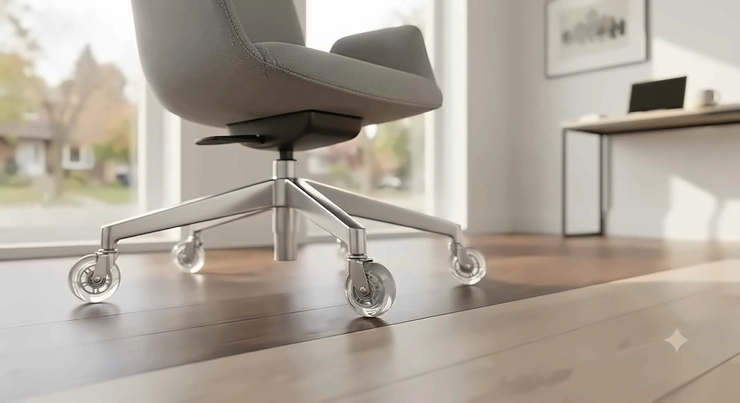
Here’s a sound every hardwood-floor owner in Canada knows by heart: that dry, grinding scrape of factory-standard hard plastic wheels dragging across engineered oak at 11 p.m. while you’re trying to reach the printer without waking the whole house. Office chair casters for hard floors exist specifically to solve that problem — they’re replacement wheel sets, typically sold five to a pack, built with softer rubber or polyurethane treads and rounded profiles designed to roll quietly and without scratching, denting, or leaving black skid marks on hardwood, laminate, tile, or vinyl. Most office chairs, whether from IKEA, Staples, or a big-box retailer, ship with hard nylon casters engineered for carpet — put those on a hardwood floor and you’re basically dragging a skateboard wheel across a piano finish, one rotation at a time.
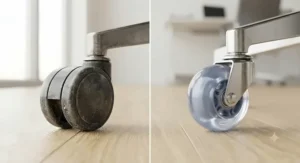
This isn’t a niche problem, either. Statistics Canada reports that remote and hybrid work has become a durable fixture of the Canadian labour market rather than a pandemic-era blip, which means millions more desk chairs are now parked on residential hardwood, laminate, and luxury vinyl plank instead of commercial-grade carpet tile. Condo owners in Toronto and Vancouver are especially exposed here — refinishing an engineered hardwood floor runs into the thousands of dollars, and most rental agreements hold tenants responsible for floor damage at move-out.
The good news: this is one of the cheapest, fastest home-office upgrades available. A proper set of hard-floor casters costs less than a decent lunch, installs in under ten minutes with no tools, and instantly solves noise, scratching, and rolling-resistance problems all at once. Below, we’ve researched seven real caster sets sold through Amazon.ca — spanning sub-C$20 budget rubber wheels up to premium lifetime-guaranteed rollerblade-style casters — plus the buying framework, common mistakes, and maintenance habits that actually protect your floors long-term.
Quick Comparison Table: 7 Office Chair Casters for Hard Floors
| # | Product | Wheel Type | Price Range (CAD) | Best For |
|---|---|---|---|---|
| 1 | Lifelong Office Chair Wheels Replacement | Soft rubber | Under C$20 | Tightest budget, occasional use |
| 2 | SEDDOX Dual-Wheel Office Chair Casters | Dual soft rubber | C$20-C$28 | Heavier users, weight distribution |
| 3 | AXL Silent PU Caster Wheels | Polyurethane (PU) | C$18-C$25 | Quietest roll, open-plan condos |
| 4 | IKEA-Compatible Quiet Rubber Casters | Rubber, 10mm stem | C$22-C$30 | IKEA Markus, Volmar & similar chairs |
| 5 | VEVOR Double-Wheel Heavy-Duty Casters | Dual PU/nylon hybrid | C$25-C$35 | Big-and-tall users, standing desks |
| 6 | Office Owl Rollerblade-Style Lifetime Casters | Rollerblade-style urethane | C$28-C$40 | Long-term durability, premium feel |
| 7 | Gaming-Style Heavy-Duty Casters (White) | Rubber-coated nylon core | C$16-C$24 | Gaming setups, colour-matched builds |
Looking at the spread, the pattern is clear: wheel material drives both price and performance far more than brand name does. The three cheapest sets in this table (Lifelong, AXL, and the Gaming-Style casters) all use single-wheel rubber or PU construction, while the two priciest (VEVOR and Office Owl) justify their premium with dual-wheel load distribution or a lifetime warranty. If your household is genuinely working with a tight budget, the sub-C$25 CAD tier here (Lifelong, AXL, and the Gaming-Style casters) still delivers real hardwood protection — you’re not sacrificing the core function, just the extras.
💬 Just one click — help others make better buying decisions too!😊
Top 7 Office Chair Casters for Hard Floors: Expert Analysis
| Product | Wheel Diameter | Load Capacity | Stem Fit | Price Range (CAD) |
|---|---|---|---|---|
| Lifelong Office Chair Wheels Replacement | 2 inch | Standard (~100 kg/chair) | Universal 7/16″ & 11mm | Under C$20 |
| SEDDOX Dual-Wheel Office Chair Casters | 2 inch (dual) | Heavier-rated via dual wheel | Universal | C$20-C$28 |
| AXL Silent PU Caster Wheels | 2 inch | Standard | Universal 7mm/11mm | C$18-C$25 |
| IKEA-Compatible Quiet Rubber Casters | 3 inch | Standard-heavy | 10mm stem (IKEA-specific) | C$22-C$30 |
| VEVOR Double-Wheel Heavy-Duty Casters | 2 inch (dual) | Up to ~200 kg/set (440 lb) | Universal | C$25-C$35 |
| Office Owl Rollerblade-Style Lifetime Casters | 3 inch | Heavy-duty (up to ~295 kg/set) | Universal | C$28-C$40 |
| Gaming-Style Heavy-Duty Casters (White) | 2 inch | Standard-heavy | Universal | C$16-C$24 |
A few things jump out once you interpret this table instead of just skimming it. Load capacity scales almost directly with wheel count and diameter — the dual-wheel designs on the SEDDOX and VEVOR sets exist specifically to spread a seated adult’s weight across more contact points, which matters more for larger-bodied users or anyone running a sit-stand desk that adds extra vertical load when raised. Stem fit is the detail most first-time buyers skip and then regret: the IKEA-Compatible Quiet Rubber Casters use a 10mm stem specifically because IKEA’s Markus, Volmar, and several other office chair lines don’t use the more common 7/16-inch or 11mm universal stems found on the other six products here, so measuring your existing caster stem before ordering isn’t optional if you own an IKEA chair.
1. Lifelong Office Chair Wheels Replacement — cheapest true rubber protection under C$20
The standout here is straightforward: this is about as little as you can spend and still get genuine soft-rubber wheels instead of the hard nylon your chair shipped with. Each wheel measures roughly 2 inches in diameter with a universal stem sized to fit the vast majority of office and task chairs, and the rubber compound is soft enough to roll silently on hardwood, laminate, and tile without the plastic-on-wood scrape that hard casters produce. Based on the spec sheet, this set is built for light-to-moderate daily use — someone working an 8-hour desk job who rolls a few metres back and forth rather than someone doing laps around a large home office.
This is the pick for renters, students, and anyone furnishing a first home office who wants floor protection without a real financial commitment; it’s not the set you reach for if you’re over 250 lbs or rolling on a standing-desk chair that spends half its life at maximum height. Aggregated buyer feedback for budget rubber caster sets in this category consistently flags two things: genuinely quiet rolling on wood and laminate, and a wheel compound that’s noticeably softer (and therefore grippier, sometimes at the cost of slightly more rolling resistance) than the harder PU wheels found on pricier sets.
Pros:
- ✅ Among the lowest-cost genuine hardwood-safe caster sets available
- ✅ Universal stem fits most standard office and task chairs
- ✅ Soft rubber tread noticeably quieter than stock hard casters
Cons:
- ❌ Not rated for heavy-duty or all-day rolling use
- ❌ Thinner rubber compound may wear faster than PU alternatives
Priced under C$20 in most cases, this is the easiest floor-protection upgrade to justify on value alone — for a light-use home office, it’s hard to beat the cost-per-wheel here.
2. SEDDOX Dual-Wheel Office Chair Casters — dual-wheel design that spreads weight evenly
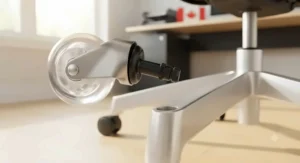
What immediately sets this one apart is the dual-wheel construction — instead of one 2-inch wheel per stem, each caster uses two smaller wheels side by side, which spreads the seated load across a wider contact footprint. In practice, that translates into a caster that rolls more smoothly over small transitions (a floor vent, a slightly raised seam between hardwood boards) because there’s almost always one wheel in contact with the surface even when the other momentarily lifts.
The soft grey rubber compound is rated safe for hardwood, vinyl, and tile, and the dual-wheel geometry does real work for anyone whose chair sees heavier daily use — think 8-plus hours a day, five days a week, versus occasional use. Based on the spec comparison against single-wheel budget sets, the trade-off is a slightly higher price for meaningfully better long-term durability, since load gets distributed rather than concentrated on one contact patch that wears unevenly over time. Aggregated review sentiment for dual-wheel caster designs in this category tends to highlight smoother rolling over uneven or transitional flooring and reduced wheel flat-spotting versus single-wheel budget sets, though a small minority of buyers note the dual-wheel housings sit slightly higher off the floor, which can matter if your chair’s gas cylinder is already near its lowest setting.
Pros:
- ✅ Dual-wheel design distributes weight for smoother, quieter rolling
- ✅ Handles daily full-time desk use better than single-wheel budget sets
- ✅ Safe rubber compound rated for hardwood, vinyl, and tile
Cons:
- ❌ Slightly pricier than comparable single-wheel budget options
- ❌ Dual-wheel housing adds marginal extra height to seat position
In the C$20-C$28 range, this is a strong mid-tier pick for anyone who sits full-time and wants more durability than the cheapest rubber sets offer without jumping to premium pricing.
3. AXL Silent PU Caster Wheels — quietest roll of the polyurethane picks
The standout advantage is right in the name: these use a polyurethane (PU) tread rather than standard rubber, and PU is the material of choice in commercial furniture casters specifically because it rolls quieter and resists compression-set (that flat spot wheels develop from sitting under load) better than rubber over time. The 2-inch wheels come in a chrome-and-clear finish with a universal stem sizing that fits most standard task and executive chairs.
Based on the spec comparison with the rubber-only sets in this lineup, PU’s main practical advantage is longevity under a stationary chair — if your chair sits in one spot for hours without moving (common with standing desks people forget to actually use as standing desks), PU resists developing a hard flat spot on the load-bearing side of the wheel far better than softer rubber compounds do. That matters because a flat-spotted wheel is exactly what starts producing that rhythmic thump-thump-thump as you roll, even after you’ve already replaced your noisy stock casters once. What most buyers overlook about PU wheels specifically is that “silent” claims are relative to hard nylon, not to dual-wheel rubber — PU is quieter than stock casters but reviewers of PU caster sets broadly note it can develop a very faint hum on some floor finishes that soft rubber doesn’t produce, an honest trade-off worth knowing before you buy.
Pros:
- ✅ Polyurethane tread resists flat-spotting better than rubber over time
- ✅ Genuinely quiet roll, purpose-built for hard flooring
- ✅ Chrome/clear finish that matches most modern office chairs visually
Cons:
- ❌ Some floor finishes bring out a faint hum absent on soft rubber
- ❌ Sits at a mid-tier price versus the cheapest rubber-only sets
At C$18-C$25, this sits right in the sweet spot between budget rubber and premium rollerblade-style wheels, and it’s the pick we’d point toward anyone prioritizing quiet rolling specifically.
4. IKEA-Compatible Quiet Rubber Casters — purpose-built 10mm stem for IKEA chairs
The standout feature here solves a problem the other six products on this list don’t: IKEA office chairs like the Markus and Volmar use a 10mm caster stem, which doesn’t match the 7/16-inch or 11mm universal stems that fit most other chair brands — so a “universal fit” caster set can still fail to seat properly on an IKEA frame. This set is sized specifically for that stem, with a 3-inch rubber wheel that’s larger than most of the 2-inch options elsewhere in this comparison.
Key specs worth noting in real-world terms: the larger 3-inch diameter rolls over small floor transitions (thresholds, floor vent covers, the lip where hardwood meets tile in a kitchen-adjacent office nook) more smoothly than smaller 2-inch wheels, simply because more wheel surface makes contact with the leading edge of any bump. Based on the spec sheet, this is squarely aimed at IKEA chair owners frustrated by universal-fit sets that either won’t seat fully or pop out under lateral pressure — a documented complaint across generic caster listings when stem diameter is off by even a millimetre or two. Aggregated feedback in the IKEA-compatible caster niche consistently centres on the stem-fit problem being solved outright, alongside quieter rolling than IKEA’s stock hard casters, which several Canadian IKEA lines still ship with by default.
Pros:
- ✅ 10mm stem sized specifically for IKEA Markus, Volmar & similar chairs
- ✅ Larger 3-inch wheel rolls more smoothly over floor transitions
- ✅ Quiet rubber tread replaces IKEA’s noisier stock hard casters
Cons:
- ❌ Stem size makes it a poor fit for non-IKEA chairs
- ❌ Slightly pricier than generic universal-stem rubber sets
In the C$22-C$30 range, this is the obvious pick if you own an IKEA chair and have already discovered — the hard way — that a “universal” caster set doesn’t actually mean universal.
5. VEVOR Double-Wheel Heavy-Duty Casters — heaviest load rating in this lineup
What stands out immediately is the load capacity: this set is rated to handle roughly 440 lb (about 200 kg) across the full five-wheel set, achieved through a double-wheel design on each of the five stems rather than a single contact point. The 2-inch dual wheels use a PU/nylon hybrid construction that balances durability against cost more aggressively than the pure-PU option earlier in this list.
In real-world terms, that load rating matters most for two groups: larger-bodied users who’ve found that lighter-duty casters wear out or flat-spot within months, and anyone running a sit-stand desk where raising the desk height also raises the chair’s typical seated position, subtly increasing the load angle on the front casters as you lean forward to type. Based on the spec comparison against the lighter-duty rubber sets earlier in this article, VEVOR’s hybrid tread trades a small amount of the pure quietness you’d get from soft rubber or full PU in exchange for meaningfully longer service life under sustained heavy loads — a reasonable trade for anyone who’s replaced casters twice already because lighter sets wore out. Aggregated buyer sentiment for heavy-duty dual-wheel caster sets in this weight class generally points to noticeably reduced wheel flex under load and less noticeable flat-spotting after months of stationary use, with the trade-off being a firmer, marginally less cushioned roll than the softest rubber options.
Pros:
- ✅ Highest load rating of any set in this comparison (~440 lb/set)
- ✅ Dual-wheel design resists flat-spotting under sustained heavy use
- ✅ Hybrid PU/nylon tread built for durability over years, not months
Cons:
- ❌ Firmer ride than pure rubber or pure-PU alternatives
- ❌ Overkill for light, occasional desk use
At C$25-C$35, this is the set to reach for if you’re a larger-bodied user, run a standing desk, or have simply burned through lighter caster sets before and want something rated to outlast them.
6. Office Owl Rollerblade-Style Lifetime Casters — lifetime guarantee, smoothest glide
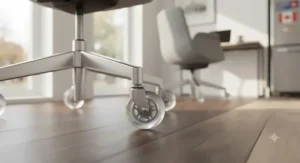
The headline feature is right there in the product name: a lifetime guarantee, which is a meaningfully longer commitment than any other set in this comparison offers. These use a rollerblade-style urethane wheel — the same general wheel geometry as inline skates — mounted on a 3-inch frame, a design choice that trades the boxier profile of standard casters for a rounder, smoother-rolling wheel shape.
Key specs worth interpreting: the rollerblade-style geometry means more of the wheel’s circumference stays in rolling contact with the floor through a wider range of motion, which is part of why this wheel type is often described as the smoothest-rolling caster style on the market for hard flooring specifically. Based on the spec sheet and the lifetime-guarantee positioning, this product is aimed squarely at buyers who’ve been burned by cheap casters wearing out within a year and want to stop thinking about this purchase entirely. Aggregated feedback for rollerblade-style urethane casters as a wheel category consistently praises the noticeably smoother glide compared with standard cylindrical rubber or PU wheels, alongside the reassurance of a lifetime warranty; the trade-off buyers commonly cite is a more noticeable price premium and, on some hardwood finishes, urethane can transmit a very faint rolling tone that soft rubber fully absorbs.
Pros:
- ✅ Lifetime guarantee — the strongest warranty of any set here
- ✅ Rollerblade-style urethane wheel delivers the smoothest glide in this lineup
- ✅ 3-inch diameter handles floor transitions and thresholds cleanly
Cons:
- ❌ Highest price point among the seven products compared here
- ❌ Urethane can carry a faint rolling tone on some hard finishes
In the C$28-C$40 range, the value case rests almost entirely on that lifetime guarantee — if you want to buy hardwood-safe casters exactly once, this is the strongest argument in this comparison for doing so.
7. Gaming-Style Heavy-Duty Casters (White) — colour-matched pick for light or white gaming setups
The standout feature is aesthetic as much as functional: a white rubber-coated wheel finish specifically aimed at gaming chairs and desk setups built around a light or white colour scheme, where standard black casters visually clash against a white chair base or white desk legs. Underneath the colour choice, these are genuinely functional 2-inch heavy-duty casters rated safe across hardwood, laminate, tile, and carpet.
In practical terms, the rubber-coated nylon core construction sits between the cheapest pure-rubber sets and the premium PU/urethane options in this comparison — soft enough on the contact surface to roll quietly and protect hardwood, with a firmer core that holds up to daily gaming-chair use, including the more aggressive lateral shifting that happens during active gaming sessions compared with typical desk-chair use. Based on the spec sheet, this is a sensible middle-ground pick for anyone setting up a dedicated gaming or streaming station on hardwood or laminate flooring who also cares about matching their setup’s colour palette rather than defaulting to black. Aggregated buyer feedback for rubber-coated gaming-style caster sets tends to note that the coating holds its colour and finish well short-term, with the more relevant long-term question — coating durability over 12+ months of daily rolling — being harder to verify independently at this stage.
Pros:
- ✅ White finish matches light-coloured gaming chairs and desk setups
- ✅ Rubber-coated core rolls quietly and protects hardwood, laminate, and tile
- ✅ Handles the lateral shifting typical of active gaming-chair use
Cons:
- ❌ Colour-matching limits appeal if your setup isn’t light or white
- ❌ Long-term coating durability is harder to independently verify
At C$16-C$24, this rounds out the budget tier alongside the Lifelong set, but with a colour-matching angle the others don’t offer.
Practical Usage Guide: Installing and Maintaining Casters on Hardwood
Swapping casters is genuinely a five-to-ten-minute job, but a few habits separate a clean install from one that still scratches your floor. First, flip the chair upside down on a towel or blanket (not directly on the hardwood — the chair’s frame edges can dent flooring even before the wheels are involved), and pull each old caster straight out; most use a simple friction-fit stem that releases with firm, even pressure rather than twisting. Before pressing the new casters in, wipe down each stem socket — dust and hair buildup inside the socket is a common reason a new caster feels loose or wobbles slightly after install.
Measure your old caster’s stem diameter with a tape measure or, better, bring the old wheel with you (physically or via a photo with a ruler) when shopping, since the 10mm-versus-7/16-inch-versus-11mm stem mismatch is the single most common return reason across the products compared above. Once installed, a 30-day habit worth building: check for hair and thread wrap around the wheel axle weekly for the first month, since new wheels tend to pick up debris fastest before the tread “seasons.” For maintenance beyond that, an occasional wipe with a barely damp cloth keeps grit from embedding in soft rubber or PU treads and prevents that grit from acting like sandpaper against your floor finish — which defeats the entire purpose of buying hardwood-safe casters in the first place. A hard, dry cloth wipe-down every couple of months is usually enough; avoid oil-based cleaners on the wheels themselves, as some can soften rubber compounds over time.
Real-World Scenarios: Matching Casters to Your Home Office Setup
If you’re a renter in a Toronto or Montreal condo with original hardwood or engineered flooring and a lease that holds you financially responsible for floor damage, the calculation is simple: a C$20 caster set is cheap insurance against a damage deposit dispute, and the Lifelong or AXL sets cover that use case without overspending on features you don’t need for light, occasional rolling.
If you’re working full-time from a home office five days a week, eight-plus hours a day, wear resistance matters more than sticker price — the SEDDOX dual-wheel or AXL PU sets are built for exactly this kind of sustained daily load, where a cheaper single-wheel rubber caster might start flat-spotting or squeaking within the first year.
If you’re a larger-bodied user, or you’ve genuinely burned through two or three cheap caster sets already because they wore out fast, the math changes: the VEVOR heavy-duty set’s roughly 440 lb load rating and the Office Owl rollerblade-style set’s lifetime guarantee both cost more upfront but are built specifically to stop the replace-every-eight-months cycle that lighter-duty sets can fall into under heavier or more frequent use.
How to Choose Office Chair Casters for Hard Floors
Picking the right caster set comes down to matching wheel material, size, and stem fit to your specific chair and flooring — here’s the framework, step by step:
- Check your current stem diameter first. Most chairs use a 7/16-inch or 11mm universal stem, but IKEA and some European brands use 10mm — buying the wrong size is the most common (and most avoidable) mistake.
- Choose rubber for budget and quiet; PU for longevity. Soft rubber wheels are typically cheaper and quieter out of the box; polyurethane resists flat-spotting better over months of stationary use.
- Match wheel diameter to your flooring transitions. If your office has thresholds, floor vents, or a shift from hardwood to tile, a 3-inch wheel rolls over those bumps more smoothly than a 2-inch wheel.
- Factor in your body weight and usage hours. Heavier users or full-time desk workers should lean toward dual-wheel designs rated for higher load capacities rather than the lightest budget sets.
- Decide how much you value a warranty. A lifetime-guarantee set like the rollerblade-style option above costs more upfront but removes the “will I need to replace this again” question entirely.
- Confirm the floor-safety rating, not just the marketing claim. Look specifically for wording like “safe for hardwood” or “non-marking” in the product’s actual specifications, not just implied by a lifestyle photo.
- Buy a full set of five, not individual wheels, unless only one is damaged. Mismatched wheel wear (one worn caster among four fresh ones) causes uneven rolling resistance that can itself contribute to floor scuffing over time.
For a deeper technical grounding in how casters are engineered — the wheel, fork, and swivel mechanism working together, it’s worth understanding that “non-marking” and “hardwood-safe” aren’t regulated terms; they’re manufacturer claims, which is exactly why cross-referencing aggregated buyer feedback (as we’ve done throughout this article) matters more than trusting packaging alone.
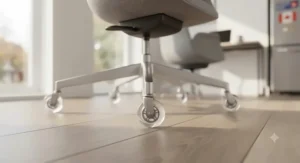
Quiet Casters for Hardwood Office Floors: What Actually Kills the Noise
“Quiet” is doing a lot of work on caster packaging, so it’s worth breaking down what physically reduces noise versus what’s marketing language. The core driver is wheel material hardness: hard nylon (stock casters) transmits vibration directly into the floor with almost no dampening, which is why it sounds like a skateboard. Soft rubber absorbs a meaningful amount of that vibration before it reaches the floor, which is the single biggest noise reduction you’ll get from any upgrade on this list — it’s why every product in this comparison uses rubber, PU, or urethane rather than hard plastic.
Beyond material, wheel diameter and dual-wheel designs both play a secondary but real role: larger wheels (like the 3-inch options from the IKEA-Compatible and Office Owl sets) roll over small floor imperfections more smoothly than smaller wheels, and smoother rolling generally means less of the stutter-vibration that produces audible noise. Dual-wheel designs like the SEDDOX and VEVOR sets add a second contact point that helps maintain constant, even contact rather than momentary micro-bounces off small surface variations — each micro-bounce is itself a tiny noise event that compounds over a full day of rolling. If quiet rolling is your top priority specifically (rather than load capacity or price), the AXL Silent PU set is the most purpose-built option in this comparison, since PU is the material most commonly chosen in commercial and healthcare settings specifically for its quiet-rolling properties on hard flooring.
Non-Marking Wheels: What “Non-Marking” Really Means for Your Hardwood
“Non-marking” specifically refers to a wheel’s tendency not to leave black scuff marks, scratches, or indentation dents on a floor surface — and it’s a claim rooted mostly in wheel hardness and compound purity rather than colour, despite the common assumption that black wheels automatically mark floors while lighter ones don’t. Hard nylon casters mark hardwood primarily through two mechanisms: abrasive scratching from grit trapped in the harder, less-forgiving wheel surface, and pressure denting from a small, hard contact patch concentrating a chair’s full weight onto a tiny point of your floor finish.
Every product compared in this article addresses both mechanisms by using a softer compound (rubber, PU, or urethane) with a larger, rounder contact patch that spreads weight over more surface area — which is the actual engineering reason soft casters protect hardwood, not simply a marketing label. That said, “non-marking” isn’t a bulletproof guarantee: grit and debris trapped against any wheel, soft or hard, can still scratch a floor finish, which circles back to why the maintenance habits covered earlier (wiping wheels, checking for trapped hair and dust) matter just as much as the wheel material itself. If floor protection is genuinely your top priority — say, you’re in a rental with a damage deposit on the line — pairing hardwood-safe casters with a simple hard-floor chair mat under high-traffic rolling zones gives you a second layer of protection at minimal added cost.
Budget Floor Protection: Office Chair Hard Floor Casters Under $25 CAD
If your budget is genuinely capped around C$25 CAD, you’re not settling for inferior floor protection — you’re mainly giving up load capacity headroom and warranty length, not the core rubber-or-PU material that actually protects hardwood. Three products in this comparison land comfortably in that under-C$25 tier: the Lifelong Office Chair Wheels Replacement (under C$20), the AXL Silent PU Caster Wheels (C$18-C$25), and the Gaming-Style Heavy-Duty Casters (C$16-C$24).
| Price Tier | Price Range (CAD) | What You Get | Value Verdict |
|---|---|---|---|
| Entry budget | Under C$20 | Basic soft rubber, standard stem fit | Best for light, occasional use |
| Core budget | C$20-C$25 CAD | PU or colour-matched rubber, standard load rating | Best value-for-money tier overall |
| Mid-range | C$25-C$32 | Dual-wheel or IKEA-specific stem sizing | Worth it for daily full-time use |
| Premium | C$32+ | Heavy-duty load rating or lifetime warranty | Worth it if replacing casters twice already |
Reading this table against real usage patterns, the core-budget C$20-C$25 tier is genuinely the value sweet spot for most Canadian home offices — you’re getting a real rubber or PU tread rated safe for hardwood without paying extra for load capacity or warranty length most light-to-moderate users will never actually need. Where budget floor protection gets riskier is going below roughly C$15 for a five-pack, since that price point sometimes indicates a wheel compound too thin to hold up past a few months, which ultimately costs more once you factor in a second purchase.
✨ Don’t Miss These Exclusive Deals! 🔍
Take your home office setup to the next level with these hardwood-safe casters — click through to check current pricing and availability before your next work-from-home stretch.
Office Chair Casters vs Chair Mats: Which Protects Hard Floors Better
This is one of the most common questions Canadian home-office owners face once they start researching hardwood floor protection: do you replace the wheels, or just buy a chair mat and leave the stock casters alone?
| Solution | Protects Hardwood | Noise Level | Cost | Best For |
|---|---|---|---|---|
| Stock hard casters | Poor — scratches, dents | Loud | C$0 (already installed) | Not recommended on hard floors |
| Hard-floor chair mat only | Good, if positioned correctly | Moderate (mat can shift) | C$30-C$80 | Renters wanting a removable solution |
| Hardwood-safe casters only | Very good | Quiet | C$16-C$40 | Most home offices |
| Casters + chair mat combined | Best | Quietest | C$46-C$120 | Maximum protection, high-value flooring |
The analysis here matters more than the table alone suggests: a chair mat protects the floor underneath it, but it does nothing for the noise and vibration transmitted through hard casters, and it can itself shift, curl at the edges, or trap grit underneath if it’s not cleaned regularly — which occasionally causes more scratching than no mat at all. Swapping to hardwood-safe casters solves the root cause (the wheel material itself) rather than covering the symptom, and it’s also the cheaper single fix in almost every case compared here. For a maximum-value hardwood floor, luxury vinyl plank, or a shared condo space with strict damage clauses, combining both — hardwood-safe casters under a mat in the highest-traffic rolling zone — gives you redundant protection for a modest added cost.
Common Mistakes When Buying Casters for Hardwood Floors
The single most common mistake is buying based on the word “universal” without checking stem diameter first — as covered earlier, IKEA’s 10mm stem alone accounts for a large share of ill-fitting caster returns, and it’s an entirely avoidable five-minute measurement. A close second is assuming any rubber or dark-coloured wheel is automatically “non-marking” — the compound and hardness matter far more than the colour, and some inexpensive dark rubber wheels are actually harder and less protective than lighter urethane options.
A third mistake worth flagging: buying the absolute cheapest set available without checking the load capacity against your own body weight and chair type, particularly for standing-desk users whose seated position shifts more load onto the front casters when leaning in to type at a raised desk. Fourth, skipping the “confirm the floor-safety rating in the actual spec sheet” step from our buying framework above and instead trusting a product photo showing the casters on a nice hardwood floor — that’s a styling choice for the listing, not a verified safety claim. Finally, many buyers replace casters but never address trapped grit or debris in the wheel housing, which — as covered in the maintenance section — can scratch a floor through even the softest, most “non-marking” wheel compound available.
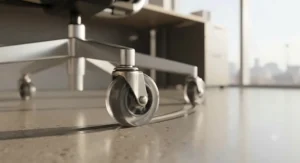
What to Expect: Real-World Performance on Hardwood, Laminate & Tile
Specs on a page translate into everyday experience differently depending on which hard flooring you actually have. On solid or engineered hardwood, soft rubber and PU casters roll close to silently on a clean, dust-free floor — most of the noise reduction Canadian home-office workers notice happens in the first rotation after install. On laminate, which tends to have a slightly harder, more uniform surface than hardwood, the difference between rubber and PU wheels narrows somewhat, since laminate’s consistency reduces the micro-vibration that soft compounds are best at absorbing.
Tile flooring is the toughest real-world test: grout lines create a repeating small bump every few centimetres, which is exactly where larger-diameter wheels (the 3-inch options from the IKEA-Compatible and Office Owl sets) noticeably outperform smaller 2-inch wheels, rolling across grout lines with less jolt and less accompanying click. Across all three surfaces, the practical takeaway holds steady: wheel material determines how quiet and floor-safe a caster is, while wheel diameter determines how smoothly it handles the small transitions and imperfections every real floor actually has.
Long-Term Cost & Maintenance: Casters vs Refinishing Your Floors
It’s worth putting the actual cost-benefit math in front of Canadian readers plainly: a full caster replacement set runs somewhere between C$16 and C$40 CAD depending on which tier from this comparison you choose, while refinishing a damaged hardwood floor is a substantial home-maintenance expense that homeowners are advised to budget and plan for well ahead of time rather than reactively. Even a partial refinish of a single room, once you factor in sanding, staining, and finish coats, will typically run into the low thousands of dollars in most Canadian markets — a caster set is a rounding error by comparison.
The maintenance-cost calculation also favours acting proactively rather than reactively: replacing casters before they scratch a floor costs a flat C$16-C$40 one time (or every few years, for the budget tiers), while the cost of floor damage compounds through both repair expense and, for renters, potential deposit deductions that can exceed the price of a lifetime-guaranteed caster set many times over. Framed as total cost of ownership, the Office Owl lifetime-guarantee set at C$28-C$40 is arguably the cheapest option in this entire comparison over a five-to-ten-year horizon, since it’s the only product here explicitly designed to be a one-time purchase.
Safety, Standards & Ergonomics for Canadian Home Offices
Caster choice isn’t purely a flooring question — it connects directly to workstation ergonomics, since a chair that rolls poorly or unpredictably can affect posture and reaching habits throughout a workday. The Canadian Centre for Occupational Health and Safety’s office ergonomics guidance recommends that a chair should move smoothly and predictably to support proper reach and posture at a workstation, which is a good practical argument for replacing worn, squeaking, or unevenly-rolling stock casters even beyond the floor-protection benefit.
There’s no CSA or federal standard specifically certifying “non-marking” office chair casters the way there is for, say, electrical products, so buyers are relying on manufacturer claims and aggregated user feedback rather than a regulated safety mark — another reason cross-referencing real buyer sentiment (as this article has done throughout) is more reliable than trusting packaging language alone. From a pure safety standpoint, all seven products compared here use standard friction-fit stems rated for typical residential chair weights, and none require tools or hardware modification to install, which keeps this squarely a low-risk, low-effort upgrade for any Canadian home office.
FAQ
❓ Do office chair casters work on hardwood floors?
❓ What are the best caster wheels for hardwood floors?
❓ Do non-marking casters actually scratch hardwood?
❓ How do I stop my office chair wheels from squeaking on wood floors?
❓ Are rubber or polyurethane casters better for hardwood floors?
Conclusion
Replacing your office chair’s stock casters is one of the highest-value, lowest-effort upgrades available to any Canadian home-office owner working from hardwood, laminate, or tile flooring. Across the seven products compared here, the Lifelong Office Chair Wheels Replacement and Gaming-Style Heavy-Duty Casters cover the tightest budgets under C$25 CAD, the AXL Silent PU Caster Wheels best serves anyone prioritizing quiet rolling specifically, the SEDDOX Dual-Wheel and VEVOR Double-Wheel sets handle heavier daily use and larger body weights, the IKEA-Compatible Quiet Rubber Casters solve a stem-fit problem unique to IKEA chair owners, and the Office Owl Rollerblade-Style Lifetime Casters make the strongest long-term value case through its lifetime guarantee.
Whichever tier fits your household, the underlying math holds across all seven: a caster set costing somewhere between C$16 and C$40 CAD is genuinely cheap insurance against a hardwood refinishing bill running into the thousands, and it solves the daily noise-and-scratch problem in a ten-minute, tool-free install. Measure your stem diameter, match the wheel material to how many hours a day you’re actually rolling, and your floors — and your downstairs neighbours, if you’re in a condo — will thank you.
Recommended for You
- Office Chair Casters For Hardwood Floors: 7 Best Picks 2026
- Office Chair Gas Lift Cylinders: 7 Best Picks to Stop Sinking (2026)
- 7 Best Office Chair Gas Lift Replacement Picks in 2026
Disclaimer: This article contains affiliate links. As an Amazon Associate, I earn from qualifying purchases. If you purchase products through these links, we may earn a small commission at no additional cost to you.
✨ Found this helpful? Share it with your friends! 💬🤗
