
In This Article
Somewhere in your home or office there’s a drawer that holds more risk than your laptop does. It has a signed lease, a tax return, an employee’s Social Insurance Number, maybe a client’s medical note. A lockable filing cabinet for confidential documents is the unglamorous fix, and it’s one of the few security upgrades that costs less than a good office chair.
What Is a Lockable Filing Cabinet for Confidential Documents?
A lockable filing cabinet for confidential documents is a drawer-based storage unit, usually steel, that holds hanging folders behind a key lock. Better models add a central locking bar that secures every drawer with one turn, plus interlock and anti-tip features so private paperwork stays out of casual reach and the cabinet stays upright.
Yes, the filing cabinet is one of the office’s most stubborn survivors. Digital storage was supposed to kill it. It didn’t, because paper contracts, original signatures and legacy records keep showing up.
A quick note on method. I haven’t hauled these cabinets through my own office, so you won’t find invented “I tested it” stories here. This guide is built from published specs, retailer listings and aggregated buyer feedback, and it tells you plainly where review data is thin. You’ll get seven real options, honest analysis of what each spec means in practice, and a plan for matching a cabinet to your actual risk. Grab a coffee. Your paperwork is about to get a bodyguard.
Quick Comparison: 7 Lockable Cabinets at a Glance
| Product | Type | Lock Style | Price Range (CAD) | Best For |
|---|---|---|---|---|
| Vinsetto 3-Drawer Mobile Filing Cabinet | Under-desk vertical, steel | Key lock, two keys | C$200–C$300 | Tight home offices |
| HOMCOM 3-Drawer Vertical Cabinet with Lock | Mobile vertical | Central lock | Budget tier; check current price | Shared small spaces |
| Hirsh 25-Inch Deep 2-Drawer Letter Vertical | Commercial vertical | Key lock | C$300–C$400 | A first proper cabinet |
| Hirsh 30-Inch 2-Drawer Lateral | Lateral | Key lock, both drawers | C$450–C$750 | Credenza-height storage |
| HON 510 Series 4-Drawer Vertical Letter | Full-height vertical | One-key, core-removable | C$650–C$1,000 | Growing small businesses |
| Lorell Fortress Series 3-Drawer Lateral | Lateral, 36 in | Core-removable plus locking bar | Premium; check current price | Multi-user offices |
| Hirsh HL8000 Series 3-Drawer Lateral | Lateral combo | Central lock, drawers and door | Roughly C$1,800+ | Maximum lockdown |
Ranges are indicative. They come from 2026 retailer listings, with US listings converted to CAD, so confirm the current price before you commit. Looking at the table, the Vinsetto 3-Drawer Mobile Filing Cabinet and HOMCOM 3-Drawer Vertical Cabinet with Lock win on price and footprint, while the HON 510 Series 4-Drawer Vertical Letter is where durability really starts. Budget buyers should note that the cheapest models trade steel thickness and warranty length for their low price. If anyone besides you will touch the cabinet, the central-lock designs deserve a hard look.
💬 Just one click — help others make better buying decisions too!😊
Top 7 Lockable Filing Cabinets for Confidential Documents: Expert Analysis
Each pick below follows the same logic: what the spec means, who it suits, and what buyers report.
1. Vinsetto 3-Drawer Mobile Filing Cabinet (924-007BK) — best compact pick for tight desks
The headline here is footprint. At about 39 × 48 × 59 cm (15.4 × 18.9 × 23.2 in), it slides under a desk and doubles as a printer stand, which is where most home-office paperwork lives anyway.
Retailer listings rate each drawer at roughly 15 kg and the whole unit at 50 kg. That’s about six reams of paper per drawer, enough for an active client folder system but not an archive. The bottom drawer takes hanging files in letter, legal or A4, and the unit ships with two keys.
Based on the spec comparison, this is a privacy cabinet rather than a security cabinet. Light cold-rolled steel (around 19.5 kg empty) and a rolling base mean a determined intruder simply wheels it away. For keeping paperwork from curious housemates, kids or visiting contractors, though, it does the job.
On reviews: the Canadian listing I checked shows a seller rating of 4.4 across roughly 1,500 reviews, but that describes the seller, not this cabinet. I can’t responsibly summarize product-specific sentiment from it.
Pros:
- ✅ Compact enough to tuck under a desk
- ✅ Takes letter, legal and A4 hanging files
- ✅ Two keys included in the box
Cons:
- ❌ Short 90-day limited warranty
- ❌ Lightweight, so easy to roll away
Price: around C$200–C$300. Verdict: fair value as a discreet privacy tier, not a security upgrade.
2. HOMCOM 3-Drawer Vertical Cabinet with Lock (836-301) — central locking on a budget
What stands out is the central locking system. One key secures all three drawers, so there’s no “I locked drawer one and forgot the others” moment, which is the most common human failure with confidential paperwork.
The listing describes three drawers, a roomy top surface and wheels. What it doesn’t publish, at least on the Canadian page I reviewed, is steel gauge or per-drawer weight limits. That’s a gap worth closing before you buy.
Here’s what to weigh: a central lock simplifies your routine, but it protects only as well as the lock mechanism and the drawer fronts behind it. Check whether the casters themselves lock, because a cabinet that rolls is a cabinet that leaves.
Buyer feedback is again seller-level. The Best Buy Canada marketplace listing shows a 4.5 seller rating across about 2,100 reviews. It’s a decent sign about shipping and service, but it tells you nothing about drawer glide quality. If buyer comments on your chosen listing mention misaligned drawers or lock wobble, treat that as the real signal.
Pros:
- ✅ Central lock handles every drawer at once
- ✅ Wheels make cleaning and rearranging easy
- ✅ Large top surface adds usable workspace
Cons:
- ❌ Limited published specs on steel and capacity
- ❌ Casters invite relocation unless locked
Price: budget tier, so check current price. Verdict: sensible for shared spaces if the specs check out.
3. Hirsh 25-Inch Deep 2-Drawer Letter Vertical File Cabinet — best first “real” cabinet
This is where cabinets start feeling like furniture instead of lunchboxes. Listings describe commercial-grade steel, aluminum handles and label holders, thumb-latch drawers and follower wires that keep folders upright. At roughly 38 × 64 × 72 cm (15 × 25 × 28 in), it holds a surprising amount.
The triple-tied ball-bearing suspension matters more than it sounds. Listings claim it performs better fully loaded, and that’s the test that sinks cheap slides: a drawer that glides empty and grinds at 15 kg.
Reviewers consistently describe the Hirsh vertical line as sturdy. One Sam’s Club listing shows 4.4 out of 5 across 87 ratings, with 68 per cent giving five stars. Complaints are small but telling: one buyer struggled with rails that arrived together in one drawer, and a buyer of the 22-inch-deep sibling found the lock installed but not engaged, with no instructions in the box. Lesson: test the lock on day one.
Pros:
- ✅ Heavier-duty slides that cope with full loads
- ✅ Thumb latches stop accidental drawer openings
- ✅ Strong reputation among verified buyers
Cons:
- ❌ Only two drawers of capacity
- ❌ Lock setup may need a quick check
Price: around C$300–C$400. Verdict: the best value-for-steel in this lineup.
4. Hirsh 30-Inch 2-Drawer Lateral File Cabinet — credenza-height filing that locks both drawers
Lateral cabinets trade height for width. At 30 inches (76 cm) wide, this one sits under a window or beside a printer and holds letter, legal and A4 hanging folders side to side. The listing says one lock secures both drawers, and the “101” variant adds an interlock so only one drawer opens at a time.
The interlock is the sleeper spec. Lateral cabinets have a reputation for tipping when two drawers are open, and an interlock removes that human-error risk.
Buyer feedback is mixed, and that’s worth saying out loud. One listing shows 4.7 across 30 ratings, while others show 3.3 across 7 and 2.8 across 6. Fans praise the steel over laminate alternatives and the pre-assembled delivery. Critics mention receiving only one set of rails for two drawers and a drawer that needed realigning. Small sample sizes, so read them as flags to check rather than verdicts.
Pros:
- ✅ Pre-assembled and ready to load
- ✅ Single lock secures both drawers
- ✅ Wide, low profile suits shared offices
Cons:
- ❌ Reports of missing rails on some listings
- ❌ Inconsistent ratings across sellers
Price: roughly C$450–C$750 depending on finish and seller. Verdict: worth it if you want lateral storage, provided you inspect on arrival.
5. HON 510 Series 4-Drawer Vertical Letter File Cabinet — one-key core-removable lock
The standout is the lock architecture. HON’s one-key interchangeable core-removable lock lets you key several cabinets alike, and re-key one without replacing the whole cabinet. For a growing office, that’s the difference between one key ring and a drawer full of keys.
The cabinet itself stands about 132 × 38 × 64 cm (52 × 15 × 25 in) in heavy-gauge steel with a baked-enamel finish. Listings highlight full-suspension drawers, a double-wall front kickplate, label holders and an adjustable wire follower. It meets ANSI/BIFMA standards, the North American benchmark for office furniture, and carries a lifetime warranty.
Based on the specs, this is where lockable filing cabinet for confidential documents shopping becomes a long-term investment. Four tall drawers do mean tip-over risk, so anchor it.
Sentiment is mixed but informative. One US retailer listing shows about 3.9 out of 5 across 77 reviews. Buyers praise smooth operation and one liked that it needs a key to lock, so you can’t accidentally lock your keys inside. A critical reviewer reported drawers dragging and refusing to close fully.
Pros:
- ✅ Core-removable lock lets you re-key easily
- ✅ Lifetime warranty on a heavy-gauge build
- ✅ Four drawers for serious capacity
Cons:
- ❌ Tall frame needs wall anchoring
- ❌ Some buyers report sticky drawers
Price: around C$650–C$1,000. Verdict: strong long-run value for businesses.
6. Lorell Fortress Series 3-Drawer Lateral File (36-Inch) — locking bar plus anti-tip engineering
Fortress lateral listings read like a safety checklist: a core-removable lock, a locking bar, an interlock that limits you to one open drawer, a counterweight, adjustable levelling glides and a reinforced base. The 36-inch, three-drawer layout measures about 91 × 48 × 102 cm (36 × 18.8 × 40.3 in) and uses hanging rails for letter, legal or A4 folders.
Why does that matter? A central locking bar is the mechanism that engages all drawers from one lock, and the anti-tip kit protects people, not just paper. Listings add GREENGUARD certification and roughly 28–30 per cent recycled content, which matters for offices with procurement policies.
Review volume is thin. One retailer shows five stars from three reviews, plus a Q&A confirming the central lock secures all three drawers. That’s encouraging but nowhere near enough to generalize. Treat this as a spec-driven choice, not a crowd-validated one.
Pros:
- ✅ Locking bar plus interlock plus counterweight
- ✅ Core-removable lock simplifies key management
- ✅ Environmental certifications for office buyers
Cons:
- ❌ Very few verified buyer reviews
- ❌ Premium price, and some listings are non-returnable
Price: premium; compare sellers carefully, since listings vary widely. Verdict: justified for multi-user offices.
7. Hirsh HL8000 Series 3-Drawer Lateral File Cabinet — one lock for drawers and door
This one is unusual. Listings describe a 30-inch (76 cm) lateral combo with one 12-inch file drawer, two 6-inch box drawers and a central lock that secures all three drawers and the door. That’s a cabinet designed to hold files and the small stuff, like cheque books, backup drives and corporate seals.
It also ships fully assembled, with hangrails, counterweight, four levelling glides and magnetic label holders included. The counterweight is the quiet hero, especially in lateral formats.
On paper, this is the closest thing to a one-key lockdown in the lineup. What the spec sheet won’t tell you is how the door latch feels after five years. I found no verified buyer reviews for this model, so I can’t speak to long-term durability. Be honest with yourself about whether your risk justifies paying premium money for an unreviewed unit.
Pros:
- ✅ One lock covers drawers and the door
- ✅ File and box drawers in one footprint
- ✅ Counterweight and levelling glides included
Cons:
- ❌ No verified review history to lean on
- ❌ Highest price in this guide
Price: roughly C$1,800 and up. Verdict: the choice for small offices that treat privacy as a line item.
Spec Scoreboard: How the Seven Compare
| Product | Size (cm) | Standards / Warranty as Listed | Review Picture | Best For |
|---|---|---|---|---|
| Vinsetto 3-Drawer Mobile Filing Cabinet | 39 × 48 × 59 | 90-day limited | Seller-level only | Under-desk privacy |
| HOMCOM 3-Drawer Vertical Cabinet with Lock | Not published | Not published | Seller-level only | Shared small spaces |
| Hirsh 25-Inch Deep 2-Drawer Letter Vertical | 38 × 64 × 72 | Commercial grade | Positive, sturdy | First serious cabinet |
| Hirsh 30-Inch 2-Drawer Lateral | 76 wide | Varies by listing | Mixed | Low-profile storage |
| HON 510 Series 4-Drawer Vertical Letter | 38 × 64 × 132 | ANSI/BIFMA; lifetime | Mixed to positive | Growing offices |
| Lorell Fortress Series 3-Drawer Lateral | 91 × 48 × 102 | ANSI/BIFMA; GREENGUARD | Too few to judge | Multi-user offices |
| Hirsh HL8000 Series 3-Drawer Lateral | 76 wide | Not published | None verified | Maximum lockdown |
Read the “Review Picture” column twice. The Hirsh 25-Inch Deep 2-Drawer Letter Vertical has the clearest positive record, while the Lorell Fortress Series 3-Drawer Lateral and Hirsh HL8000 Series 3-Drawer Lateral are bets on engineering rather than crowd wisdom. Anyone who wants proof before paying should lean toward the HON 510 Series 4-Drawer Vertical Letter or the Hirsh 25-Inch Deep 2-Drawer Letter Vertical.
Setup and First-30-Days Guide: Make Any Cabinet Safer Than It Ships
A cabinet is only as good as its first week. Here’s the sequence that matters.
Day one: test before you trust. Turn the lock with the door open, then closed, and tug every drawer. One buyer of a Hirsh vertical found the lock installed but unengaged, with no instructions. Better to find that now than during a break-in.
Level it, anchor it. Adjust the levelling glides until the cabinet doesn’t rock. Anything three drawers or taller should be anchored to a wall stud with a strap or anti-tip bracket, even when it has an interlock. Tip-over injuries are well documented in office-safety guidance, and they happen when two drawers are open at once.
Load bottom-up. Heavy files go low, lighter ones high. Open one drawer at a time, always.
Label by code, not by content. A drawer marked “Payroll: Smith, SIN” is a gift to a snoop. Use year or category codes and keep the key to them elsewhere.
Control the keys. Keep one working key on you and one in a separate secure place. Never leave a key in the top desk drawer. If you’ve got a core-removable lock, such as on the HON 510 Series 4-Drawer Vertical Letter or Lorell Fortress Series 3-Drawer Lateral, store the control key apart from the operating keys.
Month one maintenance. Wipe dust from slides and recheck the glides after your first full load. If a lock stiffens, use a lock-specific lubricant rather than household oil.
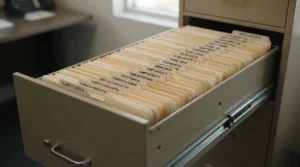
Real-World Scenarios: Three Buyers, Three Cabinets
The home-based bookkeeper. She works from a condo, handles clients’ T4s and bank statements, and has roughly C$350 to spend. The Canada Revenue Agency’s keeping-records guidance generally asks businesses to keep records for six years from the end of the last tax year they relate to, so she needs capacity and a retention routine. The Hirsh 25-Inch Deep 2-Drawer Letter Vertical fits her budget and footprint. She’d scan older years and shred them when the retention clock runs out.
The six-person physiotherapy clinic. Patient files, daily use, shared keys, and a front desk that stays open. The clinic’s staff open drawers dozens of times a day, so smooth suspension and an interlock matter. A HON 510 Series 4-Drawer Vertical Letter or Lorell Fortress Series 3-Drawer Lateral gives them core-removable locks and a re-keying path when someone leaves. Provincial health-privacy rules may add requirements beyond federal law, so they’d confirm with their regulatory college.
The freelance designer. Signed contracts, a few IDs, light weekly access, and a desk with a gap under it. The Vinsetto 3-Drawer Mobile Filing Cabinet is plenty. It keeps casual eyes away, and the real backup is a scanned copy in encrypted cloud storage.
Buyer’s Decision Framework: If You’re This, Choose That
Think of this as a quick triage. Start with what you’d lose, not what you’d like.
- If you need privacy, not fortress-grade security, and have under C$300 to spend: choose the Vinsetto 3-Drawer Mobile Filing Cabinet because it fits under a desk and costs little.
- If you share space and worry about forgetting to lock a drawer: choose the HOMCOM 3-Drawer Vertical Cabinet with Lock because one central lock covers everything.
- If you want sturdy, proven steel at a fair price: choose the Hirsh 25-Inch Deep 2-Drawer Letter Vertical because buyer feedback backs it.
- If you want wide, low storage that won’t tip: choose the Hirsh 30-Inch 2-Drawer Lateral and inspect the rails on arrival.
- If staff will come and go: choose the HON 510 Series 4-Drawer Vertical Letter because its core-removable lock allows re-keying.
- If safety engineering is a priority: choose the Lorell Fortress Series 3-Drawer Lateral because of its locking bar, interlock and counterweight.
- If you need to lock small valuables with your files: choose the Hirsh HL8000 Series 3-Drawer Lateral because one lock handles drawers and door.
Priorities, in order: sensitivity of the contents, number of people with access, floor space, budget. If you can’t rank those, start with sensitivity.
How to Choose a Lockable Filing Cabinet for Confidential Documents
Short answer: match lock type, build quality and size to the harm a leak would cause. Here are the steps.
- Measure your paper. Count linear centimetres of files and add 25 per cent growth. Buying small and upgrading twice costs more than buying right once.
- Pick vertical or lateral. Vertical saves floor area. Lateral saves wall height and suits credenza spots.
- Check the lock type. A single key lock is the baseline. A central locking bar or central lock covers every drawer, and a core-removable lock lets you re-key without replacing the cabinet.
- Look at the steel. Heavy-gauge steel with a baked-enamel finish beats thin, light units for anything truly sensitive.
- Demand anti-tip features. Interlock, counterweight and levelling glides turn a hazard into furniture.
- Verify standards and warranty. ANSI/BIFMA compliance and a lifetime warranty signal a manufacturer that expects the cabinet to last. A 90-day warranty signals the opposite.
- Read reviews critically. Separate seller ratings from product reviews, and weigh complaints about drawers and locks over complaints about shipping.
Filing Cabinet With Key Lock vs Central Locking Bar: Which Protection Is Real?
Let’s untangle this, because the terms get mashed together in listings.
A filing cabinet with key lock usually has one cylinder, often on the top drawer. Turn the key and a mechanism blocks every drawer from opening, or in cheaper units, only that one drawer. Always check, because that distinction sinks people. The baseline is fine for household privacy.
A central locking bar is a vertical steel member inside the cabinet that engages all drawers from one lock. When it works, you lock one thing, not four. Listings for the Lorell Fortress Series 3-Drawer Lateral specifically mention a locking bar, and the Hirsh HL8000 Series 3-Drawer Lateral and HOMCOM 3-Drawer Vertical Cabinet with Lock advertise a central lock.
Here’s the honest analysis: a central bar improves consistency far more than it improves resistance. It stops you forgetting a drawer. It doesn’t make thin sheet steel prying-proof. For a cabinet that holds a few client files, a filing cabinet with key lock is plenty. For a cabinet used by five people, the central locking bar earns its price. Either way, key control is the real security feature.
Pick-Resistant Locks: Marketing Label or Real Protection?
“Pick-resistant locks” sounds reassuring. It’s also an unregulated phrase on most product pages.
Here’s what the engineering literature actually says. In a pin tumbler lock, pins must align at a shear line, and a skilled person with tension and a pick can set them one by one. Patent filings note that wafer-tumbler locks, the cheaper type common in furniture, are typically less pick-resistant than pin-tumbler designs, and add features such as sidebars to compensate. One older patent background also observes that removable-core locks are usually not as pick-resistant as other pin-tumbler locks, which is a trade-off against their re-keying convenience.
Notice what’s missing from the listings I reviewed: no pick-resistance rating, no grade, no test standard. So the claim is something to verify, not trust.
Practical reasoning follows. A thief facing a cabinet is far more likely to pry the drawer front than to pick the cylinder. If you truly have documents that justify pick-resistant locks, treat the cabinet as one layer, and add a locked room, a safe, or an alarm. For everyday confidential paperwork, a decent lock plus good key habits beats a mystery marketing label.
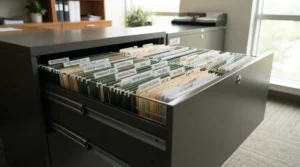
Secure File Cabinet for Private Records: What Canadian Privacy Law Expects
If you collect personal information in the course of business, a secure file cabinet for private records isn’t just good manners, it’s part of your compliance picture. Canada’s federal private-sector law, PIPEDA, applies to most organizations, with Quebec, British Columbia and Alberta running their own substantially similar regimes.
The Office of the Privacy Commissioner’s guidance on breaches of security safeguards explains that organizations must report breaches that pose a real risk of significant harm, notify affected individuals, and keep records of all breaches. Legal commentary on that guidance stresses that small businesses get no exemption.
Required safeguards cover physical, organizational and technological measures, scaled to how sensitive the information is. Privacy guidance regularly cites locked filing cabinets and restricted access as examples of physical measures. In practice, that means a cabinet that locks, a key log, and a rule about who can enter the room.
Here’s the useful reframe: you’re not buying a cabinet to satisfy a regulator. You’re buying evidence that you took reasonable steps. If something goes wrong, “locked cabinet, controlled keys, written policy” is a far better story than “it was in a drawer.”
Document Security for Small Business Records: A Layered Plan
Document security for small business records works like an onion. Each layer is flawed, but together they’re tough.
Layer 1: the room. A locked office door beats any cabinet lock. If you can only fix one thing, fix this.
Layer 2: the cabinet. This is where your choice from this guide lives. For most small businesses, a mid-tier model like the HON 510 Series 4-Drawer Vertical Letter or Hirsh 25-Inch Deep 2-Drawer Letter Vertical strikes the balance.
Layer 3: the keys. Write down who holds which key. Re-key, or swap the core on cores like the Lorell Fortress Series 3-Drawer Lateral, when staff leave.
Layer 4: the copies. Scan critical records to encrypted storage. A fire or flood is a bigger threat to most paper than a thief, and the listings I reviewed commonly flag these cabinets as not fire-resistant.
Layer 5: the end of life. Shred records once retention periods lapse. Keeping everything forever isn’t caution, it’s liability.
Treat the cabinet as the middle of the plan, not the plan.
Lockable Filing Cabinets vs Safes, Fireproof Boxes and Going Digital
| Option | Strength | Weakness | Best For |
|---|---|---|---|
| Lockable steel cabinet (e.g., HON 510 Series 4-Drawer Vertical Letter) | High capacity, everyday access | Typically not fire-rated | Daily-use confidential files |
| Fire-rated safe or file | Fire and theft protection | Costly and small capacity | Deeds, originals, key documents |
| Digital scan plus encryption | Searchable, backed up | Needs ongoing discipline | Long-term archives |
| Offsite records storage | Space-saving, managed | Ongoing fees, slower access | Large, old archives |
Notice the pattern: nothing wins on every axis. A lockable cabinet wins for convenience and capacity, which is why it remains the daily workhorse. A safe wins on fire and theft, but you won’t keep six years of invoices in one. Digital wins on search and backup, but originals with signatures still matter.
The sensible combination for most Canadian small businesses: a cabinet like the Hirsh 25-Inch Deep 2-Drawer Letter Vertical for current files, a small safe for irreplaceable originals, and encrypted scans for everything else.
Long-Term Cost and Maintenance: What Ownership Really Looks Like
Price tags lie by omission. Do the maths over years instead.
A C$350 cabinet that serves 15 years costs about C$23 a year. A C$1,000 cabinet that lasts 20 years comes to roughly C$50 a year. Add the warranty gap. Lifetime coverage, as listed for the HON 510 Series 4-Drawer Vertical Letter and Hirsh commercial lines, means a failed slide has a remedy. A 90-day limited warranty, as on the Vinsetto 3-Drawer Mobile Filing Cabinet, means you’re on your own after one season.
Then there’s re-keying. Cabinets with core-removable locks let you swap cores when staff change, instead of living with a key that walked out the door. That’s real money saved for any team larger than three.
Maintenance is modest: wipe dust off slides, check levelling glides after loading changes, re-test the lock every few months, and never overload upper drawers. Spend ten minutes a quarter and a good cabinet will outlast your lease.

FAQ: Lockable Filing Cabinets in Canada
❓ How much does a lockable filing cabinet for confidential documents cost in Canada?
❓ Can I add a lock to a filing cabinet that doesn't have one?
❓ Is a two-drawer or four-drawer cabinet better for a home office?
❓ Are standard filing cabinets fireproof?
❓ Should I choose a core-removable lock?
Conclusion: Lock Down the Paper, Not Your Life
Paper privacy isn’t about paranoia. It’s about reducing the number of ways a bad day can happen. The right lockable filing cabinet for confidential documents turns a loose drawer into a controlled system, and the best choice depends on your actual risk, not the shiniest spec.
Here’s the short version. The Vinsetto 3-Drawer Mobile Filing Cabinet and HOMCOM 3-Drawer Vertical Cabinet with Lock cover privacy cheaply. The Hirsh 25-Inch Deep 2-Drawer Letter Vertical and Hirsh 30-Inch 2-Drawer Lateral bring commercial-grade steel to a sane price. The HON 510 Series 4-Drawer Vertical Letter, Lorell Fortress Series 3-Drawer Lateral and Hirsh HL8000 Series 3-Drawer Lateral serve offices that want re-keying, locking bars and anti-tip engineering. Whichever you pick, test the lock on day one, anchor anything tall, control your keys, and keep scanned backups elsewhere.
Spend an hour on this and your future self will thank you, probably while calmly not panicking about a missing folder.
Recommended for You
- Lateral Vs Vertical Filing Cabinet: 7 Proven Picks For 2026
- 4 Drawer Filing Cabinet For Heavy-Duty Office Use: 7 Top 2026 Picks
- 3 Drawer Filing Cabinet: 7 Best Picks For Canada (2026)
Disclaimer: This article contains affiliate links. As an Amazon Associate, I earn from qualifying purchases. If you purchase products through these links, we may earn a small commission at no additional cost to you.
✨ Found this helpful? Share it with your friends! 💬🤗
