
In This Article
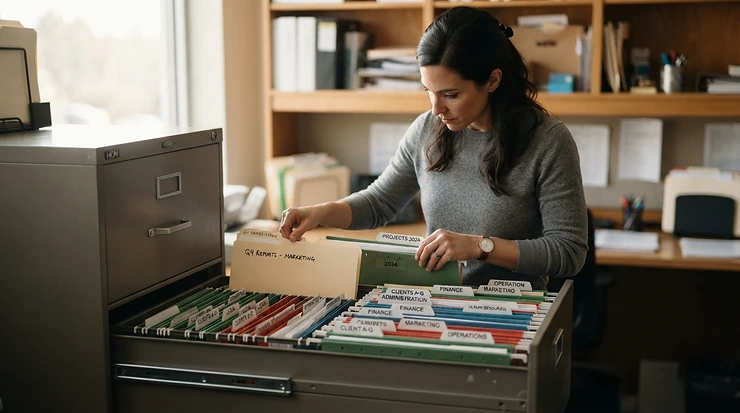
Nobody gets excited about a filing cabinet. Then the bottom drawer jams, the whole thing lurches forward when you yank the top one, and suddenly you’re an expert on steel gauge and suspension.
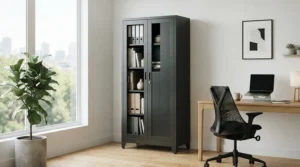
What is a 4 drawer filing cabinet for heavy-duty office use? It’s a tall, vertical steel cabinet with four full-height drawers sized for hanging folders. It pairs commercial-grade suspension with a lock and a reinforced frame built for daily loading. Unlike light-duty home units, it’s designed to carry real paper weight for years without sagging, binding or tipping.
That definition matters because the category is crowded with look-alikes. A 4 drawer filing cabinet for heavy-duty office use and a budget “home office” cabinet can share the same 52″ (132 cm) silhouette, and the humble filing cabinet has barely changed in a century. What changes is the suspension, the frame, the lock and the safety engineering hiding behind the paint.
This guide compares seven real models using published specs, then interprets what those numbers mean on a Monday morning with a full drawer. Everything here is based on manufacturer and retailer specifications. I haven’t handled these cabinets, so there are no hands-on claims. Where something couldn’t be verified, I say so.
Two ground rules for the Canadian reader:
- ⚡ Sizes are given in metric with imperial in brackets, because that’s how the listings read.
- 🍁 Prices are rough CAD ranges converted from published US retail listings. Amazon.ca pricing and stock will differ, so check current price and availability before you buy.
Quick Comparison Table: 7 Cabinets at a Glance
| Model | Size (H × W × D) | Suspension | Approx. price range | Best For |
|---|---|---|---|---|
| Hirsh 25″ Letter | 132 × 38 × 63.5 cm | Ball-bearing, full extension | C$450–C$600 | Best all-round value |
| Hirsh 25″ Legal | 132 × 46 × 63.5 cm | Ball-bearing | C$600–C$1,000 | Offices that file legal-size |
| HON 510 | 132 × 38 (letter) × 63.5 cm | Full-cradle, up to 10 nylon rollers | C$800–C$1,150 | Long-haul durability |
| HON 310 | 132 × 38 × 67 cm | Steel ball-bearing | C$750–C$950 | Deep drawers, 25″ filing depth |
| Lorell LLR60650 | 132 × 38 × 63.5 cm | Three-piece ball-bearing slides | C$700–C$850 | Security-minded teams |
| Hirsh 22″ | 132 × 38 × 56 cm | 80% extension ball-bearing | C$420–C$520 | Tight budgets and tight rooms |
| HON Brigade 600 (lateral) | Varies by model | Three-part ball-bearing | C$1,550–C$1,950 | Maximum tip-over protection |
Read the table as a ladder, not a leaderboard. The Hirsh 22″ wins on entry price but gives up depth and drawer capacity. The HON Brigade 600 costs roughly four times as much, and you’re paying specifically for an interlock and counterweight system the vertical models don’t advertise. In the middle, the Hirsh 25″ Letter and Lorell LLR60650 sit close together on paper, so the deciding factor is usually warranty, lock and availability.
💬 Just one click — help others make better buying decisions too!😊
Top 7 Cabinets: Expert Analysis
1. Hirsh 25″ Deep 4-Drawer Letter File Cabinet — best all-round value
The Hirsh 25″ Letter is the cabinet I’d shortlist first for most offices. It measures 52″ × 15″ × 25″ (132 × 38 × 63.5 cm) and ships fully assembled, which is a bigger deal than it sounds when you’d otherwise lose a Saturday to a bag of bolts.
Each drawer uses full-extension ball-bearing slides, so you can reach the back of a hanging folder without bending over the cabinet. Follower wires keep files upright, and the aluminum handles and label holders are standard. The manufacturer’s 2026 sheet lists a limited lifetime warranty and a unit weight around 65 lb (29.5 kg). That’s hefty enough to feel planted, light enough for two people to place.
On paper, this is the “no surprises” pick. It’s built for business use rather than dressed-up home-office use, and the ball-bearing slides are exactly what you want under a full load. The gap I’d flag is that the listings I reviewed don’t mention an interlock, so tip-over protection is something to manage through loading habits (more on that later).
I couldn’t verify detailed customer-review themes for this exact model, so I won’t pretend to summarize them. Check the current review pool on Amazon.ca and look for comments on drawer alignment after a year or two.
Pros:
- ✅ Full-extension ball-bearing slides on every drawer
- ✅ Ships assembled, with lock included
- ✅ Limited lifetime warranty listed by the manufacturer
Cons:
- ❌ No interlock mentioned in reviewed listings
- ❌ Letter-only width excludes legal folders
Expect roughly C$450–C$600 depending on colour and seller. For the specs, that’s strong value.

2. Hirsh 25″ Deep 4-Drawer Legal File Cabinet — best for legal-size paperwork
If your files include contracts, titles or court documents, the Hirsh 25″ Legal earns its wider frame. It’s 52″ high × 18″ wide × 25″ deep (132 × 46 × 63.5 cm), and the extra 8 cm of width means legal-size hanging folders sit properly instead of drooping off the rails.
The retailer listing describes precision steel ball-bearing slides, high-side drawers that accept hanging folders, a factory-installed core-removable lock, aluminum handles and label holders, and compliance with ANSI/BIFMA standards. That core-removable lock matters in practice. If a key vanishes (and keys always vanish), the lock core can be swapped rather than the whole cabinet written off.
Who is it for? Law offices, property managers, accountants who handle statements and anyone whose paperwork predates the standardized-letter era. Canada uses both letter and legal widely, so this isn’t a niche concern.
Retail pricing for this model jumps around, and the one listing I found was notably high. Treat the C$600–C$1,000 range as a warning to compare sellers carefully. Specs are nearly identical to its letter-width sibling, so if you don’t actually file legal-size, you’re paying for width you’ll never use.
I couldn’t verify review sentiment specific to the legal model.
Pros:
- ✅ Wider drawers fit legal-size hanging folders
- ✅ Core-removable lock simplifies key problems
- ✅ Ball-bearing slides and ANSI/BIFMA compliance listed
Cons:
- ❌ Price varies widely between sellers
- ❌ Wasted width if you only file letter
Value verdict: worth it only if legal-size paper is part of your real workflow.
3. HON 510 Series 25″D 4-Drawer Vertical File — built for the long haul
The HON 510 takes a different engineering route. Instead of ball-bearing slides, it uses a full-cradle suspension with up to 10 nylon rollers. Specs sourced from retailers list heavy-gauge steel, a baked-enamel finish, four vertical reinforcements and a double-walled front kickplate that stands up to impact.
The standout number is 52.5 lb (about 23.8 kg) listed per drawer, one of the few published drawer ratings in this roundup. The weight is also telling: the legal version is listed around 118 lb (53.5 kg), nearly double the Hirsh 25″ Letter. Steel is heavier than it looks.
What does that mean in practice? Stability. A heavier frame is harder to tip, and HON’s reinforcements and kickplate suggest it’s engineered for knocks. The putty version lists 30% recycled content and SCS Indoor Advantage Gold certification, which is a nice bonus for offices tracking indoor-air credentials. HON backs it with a full lifetime warranty per retailer descriptions.
The trade-off is cost. Expect roughly C$800–C$1,150, around double the Hirsh 22″. Nylon rollers can feel slightly different from steel ball-bearing slides, so if “ball-bearing” is on your must-have list, this isn’t technically that.
Pros:
- ✅ Published 52.5 lb per-drawer rating
- ✅ Four vertical reinforcements and double-walled kickplate
- ✅ Full lifetime warranty listed
Cons:
- ❌ Roller suspension, not ball-bearing slides
- ❌ Premium price range
Value verdict: expensive, but sensible if the cabinet should outlast the lease.
4. HON 310 Series 4-Drawer Vertical File (H314) — deepest drawers per dollar
The HON 310 offers a 26.5″ case (67 cm) that yields 25 filing inches per drawer. That’s the specification to focus on if you file in bulk. Four vertical reinforcements keep the case rigid, and the suspension is steel ball-bearing. Features listed include tilt-and-slide follower blocks, label holders and a One Key core-removable lock.
The H314C variant is 18.3″ wide (legal), while the H314PP is a 15″ letter-width unit. Check that your choice matches your folders.
A practical advantage is that the One Key system lets one key open multiple HON cabinets, which is handy when you’re buying several. I’d weigh this heavily for small offices that hate juggling key rings.
Retail pricing I found sat near US$611 for the letter version, so budget something like C$750–C$950. That’s less than the HON 510 and comes with ball-bearing slides, though the listings I found don’t spell out lifetime warranty terms or a published per-drawer capacity. Ask the seller about both.
Retailer listings I checked show a decent number of reviews for this model, but I couldn’t verify specific recurring complaints, so I won’t invent any.
Pros:
- ✅ 25 filing inches per drawer
- ✅ Steel ball-bearing suspension
- ✅ One Key lock system across HON cabinets
Cons:
- ❌ No published per-drawer weight rating in listings
- ❌ 67 cm depth demands more floor space
Value verdict: a smart mid-range pick for document-heavy teams.
5. Lorell 4-Drawer Heavy Duty Vertical File (LLR60650) — security-forward features
Sold widely through business-supply channels, the Lorell LLR60650 measures 15″ × 25″ × 52″. Its listing mentions four high-sided drawers that take letter-size hanging folders without extra rails, three-piece slide suspension for maximum extension, steel ball-bearings, adjustable wire followers, a core-removable lock, and compliance with ANSI/BIFMA standards.
Three-piece slides are the part to appreciate. They let the drawer travel nearly fully out, so a folder at the back doesn’t require a shoulder injury to reach. Combined with a core-removable lock, the package reads as “office-grade, not dorm-room-grade.”
I’d position it for teams storing HR files, client records or anything where privacy is part of the job. A lock isn’t a safe, but it’s a meaningful deterrent against casual snooping.
The pricing I found was around US$539, so plan on C$700–C$850. That’s a mild premium over the Hirsh 25″ Letter for broadly similar specs, and I couldn’t verify what the price buys beyond brand and lock details.
Review sentiment for this specific model wasn’t verifiable in what I found. Read recent buyer comments on Amazon.ca before deciding.
Pros:
- ✅ Three-piece ball-bearing slides for full extension
- ✅ Core-removable lock and wire followers
- ✅ ANSI/BIFMA compliance listed
Cons:
- ❌ Priced above comparable Hirsh specs
- ❌ No interlock mentioned in the listing
Value verdict: reasonable if lock and slide design matter more than the lowest price.
6. Hirsh 22″ Deep 4-Drawer Letter File Cabinet — budget pick for tighter rooms
The Hirsh 22″ is the compact, wallet-friendly sibling at 52″ × 15″ × 22″ (132 × 38 × 56 cm). It’s listed with 80% extension ball-bearing slides, follower wires, aluminum handles and a lock. Weight is listed around 59–68 lb (27–31 kg) depending on the retailer.
Here’s where the specs get genuinely interesting. One listing publishes a per-drawer capacity of 44.7 lb (about 20.3 kg) and an interior drawer measuring roughly 12″ wide × 20.7″ deep × 10.6″ high. It also states “No” for anti-tip mechanism. That’s honest, useful data, and it tells you this cabinet’s job is moderate loads in moderate offices.
Compare the 44.7 lb figure to the HON 510‘s 52.5 lb, and you see the real gap. You’re saving money, but you’re also getting about 15% less rated capacity per drawer and shallower filing depth.
If you’re furnishing a small business on a budget and your paperwork is more “invoices” than “case files,” it’s a sensible choice. Just don’t treat it as a stand-in for the heavier models.
I couldn’t verify detailed review sentiment for this size either.
Pros:
- ✅ Lowest entry price in this roundup
- ✅ Compact 56 cm depth saves floor space
- ✅ Published per-drawer capacity figure
Cons:
- ❌ 80% extension, not full
- ❌ Listing shows no anti-tip mechanism
Expect roughly C$420–C$520. Value verdict: great for light-to-moderate loads, not for archive duty.
7. HON Brigade 600 Series 4-Drawer Lateral File — the tip-over protection specialist
Strictly speaking, the HON Brigade 600 isn’t a vertical cabinet. The 4-drawer model in the H694 family is a lateral file, so it spreads wider and stands shorter. I’m including it because its tip-over engineering is the most thoroughly documented in this roundup.
Retail listings describe a mechanical interlock that allows only one drawer to open at a time, a counterweight included where applicable to meet ANSI/BIFMA stability requirements, three-part telescoping steel ball-bearing suspension, a lock that secures both sides of the drawer, and four adjustable leveling glides to compensate for uneven floors. Certifications listed include Level 2 and SCS Indoor Advantage Gold.
That’s a different philosophy. The vertical models above assume you’ll behave. The HON Brigade 600 assumes you’re in a hurry and engineers around it.
The cost reflects that. US retail listings for the 4-drawer models sit well above US$1,100, so budget something like C$1,550–C$1,950. One of its sibling listings notes it isn’t fire-resistant, so don’t mistake it for a records vault.
Review sentiment was not verifiable in what I found.
Pros:
- ✅ Mechanical interlock plus counterweight
- ✅ Three-part ball-bearing suspension
- ✅ Adjustable leveling glides
Cons:
- ❌ Highest price in this roundup
- ❌ Lateral footprint is wider than a vertical cabinet
Value verdict: expensive, but justified in busy, shared or public-facing offices.
How to Choose a 4 Drawer Filing Cabinet for Heavy-Duty Office Use
Choosing well comes down to a short checklist, applied in order.
- Match the paper size. Letter and legal widths aren’t interchangeable. Pick based on what you file today and what you’ll file in three years.
- Check the suspension type. Ball-bearing slides, three-piece slides and nylon-roller cradles all work, but they feel and age differently. If you want ball-bearing drawer slides, confirm that in the listing rather than assuming.
- Look for a published capacity. Only some manufacturers state weight per drawer. A missing number doesn’t mean a bad cabinet, but it does mean you should ask.
- Evaluate tip-over protection. An interlock plus counterweight is the strongest design. ANSI/BIFMA compliance is a good baseline, not a guarantee against misuse.
- Measure the room. A 63.5 cm depth plus a fully open drawer needs more clearance than a spec sheet suggests. Mark it on the floor with tape.
- Think about keys and locks. Core-removable locks are friendlier long-term than fixed ones.
- Confirm warranty and returns. A lifetime warranty is only as useful as the seller’s willingness to honour it, so confirm who handles claims.
Treat step 4 as non-negotiable if the cabinet will sit in a high-traffic area or near staff who aren’t the ones loading it.

Load Capacity Per Drawer: What the Numbers Actually Mean
Load capacity per drawer is the most misunderstood line on a spec sheet. A rating of 52.5 lb doesn’t tell you how many folders you can stuff in. It tells you how much weight the slides and frame were designed to carry in one drawer without damage.
Here’s a back-of-envelope reality check. A standard letter drawer offers about 25 filing inches. A ream of 500 sheets is roughly two inches thick and weighs about 5 lb (2.3 kg). Fill 25 inches solid with paper and you’d be near 60 lb, before counting hanging folders. That’s an estimate, not a lab test, but it shows how a tightly packed drawer can exceed the rating of the HON 510 (52.5 lb) and the Hirsh 22″ (44.7 lb).
| Model | Published per-drawer rating | Listed weight | Tip-over features listed |
|---|---|---|---|
| Hirsh 22″ | 44.7 lb (20.3 kg) | 59–68 lb | None (listed “No”) |
| HON 510 | 52.5 lb (23.8 kg) | ~118 lb (legal) | ANSI/BIFMA compliance |
| Hirsh 25″ Letter | Not found | ~65 lb | ANSI/BIFMA compliance |
| HON Brigade 600 | Not found | Not found | Interlock + counterweight |
The pattern is clear. Cabinets that publish a capacity are easier to size, and heavier cabinets tend to be more stable. For models without a published rating, I’d treat the HON 510‘s figure as a conservative planning benchmark and ask the seller for the real number.
Practical rule: don’t pack drawers to the brim. Leave a few inches of slack, which also makes folders easier to flip through and spreads weight more evenly.
Ball-Bearing Drawer Slides vs Roller Suspension
Ball-bearing drawer slides use rows of steel balls between telescoping rails. They’re smooth, quiet and handle load well, which is why they dominate this roundup. The Hirsh 25″ Letter, Lorell LLR60650, HON 310 and HON Brigade 600 all list them.
Roller-cradle systems work differently. The HON 510 uses a full cradle with up to 10 nylon rollers, which spreads load across many contact points and runs quietly. In theory it’s forgiving, and HON’s reinforcement details suggest durability is the design goal.
So which is better? There’s no universal winner. Ball-bearing slides generally give longer, more complete extension, which matters when you’re reaching for the last folder. Rollers can be quieter and simpler. What I’d actually prioritize is extension: full extension beats 80% extension every time you’re hunting for something at the back of a drawer.
The Hirsh 22″ shows the compromise clearly. Its slides are ball-bearing, but at 80% extension you’ll still do some fingertip work. Spend the extra money if retrieval speed matters.
Tip-Over Protection: The Spec Nobody Reads Until It Matters
A loaded tall cabinet has a high centre of gravity. Pull a heavy top drawer out far enough, and the weight shifts forward. That’s physics, not a design flaw, and it’s why tip-over protection exists.
Based on the listings, there are three layers:
- Interlock: a mechanical system allowing only one drawer open at a time. The HON Brigade 600 lists this explicitly.
- Counterweight: extra mass included “where applicable” to satisfy ANSI/BIFMA stability requirements, also listed for the HON Brigade 600.
- Baseline compliance: many vertical models state they meet or exceed ANSI/BIFMA standards, including the Hirsh 25″ Letter, Hirsh 25″ Legal, HON 510 and Lorell LLR60650.
Notice what’s missing. The vertical listings I reviewed don’t call out an interlock. That doesn’t prove they lack one, but it does mean you should confirm before buying, especially for offices with visitors or younger staff. The Hirsh 22″ listing explicitly shows no anti-tip mechanism.
Habits fill the gap. Load heavy binders in lower drawers, open one drawer at a time, and keep the cabinet level. If space allows, anchoring to a wall adds another layer of protection.
Tall 4 Drawer File Cabinet vs Lateral vs Shorter Alternatives
A tall 4 drawer file cabinet is the floor-space champion. At 15″ wide, it stores around 100 filing inches in a footprint smaller than a bar stool. The catch is height, which brings the tipping risk above and a top drawer that sits high.
| Option | Footprint | Filing capacity | Best For |
|---|---|---|---|
| Tall 4-drawer vertical (Hirsh 25″ Letter) | Narrow, deep | ~100 inches | Tight offices, high storage |
| 4-drawer lateral (HON Brigade 600) | Wide, shallow | Varies | Shared spaces, tip-over protection |
| 2-drawer vertical | Narrowest, short | ~50 inches | Under-desk or light use |
| 3-drawer vertical | Narrow, medium | ~75 inches | Lower reach, moderate volume |
Lateral cabinets spread files across a wider face, so every folder is visible at once and drawers don’t extend as far into walkways. They also double as a credenza surface. You pay for that in floor length and, usually, in price.
My read: if your wall space is limited and the cabinet will be managed by one or two people, a tall vertical model is hard to beat. If it’s shared, busy or near the public, the lateral interlock design earns its premium.
Commercial-Grade Filing Cabinet: What the Label Actually Promises
“Commercial-grade” is a marketing phrase, so it pays to translate it. On the listings reviewed, the term shows up alongside real, checkable features:
- Full-extension or three-piece suspension rather than basic friction slides
- High drawer sides that accept hanging folders without extra rails
- Core-removable locks
- Reinforced frames (for example, the four vertical reinforcements listed for the HON 310 and HON 510)
- Published compliance with ANSI/BIFMA standards
- Lifetime or limited lifetime warranties
A commercial-grade filing cabinet isn’t automatically fire-resistant, either. A sibling listing for the HON Brigade line states plainly that it isn’t. If you need fire protection, you’re shopping for a different product category.
Features that don’t matter as much as they look: colour, handle styling and fancy label holders. Features that do: slide travel, frame stiffness, lock type and what the warranty actually covers. Spend your attention accordingly.
High-Capacity Filing Cabinet for Small Business: Planning Guide
A small business doesn’t need a high-capacity filing cabinet because it has a lot of paper. It needs one because the law and the taxman both expect it to hold on to paper for years.
The Canada Revenue Agency says to keep your business records for six years from the end of the last tax year they relate to, kept at your business or Canadian residence unless the CRA permits otherwise. CRA guidance also says records tied to long-term property acquisitions and similar history may need to be kept longer. Digital copies can help, but only if they meet CRA requirements.
Translate that into storage. A business generating one drawer of paper per year needs six drawers just to cover the minimum, which is roughly 1.5 cabinets. Add asset records, payroll and contracts, and two cabinets quickly become realistic.
A planning shortcut:
- ⚡ Count how many filing inches you generate per year.
- 🗄️ Multiply by seven to give yourself a buffer beyond six years.
- 📏 Divide by about 25 inches per drawer, then by four drawers per cabinet.
If the answer exceeds two cabinets, consider scanning older files, then keeping originals only where the rules require. A Hirsh 25″ Letter pair is a sensible starting point for most small shops, while a single HON 510 suits owners who’d rather buy once.
Setup and Loading Guide: Your First 30 Days
Good cabinets fail from bad habits, not bad steel. Here’s a simple routine.
Day one: place it right.
- Put the cabinet on a hard, level surface. If it has leveling glides, adjust them until nothing wobbles.
- Leave about 90 cm (3 ft) of clearance in front for fully extended drawers.
- Keep it away from doors that swing into the drawer path.
Day one: load it smartly.
- Put heavy binders and bulky files in the middle or lower-middle drawers. Government of Canada ergonomics guidance notes that lifting below knee height and above shoulder height can be avoided by adjusting storage, which maps neatly onto the bottom and top drawers of a tall cabinet.
- Reserve the top drawer for light, frequently used files.
- Use the follower wire or block to keep folders upright, so drawers don’t jam.
First 30 days: avoid these mistakes.
- Don’t open two drawers at once on a model without an interlock.
- Don’t slam drawers shut, which stresses the latch and slides.
- Don’t overfill past your drawer rating (see load capacity above).
- Label early, because relabelling 100 folders later is nobody’s idea of fun.
Monthly: a two-minute check. Wipe the slides, test the lock, and confirm the cabinet is still level. Add a light lubricant only if the manufacturer recommends one.
Real-World Scenarios: Matching Cabinets to Buyers
Three profiles help turn specs into decisions.
The home-based consultant. Budget around C$500, a spare room corner, mostly letter-size invoices and contracts. The Hirsh 25″ Letter fits: full-extension slides, assembled, lockable, and sized for roughly six years of records. If the room is truly tight, the Hirsh 22″ saves 7.5 cm of depth at the cost of capacity.
The three-person law practice. Legal-size files, confidentiality obligations, a shared reception area. The Hirsh 25″ Legal or a legal-width HON 310 make sense for the wider frame and core-removable locks. If clients wander through, I’d seriously consider the HON Brigade 600 for its interlock.
The property management office. Heavy files, frequent access, multiple staff, a budget that treats furniture as a long-term asset. The HON 510 is the logical choice, with its published 52.5 lb drawer rating, reinforced frame and full lifetime warranty. Buy two and enjoy the One Key-style consistency where available.
Each scenario comes back to the same three questions. How heavy is the paper? How many hands touch it? How long should the cabinet last?
Price Range & Value Analysis
| Model | Approx. range (CAD) | Value signal | Best For |
|---|---|---|---|
| Hirsh 22″ | C$420–C$520 | Lowest price, lower capacity | Light use, small rooms |
| Hirsh 25″ Letter | C$450–C$600 | Ball-bearing, warranty, assembled | Everyday value |
| Lorell LLR60650 | C$700–C$850 | Lock and slide design | Security-sensitive files |
| HON 310 | C$750–C$950 | Deep drawers, steel slides | High filing volume |
| HON 510 | C$800–C$1,150 | Published capacity, lifetime warranty | Long-term ownership |
| HON Brigade 600 | C$1,550–C$1,950 | Interlock and counterweight | Shared or public spaces |
Cost per year is where this gets interesting. A C$500 cabinet used for 15 years costs about C$33 a year. A C$1,100 cabinet used for 25 years costs about C$44 a year, and you probably replaced fewer drawers or locks along the way. Those are illustrative numbers, not guarantees, but they show why the cheapest option isn’t always the cheapest over time.
Total cost also includes delivery, since these cabinets are heavy, and any shipping damage claims. Confirm the return policy before you order a 30 kg steel box.
Long-Term Maintenance and Total Cost of Ownership
Steel cabinets rarely die. Parts do. The usual suspects are locks, latches and slides, which is why a core-removable lock and a real warranty matter more than glossy paint.
Budget a little for these items over a decade:
- Replacement keys or lock cores (cheaper on core-removable systems)
- Spare follower blocks or wires
- Leveling adjustments if the floor shifts
Keep the interior dry, and don’t stack boxes on top of a tall unit, which raises the centre of gravity. If the cabinet moves offices, empty it first and have two people carry it.

FAQ: Quick Answers
❓ How much weight can one drawer hold on a heavy-duty 4 drawer cabinet?
❓ Do I need to anchor a tall filing cabinet to the wall?
❓ Is a heavy-duty filing cabinet fire-resistant?
❓ Should I buy letter or legal width in Canada?
❓ How many cabinets does a small business need for CRA records?
Conclusion
The best 4 drawer filing cabinet for heavy-duty office use isn’t the priciest or the heaviest. It’s the one whose published specs match how your office really works.
For most buyers, the Hirsh 25″ Letter delivers the cleanest mix of ball-bearing slides, assembled convenience and warranty at a fair price. The HON 510 earns its premium through a published drawer rating and a frame built to last. The HON 310 is the filing-depth specialist, the Lorell LLR60650 suits security-minded teams, and the Hirsh 25″ Legal covers wider paper. The Hirsh 22″ keeps costs down for light duty, and the HON Brigade 600 is the one to buy when tip-over protection is the top priority.
Before you commit, check current prices and availability on Amazon.ca, confirm the warranty terms, and match the cabinet to your paper size. If you’re a small business, also look at your province’s record rules, such as CFIB’s record-keeping guide across Canada, so you buy enough drawers for the years you’re required to keep paper.
Recommended for You
- 3 Drawer Filing Cabinet: 7 Best Picks For Canada (2026)
- 2 Drawer Filing Cabinet For Home Office: 7 Best Picks (2026)
- Transparent Chair Mats: 7 Ultimate Picks For Canada In 2026
Disclaimer: This article contains affiliate links. As an Amazon Associate, I earn from qualifying purchases. If you purchase products through these links, we may earn a small commission at no additional cost to you.
✨ Found this helpful? Share it with your friends! 💬🤗
