

In This Article
Remember when buying a desk meant you were stuck with that exact configuration forever? Those days are behind us. In 2026, Canadian workers are embracing modular desk system solutions that evolve alongside their careers, shifting from cramped apartment corners to sprawling home offices without requiring a furniture replacement budget.

Think of a modular desk system as LEGO for adults—except instead of building castles, you’re crafting the perfect workspace that adapts when you transition from freelance writer to full-time content creator, or when that side hustle suddenly demands dual monitors and a standing desk option. The beauty lies in the flexibility: start with a basic rectangular surface this month, add an L-shaped extension next quarter, and integrate storage modules as your book collection grows beyond control.
According to Canada’s official ergonomics guidelines, proper workspace design isn’t just about comfort—it’s about preventing the musculoskeletal disorders that cost Canadian employers approximately $22 billion annually. A scalable workspace solution allows you to maintain ergonomic standards even as your professional needs transform, ensuring your furniture investment protects both your productivity and your physical wellbeing.
The Canadian market has responded enthusiastically to this demand. From Vancouver condos to Toronto lofts and Montreal co-working spaces, adaptable office furniture is reshaping how we think about home offices. The modular approach aligns perfectly with our transient lifestyle—whether you’re moving between provinces for work opportunities or simply rearranging your spare bedroom for the third time this year.
Quick Comparison Table
| Modular Desk System | Price Range (CAD) | Configuration Options | Weight Capacity | Best For |
|---|---|---|---|---|
| Tribesigns L-Shaped Executive | $420-$550 | L-shape, drawers, shelves | 220 lbs | Home offices with storage needs |
| UPLIFT V2 Standing Desk | $850-$1,400 | Height-adjustable, multiple widths | 355 lbs | Ergonomic sit-stand setups |
| IKEA BEKANT Corner | $380-$480 | Corner, adjustable height | 154 lbs | Budget-conscious buyers |
| FlexiSpot EC1 | $350-$520 | Electric height adjustment | 187 lbs | Mid-range standing desks |
| Bestar Pro-Concept Plus | $680-$920 | L-shaped with hutch options | 200 lbs | Professional home offices |
| Tribesigns Modular Farmhouse | $280-$380 | Reversible, fabric drawers | 180 lbs | Small spaces |
| Bush Furniture Salinas | $550-$750 | L-desk with file cabinet | 200 lbs | Traditional office aesthetics |
💬 Just one click – help others make better buying decisions too! 😊
Top 7 Modular Desk Systems: Expert Analysis
1. Tribesigns 78″ L-Shaped Executive Desk
Canadians shopping on Amazon.ca consistently praise this expandable workstation Canada favourite for delivering commercial-grade features at residential prices. The Tribesigns 78″ L-Shaped Executive Desk transforms awkward corner spaces into productivity powerhouses, with its walnut-and-black aesthetic striking that difficult balance between professional and approachable.
Key Specifications:
- Dimensions: 78.7″L × 55.1″W × 29.5″H
- Two standard drawers plus lateral file drawer
- Four open shelving units for vertical storage
- Engineered wood construction with scratch-resistant finish
Price: $420-$550 CAD depending on configuration
Canadian buyers particularly appreciate that Tribesigns ships within Canada with no surprise customs fees—a detail that matters when you’re budgeting for a complete office setup. Assembly typically takes 45-60 minutes with the included tools, though several reviewers from Ontario and British Columbia recommend having a second person available for the larger panel attachments.
The modular elements here aren’t about adding pieces later; they’re about intelligent multi-zone design. One surface handles your primary computer work while the perpendicular section becomes your reading nook, crafting station, or “permanent home for that stack of papers you’ll definitely organize next week.”
Pros:
✅ Generous workspace accommodates multiple monitors
✅ Storage capacity rivals standalone filing systems
✅ Ships fully within Canada with predictable delivery
Cons:
❌ Some assembly panels require wall-facing orientation
❌ Drawers lack full-extension glides
Customer feedback from Canadian buyers: “Perfect for my Toronto condo office. The file drawer fits letter-size folders perfectly, and the open shelving keeps my textbooks organized without needing a separate bookcase.” (Keith, Ontario)
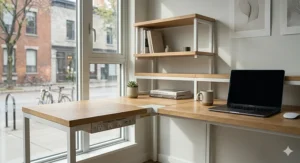
2. UPLIFT V2 Standing Desk
When you’re ready to invest in workspace infrastructure that outlasts job changes and cross-country moves, the UPLIFT V2 Standing Desk represents the build-your-own desk system philosophy at its finest. Available on Amazon.ca with multiple desktop materials (bamboo, laminate, solid wood), this customizable office desk delivers commercial stability with the modularity Canadian professionals demand.
Key Specifications:
- Height range: 22.6″-48.7″ (meets BIFMA ergonomic standards)
- 355 lb lifting capacity with dual motors
- Desktop width options: 42″-80″
- Advanced keypad with 4 programmable height presets
Price: $850-$1,400 CAD based on desktop size and material
The 48 threaded mounting points across the steel frame transform this from a simple standing desk into a growth-friendly desk system foundation. Add a monitor arm this month, integrate a cable management tray next quarter, attach a CPU holder when you upgrade your computer—the infrastructure supports your evolving needs without requiring furniture replacement.
According to the Canadian Centre for Occupational Health and Safety, alternating between sitting and standing throughout the workday significantly reduces musculoskeletal strain. The UPLIFT V2 makes those transitions effortless with one-touch height adjustment, moving from seated to standing position in roughly 8 seconds.
Canadian buyers particularly value the 7-year comprehensive warranty, which covers motors, frames, and control boxes against defects. Shipping within Canada typically takes 5-10 business days, with most components arriving in two separate packages.
Pros:
✅ Industry-leading weight capacity supports heavy equipment
✅ Desktop interchangeable—keep frame, swap surface years later
✅ Quiet motors (under 50 dB) won’t disrupt video calls
Cons:
❌ Premium pricing requires larger initial investment
❌ Assembly complexity increases with accessory additions
3. IKEA BEKANT Corner Desk
Not every budget accommodates four-figure furniture investments, which is precisely where the IKEA BEKANT Corner Desk earns its reputation as Canada’s favourite entry point into modular workspace design. At $380-$480 CAD, this scalable workspace solution delivers the L-shaped footprint and height adjustability that typically command premium prices.
Key Specifications:
- Available in manual or electric height adjustment
- Corner configuration maximizes awkward spaces
- Multiple colour combinations (white, black, birch veneer)
- 10-year limited warranty
Price: $380-$480 CAD (manual adjustment version)
The BEKANT’s modularity comes through IKEA’s broader ecosystem. Start with the corner desk, add the ALEX drawer unit for under-desk storage, integrate the SIGNUM cable management system, and mount a TERTIAL work lamp—each component works independently but connects into a cohesive system.
Assembly requires about 90 minutes and that particular brand of Swedish furniture patience. The instruction manual communicates exclusively through diagrams, which some Canadian buyers find charmingly minimalist and others describe as “deliberately cryptic.” Either way, the pre-drilled holes align cleanly, and the adjustable feet compensate for uneven floors common in older Canadian homes.
Pros:
✅ Price point accessible for students and early-career professionals
✅ Extensive IKEA ecosystem enables gradual system expansion
✅ Multiple locations across Canada for in-person viewing
Cons:
❌ Particleboard construction less durable than solid wood alternatives
❌ Manual height adjustment requires full surface clearing
4. FlexiSpot EC1 Electric Standing Desk
The FlexiSpot EC1 occupies that sweet spot between budget constraints and feature expectations, delivering electric height adjustment and a spacious bamboo desktop for roughly half what premium competitors charge. This adaptable office furniture option has earned strong reviews from Canadian remote workers who need standing desk functionality without executive-level pricing.
Key Specifications:
- 55″ × 28″ eco-friendly bamboo desktop
- Height range: 28.5″-47.6″ (includes desktop thickness)
- 187 lb weight capacity
- Simple 2-button controller
Price: $350-$520 CAD depending on desktop material and size
The bamboo surface represents more than aesthetic choice—it’s an environmentally conscious decision that resonates with Canadian values. Bamboo grows significantly faster than traditional hardwoods, making it a renewable resource that doesn’t compromise desk durability. The smooth finish resists scratches and water marks, essential when your workspace doubles as a kitchen table during video conferences.
Canadian buyers report assembly takes about 45 minutes with two people, though the instruction clarity receives mixed reviews. Several Ontario and Quebec customers note that pre-drilling pilot holes before attaching the desktop to the frame prevents wood splitting—a modification not mentioned in the official manual.
The EC1’s modularity manifests in FlexiSpot’s accessory compatibility. Add the under-desk drawer ($80-$120 CAD) for stationery storage, integrate the monitor arm ($90-$150 CAD) to free up desktop space, or attach the keyboard tray ($60-$85 CAD) for optimal typing ergonomics. Each addition clips or bolts directly to the existing frame.
Pros:
✅ Bamboo desktop combines durability with environmental responsibility
✅ Electric motor operates quietly enough for shared spaces
✅ Accessory ecosystem allows gradual capability expansion
Cons:
❌ Basic controller lacks programmable memory positions
❌ Weight capacity lower than commercial-grade alternatives
5. Bestar Pro-Concept Plus L-Desk
Quebec-based Bestar has spent decades understanding Canadian office furniture needs, and the Pro-Concept Plus L-Desk demonstrates that institutional knowledge through thoughtful design details that matter during long work sessions. This customizable office desk targets professionals who need substantial storage capacity and premium aesthetics without crossing into executive furniture price territory.
Key Specifications:
- L-configuration with integrated hutch options
- Solid wood components with commercial-grade laminate
- Multiple finish choices (Bordeaux, Tuscany Brown, White)
- Keyboard drawer with metal slides
Price: $680-$920 CAD based on finish and configuration
The Pro-Concept Plus approaches modularity differently than adjustable-height competitors. Instead of physical reconfiguration, it offers modular purchasing—buy the basic L-desk now, add the matching hutch later when budget permits, integrate the lateral file cabinet as your document collection grows. Each component shares identical finishes and hardware, creating visual continuity even when purchased years apart.
Canadian customers particularly value Bestar’s domestic manufacturing and distribution network. Orders ship from facilities in Quebec and Ontario, meaning delivery timelines rarely exceed one week even to remote addresses in the Maritimes or Western provinces. Assembly instructions arrive in both English and French, reflecting the company’s bilingual heritage.
The scratch-resistant laminate surface withstands daily abuse from coffee mugs, keyboards, and the occasional frustrated pen stabbing that accompanies difficult spreadsheet work. Several Alberta and Saskatchewan reviewers note the desk’s stability on uneven basement floors, attributing this to the adjustable leveling feet and solid construction quality.
Pros:
✅ Canadian-manufactured quality with quick domestic shipping
✅ Modular purchasing enables budget-friendly phased acquisition
✅ Finish quality appropriate for client-facing video backgrounds
Cons:
❌ Fixed height limits ergonomic adjustment options
❌ Hutch configuration reduces natural light to workspace

6. Tribesigns Modular Farmhouse Desk
Small Canadian apartments demand furniture that punches above its footprint, and the Tribesigns Modular Farmhouse Desk delivers storage capacity that seems physically impossible given its compact dimensions. This build-your-own desk system variant targets urban dwellers, students, and anyone working within constrained square footage.
Key Specifications:
- 47″ width fits tight corners and narrow walls
- Eight fabric storage drawers with metal frames
- Reversible structure for left or right orientation
- Rustic industrial aesthetic
Price: $280-$380 CAD
The modular aspect here centres on reversible assembly—install the drawer towers on your preferred side depending on room layout, window placement, or simply which configuration feels more natural given your dominant hand. Canadian buyers appreciate this flexibility when dealing with awkward room geometries common in older buildings across Toronto, Montreal, and Vancouver.
Those eight fabric drawers become surprisingly practical for hybrid work-life spaces. Dedicate certain drawers to office supplies while others handle craft materials, fitness accessories, or the children’s school supplies that somehow accumulate across every horizontal surface. The fabric construction keeps weight minimal—important for renters concerned about floor load limits in heritage buildings.
Multiple British Columbia reviewers specifically mention using this desk in bedroom-office combinations, where traditional wooden drawers would feel too corporate. The fabric softens the aesthetic while maintaining functional organization.
Pros:
✅ Exceptional storage-to-footprint ratio for small spaces
✅ Lightweight construction simplifies apartment moving
✅ Reversible design adapts to room layout changes
Cons:
❌ Fabric drawers less formal than traditional alternatives
❌ Lower weight capacity limits heavy equipment setup
Canadian customer insight: “This desk saved my sanity during remote work. My Toronto apartment is tiny, but the eight drawers mean everything has a home. Assembly took about two hours solo, and the instructions were clearer than expected.” (William, Toronto)
7. Bush Furniture Salinas L-Shaped Desk
When your professional image depends on video conference backgrounds that communicate competence and organization, the Bush Furniture Salinas delivers that traditional executive aesthetic Canadians associate with corner offices and leather-bound agendas. This growth-friendly desk system combines classic styling with modern modular capabilities.
Key Specifications:
- 60″W main surface with matching return
- Integrated file drawer for letter/legal documents
- Cable management grommets in desktop
- Antique White or Vintage Black finish options
Price: $550-$750 CAD
Bush Furniture’s modularity philosophy centres on coordinated collection expansion. The Salinas line includes matching bookcases, lateral files, and storage cabinets designed to visually integrate while remaining functionally independent. Purchase the desk today, add the bookcase next month, integrate the filing cabinet as your document load increases—each piece maintains consistent styling and build quality.
The integrated cable grommets might seem like minor details, but Canadian remote workers dealing with desktop computers, external monitors, desk lamps, and charging cables quickly appreciate the difference between tangled wire chaos and organized routing. Several reviewers from Alberta and Manitoba mention this feature specifically when praising the desk’s professional appearance during client calls.
Assembly complexity falls somewhere between IKEA simplicity and commercial furniture installation. Expect 90-120 minutes with two people, particularly when aligning the return section’s support brackets. The instruction manual provides detailed diagrams, though some steps require interpretation rather than explicit clarity.
Pros:
✅ Traditional styling appropriate for professional video backgrounds
✅ Coordinated collection enables gradual office completion
✅ Cable management infrastructure built into design
Cons:
❌ Fixed height configuration limits ergonomic adjustment
❌ Larger footprint requires dedicated office space
Understanding Modular Desk System Design: What Makes Them Different
The fundamental distinction separating modular desk system options from traditional furniture lies in the philosophy of progressive acquisition rather than complete replacement. Traditional desks function as monolithic units—buy the entire piece, use it until it fails or frustrates you, then discard and start over. Modular systems embrace incremental evolution.
This matters practically when your career transitions from freelance graphic designer to agency creative director, or when that hobby blog suddenly generates enough revenue to justify proper equipment. Instead of junking your existing desk and shopping for something larger, you add components that integrate seamlessly with your current setup. The financial implications compound over years—modular buyers typically spend more initially but save substantially across a decade of workspace evolution.
Canadian workplace ergonomics research from CCOHS (Canadian Centre for Occupational Health and Safety) emphasizes that static postures contribute significantly to musculoskeletal disorders. The ability to reconfigure your workspace—adjusting height, changing orientation, or expanding surface area—directly addresses these health concerns. Your furniture adapts to your body rather than forcing your body to adapt to fixed furniture.
The environmental angle resonates particularly well with Canadian values around sustainability. Modular furniture reduces landfill waste by extending functional lifespan. When components wear out or become obsolete, you replace individual elements rather than discarding entire systems. This approach aligns with circular economy principles that many Canadian municipalities actively promote through waste reduction programs.
Top 7 Products Price & Value Breakdown
| Price Category | Products | Value Proposition |
|---|---|---|
| Budget-Friendly ($280-$480 CAD) | Tribesigns Farmhouse, IKEA BEKANT | Entry point for students and early-career professionals |
| Mid-Range ($420-$680 CAD) | Tribesigns Executive, FlexiSpot EC1, Bush Salinas | Balance between features and affordability |
| Premium ($850-$1,400 CAD) | UPLIFT V2, Bestar Pro-Concept Plus | Commercial-grade durability and extensive customization |
The price-to-value ratio varies significantly based on individual priorities. Students and renters frequently maximize value through budget options that provide adequate functionality without long-term commitment. Established professionals investing in permanent home offices often find premium systems cost-effective across 10+ year lifespans, particularly when factoring replacement avoidance.
Canadian shipping costs influence true pricing—domestic brands like Bestar avoid customs complications while international shipments occasionally surprise buyers with unexpected brokerage fees. Always verify seller location and shipping terms before finalizing purchases.
How to Choose Your Perfect Modular Desk System
Selecting the optimal customizable office desk requires honest assessment across multiple dimensions that extend beyond simple aesthetic preference. Let’s walk through a practical evaluation framework.
Space Measurement Reality Check
Measure your available space three times, because that corner you mentally allocated for an L-shaped desk is probably 8 inches narrower than you think. Account for:
- Door swing clearance (add 30 inches minimum)
- Window placement and natural light access
- Electrical outlet proximity for equipment power
- Radiator or baseboard heater location in Canadian winter climates
- Floor level variations common in older buildings
Growth Trajectory Assessment
Consider your professional evolution over the next 3-5 years rather than current state. Will your freelance writing eventually require dual monitors? Could that hobby podcast become serious enough to need dedicated recording space? Modular systems excel when initial purchases accommodate future expansion without requiring replacement.
Budget Allocation Strategy
Canadian financial advisors typically recommend allocating 1-2% of annual income toward home office infrastructure for remote workers. This means someone earning $60,000 CAD annually might reasonably budget $600-$1,200 for workspace furniture. Modular systems enable phased spending—invest $400 in a quality base now, add $300 in accessories across the next six months.
Ergonomic Priority Ranking
According to Canadian ergonomic guidelines, these factors most significantly impact long-term comfort:
- Desk height adjustability (seated or sit-stand functionality)
- Keyboard and mouse positioning relative to elbow angle
- Monitor distance and height for neutral neck position
- Legroom clearance underneath workspace
- Storage accessibility without excessive reaching or twisting
Rank these personally—someone with existing back issues might prioritize height adjustability while a graphic designer might emphasize monitor positioning flexibility.
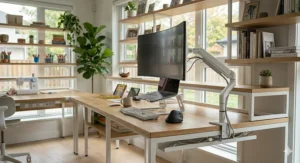
Modular Desk System Setup: Canadian Home Office Best Practices
Climate Considerations for Canadian Workspaces
Canadian seasonal extremes demand furniture placement awareness. Winter radiators create heat zones that warp wooden components if desks sit too close. Summer humidity in Ontario and Quebec basements can affect engineered wood integrity. Position desks at least 18 inches from heating elements and maintain 40-60% relative humidity where possible.
Lighting Integration Strategies
Northern Canadian latitudes mean limited natural light during winter months. Modular desk system configurations should maximize window proximity without creating screen glare. Several Manitoba and Saskatchewan reviewers specifically mention orienting desks perpendicular to windows rather than facing them directly—this provides ambient light without forcing constant squinting.
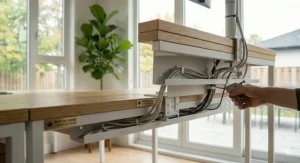
Cable Management Infrastructure
Modern workspace requirements include desktop computers, monitors, desk lamps, phone chargers, and various peripherals. Plan cable routing before assembly rather than after. The best expandable workstation Canada setups incorporate:
- Under-desk cable trays to prevent floor tangles
- Desktop grommets for clean vertical cable routing
- Surge protector mounting to desk frame or wall
- Label systems to identify which cable powers what device
Canadian electrical codes require grounded outlets for computer equipment. Verify your workspace includes proper electrical infrastructure before purchasing equipment-heavy configurations.
Modular vs Traditional Desks: The Real Cost Comparison
| Consideration | Modular Desk System | Traditional Fixed Desk |
|---|---|---|
| Initial Cost | $350-$1,400 CAD | $180-$600 CAD |
| 5-Year Total Cost | $350-$1,600 CAD | $360-$1,200 CAD (likely requires replacement) |
| 10-Year Total Cost | $400-$1,800 CAD | $540-$1,800 CAD (2-3 replacements) |
| Resale Value | 40-60% of original | 10-25% of original |
| Adaptation Capability | High (add components) | None (full replacement required) |
The numbers reveal a counterintuitive truth: higher-quality modular systems often cost less across extended timelines because they eliminate replacement cycles. A $1,200 CAD UPLIFT desk used for 15 years costs $80 annually, while replacing $400 traditional desks every 5 years costs $80 annually—except the modular option maintains resale value and adapts to changing needs.
Common Mistakes When Buying Modular Office Furniture
Underestimating Future Needs
Buying for today’s requirements rather than tomorrow’s realities represents the most frequent modular desk system mistake. Your current laptop-only setup might seem adequate, but will you feel the same when that side project requires a second monitor? Or when video editing becomes regular work rather than occasional experimentation? Build 30% expansion capacity into initial purchases.
Ignoring Material Quality Differences
Not all engineered wood deserves equal respect. CARB Phase 2 certification indicates formaldehyde emissions meet California’s strict air quality standards—important for small, poorly-ventilated Canadian spaces. Canadian buyers should verify material certifications before purchasing, particularly for desks spending 8+ hours daily in close proximity to breathing zones.
Overlooking Assembly Complexity
Some modular systems require basic tools and moderate patience. Others demand power drills, precise measurements, and that special kind of determination usually reserved for IKEA furniture marathons. Read assembly reviews from other Canadian buyers before purchasing—their experiences reveal whether “some assembly required” means “30 minutes with an Allen key” or “3 hours plus a YouTube tutorial.”
Forgetting Delivery Logistics
A modular desk system that fits your office might not fit your apartment building elevator or stairwell. Several Toronto and Vancouver condo residents report delivery nightmares when 78-inch desktops wouldn’t navigate building entry points. Measure not just your destination space but also your delivery path—hallways, doorways, elevators, and stairwells all impose constraints.
Frequently Asked Questions
❓ How much should I budget for a quality modular desk system in Canada?
❓ Can I expand my modular desk system years after initial purchase?
❓ Do modular desk systems work in small Canadian apartments?
❓ What's the typical delivery time for modular desks shipped within Canada?
❓ Are standing desk converters better than full modular standing desks?
Maintenance and Care for Long-Term Performance
Seasonal Adjustment Requirements
Canadian climate extremes demand seasonal furniture maintenance most tropical guides overlook. Winter indoor heating dries wood components, potentially causing joints to loosen. Check and retighten hardware every 3-4 months, particularly after transitioning from summer humidity to winter dryness. Ontario and Quebec residents report best results applying furniture wax twice yearly—once before winter heating season, once before summer humidity arrives.
Cleaning Protocols for Different Materials
Bamboo Surfaces: Wipe with barely-damp microfibre cloth followed by immediate drying. Avoid excessive water exposure that can cause swelling. Apply food-safe mineral oil annually to maintain moisture balance during dry Canadian winters.
Laminate Finishes: Use pH-neutral cleaners diluted according to manufacturer specifications. Harsh chemicals can dull protective coatings over time. Several Alberta reviewers recommend simple dish soap solutions for regular maintenance.
Metal Frames: Wipe standing desk frames monthly to prevent dust accumulation in mechanical components. Check motor housing for debris that might interfere with height adjustment mechanisms.
Motor Maintenance for Electric Systems
Electric standing desks require minimal but crucial maintenance. Monthly testing of height adjustment confirms motors function properly before urgent deadlines require desk repositioning. Annual lubrication of moving parts extends lifespan—consult manufacturer guidelines for approved lubricant types. Most Canadian warranty claims relate to neglected maintenance rather than manufacturing defects.
✨ Don’t Miss These Exclusive Deals!
🔍 Take your workspace to the next level with these carefully selected products available in Canada. Click on any highlighted item to check current pricing and availability on Amazon.ca. These tools will help you create an authentic productive environment your career deserves!
Sustainability Considerations for Canadian Buyers
Environmental consciousness increasingly influences Canadian furniture purchasing decisions. Several factors deserve consideration when evaluating modular desk system sustainability:
Material Sourcing Transparency
Bamboo desktops from FlexiSpot and UPLIFT represent rapidly renewable resources compared to traditional hardwoods. Bamboo reaches maturity in 3-5 years versus 20-50 years for oak or maple. Canadian buyers concerned about deforestation impact should prioritize FSC-certified wood products or bamboo alternatives.
Manufacturing Location Impact
Domestically-manufactured options like Bestar reduce transportation emissions while supporting Canadian employment. However, some international manufacturers offset carbon footprints through verified programs. Research individual company sustainability reports rather than assuming domestic automatically means environmentally superior.
End-of-Life Disposal Planning
Modular systems generate less waste through component replacement rather than complete disposal. When desks do reach end-of-life, engineered wood components often qualify for recycling through municipal programs in Toronto, Vancouver, Calgary, and other major cities. Metal frames from standing desks maintain high scrap value and recycling acceptance.
According to Canadian waste reduction guidelines, furniture represents approximately 7% of residential waste volume. Modular purchasing patterns could reduce this significantly if adopted broadly—each avoided replacement eliminates roughly 60-120 lbs from landfill streams.
Accessibility Features in Modern Modular Desks
Universal design principles increasingly influence modular desk system development, creating workspaces that accommodate diverse physical abilities without requiring specialized modifications.
Height Adjustment for Wheelchair Users
Electric standing desks accommodate wheelchair users through ultra-low minimum heights (typically 22-24 inches). This allows wheelchair armrests to slide underneath while maintaining proper ergonomic positioning. UPLIFT and FlexiSpot models specifically advertise BIFMA height compliance, ensuring compatibility with mobility devices.
Cable Management for Visual Impairments
Organized cable routing prevents tripping hazards particularly important for users with visual impairments navigating workspace areas. Integrated grommets and under-desk trays reduce floor-level cable obstacles while improving overall safety.
Control Accessibility
Standing desk controllers increasingly feature tactile buttons rather than flat touch surfaces, improving usability for users with limited fine motor control or visual impairments. Several Canadian reviewers specifically praise UPLIFT’s physical button layout for easier operation without visual confirmation.
Remote Work Tax Implications for Canadian Home Offices
Home Office Expense Deductions
The Canada Revenue Agency (CRA) allows employees working from home to claim home office expenses under specific conditions. Modular desk system purchases potentially qualify as workspace furniture expenses for self-employed Canadians or employees with T2200 forms from employers.
Eligibility Requirements:
- Workspace used exclusively or primarily (more than 50% of time) for employment
- Regular and continuous use for meeting clients or customers
- Employment contract requires home workspace
Deductible Percentages:
Self-employed Canadians can deduct full workspace furniture costs proportional to home office square footage percentage. For employees, the temporary flat rate method ($2 per day working from home, maximum $500 annually) offers simpler claiming but excludes specific furniture deductions.
Capital Cost Allowance Considerations
High-value modular desk system purchases may qualify for Capital Cost Allowance (CCA) claiming spread across multiple years rather than single-year deductions. Consult tax professionals familiar with current CRA guidelines, as regulations evolved significantly during 2020-2024 remote work shifts.
Future-Proofing Your Workspace Investment
Technology evolution challenges desk longevity through changing equipment requirements. Today’s laptop-only setup becomes tomorrow’s dual-monitor configuration, then next year’s triple-screen productivity station. Anticipating these transitions during initial modular desk system selection prevents premature obsolescence.
Monitor Mounting Infrastructure
Modern workflows increasingly rely on multiple displays. Ensure selected desks accommodate monitor arms—either through built-in mounting points or adequate rear clearance for clamp-style mounts. The UPLIFT V2’s 48 mounting holes represent extreme future-proofing, while even basic desks should allow clamp installation.
Power and Connectivity Evolution
USB-C power delivery, wireless charging pads, and integrated electrical outlets represent current standards. Within 3-5 years, new connectivity standards will emerge. Modular desks accommodating aftermarket power solutions adapt more successfully than fixed configurations with built-in but obsolete connectivity.
Weight Capacity Reserves
Today’s laptop weighs 3 lbs. Tomorrow’s professional workstation might include desktop computer (15 lbs), dual monitors (20 lbs), desk lamp (5 lbs), and various peripherals. Build weight capacity margins into initial selections—if current setup weighs 40 lbs, choose desks rated 150+ lbs rather than barely adequate 75 lb capacity.
Conclusion
The modular desk system revolution transforms how Canadians approach workspace design, shifting from static furniture acceptance to dynamic environment optimization. Whether you’re launching a freelance career from a Winnipeg apartment, managing remote teams from a Montreal home office, or simply reorganizing that spare bedroom in your Calgary condo, the right adaptable office furniture grows alongside your professional journey.
Start with clear space measurements and honest needs assessment. Budget for quality that justifies initial investment through years of reliable service. Consider Canadian shipping logistics, climate impacts, and warranty coverage that actually matters when components fail at inconvenient moments. Most importantly, embrace the iterative mindset—your perfect workspace rarely emerges fully-formed. It evolves through thoughtful additions and strategic reconfigurations as your career and life circumstances develop.
The seven customizable office desk options we’ve explored represent diverse approaches to workspace modularity. Budget-conscious students find value in IKEA’s ecosystem integration. Established professionals appreciate UPLIFT’s commercial-grade durability. Space-constrained urban dwellers maximize Tribesigns’ storage innovations. Your optimal choice depends on the unique intersection of your requirements, constraints, and aspirations.
Remember that Canadian ergonomics research consistently demonstrates workspace quality directly impacts long-term health outcomes. The $500-$1,200 you invest in a proper build-your-own desk system today potentially prevents thousands in physiotherapy costs and lost productivity tomorrow. View modular furniture not as expense but as infrastructure investment in your most valuable asset—your professional capabilities and physical wellbeing.
Ready to transform that awkward corner into productivity headquarters? Start by measuring your space three times, bookmarking this comparison guide, and browsing Amazon.ca for current pricing on your shortlisted options. Your ideal scalable workspace solution awaits—it just needs you to take that first modular step.
Recommended for You
- 7 Best Corner Standing Desks Canada 2026
- 7 Best Corner Desk for Dual Monitor Setup in Canada 2026
- 7 Best Small L Shaped Desk for Home Office Canada 2026
Disclaimer: This article contains affiliate links to Amazon.ca. If you purchase products through these links, we may earn a small commission at no additional cost to you.
✨ Found this helpful? Share it with your friends! 💬🤗
