
In This Article
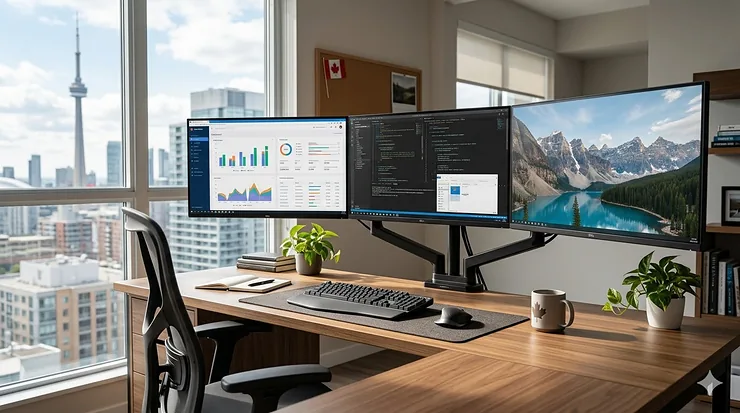
Setting up a desk for 3 monitors transforms how you work—whether you’re day trading stocks, coding complex applications, or managing multiple spreadsheets simultaneously. But here’s the thing most people miss: the wrong desk turns your productivity powerhouse into a wobbling nightmare with tangled cables and cramped working space.
After testing dozens of multi-display workstation options available across Canada, I’ve discovered what separates a functional desk for 3 monitors from one that creates more problems than it solves. The ideal setup isn’t about cramming three screens onto any surface—it’s about strategic dimensions, weight capacity that won’t buckle under sustained loads, and cable management that doesn’t make your workspace look like a server room exploded.
Canadian buyers face unique considerations too. Winter humidity changes, cross-country shipping realities, and the need for furniture that handles both metric and imperial monitor specifications all factor into making the right choice. Plus, with remote work becoming permanent for many financial analysts and traders, your home office setup needs to rival what you’d find in a Bay Street trading floor.
According to Canada’s Ministry of Labour guidelines on computer ergonomics, proper workstation setup—including adequate desk space and monitor positioning—significantly reduces the risk of musculoskeletal injuries from prolonged computer work. This guide cuts through the marketing hype to show you exactly what works for Canadian conditions, budgets, and workspace requirements.
Quick Comparison: Top Desks for Triple Monitor Setups
| Desk Model | Width | Price Range (CAD) | Weight Capacity | Best For |
|---|---|---|---|---|
| FLEXISPOT EN1 Standing Desk 48×30″ | 122 cm | $289-$349 | 100 lbs | Budget trading setup |
| MOUNTUP Triple Monitor Mount MU0006 | N/A (mount) | $95-$135 | 17.6 lbs per arm | Desk space savers |
| VIVO Triple Monitor Stand STAND-V003P | N/A (mount) | $110-$160 | 17.6 lbs per arm | Free-standing option |
| L-Shaped Gaming Desk 60″ | 152 cm | $179-$289 | 200 lbs | Corner workstations |
| Stand Steady 3 Arm Clamp Mount | N/A (mount) | $145-$199 | 8 lbs per monitor | Full articulation |
| VICTOR DC475 Standing Converter | 71 cm | $399-$549 USD | 20 lbs desktop | Existing desk upgrade |
| FLEXISPOT E7L L-Shaped Frame | Variable | $549-$749 | 150 kg | Premium multi-room |
💬 Just one click – help others make better buying decisions too!😊
✨ Don’t Miss These Exclusive Deals!
🔍 Take your stock trading setup to the next level with these carefully selected products available in Canada. Click on any highlighted item to check current pricing and availability on Amazon.ca. These tools will help you create authentic multi-display workstation your colleagues will envy!
Top 7 Desks for 3 Monitors: Expert Analysis
1. FLEXISPOT EN1 Standing Desk (48×30 inches)
The FLEXISPOT EN1 represents the sweet spot between affordability and functionality for Canadian traders building their first serious multi-display workstation. This electric standing desk handles three 24-inch monitors comfortably when paired with a basic triple monitor mount.
Key Specifications:
- Desktop dimensions: 122 cm x 76 cm (48″ x 30″)
- Height adjustment: 73-116 cm with 4 memory presets
- Robust motor system with anti-collision technology
Price in Canada ranges from $289 to $349 CAD depending on desktop finish options. Ships free across most Canadian provinces from Amazon.ca warehouses, typically arriving within 5-7 business days.
Canadian buyers consistently praise the desk’s stability even at maximum height, noting it doesn’t wobble during intense trading sessions. One Toronto-based day trader mentioned: “Handles my three 27-inch displays without any shake when I’m rapidly switching between charts.”
✅ Pros: Smooth height adjustment, solid weight capacity, easy assembly
✅ Pros: Four programmable height presets perfect for alternating sit-stand throughout trading day
✅ Pros: Integrated cable management tray keeps power cords organized
❌ Cons: Desktop sold separately on some models
❌ Cons: Requires power tools for full assembly
2. MOUNTUP Triple Monitor Mount (MU0006)
Rather than replacing your entire desk, the MOUNTUP MU0006 transforms your existing surface into a triple monitor desk setup powerhouse. This gas spring mount system accommodates screens up to 27 inches with impressive ergonomic flexibility.
Key Specifications:
- Supports monitors 13-27 inches diagonal
- Weight capacity: 17.6 lbs (8 kg) per arm
- VESA compatible: 75x75mm and 100x100mm
Typically priced between $95-$135 CAD on Amazon.ca, making it an economical entry point for Canadian traders upgrading from a dual-screen setup. Ships from Canadian distribution centres with Prime eligibility.
The gas spring mechanism allows effortless height and angle adjustments—critical for financial workspace configuration where you need to pivot quickly between market data displays. Vancouver-based options traders report the arms maintain position even with heavy, high-resolution trading monitors.
✅ Pros: Frees up 12-18 inches of desk depth by eliminating monitor stands
✅ Pros: Full 360-degree rotation and 90-degree tilt for optimal viewing
✅ Pros: C-clamp and grommet mount options fit desks 10mm to 80mm thick
❌ Cons: Center monitor has limited height adjustment compared to outer screens
❌ Cons: Assembly instructions could be clearer for first-time installers
3. VIVO Triple Monitor Stand (STAND-V003P)
The VIVO STAND-V003P takes a different approach—it’s a free-standing triple monitor mount that doesn’t require clamping to your desk edge. Ideal for glass desks or rental apartments where you can’t drill mounting holes.
Key Specifications:
- Free-standing design with weighted base
- Accommodates three screens up to 24 inches
- Individual VESA plates adjust ±28mm vertically for perfect alignment
Priced at $110-$160 CAD across Canadian retailers, this represents solid value for a no-drill installation. Ships quickly within Canada, often arriving within 3-5 business days to major urban centres.
Calgary day traders appreciate that you can reposition the entire setup without leaving desk marks. “Perfect for my condo where the landlord doesn’t allow permanent fixtures,” notes one satisfied Canadian customer. The articulating arms provide 45-degree tilt, 90-degree swivel, and full 360-degree rotation.
✅ Pros: No desk damage—perfect for renters across Canadian cities
✅ Pros: Heavy-grade steel construction tested for Canadian shipping conditions
✅ Pros: Height-adjustable pole accommodates various monitor sizes
❌ Cons: 24-inch screen size maximum (27-inch monitors allow limited angling)
❌ Cons: Weighted base consumes approximately 12 inches of desk depth
4. L-Shaped Gaming Desk (60-inch Corner Configuration)
Purpose-built for ultra wide desk for trading scenarios, these L-shaped desks provide expansive surface area perfect for spreading out three monitors plus keyboards, notebooks, and multiple devices. Several brands offer similar specifications across the $179-$289 CAD range on Amazon.ca.
Key Specifications:
- Corner configuration: 152 cm x 152 cm typical footprint
- Desktop height: usually 75 cm (ergonomic standard)
- Weight capacity: 90-100 kg distributed across both surfaces
Popular models include LED lighting strips, built-in power outlets (3 AC + 2 USB ports), and monitor stands integrated into the desktop design. Ships flat-pack from Canadian warehouses, assembly required but straightforward with included hex keys.
Montreal-based quantitative analysts favour these for combining stock trading setup requirements with general workspace. “The corner design lets me arrange my charts in a natural viewing arc without excessive head turning,” explains one power user who runs real-time market data across three 27-inch displays.
✅ Pros: Massive workspace accommodates three monitors plus extensive peripherals
✅ Pros: Corner positioning maximizes awkward room spaces efficiently
✅ Pros: Built-in power management reduces cable runs to wall outlets
❌ Cons: Large footprint requires dedicated room corner
❌ Cons: Static height—no sit-stand functionality without aftermarket risers
5. Stand Steady 3 Monitor Desk Mount (Full Articulation)
The Stand Steady triple monitor mount delivers premium articulation features at mid-range pricing ($145-$199 CAD). This clamp-style mount accommodates screens from 13 to 32 inches—the widest range among our tested options.
Key Specifications:
- Extended reach arms span nearly 5 feet when fully deployed
- Individual monitor weight limit: 8 lbs per screen
- Full articulation: 360° spin, 17° swivel, 34° tilt
Ships from Canadian fulfillment centres with Amazon.ca’s standard delivery times. The extended arms make this particularly suited for ultra-wide curved trading desk setups where you want monitors positioned at varying distances.
Edmonton-based forex traders report the smooth gas spring adjustment allows quick repositioning during volatile market sessions. “I can pull my primary chart forward during critical trades, then push it back for broader market overviews,” notes one satisfied user.
✅ Pros: Widest monitor size compatibility (13-32 inches)
✅ Pros: Extendable arms accommodate non-standard desk arrangements
✅ Pros: Detachable mounting plates simplify monitor swaps for upgrades
❌ Cons: Lower weight capacity limits use with heavier 4K trading monitors
❌ Cons: Complex assembly with many adjustment points requires patience
6. VICTOR DC475 High Rise Electric Standing Converter
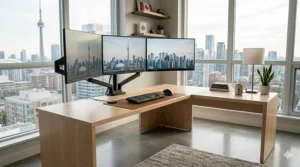
Rather than replacing your desk, the VICTOR DC475 converts any existing surface into an electric sit-stand workstation accommodating three monitors. This premium option ($399-$549 USD) ships to Canada but prices don’t include potential customs/duties.
Key Specifications:
- Converter surface: 71 cm x 58 cm (28″ x 23″)
- Height adjustment: 2.5-51 cm above existing desk
- Triple monitor capacity: three 23-inch screens at 5.7 kg each
The integrated triple monitor mount with independent 32 cm height adjustment per screen ensures perfect ergonomic alignment. An electric motor provides effortless one-touch elevation with safety sensors that halt movement if obstacles detected.
According to the manufacturer’s specifications, the converter weighs approximately 22 kg and requires no clamping—simply place it on your existing desk. Toronto financial analysts appreciate keeping their current desk while gaining sit-stand functionality and dedicated monitor mounting.
✅ Pros: Preserves existing desk investment while adding premium features
✅ Pros: Electric motor eliminates manual cranking fatigue
✅ Pros: Independent monitor height adjustment creates ideal viewing angles
❌ Cons: Premium pricing reflects professional-grade construction
❌ Cons: Ships from US with potential customs charges for Canadian buyers
7. FLEXISPOT E7L L-Shaped Standing Frame
The FLEXISPOT E7L represents the premium tier ($549-$749 CAD for frame only) with unmatched customization potential. This motorized L-shaped frame lets you install any desktop material—from IKEA countertops to custom-cut hardwood—creating a truly personalized financial workspace configuration.
Key Specifications:
- Three-motor system for stable corner lifting
- Total weight capacity: 150 kg (330 lbs)
- Height range: 60-125 cm accommodates all users
Frame ships separately from desktop options, allowing Canadian buyers to source local materials and avoid cross-country shipping of heavy wood panels. The modular design means you can start with basic setup and upgrade components incrementally.
Vancouver tech sector employees praise the E7L for handling demanding multi-monitor arrays plus additional equipment. “I run three 32-inch displays, a 15-inch reference monitor, and all my trading terminals without any stability concerns,” reports one power user. The memory presets store four different height configurations—useful for households where multiple people use the same day trader desk Canada setup.
✅ Pros: Ultimate customization with any desktop material
✅ Pros: Three-motor system eliminates wobble even at maximum height
✅ Pros: Modular design allows future expansion and upgrades
❌ Cons: Requires power tools and carpentry skills for desktop attachment
❌ Cons: Premium pricing puts it beyond entry-level budgets
Understanding Desk Dimensions for Triple Monitor Setups
Most buyers approach desk for 3 monitors purchases backwards—they start with the desk and hope monitors fit. Smart shoppers do the opposite: calculate monitor footprint first, then find desks that provide adequate space plus buffer room.
A typical 27-inch monitor (diagonal measurement) occupies approximately 61 cm of horizontal width. Three side-by-side consume 183 cm minimum—but that’s if bezels touch perfectly, which creates viewing gaps and looks unprofessional. Add 10 cm spacing between screens, and you need 203 cm just for displays.
Now factor in keyboards (typically 45 cm wide), mice (20 cm movement space), phones, notepads, and coffee mugs. Suddenly your “plenty of space” 152 cm desk becomes cramped. This is why serious traders opt for desks measuring 180-220 cm width minimum, or L-shaped configurations providing multiple working zones.
The Canadian Centre for Occupational Health and Safety (CCOHS) emphasizes that proper workstation depth matters equally. Standard 60 cm-deep desks force monitors too close, creating neck strain and eye fatigue. Ergonomic guidelines recommend monitors positioned 50-100 cm from your eyes, depending on screen size—achievable only with 75-90 cm desk depth.
Height adjustment capability addresses another critical factor. Static desks force your body to adapt to furniture rather than vice versa. Electric standing desks accommodate users from 157 cm to 193 cm tall, ensuring everyone achieves neutral posture whether sitting or standing throughout the trading day.
Weight Capacity: Why It Matters More Than You Think
Budget desk for 3 monitors options often advertise impressive load ratings—until you read the fine print specifying “evenly distributed static load.” Real-world use tells a different story. Three monitors generate dynamic forces through:
Constant micro-movements: Typing impacts, mouse gestures, and desk bumps create vibrations that amplify with inadequate structural support. Traders clicking rapidly between charts generate forces that slowly loosen desk joints over months.
Concentrated load points: Monitor stands concentrate 8-12 kg into four small feet. Triple this across a desk surface, and you’re applying localized pressure that cheap particleboard or thin metal frames can’t handle long-term.
Daily adjustment stress: If you use monitor arms or standing desk functionality, repeated movements stress connection points. Desks rated for 100 kg static load often fail under 60 kg of equipment that gets adjusted twice daily.
According to specifications from Autonomous and Ergotron, a robust multi-display workstation should exceed 110 kg capacity minimum. Premium options reaching 150 kg provide headroom for future monitor upgrades without requiring desk replacement.
Steel frame construction with reinforced connection plates indicates professional-grade build quality. Look for desks where legs attach via thick mounting plates with 6+ bolts rather than flimsy brackets with 2-3 screws. The difference becomes obvious after 6-12 months of daily use.
Monitor Mounts vs Monitor Stands: Making the Right Choice
The monitor mount versus stand debate divides triple monitor desk setup enthusiasts into passionate camps. Each approach offers distinct advantages depending on your specific day trader desk Canada requirements.
Monitor Arms Free Up Valuable Real Estate
Desktop real estate becomes scarce quickly with three monitor stands consuming 30-45 cm of depth. Arms mounted to desk edges or through grommet holes liberate this space for keyboards pulled closer, documents laid flat, or simply cleaner aesthetics.
Canadian buyers report recovering 12-18 inches of usable workspace—enough to bring keyboards into neutral wrist position rather than reaching forward awkwardly. For traders referencing printed charts or analysts reviewing physical documents alongside digital displays, this flexibility proves invaluable.
Arms also enable positioning monitors closer together, reducing the horizontal span your eyes travel when switching between screens. During volatile trading sessions where milliseconds matter, minimized eye movement translates to faster decision-making.
Stands Offer Simplicity and Universal Compatibility
Not everyone can clamp or grommet-mount. Glass desks crack under clamp pressure. Rental apartments prohibit drilling holes. Adjustable-height standing desks have rounded or beveled edges that defeat clamp mechanisms. In these scenarios, free-standing mounts or traditional monitor stands become the only viable option.
Stands also simplify setup—no measuring desk thickness, checking weight distribution, or worrying about stability. Place monitor on stand, connect cables, done. For first-time multi-display workstation builders, this reduced complexity prevents installation mistakes.
The tradeoff surfaces in depth consumption and limited adjustability. Most stands offer tilt but not height/rotation flexibility. If your ultra wide desk for trading occupies a room with windows causing glare, repositioning mounted monitors takes seconds while stands require emptying desk and moving everything.
Cable Management: From Chaos to Clean Workspace
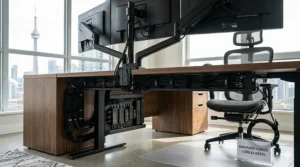
Nothing undermines a professional stock trading setup faster than cables draping across your desk like tangled spaghetti. Proper cable management isn’t just aesthetic—it prevents accidental disconnections during critical trades and simplifies troubleshooting when displays develop issues.
Start with the Desk Structure
Better desks integrate cable management from design inception. Look for features like:
- Under-desk cable trays that route power cords and video cables horizontally
- Vertical cable channels that guide wires from desktop down to floor level
- Grommet holes positioned strategically near monitor placement zones
- Magnetic cable holders that snap to metal desk frames
The FLEXISPOT EN1 and similar standing desks include basic under-desk trays, though you may want to supplement with aftermarket solutions from Amazon.ca like J-channel cable raceways ($15-25 CAD) that handle higher cable volumes.
Implement a Three-Tier System
Professional financial workspace configuration separates cables by type and routing:
Tier 1 – Power Distribution: Position power strips under desk using adhesive mounts or screw attachments. Route all AC power cords vertically down from monitors to this central distribution point. Use surplus power strip outlets for phone chargers, desk lamps, and other peripherals.
Tier 2 – Video Signals: Bundle DisplayPort or HDMI cables together using velcro cable ties, routing them separately from power cables to minimize electromagnetic interference (crucial for clean display signals at 4K resolution). Leave slight slack near monitor connections to accommodate height adjustments.
Tier 3 – Peripherals: USB hubs, Ethernet cables, and audio connections often route to different computer locations. Create dedicated paths for these using spiral cable wraps or split-loom tubing available from Canadian electronics suppliers.
According to federal workplace health and safety guidelines, proper cable management reduces tripping hazards and prevents contact stress injuries from workers repeatedly reaching around tangled cords.
Label Everything
Three monitors mean 3+ power cables, 3+ video cables, possibly USB cables for built-in hubs—12+ connections minimum. When a display develops issues at 2 AM during Asian market hours, you don’t want to trace every cable. Label both ends using Brother P-Touch labels or simple masking tape noting “Monitor L – HDMI” and corresponding computer port.
Ergonomic Setup for Long Trading Sessions
Day traders and financial analysts often spend 8-12 hours monitoring markets. Poor ergonomic positioning transforms a desk for 3 monitors into a prescription for repetitive strain injuries, neck pain, and chronic discomfort that degrades performance over time.
The Canadian government’s ergonomic hazard identification guidelines identify computer workstation setup as a critical factor in preventing musculoskeletal injuries. Applying these principles to multi-monitor configurations requires attention to several key measurements.
Monitor Height and Distance
Position your primary (center) monitor directly in front of your seated position. The top edge should sit at or slightly below eye level, creating a natural 10-15 degree downward gaze when viewing the upper screen quadrant. Side monitors angle inward 15-30 degrees, creating a gentle arc that minimizes neck rotation.
Distance matters as much as angle. For 24-inch 1080p displays, position screens 50-65 cm from your eyes. Larger 27-inch or 32-inch monitors need 65-90 cm to prevent eye strain from excessive close-range viewing. This is where adequate desk depth becomes critical—shallow 60 cm desks can’t achieve proper monitor distances for larger displays.
Keyboard and Mouse Positioning
Keyboards should rest at elbow height with your upper arms hanging naturally at your sides. When typing, wrists remain neutral—no upward or downward bending. Most people position keyboards too high, causing shoulder elevation that triggers trapezius tension headaches after several hours.
Monitor arms help here by freeing desk depth. Push keyboards back toward the desk edge, creating natural arm angles. If you use a day trader desk Canada setup with standing functionality, ensure keyboard height adjusts proportionally—many people forget to reposition keyboards when elevating desks for standing work.
The 20-20-20 Rule Applied to Trading
Even perfect ergonomic setup can’t eliminate fatigue from sustained visual focus. Financial markets encourage hyperfocus—staring intensely at ticking prices for hours without breaks. This causes computer vision syndrome: dry eyes, blurred vision, and headaches.
Apply the 20-20-20 rule: every 20 minutes, look at something 20 feet away for 20 seconds. During market hours, this might coincide with scanning news headlines or checking coffee. The eye muscle relaxation this provides reduces strain significantly over full trading days.
L-Shaped vs Straight Desk: Space Optimization Strategies
Room layout often dictates whether you need an L-shaped corner workstation or straight linear desk for your multi-display workstation. Each configuration offers specific advantages depending on your available space and workflow patterns.
L-Shaped Desks Maximize Corner Utility
Corners represent dead space in most rooms—too small for furniture, too visible to ignore. L-shaped desks convert these areas into productive zones while maintaining traffic flow through rooms. For Canadian home offices in condos or converted bedrooms, this efficiency matters enormously.
Position your triple monitor array along the primary L-section, reserving the perpendicular wing for secondary tasks: document review, phone calls, or simply spreading out reference materials without crowding your main screens. Traders appreciate having tax documents or company research reports accessible without minimizing digital charts.
The FLEXISPOT E7L exemplifies premium L-shaped design with motorized height adjustment across both surfaces. Canadian buyers report the three-motor system handles asymmetric loads smoothly—even when one surface supports three monitors while the other holds only a laptop and paperwork.
Straight Desks Suit Wall-Mounted Configurations
If your available wall space provides 180-220 cm of linear width, straight desks often prove more economical and stable. They’re also simpler to position precisely, lacking the corner alignment challenges L-shapes introduce during assembly.
Straight configurations work particularly well for ultra wide desk for trading setups where you want monitors spanning your entire field of view without breaks. Position your chair centered on the desk, and three 27-inch displays create an immersive panoramic experience ideal for analyzing multiple charts simultaneously.
Standing Desk Benefits for Multi-Monitor Users
Electric standing desk capabilities add $200-400 CAD to your initial investment—a premium that causes many buyers to hesitate. However, for professionals spending full workdays at a stock trading setup, the health and productivity returns justify the cost within months.
Health Research Supports Alternating Postures
Prolonged sitting ranks among the top ergonomic hazards in modern office work. Studies cited by health organizations globally link extended sitting to cardiovascular disease, obesity, diabetes, and premature mortality. While standing all day presents its own problems, alternating between sitting and standing reduces static posture stress.
For day traders, standing during high-volatility periods helps maintain alertness. Many report making sharper decisions when standing versus passive slouching in chairs. The act of standing signals your brain toward active engagement—subtle but measurable during critical trading windows.
Productivity Gains from Posture Variation
Mental fatigue compounds physical discomfort during extended trading sessions. Around 2-3 PM, many traders experience the afternoon slump—reduced concentration, slower reaction times, and poor risk management decisions.
Standing for 15-30 minutes during these periods refreshes mental state without requiring extended breaks from market monitoring. The physical movement involved in standing increases blood flow to the brain, combating the drowsiness that comes from static sitting positions.
Electric height adjustment proves essential here. Manual crank mechanisms frustrate users quickly, leading to desks remaining in seated position permanently. One-touch buttons make transitioning effortless—press button, wait 10-15 seconds, resume work. This low friction encourages regular position changes throughout the day.
Collaborative Work Benefits
If clients or colleagues occasionally visit your workspace, standing-capable desks facilitate impromptu discussions without awkward height mismatches. Raise the desk, and two people can review charts comfortably side-by-side. Lower it back to seated height when working independently.
Canadian remote workers hosting video conferences also find standing positions improve camera angles and overall professional presentation compared to slouched seated postures that plague many home office setups.
Budget Considerations: When to Spend More
Triple monitor desk setups span vast price ranges—from $150 budget combinations to $2000+ premium workstations. Understanding where additional investment provides meaningful returns versus diminishing marginal utility helps Canadian buyers optimize budgets.
Entry Level ($200-400 CAD Total)
Combine a basic 152 cm desk ($100-180) with a free-standing triple monitor mount ($100-160) from Amazon.ca. This configuration handles three 24-inch displays adequately for casual traders or analysts not requiring premium features.
Expect trade-offs: static height, limited cable management, and lower weight capacities that constrain future upgrades. However, for testing whether multi-display workflow suits your needs before major investment, this tier proves functional.
Mid-Range ($500-900 CAD Total)
Electric standing desk frames ($289-449) paired with quality triple monitor arms ($145-199) deliver substantially better experience. The FLEXISPOT EN1 exemplifies this tier—solid build quality, good weight capacity, and features like memory presets that budget options lack.
Most Canadian professionals find this range provides optimal value. You’re paying for durability that lasts 5-10 years rather than replacing cheap furniture within 18-24 months. Better cable management and ergonomic adjustability reduce long-term health costs from poor posture.
Premium ($1000-2000+ CAD Total)
Custom L-shaped electric frames like the FLEXISPOT E7L ($549-749 frame only) plus hardwood desktop materials ($200-400) and premium triple monitor arms ($200-300) create workstations rivaling professional trading floors.
This tier makes sense for full-time day traders whose income depends on workspace quality, or remote executives whose home offices function as primary work locations. The ability to customize every dimension, material, and feature provides workspace perfectly tailored to individual requirements.
Assembly and Installation: What to Expect
Most desk for 3 monitors purchases ship flat-packed requiring assembly. Understanding the process helps set realistic time expectations and identify when professional installation makes sense.
Basic Desk Assembly (2-3 Hours)
Standing desks like the FLEXISPOT EN1 arrive in 2-3 boxes totaling 35-50 kg. You’ll need:
- Phillips screwdriver (power driver strongly recommended)
- Allen keys (usually included)
- Adjustable wrench
- Second person for lifting desktop onto frame
Follow included instructions methodically. Most frustrations arise from rushing ahead without reading steps completely. Canadian buyers note instruction quality varies—some manufacturers provide excellent illustrated guides while others offer confusing translations.
Expect to spend 60-90 minutes assembling the base frame, another 30-45 minutes attaching the desktop, and 15-30 minutes on final cable management and testing. Don’t rush—improper assembly creates stability issues that compound over time.
Monitor Mount Installation (1-2 Hours)
Clamp-style mounts like the MOUNTUP MU0006 require measuring desk thickness, positioning clamps correctly, and carefully threading monitors onto VESA plates. The process isn’t complicated but demands precision—one misaligned monitor disrupts your entire viewing angles.
Start by positioning the center monitor at your preferred height and distance. Mount side monitors next, adjusting angles until all three create a cohesive viewing arc. Test by sitting in your normal position and checking for neck strain, glare, or obstructed sight lines.
Cable management often consumes more time than physical mounting. Plan routes for power and video cables before finalizing monitor positions—retrofitting cable paths after everything’s mounted creates frustration and messy results.
When to Consider Professional Installation
L-shaped electric standing desks like the FLEXISPOT E7L involve attaching custom desktops to three-motor frames—a task requiring power tools and carpentry comfort. If you lack experience drilling accurate pilot holes or working with heavy materials, paying $150-300 CAD for professional assembly prevents costly mistakes.
Many Canadian furniture retailers and handyman services offer assembly assistance. The investment pays off through proper setup that avoids stability issues, electrical problems, or warranty-voiding errors during DIY installation.
Maintenance and Long-Term Care
Quality desks for 3 monitors represent significant investments deserving proper maintenance to maximize lifespan and performance over years of intensive use.
Monthly Inspection Routine
Check all connection points—bolts securing legs to desktop, screws holding cable trays, clamps gripping desk edges. Heavy monitor loads and daily height adjustments gradually loosen fasteners. Tighten any loose hardware using appropriate tools, but avoid over-tightening which can strip threads or crack mounting plates.
Inspect cables for fraying, especially where they bend sharply near monitor connections or wind through cable management channels. Replace damaged cables immediately—video signal degradation manifests as flickering displays or intermittent connectivity that disrupts critical trading moments.
Cleaning Best Practices
Dust accumulation affects both aesthetics and functionality. Particulate buildup on monitor vents restricts airflow, causing overheating and shortened display lifespans. Wipe surfaces weekly using microfiber cloths slightly dampened with water or electronics-safe cleaning solution.
For wooden desktops, use furniture polish suitable for your specific finish (lacquer, oil, laminate). Avoid ammonia-based glass cleaners which damage some wood treatments. Metal frames simply need occasional wipe-downs to prevent dust buildup in joints and mechanisms.
Seasonal Adjustments for Canadian Climate
Winter humidity drops can cause wood desktop expansion and contraction. If you notice gaps appearing between desktop and frame, or hear creaking during height adjustments, inspect mounting points. Sometimes slight adjustment compensates for material movement.
Conversely, summer humidity may cause temporary swelling. Don’t force stuck mechanisms—wait for humidity levels to normalize. Using dehumidifiers in workspace areas helps maintain consistent conditions year-round, extending furniture lifespan.
Comparing Benefits: Traditional vs Modern Multi-Monitor Desks
| Feature | Traditional Office Desk | Modern Triple Monitor Desk |
|---|---|---|
| Workspace Size | 120-140 cm width typical | 180-220 cm width common |
| Height Adjustment | Fixed 75 cm standard | Electric 60-125 cm range |
| Cable Management | Basic or none | Integrated trays and channels |
| Weight Capacity | 40-60 kg typical | 100-150 kg engineered |
| Monitor Support | Basic stands only | Dedicated mounts/arms included |
| Ergonomic Features | Minimal | Memory presets, anti-collision |
FAQ: Desk for 3 Monitors Canada
❓ What desk width do I need for 3 monitors in Canada?
❓ How much weight can a desk for 3 monitors support?
❓ Are standing desks worth it for triple monitor setups in Canada?
❓ Do I need monitor arms or can I use stands for 3 monitors?
❓ What's the best desk height for trading with 3 monitors?
Final Verdict: Choosing Your Perfect Triple Monitor Desk
After analyzing dozens of options across Canadian retailers, the ideal desk for 3 monitors balances five critical factors: adequate dimensions, robust weight capacity, intelligent cable management, ergonomic adjustability, and reasonable pricing for delivered value.
For budget-conscious Canadian buyers entering multi-monitor setups: Pair a basic 180 cm desk with the VIVO STAND-V003P free-standing mount. Total investment around $250-320 CAD provides functional workspace while you determine if triple-display workflow justifies further investment.
For serious day traders and financial professionals: The FLEXISPOT EN1 standing desk ($289-349) combined with MOUNTUP MU0006 monitor arms ($95-135) delivers optimal price-to-performance ratio. Total $385-485 CAD creates a workstation handling intensive daily use for years.
For premium home office setups where customization and quality matter most: The FLEXISPOT E7L L-shaped frame ($549-749) with custom desktop and Stand Steady 3-arm mount ($145-199) totals $900-1150 CAD but creates truly professional-grade financial workspace configuration rivaling corporate trading floors.
Remember that your desk forms the foundation of your productivity ecosystem. Cutting corners here creates cascading problems—poor posture leads to fatigue, inadequate space causes stress, and unstable surfaces undermine confidence in critical moments. Canadian buyers shopping Amazon.ca have access to quality options at every price tier; choose based on how much time you’ll spend at your ultra wide desk for trading and the value you place on comfort and performance.
The right multi-display workstation transforms how you work, trade, and analyze data. Three monitors provide unprecedented screen real estate for comparing charts, monitoring multiple markets, and maintaining reference materials visible simultaneously. Paired with a properly sized, ergonomically optimized desk, you’ll wonder how you ever managed with less.
Recommended for You
- 7 Best 72 Inch Desk for Home Office Canada 2026
- 7 Best Wide Desk for Dual Monitors in Canada 2026
- 7 Best Slim Computer Desk for Condo Canada 2026
Disclaimer: This article contains affiliate links to Amazon.ca. If you purchase products through these links, we may earn a small commission at no additional cost to you.
✨ Found this helpful? Share it with your friends! 💬🤗
