
In This Article
If you’ve ever peeled yourself off an office chair at 4 p.m. with a damp shirt and a bad mood, you already know why breathable office chairs exist. Heat and moisture build up between your back and a padded seat faster than most people expect, especially in a warm apartment, a sun-facing home office, or an un-air-conditioned corner of an open-plan floor. A properly built mesh chair changes that equation by letting air move where a slab of foam would just trap it.
This guide is built for a Canadian buyer working from a condo in Toronto’s July humidity or a Calgary basement office that turns into a sauna every August. We researched real products sold on amazon.ca, dug into aggregated review sentiment, and compared specs the way an engineer would rather than the way a listing writer would. You’ll find seven genuine chairs across budget, mid-range, and premium tiers, honest pros and cons, and the kind of practical advice — setup tricks, buying mistakes, decision frameworks — that no product page bothers to include.
One quick definition before we dive in: a breathable office chair is a task chair built with open-weave mesh (sometimes on the backrest only, sometimes on the seat too) instead of solid foam-and-fabric upholstery, so air circulates freely against your body and heat doesn’t pool the way it does on padded or leather seating.
Quick Comparison Table
| Chair | Best For | Mesh Coverage | Price Range (CAD) |
|---|---|---|---|
| SIHOO M57 | Best all-around value | Back only | Around C$220-C$280 |
| GABRYLLY Ergonomic Mesh Chair | Big & tall budget buyers | Back only | Around C$150-C$200 |
| Hbada E3 Office Chair | Small spaces, minimalists | Back only | Around C$170-C$220 |
| Steelcase Series 1 | Long-term durability | Back only | C$500-C$700 range |
| Nouhaus Ergo3D | Balanced ergonomics | Back only | C$350-C$450 range |
| Razer Fujin Pro | Full-mesh cooling | Seat + back | C$800-C$950 range |
| Herman Miller Aeron | Premium buy-it-for-life | Seat + back | C$2,200-C$2,600 range |
Even in a five-second glance, the spread tells a story: coverage, not just price, is what separates a chair that merely looks breathable from one that actually behaves that way under your body for eight hours. Budget picks like the SIHOO M57 and GABRYLLY chair breathe where you need it most immediately — your back — while reserving full seat-and-back mesh for the higher tiers where the manufacturing cost of an all-mesh pan is easier to absorb. If you run hot specifically through your thighs and lower back rather than your spine, that distinction should weigh more heavily on your decision than the price tag alone.
💬 Just one click — help others make better buying decisions too!😊
Top 7 Breathable Office Chairs: Expert Analysis
1. SIHOO M57 — best all-around value for warm home offices
The standout here is balance: this chair packs a tensioned, high-density mesh backrest, adjustable lumbar, and 3D or 4D armrests (depending on configuration) into a price point that undercuts most “ergonomic” competitors by a wide margin.
Key specs worth translating into real life: the backrest uses a tightly woven elastic mesh rated for extended sitting without sagging, the lumbar support slides vertically to meet the natural curve of your lower spine, and the base is rated to handle users up in the 300-pound range. In practice, that lumbar adjustability matters more than most buyers assume — a fixed lumbar bump that sits an inch too low does nothing for you, while a slider that actually reaches your belt line is the difference between all-day comfort and a 2 p.m. slouch.
Who should buy it: anyone furnishing a first home office on a real budget who still wants genuine adjustability rather than a chair that only pretends to be ergonomic. Reviewers consistently report that assembly is straightforward and that the mesh stays taut well past the one-year mark, though a handful note the seat cushion (not mesh) can feel firm for users under 130 pounds.
Pros:
- ✅ Strong lumbar and armrest adjustability for the price tier
- ✅ Mesh backrest resists sagging better than cheaper alternatives
- ✅ Wide weight rating suits larger body types
Cons:
- ❌ Padded seat, not full mesh, so airflow lives mainly in the back
- ❌ Firmer seat cushion may not suit lighter users
Priced around C$220-C$280 at the time of research, the SIHOO M57 is arguably the best value-per-adjustment-point chair in this entire lineup — check current price before buying, since mesh-chair pricing shifts often with seasonal promotions.
2. GABRYLLY Ergonomic Mesh Office Chair — best budget pick for big & tall users
What jumps out immediately is the sizing: this chair is explicitly built with a wider seat pan and taller backrest than most entry-level mesh chairs, aimed squarely at users who find standard budget chairs cramped.
The breathable mesh backrest handles the airflow half of the equation, while flip-up armrests and a 90-120° tilt lock give you real control over your sitting angle throughout the day — a small feature that a lot of chairs at this price skip entirely. The headrest, height-adjustable rather than fixed, is another detail that separates it from cheaper “mesh-look” chairs that bolt on a headrest as an afterthought.
Who it’s for: taller or larger-framed users who’ve been squeezed by narrow budget chairs, plus anyone who wants flip-up arms so the chair tucks under a desk cleanly. Aggregated customer sentiment points to strong satisfaction on comfort-for-price, with a recurring complaint that the seat cushion, while adequately padded, isn’t mesh — so buyers chasing full-body airflow should temper expectations.
Pros:
- ✅ Generous seat width and tall backrest for big & tall frames
- ✅ Flip-up arms simplify desk clearance and storage
- ✅ Height-adjustable headrest is rare at this price
Cons:
- ❌ Seat is padded cushion, not ventilated mesh
- ❌ Some reports of squeaky components after months of daily use
At roughly C$150-C$200, the GABRYLLY chair delivers the widest frame-to-dollar ratio on this list, making it the pragmatic pick if fit matters more to you than full-mesh cooling.
3. Hbada E3 Office Chair — best compact pick for small home offices
The standout feature is footprint: this chair is engineered with a slimmer profile and lighter frame than most ergonomic mesh chairs, which matters enormously if your “office” is a corner of a bedroom or a condo nook.
Specs that translate directly into daily use: a breathable mesh backrest paired with a sliding seat-depth adjustment, letting shorter or taller users dial in the right knee-to-seat-edge gap — a detail CCOHS specifically flags as important for circulation. The recline mechanism locks at multiple angles rather than offering just one fixed position, which gives you posture variety across a long workday.
Who should consider it: apartment and condo dwellers who need a chair that looks tidy in a small space and doesn’t dominate the room visually, plus first-time buyers who want mesh breathability without committing to a bulky high-back frame. Real user feedback tends to praise the minimalist look and easy assembly, with a recurring theme that the armrests, while functional, aren’t as plush as pricier competitors.
Pros:
- ✅ Slim, apartment-friendly footprint without sacrificing mesh
- ✅ Multi-angle recline lock adds real posture variety
- ✅ Lightweight frame is easy to move and reposition
Cons:
- ❌ Armrest padding is thinner than mid-range competitors
- ❌ Smaller seat pan may feel tight for larger frames
Expect a price in the C$170-C$220 range, positioning the Hbada E3 as the space-conscious answer to the SIHOO and GABRYLLY chairs above.
4. Steelcase Series 1 — best long-term durability investment
The headline feature is engineering pedigree: Steelcase built this chair using its LiveBack technology, which flexes the backrest to mirror your spine’s movement rather than forcing your spine to conform to a fixed shape.
In practical terms, the mesh backrest isn’t just breathable — it’s tensioned to move dynamically as you shift, recline, or lean forward to type, which reduces the pressure points that static mesh chairs can still create over a long session. Steelcase also backs the Series 1 with a lengthy warranty program, a detail that matters more than most spec sheets let on: a chair that’s engineered to be serviced and repaired, rather than replaced, is a fundamentally different value proposition than a chair that’s simply cheap to buy.
Who it’s built for: buyers who think in terms of cost-per-year rather than cost-per-purchase, and anyone whose employer will reimburse a portion of a “real” ergonomic chair. Reviewers, including several from professional testing outlets, consistently point to the adjustability-to-price ratio as the chair’s core strength, while the recurring critique is that the base configuration lacks adjustable lumbar support — you often need to step up a tier or add an accessory for that.
Pros:
- ✅ LiveBack mesh flexes dynamically with your spine’s movement
- ✅ Backed by an unusually long warranty for the category
- ✅ Wide range of official colourways and configurations
Cons:
- ❌ Base model often skips adjustable lumbar support
- ❌ Meaningfully pricier than the budget tier above
Sitting in the C$500-C$700 range, the Steelcase Series 1 rewards buyers who plan to keep one chair for a decade rather than replace a budget chair every eighteen months.
5. Nouhaus Ergo3D — best balanced ergonomics for long workdays
What stands out on paper is the “3D” in the name: 3D adjustable lumbar support that moves both vertically and in depth, not just up and down like most competitors in this price bracket.
The breathable mesh backrest is paired with adjustable armrests and a seat that’s shaped with a waterfall front edge, meaning the front of the seat curves downward instead of cutting straight across the back of your thighs — a small geometric choice that meaningfully reduces circulation pressure on longer sits, echoing exactly the guidance CCOHS gives on seat-edge design. The tilt tension is also user-adjustable, so lighter and heavier users both get a recline that resists at the right pressure rather than one generic setting.
Who benefits most: remote workers logging genuinely long days (six-plus hours) who need a chair that adapts through the afternoon rather than staying locked in one posture. Aggregated review sentiment frequently highlights the lumbar system as a standout relative to price, with a consistent minor gripe that the armrests, while adjustable, feel slightly wobbly under heavy lean.
Pros:
- ✅ True 3D lumbar adjustment rare below C$500
- ✅ Waterfall seat edge reduces thigh pressure on long sits
- ✅ User-adjustable tilt tension suits varied body weights
Cons:
- ❌ Armrests can feel less rigid than competitors at this price
- ❌ Assembly instructions are reportedly less detailed than rivals
At around C$350-C$450, the Nouhaus Ergo3D lands as the sweet spot for buyers who’ve outgrown a budget chair but aren’t ready for four-figure spending.
6. Razer Fujin Pro — best full-mesh cooling for hot rooms
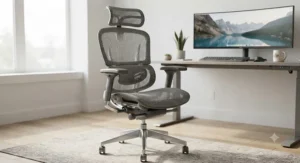
This is the first chair on the list where the seat itself, not just the backrest, is open mesh — the standout feature that actually earns the word “breathable” in its most literal sense.
Both the seat pan and backrest use tensioned mesh rated to support the body without sagging, which means airflow moves underneath your legs, not just behind your spine — a genuinely different experience from every chair above it on this list. The 3D padded armrests, adjustable lumbar, and 130-degree recline round out a build quality that reads more like a flagship office chair than a gaming peripheral, even though it’s marketed primarily to gamers.
Who it suits: anyone who runs hot specifically through the seat — a common complaint among people who sweat easily during long sits — plus dedicated home-office users who want gaming-chair recline range without a gaming-chair aesthetic. Reviewers are fairly unanimous that the full-mesh build noticeably reduces the “stuck to the seat” feeling of a long session, with the honest caveat that a firm mesh pan feels less plush than a cushioned seat, so buyers who prefer sinking in should test that trade-off before committing.
Pros:
- ✅ Full-mesh seat and back deliver genuine two-zone airflow
- ✅ 130-degree recline supports real lean-back breaks
- ✅ Flagship-level build quality and adjustability
Cons:
- ❌ Firmer feel than a padded seat, which won’t suit everyone
- ❌ Meaningfully pricier than back-only mesh alternatives
Expect a price in the C$800-C$950 range — a real jump, but one that buys the specific thing back-only mesh chairs structurally can’t: airflow under your thighs, not just behind your spine.
7. Herman Miller Aeron — best premium, buy-it-for-life choice
The standout is the material itself: Herman Miller’s 8Z Pellicle mesh, an engineered weave that varies its tension across different zones of the seat and back to act as a suspension system rather than a static barrier.
That zoned tension means the mesh under your sit bones is tuned differently than the mesh supporting your lower back, distributing pressure in a way flat, uniform mesh simply can’t replicate. The PostureFit SL system adds a second layer of support specifically for the sacrum and lumbar region, and the chair ships in three distinct sizes — A, B, and C — rather than one frame with adjustable parts trying to fit every body. That sizing approach is worth pausing on: instead of stretching one geometry to accommodate a 5’1″ user and a 6’4″ user with the same seat pan, Herman Miller built three different seat pans.
Who it’s for: buyers treating this as a decade-plus investment, professionals who sit eight-plus hours daily, and anyone whose lower back has specifically struggled with generic mesh chairs. Aggregated review sentiment across major retailers and workplace-furniture reviewers consistently ranks the Aeron among the most breathable chairs tested, with the near-universal caveat being price — this is not an impulse purchase, and the fully loaded configuration (adjustable arms, headrest) pushes the total meaningfully higher.
Pros:
- ✅ Zoned 8Z Pellicle mesh outperforms uniform mesh on pressure distribution
- ✅ Three dedicated sizes instead of one-size-fits-most
- ✅ Exceptional reputation for long-term durability
Cons:
- ❌ Premium price puts it out of reach for many budgets
- ❌ Fixed seat depth per size means less micro-adjustment than rivals
At a price typically in the C$2,200-C$2,600 range depending on size and configuration, the Herman Miller Aeron remains the chair most ergonomics-focused reviewers point to first — check current price and configuration options carefully, since size and add-ons swing the total substantially.
Practical Usage Guide: Getting the Most Airflow From Any Mesh Chair
Buying breathable mesh is only half the equation — how you set the chair up determines whether you actually feel the airflow benefit. Start with seat height: CCOHS recommends adjusting the chair so your feet sit flat on the floor (or on a footrest) with knees at roughly 90 degrees, because a seat that’s too high pushes more of your body weight onto the back of your thighs, exactly where you want mesh to breathe rather than compress.
Next, dial in lumbar depth before anything else — CCOHS’s chair-adjustment guidance calls this the “chair-first” step, since a poorly positioned lumbar support forces you to slouch forward, which presses your back flat against the mesh and cancels out the airflow gap the mesh is designed to create. Leave a two-to-three finger gap between the front seat edge and the back of your knees; too little gap restricts circulation and traps heat locally, regardless of how breathable the material is.
In the first 30 days, the most common mistake is leaving tilt tension on the factory default. Loosen it slightly if you recline often — a tension that’s too tight keeps your back pressed rigidly against the mesh instead of letting natural micro-movements circulate air behind you. Finally, vacuum the mesh weave monthly; dust and pet hair clog the open weave faster than most owners expect, quietly reducing the very airflow you paid extra for.
Real-World Scenarios: Which Breathable Chair Fits Your Day
Consider three common buyer profiles. A university student working from a shared apartment bedroom, budget capped near C$200, chronically warm because the unit has no air conditioning — the Hbada E3 or GABRYLLY chair fits both the space constraint and the price ceiling, with the GABRYLLY winning out if the student runs on the larger side physically.
A hybrid-office professional splitting time between a downtown tower and a home desk, sitting six-plus hours on home-office days, budget flexible up to roughly C$500 — the Nouhaus Ergo3D or Steelcase Series 1 both make sense here, with the Nouhaus edging ahead for buyers who specifically complain of lower-back heat and pressure, and the Steelcase winning for buyers who value warranty coverage and brand-backed service.
A self-employed consultant working nine- and ten-hour days from a sun-facing home office, explicitly bothered by sweating through the backs of their thighs by early afternoon — this is the textbook case for full-mesh seating, meaning either the Razer Fujin Pro at the mid-premium tier or the Herman Miller Aeron if budget genuinely isn’t the limiting factor.
Buyer’s Decision Framework
If your main problem is a hot back but a cool enough seat, choose a back-only mesh chair like the SIHOO M57 or Steelcase Series 1, because paying extra for full-mesh seating solves a problem you don’t actually have. If you specifically sweat through your seat during long sits, choose full-mesh coverage — the Razer Fujin Pro or Herman Miller Aeron — because back-only mesh structurally cannot fix that. If your space is small or you move the chair often, prioritize the Hbada E3‘s lighter frame over heavier premium builds. If you’re taller than 6’1″ or heavier than 250 pounds, prioritize frame rating and seat width — the GABRYLLY or Aeron’s Size C — over price alone, since an undersized frame degrades both comfort and mesh lifespan faster than normal wear would.
✨ Don’t Miss These Exclusive Deals!
🔍 Take your home office setup to the next level with these carefully selected breathable chairs. Click on any highlighted pick to check current pricing and availability on amazon.ca. A cooler, more comfortable workday is one click away!
Breathable Office Chair vs Leather Office Chair
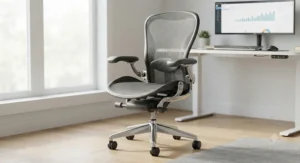
This comparison comes up constantly, and it deserves more than a one-line answer. Leather (and its more common cousin, bonded or PU leather) traps heat against the body by design — it’s a solid, largely non-porous surface, which is exactly why it feels premium and wipes clean but also why it’s the material most associated with a sweaty back by mid-afternoon. Mesh, by contrast, is an open weave that lets air pass directly through the material rather than pooling against it.
Where leather wins is aesthetics and durability against spills — a leather executive chair looks the part in a client-facing office and shrugs off a coffee spill that would soak straight through mesh. Where breathable mesh wins decisively is thermal comfort over long sitting sessions, particularly in warm climates or homes without reliable air conditioning, which describes a meaningful share of Canadian summers outside the coastal regions. For a home office used eight-plus hours a day, the airflow advantage of mesh tends to outweigh leather’s aesthetic edge; for a boardroom chair used in short client meetings, leather’s polish matters more than its heat retention.
How to Choose a Breathable Office Chair
Five criteria matter more than marketing copy when you’re comparing mesh chairs:
- Mesh coverage — back-only versus full seat-and-back. Full coverage costs more but solves seat-heat directly; back-only is sufficient for most users whose main complaint is a hot spine, not a hot seat.
- Mesh tension and grade — a tighter, higher-quality weave holds its shape for years, while loose, cheap mesh sags within months and stops supporting your back at all.
- Adjustable lumbar support — a slider that actually reaches your lower spine, not a fixed bump positioned for an “average” torso that may not match yours.
- Weight and size rating — check the manufacturer’s stated capacity and seat dimensions against your own body before assuming “one size fits most” applies to you.
- Armrest adjustability — 3D or 4D arms let you match forearm height to your specific desk, reducing shoulder tension that has nothing to do with breathability but affects comfort just as much.
Breathable Office Chair Review: What Real Buyers Report
Rather than inventing composite testimonials, it’s worth summarizing the patterns that show up repeatedly across aggregated customer feedback for mesh chairs in this category. First, satisfaction with temperature control is consistently high — buyers switching from padded or leather seating to mesh almost universally report noticeably less sweating and stickiness during long sessions, which lines up with the basic physics of an open weave versus a solid surface. Second, the most common complaint across price tiers isn’t breathability at all — it’s assembly difficulty and instruction quality, particularly on chairs with more adjustment points like 4D armrests. Third, longevity concerns cluster heavily around cheaper mesh: reviewers of sub-C$200 chairs report sagging or fraying mesh in the 18-24 month range far more often than reviewers of chairs in the C$400-plus tier, which tracks with the mesh-tension point covered above. If you’re reading reviews yourself before buying, weigh reviews older than a year more heavily for durability signals, since early reviews can’t speak to how a chair holds up.
Breathable Office Chairs for People Who Sweat Easily
If you already know you sweat more than most people during ordinary sitting — not exercising, not overheated, just sitting — a standard mesh-back chair may not be enough. The Canadian Dermatology Association estimates that roughly three percent of Canadians live with hyperhidrosis, a diagnosable condition of excessive sweating that goes beyond normal thermoregulation, and for that group, seat-level airflow isn’t a nice-to-have — it’s closer to a necessity.
For this specific audience, full-mesh seating like the Razer Fujin Pro or Herman Miller Aeron earns its higher price more directly than for the average buyer, because the problem being solved is localized to the seat pan itself, not just the backrest. Pairing a full-mesh chair with moisture-wicking seat cushion covers (sold separately, widely available) and scheduling brief standing breaks every 45-60 minutes compounds the benefit further — no chair alone eliminates hyperhidrosis, but airflow at the contact point measurably reduces how much moisture accumulates during a sitting block. If sweating is frequent, severe, and affecting your quality of life beyond the office chair itself, that’s worth raising with a healthcare provider rather than solving through furniture alone.
Climate Comfort and Ventilated Seating: The Science of Staying Cool
“Climate comfort” in seating design refers to how well a chair manages the microclimate between your body and the surface you’re sitting on — humidity, temperature, and airflow all combine to determine whether you feel dry and cool or damp and overheated after an hour in the same position. Ventilated seating tackles this through open-cell structures, whether that’s true mesh weave or perforated foam with air channels cut through it, both of which give heat and moisture somewhere to go instead of building up in a sealed pocket against your skin.
The practical upshot: two chairs can look nearly identical in a product photo and perform completely differently on this metric, because climate comfort depends on the density and openness of the weave, not just the presence of the word “mesh” on the listing. A loosely woven mesh with large gaps moves more air but supports less weight before sagging; a tightly woven high-tension mesh supports more weight but moves marginally less air per square inch. Every chair on this list leans toward the tighter, more supportive end of that spectrum, which is deliberate — sagging mesh is a bigger long-term comfort problem than a marginal airflow difference.
Common Mistakes When Buying a Breathable Office Chair
The single most common mistake is assuming “mesh chair” automatically means full-body breathability, when in reality most chairs under C$400 use mesh on the backrest only and keep a padded seat, as covered throughout this guide. A second frequent error is skipping the weight and size specs entirely and buying on looks — a chair rated for an average frame will sag and lose lumbar accuracy faster under a heavier or taller user, undermining both comfort and mesh lifespan. Third, buyers regularly ignore armrest adjustability, treating it as a minor feature, when mismatched armrest height is a well-documented contributor to shoulder and neck tension independent of how breathable the seat is. Finally, many buyers set up a new chair once and never touch the adjustments again — as CCOHS notes, chairs need periodic re-adjustment throughout the day and as your desk setup changes, not a single set-and-forget calibration on day one.
Long-Term Cost & Maintenance
Sticker price tells an incomplete story. A C$180 budget mesh chair replaced every 18-24 months due to sagging works out to roughly C$90-120 per year of ownership, before accounting for the discomfort and productivity cost of a degrading chair in month 20. A C$600 mid-range chair backed by a genuine multi-year warranty, replaced once every six to eight years, can land in a similar or lower annual cost once you factor in fewer replacement cycles and, often, replaceable parts rather than full chair disposal. At the premium tier, the Herman Miller Aeron‘s widely cited 12-year warranty changes the math again — spread across a decade-plus of daily use, the effective annual cost narrows the gap with mid-range options considerably, even though the upfront number is intimidating.
Maintenance itself is low but not zero: vacuum the mesh weave monthly to prevent clogging, wipe the frame with a damp cloth rather than harsh solvents that can degrade mesh fibres, and check caster and gas-lift function every few months, since a sticking height mechanism is one of the more common failure points across every price tier.
Safety, Certification, and Canadian Workplace Guidelines
Canada doesn’t have a single federal law dictating exactly what an office chair must include, but the Canadian Centre for Occupational Health and Safety publishes detailed guidance that most Canadian employers reference when furnishing workspaces, and it’s worth applying at home even if no one’s checking. CCOHS’s chair-selection criteria explicitly call out breathable, non-slippery seat fabric as a desirable feature alongside adjustable seat height, backrest tilt, and lumbar support — meaning the “breathable” priority in this guide isn’t just a comfort preference, it’s aligned with recognized occupational health guidance.
The CSA Group’s Z412 standard on office ergonomics goes further for employers designing formal workstations, recommending that workers alternate between sitting postures throughout the day rather than holding one position for hours — a principle that reinforces why recline range and tilt-lock features, present on every chair in this guide, matter as much as the mesh itself. If your employer is reimbursing a home-office chair purchase, referencing CCOHS’s published criteria in your request can also help justify a mid-range or premium pick over the cheapest available option.
Frequently Asked Questions
❓ Are breathable mesh office chairs actually cooler than padded chairs?
❓ Is a breathable office chair worth it for someone who works from home part-time?
❓ Do full-mesh seats feel less comfortable than padded seats?
❓ How long does mesh last on an office chair before it sags?
❓ Can a breathable office chair help with excessive sweating while sitting?
Conclusion
The right breathable office chair depends less on brand reputation and more on matching mesh coverage to where you actually run hot. If your discomfort lives mainly in your back, a back-only mesh chair like the SIHOO M57 or Steelcase Series 1 solves the problem without the premium price tag of full-mesh seating. If your seat is the real issue — a common story for people who sweat easily or sit ten-hour days — the Razer Fujin Pro or Herman Miller Aeron deliver airflow that back-only designs structurally can’t replicate. Budget, frame size, and how long you plan to keep the chair should all factor into the final call, but the underlying physics stays the same across every price point: open weave beats solid upholstery for thermal comfort, every time you sit down for the long haul.
Whichever chair you land on, treat the setup steps in this guide — seat height, lumbar depth, tilt tension — as part of the purchase, not an optional afterthought. A breathable chair set up poorly still traps heat against a slouched back; a breathable chair set up correctly delivers on exactly what its mesh promises.
Recommended for You
- 7 Affordable Leather Office Chairs in 2026 That Won’t Wreck Your Back
- Upholstered Office Chairs 2026: 7 Comfy, Stylish Picks
- 7 Best Mesh Office Chairs for Back Support in Canada (2026)
Disclaimer: This article contains affiliate links. As an Amazon Associate, I earn from qualifying purchases. If you purchase products through these links, we may earn a small commission at no additional cost to you.
✨ Found this helpful? Share it with your friends! 💬🤗
