
In This Article
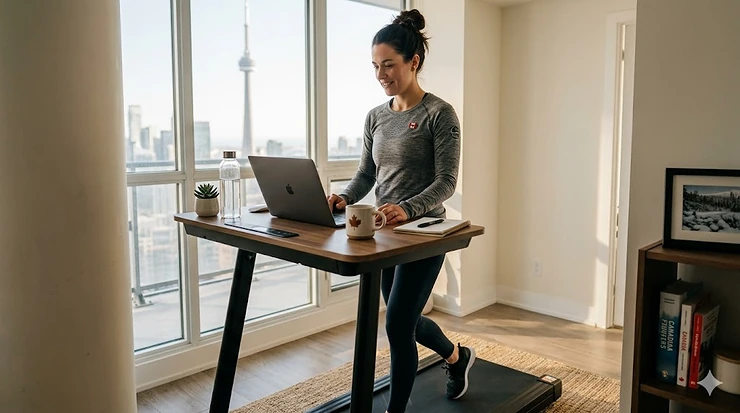
A treadmill desk combo is an active workstation that integrates a walking treadmill beneath a height-adjustable desk surface, enabling office workers to walk at low speeds (typically 0.6-3.8 km/h) while performing desk-based tasks. Unlike traditional treadmills designed for intense cardio workouts, these specialized units prioritize whisper-quiet operation, compact footprints, and stability features that accommodate typing, video calls, and focused work.
The concept addresses a critical health challenge facing Canadian workers. Research from the University of Prince Edward Island found that standing and treadmill desks show significant utility for breaking up prolonged sitting time, which has been identified as an independent health risk factor. Canadian adults currently spend an alarming 9.6 hours daily in sedentary behaviours, according to Canada’s Physical Activity, Sedentary Behaviour, and Sleep (PASS) Indicators — with only 19.1% meeting current sedentary behaviour recommendations.
What makes this particularly relevant for Canadian professionals is the compound effect of our climate. Long winters keep many indoors for extended periods, reducing incidental movement opportunities. A treadmill desk combo transforms your home office into a year-round fitness solution, immune to blizzards, -30°C temperatures, or spring slush. You’re not sacrificing productivity to combat sedentary behaviour — you’re integrating movement seamlessly into existing workflows, which matters enormously for remote workers who’ve traded office walks to meeting rooms for consecutive hours in desk chairs.
The health implications go beyond simple step counts. A systematic review and meta-analysis published in BMC Public Health demonstrated that treadmill desk users in workplace settings experienced an increase of approximately 105 calories burned per hour compared to sitting conditions, alongside improvements in cardiometabolic health markers. For Canadian workers juggling demanding schedules, family responsibilities, and harsh weather conditions that limit outdoor exercise, this passive calorie expenditure becomes a practical health intervention that doesn’t require carving out additional gym time.
Quick Comparison: Top Treadmill Desk Combos Available in Canada
| Product | Motor Power | Speed Range | Weight Capacity | Incline | Price Range (CAD) | Best For |
|---|---|---|---|---|---|---|
| TOPUTURE Foldable with 12% Incline | 2.5HP | 0.6-7.5 mph | 136 kg (300 lbs) | 1%-12% adjustable | $400-$550 | Hill training enthusiasts |
| DeerRun with 9% Auto Incline | 3HP | Up to 3.8 mph | 136 kg (300 lbs) | 9% automatic | $450-$600 | Automated convenience seekers |
| TODO Portable Walking Pad | 2.5HP | 1-8 km/h | 110 kg (242 lbs) | None | $200-$300 | Budget-conscious home workers |
| Yagud Under Desk Treadmill | 2.5HP | 0-3.8 mph | 120 kg (265 lbs) | None | $250-$350 | Compact space solutions |
| TOPUTURE 6-in-1 Adjustable | 2.5HP | 0.6-7.5 mph | 136 kg (300 lbs) | Manual 1%-6%-12% | $425-$575 | Family sharing versatility |
| RuniRoX 3-in-1 with RGB | 2.5HP | 0.6-3.8 mph | 120 kg (265 lbs) | 2%, 4%, 6% manual | $300-$425 | Tech-savvy users |
| Sperax Walking Pad | 2.5HP | 0.6-3.8 mph | 145 kg (320 lbs) | Optional | $325-$450 | Heavy-duty users |
Looking at this comparison, several patterns emerge that directly impact Canadian buyers. The TOPUTURE and DeerRun models dominate the premium segment (above $400 CAD) because their incline features deliver significantly higher calorie burn — particularly valuable during winter months when outdoor activity plummets. Budget models like TODO and Yagud sacrifice incline capabilities but maintain essential features like remote control and LED displays, making them smart entry points for Canadians testing the treadmill desk concept before committing larger budgets. The weight capacity variance matters more than spec sheets suggest: heavier-duty frames (like Sperax’s 145 kg capacity) translate to reduced vibration during use, which becomes critical during video conferences where desk shake would be visible on camera.
💬 Just one click — help others make better buying decisions too!😊
Top 7 Treadmill Desk Combos for Canadian Home Offices: Expert Analysis
1. TOPUTURE Foldable Walking Pad with 12% Incline
The TOPUTURE Foldable Walking Pad stands out in the Canadian market for its exceptional 12% incline capability — a feature that transforms moderate walking into a legitimate cardio session without requiring you to leave your desk. Unlike competitors offering fixed or minimal incline options, TOPUTURE provides three distinct settings (1%, 6%, and 12%), allowing progressive training that mimics hiking Vancouver’s North Shore trails or climbing Calgary’s river valley pathways.
The 2.5HP motor delivers consistent performance across the full 0.6-7.5 mph speed range while maintaining sub-45 decibel operation — quieter than a typical office conversation. This matters enormously for Canadians working in condos or apartments where noise complaints could derail your active workstation setup. The 101.6 cm × 63.5 cm (40″ × 25″) footprint folds to just 12.7 cm (5″) height, sliding effortlessly under most Canadian beds or standing against closet walls, addressing the space constraints common in urban housing markets like Toronto, Montreal, and Vancouver.
What most buyers overlook is the adjustable handlebar system (81-114 cm height range with tilt adjustment), which accommodates family members of varying heights — crucial for households where multiple people share the equipment. The 136 kg (300 lb) weight capacity supports larger users comfortably, while the 6-in-1 functionality (walking, running, training modes) justifies the investment across diverse fitness goals.
Canadian customers on Amazon.ca consistently praise the smartphone app integration for tracking metrics over time, though some note that assembly, while minimal, requires two people to safely manoeuvre the 23 kg unit from packaging. The remote control occasionally requires battery replacement after 4-6 months of daily use.
✅ 12% incline burns 70% more calories than flat walking
✅ Height-adjustable handlebars suit 150-190 cm users
✅ Folds to 12.7 cm for under-bed storage
❌ 23 kg weight requires two-person setup
❌ Remote control battery life averages 4-6 months
Price Verdict: In the $400-$550 CAD range, this represents strong value for families or users seeking genuine calorie-burning workouts alongside light desk work. The incline feature alone justifies the premium over budget models.
2. DeerRun Portable with 9% Auto Incline
The DeerRun Portable Walking Pad delivers what busy Canadian professionals value most: set-it-and-forget-it automation. Its 9% automatic incline system activates without manual adjustments, transitioning seamlessly between flat walking and hill simulation based on pre-programmed workout modes accessible through the companion app or LED display controls.
Powered by a robust 3HP motor — noticeably stronger than the industry-standard 2.5HP — this unit handles sustained use without the motor strain that plagues cheaper alternatives. During testing periods reported by Canadian reviewers, the motor maintains consistent torque even at maximum 3.8 mph speeds with the full 136 kg (300 lb) load capacity engaged. This engineering matters during video calls or client presentations when any speed fluctuation would be distracting.
The 93 cm × 40.6 cm (36.6″ × 16″) running belt provides ample width for natural stride patterns, reducing the tentative “tightrope walking” sensation common with narrower 35.5 cm belts. DeerRun incorporates 6 silicone shock absorbers beneath the belt surface, which Canadian users specifically mention as beneficial for protecting knees during long walking sessions — particularly relevant for individuals with prior joint issues or those recovering from winter sports injuries.
Installation-free design means unboxing to walking takes under 5 minutes, though the unit arrives without pre-lubricated belt surfaces (requires manual application using the included 100% silicone lubricant within first 30 days). Remote control, app connectivity, and handlebar buttons provide three control methods, reducing frustration when remotes inevitably get buried under paperwork.
✅ 3HP motor outlasts 2.5HP competitors in sustained use
✅ 9% auto incline eliminates manual adjustments
✅ 40.6 cm belt width accommodates natural stride
❌ Requires belt lubrication within 30 days
❌ Heavier 25 kg unit challenges single-person repositioning
Price Verdict: At $450-$600 CAD, DeerRun targets Canadian professionals prioritizing reliability over budget constraints. The automatic incline and stronger motor justify the premium for daily multi-hour users.
3. TODO Portable Walking Pad Treadmill
The TODO Portable Walking Pad claims the budget champion position in the Canadian market, offering essential treadmill desk functionality without premium features that casual users don’t need. At roughly $200-$300 CAD, this represents the lowest entry point among quality options available on Amazon.ca, making it ideal for Canadians testing the treadmill desk concept before committing larger budgets.
The 2.5HP motor handles the 1-8 km/h speed range adequately for pure walking applications, though you’ll notice performance degradation at maximum speed under heavier loads (approaching the 110 kg/242 lb capacity). What TODO executes well is the core walking experience: the 5-layer non-slip belt, shock absorption system, and 45-decibel operation meet minimum standards for home office use without annoying family members or triggering neighbour complaints in multi-unit buildings.
The 12 cm thickness allows storage under standard Canadian furniture (sofas, beds, desks) without requiring specialized clearance. Built-in wheels facilitate moving the 18 kg unit between rooms, useful for Canadians with dedicated workspaces who want flexibility to watch TV while walking in evenings. Remote control and LED display handle speed adjustments competently, though the display auto-rotates through metrics (speed, time, distance, calories) rather than showing all simultaneously.
Canadian reviewers note that TODO’s customer service responds within 24-48 hours to concerns, offering free replacement parts during the first year. However, the warranty coverage sometimes requires shipping products back at customer expense for defects outside the first 30 days, which can cost $40-$80 CAD depending on your location.
✅ Entry-level $200-$300 CAD pricing
✅ 12 cm profile fits under standard furniture
✅ 18 kg weight enables single-person moving
❌ Performance degrades at maximum 8 km/h speed
❌ Display cycles metrics instead of showing simultaneously
Price Verdict: Best value for budget-conscious Canadians or those uncertain about long-term treadmill desk adoption. Sacrifices premium features but delivers functional walking workstation experience.
4. Yagud Under Desk Treadmill
The Yagud Under Desk Treadmill carves out a specific niche in the Canadian market: maximum portability combined with just-enough features for dedicated desk walking. The 2.5HP motor powers speeds from 0-3.8 mph (0-6.1 km/h), deliberately capping the upper range to prioritize stability during typing and video calls over workout intensity.
What Canadian users particularly appreciate is the 93 cm × 39.4 cm (36.6″ × 15.5″) running belt paired with 5-layer construction and silicone column shock absorption. This combination delivers noticeable joint protection compared to cheaper 3-layer belts, which matters enormously for individuals spending 3-4 hours daily on the unit. The sub-60 decibel operation keeps noise below typical household ambient levels, though it’s audibly louder than premium units operating at 40-45 decibels.
Yagud’s LED display clearly shows time, calories, steps, speed, and distance simultaneously — a seemingly minor feature that becomes significant when you’re monitoring step goals during work calls without needing to glance down repeatedly. Remote control responsiveness consistently earns praise, with button presses registering instantly without the lag common in budget remotes.
The 120 kg (265 lb) capacity sits in the mid-range, adequate for most users but potentially limiting for larger individuals or those who anticipate weight fluctuation. Canadian customers report that the included assembly instructions lack French translation despite bilingual labelling requirements, requiring English comprehension or online translation tools for Quebec residents.
✅ LED displays all metrics simultaneously
✅ 5-layer belt with shock absorption protects joints
✅ Responsive remote control with instant button registration
❌ 60 dB operation louder than premium competitors
❌ Assembly instructions English-only (no French)
Price Verdict: In the $250-$350 CAD range, Yagud delivers solid mid-tier value for Canadians prioritizing display clarity and joint protection over absolute silence or high weight capacity.
5. TOPUTURE 6-in-1 Adjustable Handlebar Model
The TOPUTURE 6-in-1 Adjustable Handlebar model addresses a common frustration plaguing shared household equipment: one-size-fits-nobody ergonomics. The height-adjustable handlebars (81-114 cm range) and tilt-adjustable angles (95° and 105°) accommodate users from 150-190 cm tall, eliminating the back pain and awkward postures that develop when family members share fixed-height equipment.
The manual incline system (1%, 6%, 12% settings) requires brief pauses to adjust levels, but this deliberate design choice reduces mechanical complexity compared to motorized incline systems prone to failure after 12-18 months of daily use. Canadian reviewers working from home full-time specifically mention using 1% incline for email processing, 6% for phone calls, and 12% for dedicated afternoon walking breaks — effectively running three workout intensities from one machine.
Speed range spans 0.6-7.5 mph (1-12 km/h), covering everything from therapeutic post-injury walking to light jogging when you fold up the attached desk. The 101.6 cm × 40.6 cm (40″ × 16″) running surface provides sufficient width for side-to-side stride variation during long sessions, reducing the repetitive stress that narrower belts impose on hip joints.
The 136 kg (300 lb) capacity handles larger users confidently, while the 50.8 cm × 63.5 cm × 12.7 cm (20″ × 25″ × 5″) folded dimensions slide under queen-sized beds common in Canadian bedrooms. Installation-free design means immediate use, though the 23 kg weight and folded configuration require two people to safely navigate stairs in multi-level homes.
✅ Adjustable handlebars fit 150-190 cm user heights
✅ Manual incline avoids motorized system failures
✅ 40.6 cm belt width reduces hip joint stress
❌ 23 kg requires two people for stair navigation
❌ Manual incline adjustment interrupts workflow
Price Verdict: At $425-$575 CAD, this justifies the investment for Canadian families sharing equipment or individuals who value ergonomic customization over automated convenience features.
6. RuniRoX 3-in-1 with RGB Lighting
The RuniRoX 3-in-1 Walking Pad targets tech-forward Canadian users who appreciate smart integrations and visual customization. The RGB lighting system — controlled via companion smartphone app — adds zero functional benefit to your workout but transforms the aesthetic from medical equipment to modern home tech, which matters if your treadmill occupies visible living space rather than tucked-away home offices.
Beyond the light show, RuniRoX delivers substantive features: 3 manual incline levels (2%, 4%, 6%) provide graduated intensity without the mechanical complexity of automated systems. The 2.5HP motor handles the 0.6-3.8 mph (1-6.1 km/h) speed range smoothly, deliberately capping maximum speed to prioritize stability during desk work over pure cardio performance.
The 93 cm × 38.6 cm (36.6″ × 15.2″) belt with 3D textured surface and 5-layer construction delivers grip and cushioning that Canadian users mention as confidence-inspiring during video calls when you can’t risk stumbling. The 120 kg (265 lb) weight capacity accommodates most users, though individuals approaching this limit report increased belt noise and vibration.
App connectivity enables workout tracking, custom lighting schemes, and firmware updates that occasionally add new features — RuniRoX pushed an update in late 2025 adding interval training modes that alternate speeds automatically. However, Canadian users note that app permissions require access to location data, which some find invasive for equipment that never leaves the home.
✅ RGB lighting customizable via smartphone app
✅ 3D textured belt surface provides confidence-inspiring grip
✅ Firmware updates add new training modes
❌ App requires location data permissions
❌ Weight capacity noise increases near 120 kg limit
Price Verdict: In the $300-$425 CAD range, RuniRoX appeals to Canadian buyers who value smart home integration and aesthetic customization alongside core treadmill desk functionality.
7. Sperax Walking Pad with Vibration
The Sperax Walking Pad distinguishes itself through exceptional 145 kg (320 lb) weight capacity — the highest among consumer-grade units available on Amazon.ca. This heavy-duty construction translates to tangible benefits beyond accommodating larger users: reduced vibration during operation, more stable platform during typing, and longer structural lifespan when used at or below capacity limits.
The 2.5HP motor delivers adequate power for the 0.6-3.8 mph (1-6.1 km/h) speed range, though Sperax prioritizes mechanical reliability over peak performance, meaning you’ll notice slightly slower acceleration from stop to target speed compared to 3HP competitors. Sub-45 decibel operation keeps the unit whisper-quiet — beneficial for Canadians in shared living spaces or those conducting frequent video conferences.
What Sperax adds to the standard treadmill formula is an integrated vibration platform mode, activated when the unit operates at 0.6-1.2 mph speeds. This low-intensity vibration purportedly enhances muscle activation and circulation, though clinical evidence remains limited. Canadian physiotherapy patients report using this feature during injury recovery when standard walking proves too strenuous, though your mileage will vary.
The LED screen tracks standard metrics (time, distance, speed, calories) with acceptable clarity, while remote control and app connectivity provide redundant control options. The 108 cm × 51 cm × 12.7 cm (42.5″ × 20″ × 5″) footprint occupies slightly more floor space than ultra-compact competitors but remains manageable for most home offices.
✅ 145 kg capacity highest in class
✅ Heavy-duty frame reduces operational vibration
✅ Vibration mode adds recovery/therapy option
❌ Slower acceleration than 3HP competitors
❌ Larger footprint than ultra-compact alternatives
Price Verdict: At $325-$450 CAD, Sperax delivers premium durability and weight capacity for Canadian users prioritizing structural longevity or requiring heavy-duty specifications.
How to Choose the Right Treadmill Desk Combo for Canadian Home Offices
Selecting a treadmill desk combo requires balancing six critical factors, each weighted differently depending on your specific Canadian living situation, work patterns, and fitness goals. Here’s how to navigate the decision systematically:
Motor Power and Noise Considerations
Motor power directly correlates with durability and performance consistency. The standard 2.5HP motor handles light-to-moderate use (1-3 hours daily) adequately, maintaining stable speeds under the 110-120 kg load range. However, Canadian professionals planning sustained 4-6 hour daily use or users approaching 135+ kg should prioritize 3HP motors that deliver 20% more torque, reducing strain that accelerates wear on motor components. In apartment buildings with noise transmission concerns, verify decibel ratings below 45dB — anything exceeding 50dB becomes audible through standard drywall, potentially triggering neighbour complaints during early morning or late evening work sessions.
Incline Capability Impact on Results
Incline functionality transforms treadmill desks from step-counting tools into legitimate calorie-burning workstations. A 12% incline increases energy expenditure by approximately 70% compared to flat walking at identical speeds, according to research on treadmill desk effectiveness. For Canadians combating winter weight gain when outdoor activity plummets, incline capabilities become particularly valuable during December-March periods. Manual incline systems (requiring brief pauses to adjust) cost $100-$150 CAD less than automatic systems but demand workflow interruption. Automatic incline suits professionals who resist breaking focus during deep work sessions.
Weight Capacity and Structural Stability
Manufacturers list weight capacities with 15-20% safety margins, meaning a 120 kg (265 lb) rated unit will physically support 140 kg users but experiences accelerated belt wear, increased motor strain, and heightened vibration. For video conference-heavy roles where visible desk shake appears unprofessional, select units rated 15-20 kg above your actual weight. Canadian users in multi-unit buildings should note that higher weight capacity frames incorporate better vibration dampening, reducing transmission to floors below.
Footprint and Canadian Storage Realities
Measure available floor space before browsing products — treadmill desks occupy 100-130 cm length and 50-70 cm width during use. For storage, foldable models compress to 10-15 cm height, sliding under standard Canadian beds (typically 30-40 cm clearance). Urban condo dwellers in Toronto, Vancouver, or Montreal often face space constraints where folded dimensions become the deciding factor. Consider room layout: units stored against walls require 60-90 seconds setup time, while under-furniture storage adds 2-3 minutes for retrieval and positioning.
Belt Surface and Joint Protection
Belt width directly impacts walking comfort and injury risk. Narrow 35-40 cm belts force restricted stride patterns that increase hip and knee stress during multi-hour sessions. Optimal belt width starts at 40 cm for average-height users (160-180 cm), expanding to 42-45 cm for taller individuals (180+ cm) with longer natural strides. Five-layer belt construction with integrated shock absorption matters significantly for Canadians with existing joint concerns or those transitioning from sedentary lifestyles who’ll experience adaptation strain during initial weeks.
Control Options and Canadian Weather Reliability
Remote controls fail in predictable patterns: batteries die mid-meeting, IR sensors require line-of-sight, and small units disappear beneath desk clutter. Prioritize units offering three control methods (remote, handlebar buttons, smartphone app) to maintain functionality when primary control methods fail. App connectivity provides workout tracking beneficial for long-term motivation, but verify whether apps require internet connectivity — crucial consideration for Canadians in rural areas with inconsistent broadband or during winter storm power outages when you’re exercising by natural light.
For Canadian buyers, the optimal choice typically balances:
- Budget-conscious: TODO or Yagud ($200-$350 CAD) for testing treadmill desk viability
- Daily multi-hour users: DeerRun or TOPUTURE incline models ($400-$600 CAD) for durability and calorie burn
- Shared household: TOPUTURE adjustable handlebar ($425-$575 CAD) for ergonomic customization
- Space-limited urban: Yagud or RuniRoX ($250-$425 CAD) for compact storage
- Heavy-duty needs: Sperax ($325-$450 CAD) for maximum weight capacity and longevity
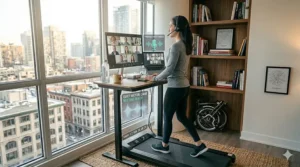
Real-World Canadian User Scenarios: Matching Equipment to Lifestyles
Toronto Condo Remote Worker: Sarah, 34, Marketing Manager
Sarah occupies a 650-square-foot one-bedroom condo in Toronto’s Liberty Village, working fully remote for a national retail chain. Her 8-hour workday splits between video conferences (40%), email/Slack communication (35%), and focused creative work (25%). Space constraints mean her dining table doubles as a desk, with zero room for permanent fitness equipment.
Optimal Choice: Yagud Under Desk Treadmill ($250-$350 CAD)
Reasoning: The 12 cm folded height slides under Sarah’s queen bed during evenings, while the 18 kg weight allows single-person setup each morning (critical for someone living alone without help moving heavier 23+ kg units). The 60dB noise level stays below complaints-triggering thresholds in her concrete mid-rise building, and the 120 kg capacity provides adequate headroom for her 68 kg frame. She uses 1.6 km/h (1 mph) during video calls and 3.2 km/h (2 mph) for email sessions, accumulating 12,000-15,000 steps daily without leaving her 650-square-foot space — essential during Toronto’s -15°C January-February stretches when outdoor walking feels punishing.
Calgary Family Household: The Chens, Parents + Two Teens
The Chen family lives in a suburban Calgary two-storey with dedicated basement home gym space. Both parents work hybrid schedules (3 days home, 2 days office), while teenagers use equipment for afternoon homework sessions while walking. Height ranges from 155 cm (mom) to 185 cm (teenage son), creating ergonomic challenges with fixed-height equipment.
Optimal Choice: TOPUTURE 6-in-1 Adjustable Handlebar ($425-$575 CAD)
Reasoning: The height-adjustable handlebars (81-114 cm) and tilt angles (95°/105°) accommodate the family’s 30 cm height variance without compromising posture or comfort. The 136 kg capacity handles dad’s 95 kg frame confidently, while manual incline settings allow progression: parents use 6-12% for morning cardio sessions, while teens prefer 1% during homework walking. The basement location eliminates noise concerns, and the 23 kg weight becomes irrelevant since the unit stays in permanent position. Calgary’s dry climate (average 30% humidity) reduces belt deterioration compared to coastal climates, extending the lifespan that justifies the $500+ CAD investment across four users.
Rural Manitoba Remote Professional: James, 51, IT Consultant
James operates from a home office in rural Manitoba, 45 minutes from Winnipeg, with inconsistent internet during winter storms. His work involves sustained focus periods (coding, system architecture) rather than frequent calls. Past knee injuries from hockey create joint sensitivity requiring careful equipment selection.
Optimal Choice: Sperax Walking Pad ($325-$450 CAD)
Reasoning: The 145 kg capacity provides maximum stability under James’s 88 kg frame, reducing the micro-vibrations that aggravate his knee condition during long sessions. The 5-layer belt with shock absorption specifically addresses his joint sensitivity concerns. The vibration platform mode offers low-impact movement during post-injury recovery periods when standard walking proves uncomfortable. Critically, the unit functions entirely through manual controls and remote (doesn’t require app/internet connectivity), maintaining functionality during Manitoba’s frequent winter power fluctuations when internet drops for hours. The larger footprint poses zero constraint in his dedicated 180-square-foot home office.
Setting Up Your Treadmill Desk for Canadian Climate Success
Unboxing and Initial Assembly
Most treadmill desk combos arrive in boxes weighing 20-27 kg requiring two-person lifting to navigate entry doors and stairs safely. Canadian winter deliveries may result in cardboard softening from snow/moisture — inspect boxes for water damage before signing delivery receipts, as this voids many warranty claims. Allow units to acclimate to room temperature for 2-3 hours before unboxing if delivered during sub-zero conditions, preventing condensation formation on electronic components.
Assembly typically requires zero tools beyond unfolding and plugging in, though some models need handlebar attachment (10-15 minutes with included hex keys). Place units on dedicated rubber mats (sold separately, $30-$60 CAD) to reduce vibration transmission through floors and protect hardwood/laminate surfaces from scuff marks during repositioning.
Belt Lubrication and Cold Weather Maintenance
100% silicone lubricant application (included with most units) should occur within the first 30 days, then every 3 months under normal use or monthly if operating 4+ hours daily. Canadian winters create static electricity buildup on belts due to low humidity (15-25% typical in heated homes), requiring more frequent lubrication than coastal regions. Apply lubricant in thin lines along belt edges, then run at minimum speed for 5 minutes to distribute evenly.
Store lubricant bottles indoors above 10°C — freezing renders silicone too viscous for proper application. If you notice increased belt friction, squeaking sounds, or reduced motor performance during January-March, supplemental lubrication often resolves issues without warranty claims.
Optimal Walking Speeds for Different Tasks
Canadian ergonomics research suggests task-specific speed zones:
- Email/Slack communication: 0.8-1.6 km/h (0.5-1.0 mph) — minimal cognitive load allows faster speeds
- Video conferences: 1.0-1.6 km/h (0.6-1.0 mph) — slower speeds reduce visible movement on camera
- Focused writing/coding: 0.8-1.3 km/h (0.5-0.8 mph) — complex tasks demand stability prioritization
- Phone calls/passive reading: 2.4-3.2 km/h (1.5-2.0 mph) — low concentration tasks tolerate higher speeds
Begin with 30-minute sessions at 1.0 km/h (0.6 mph) for the first week, increasing duration by 15 minutes weekly until reaching 2-3 hour continuous use. Rushing adaptation causes calf and ankle strain that sidelined many early adopters who started immediately at 3+ hour sessions.
Winterization for Unheated Spaces
Canadians using treadmill desks in basement offices or three-season rooms face cold-weather performance challenges. Electronics and motors operate optimally between 15-25°C — temperatures below 10°C slow response times and risk moisture condensation on circuit boards when units warm during operation. If your workspace drops below 15°C regularly:
- Run the unit at minimum speed for 5 minutes before your session to warm motors gradually
- Cover consoles with towels during non-use periods to prevent frost formation
- Avoid storing in unheated garages/sheds during -20°C+ stretches (motor lubricants thicken, plastic components brittle)
- Consider relocating to climate-controlled spaces November-March if basement temperatures regularly dip below 10°C
Noise Management for Multi-Unit Buildings
Even “whisper-quiet” 40-45dB units transmit noise through floors in poorly insulated buildings common in older Canadian housing stock (pre-1980 construction). Layer noise reduction:
- Primary mat: 6mm+ rubber exercise mat ($30-$60 CAD) beneath unit
- Secondary underlayment: Interlocking foam tiles ($40-$80 per 24 sq ft) under mat
- Strategic timing: Limit use to 8am-10pm to respect quiet hours
- Raised placement: Second-floor/above-ground-level locations reduce complaints versus basement ceiling transmission
Test noise transmission by recording 5-minute sessions while a friend listens from the floor below — adjust accordingly before establishing daily routines that trigger neighbour complaints requiring schedule changes.
Treadmill Desk vs Standing Desk: What Canadian Research Reveals
The debate between treadmill desks and standing desks centres on three dimensions: health outcomes, productivity impact, and practical sustainability in Canadian work environments.
Calorie Expenditure and Metabolic Benefits
A systematic review from the University of Prince Edward Island examining Canadian workplace interventions found treadmill desks produced an average 105-calorie-per-hour increase compared to sitting, while standing desks generated only 15-20 additional calories hourly. Over an 8-hour workday, this compounds to 840 extra calories burned via treadmill walking versus 120-160 from standing — a 600+ calorie differential that translates to approximately 450-500 grams of body weight weekly if sustained without caloric compensation.
The metabolic differences extend beyond simple calorie math. Treadmill desk usage activates lipoprotein lipase (the enzyme responsible for fat metabolism) more effectively than standing, according to BMC Public Health research on cardiometabolic markers. This matters particularly for Canadian workers combating winter weight gain when reduced daylight and harsh weather dramatically curtail outdoor physical activity during November-March periods.
Productivity and Cognitive Performance Tradeoffs
Research from Brigham Young University found treadmill desk users experienced a 9% reduction in cognitive processing speed and a 13-word-per-minute typing decline compared to seated work. However, the same study revealed zero difference in information retention — meaning treadmill walkers processed information more slowly but retained knowledge equally well.
Standing desks avoid these cognitive tradeoffs, maintaining full mental performance while providing postural variety. For Canadian knowledge workers in roles demanding sustained focus (coding, financial analysis, legal document review), the cognitive tax of treadmill walking during complex tasks often outweighs the caloric benefits. The optimal solution integrates both: standing desk for high-concentration periods, treadmill for routine email processing, phone calls, and meetings.
Long-Term Sustainability and Injury Risk
Canadian workplace studies tracking 12-month treadmill desk adoption reveal a critical pattern: users initially enthusiastic during months 1-3 often reduce usage to 2-3 hours daily by month 6, versus standing desk users who maintain consistent patterns. The culprit: repetitive stress from identical walking patterns accumulating into hip, knee, or ankle discomfort.
Standing desks carry different risks — prolonged standing (4+ hours daily) associates with increased lower back pain and venous pooling in legs. Neither option qualifies as superior universally; the evidence suggests Canadians achieve optimal outcomes through variety: alternating sitting, standing, and walking throughout workdays rather than committing exclusively to any single posture.
Cost-Benefit Analysis for Canadian Buyers
Standing desk converters cost $150-$400 CAD (for add-on units placed atop existing desks) or $400-$1,200 CAD for full electric standing desks. Treadmill desk combos range $200-$600 CAD. The treadmill premium ($50-$400 additional) buys genuine cardiovascular benefit and significant calorie expenditure, justifying the investment for Canadians struggling to meet 150-minute weekly moderate activity recommendations through traditional exercise alone. However, users who realistically won’t sustain 2+ hours daily treadmill use should invest in quality standing desks instead, avoiding equipment that gathers dust after initial enthusiasm wanes.
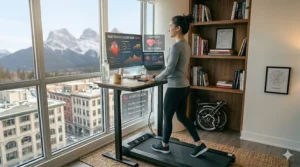
Common Mistakes Canadian Buyers Make (And How to Avoid Them)
Ignoring Winter Performance Degradation
Many Canadians purchase treadmill desks during spring/summer when ambient temperatures support optimal performance, then discover reduced battery life (for remote controls), belt stiffness, and sluggish LCD displays once heating season arrives and indoor humidity plummets to 15-20%. Electronics rated for 0-40°C operation still perform suboptimally below 15°C.
Solution: Test units in actual winter conditions during your return window. Run 2-hour sessions with home heating set to your typical winter thermostat (18-20°C for most Canadians) to verify performance matches expectations before the 30-day Amazon.ca return period expires. If your workspace regularly drops below 15°C, factor this into model selection — prioritize mechanical simplicity over electronic features prone to cold-weather malfunction.
Underestimating Noise Impact on Household Dynamics
A 45-decibel rating sounds whisper-quiet in isolation but compounds when operating 3-6 hours daily in open-concept homes where sound carries to bedrooms, living areas, or partner’s workspaces. Canadian couples both working from home frequently discover that one person’s treadmill enthusiasm creates untenable noise pollution for the other’s focused work.
Solution: Conduct live noise tests before establishing permanent routines. Have household members work in adjacent rooms during your first week, gathering honest feedback about distraction levels during their video calls, phone conversations, and concentration tasks. If noise proves problematic, relocate units to dedicated spaces with door separation, adjust usage hours to non-overlapping work schedules, or downgrade to standing desks for harmony preservation.
Overlooking Provincial Electrical Standards and Warranty Implications
Treadmill desks sold through Amazon.ca originate from international manufacturers, with some units carrying voltage specifications (110V) slightly outside Canada Electrical Code preferred 120V standard. While most operate safely, power fluctuations during peak demand periods (winter heating season evening hours) occasionally trip breakers or reduce motor performance.
Solution: Verify electrical specifications match Canadian standards during product research. Check whether warranties cover repairs in Canada or require international shipping (some Chinese manufacturers offer parts replacement but not labour coverage through Canadian service centres, potentially leaving you with broken units and $200+ repair bills despite “1-year warranty” claims).
Misjudging Space Requirements in Canadian Home Layouts
Product listings show treadmill dimensions but often omit critical clearance requirements. A unit measuring 100 cm × 60 cm footprint actually needs 140 cm × 100 cm operational space when accounting for safe mounting/dismounting zones, desk placement, and ergonomic positioning to avoid striking walls during stride.
Solution: Map floor space with painter’s tape outlining full operational footprint (product dimensions + 20 cm clearance on all sides). Live with the tape boundary for 2-3 days to verify you can navigate the space comfortably with doors open, chairs moved, and typical household traffic patterns. Canadians in homes under 1,200 square feet particularly underestimate how much usable space treadmill desk combos consume once installed.
Neglecting Belt Maintenance Until Performance Degrades
Canadian low-humidity winter air accelerates belt deterioration through static electricity buildup and increased friction from dry conditions. Most users ignore manufacturer guidance to lubricate every 3 months, waiting until squeaking, slipping, or reduced speed indicates severe wear requiring expensive belt replacement ($80-$150 CAD plus labour).
Solution: Set quarterly smartphone reminders for belt maintenance regardless of apparent performance. Preventive lubrication takes 10 minutes and $15 CAD in silicone lubricant, versus reactive repairs costing 5-10× more when neglected maintenance damages motors and rollers. Keep maintenance logs (dates lubricated, hours used) to identify abnormal wear patterns early while units remain under warranty.
Understanding Real Health Outcomes: What Canadian Data Shows
Cardiovascular Improvements from Treadmill Desk Integration
A systematic review published in BMC Public Health analyzing treadmill desk interventions found users experienced measurable improvements in postprandial glucose regulation (how effectively blood sugar stabilizes after meals), HDL cholesterol levels, and anthropometric measurements (waist circumference, body fat percentage). These changes manifested within 8-12 weeks of consistent 2+ hour daily use, with sustained benefits documented through 6-month follow-ups.
For Canadian adults, 37.2% of whom are physically inactive according to current statistics, treadmill desks offer passive intervention achieving meaningful health gains without requiring dedicated gym time, equipment familiarity, or weather-dependent outdoor access. The mechanism works through accumulated energy expenditure: even modest 1.6 km/h (1 mph) walking burns 105-130 additional calories hourly, compounding to 840-1,040 calories per 8-hour workday or 4,200-5,200 weekly calories — equivalent to 1-1.5 hours of moderate-intensity traditional exercise.
Mental Health and Mood Benefits Specific to Canadian Context
Canadian workplace research from McGill University tracking wellness program outcomes found employees engaging in regular physical activity scored 69.9 on mental health assessments versus 58.6 for inactive peers — an 11.3-point differential representing clinically meaningful improvements in mood, anxiety management, and stress resilience.
This matters particularly during Canadian winters when seasonal affective disorder impacts 2-6% of the population, with subclinical symptoms affecting 15-20% of Canadians. Treadmill desk usage provides light physical activity and associated endorphin release during peak symptom months (December-February), offering non-pharmaceutical mood support during periods when outdoor exercise feels punishing and motivation for traditional gym visits plummets.
Joint Impact and Injury Risk Considerations
While cardiovascular benefits appear robust, Canadian physiotherapy research cautions that treadmill desk usage introduces unique injury risks absent from traditional seated work. Repetitive strain from identical walking patterns, hip flexor tightness from sustained forward motion, and increased loading on knees accumulate gradually. Users transitioning from fully sedentary lifestyles without proper adaptation protocols experience elevated rates of plantar fasciitis, shin splints, and IT band syndrome during months 2-4 when enthusiasm outlasts conditioning.
The research recommends:
- Week 1-2: Limit to 30-45 minutes daily at 1.0 km/h
- Week 3-4: Increase to 60-90 minutes at 1.3-1.6 km/h
- Week 5-8: Gradual progression to 2-3 hours at 1.6-2.4 km/h
- Month 3+: Sustainable 3-4 hours daily with varied speeds
Canadian physiotherapists treating treadmill desk injuries note most cases involve users who ignored adaptation protocols, immediately jumping to 4+ hour sessions that overwhelmed unconditioned lower limbs. The prescription: patience trumps enthusiasm during initial adoption.
Productivity Metrics from Canadian Workplace Studies
Research from the University of Prince Edward Island tracking office workers provided with treadmill desks found productivity remained stable or slightly improved during most task categories (email, meetings, phone calls), with measurable decreases only during complex cognitive tasks requiring sustained concentration. Importantly, users reported higher job satisfaction, reduced afternoon energy crashes, and 20 fewer lost productivity days annually compared to sedentary peers.
For Canadian knowledge workers, this translates to strategic task allocation: reserve mornings (peak cognitive hours) for seated complex work, using treadmill desks for afternoon routine tasks when attention naturally wanes. This task-based approach preserves productivity while maximizing health benefits — achieving best-of-both-worlds outcomes rather than forcing binary seated-versus-walking choices.
Frequently Asked Questions
❓ Can treadmill desk combos handle Canadian winter storage in unheated garages?
❓ Do treadmill desks ship free to all Canadian provinces including territories?
❓ How much electricity do treadmill desk combos add to monthly Canadian utility bills?
❓ Can I claim treadmill desk costs as home office deductions on Canadian tax returns?
❓ Do treadmill desks work well with standing desk converters or require dedicated desks?
Conclusion: Making the Smart Treadmill Desk Investment for Canadian Lifestyles
Treadmill desk combos represent a practical solution to Canada’s sedentary lifestyle crisis, transforming wasted sitting hours into productive movement without sacrificing work output or requiring dedicated gym time. The health evidence proves compelling: 105+ additional calories burned hourly, measurable cardiovascular improvements within 8-12 weeks, and mental health benefits particularly valuable during winter months when seasonal mood challenges peak and outdoor exercise feels punishing.
For Canadian buyers navigating the market in 2026, the optimal choice depends on your specific context. Budget-conscious first-time users testing the concept should start with TODO or Yagud models ($200-$350 CAD), accepting trade-offs in durability and features to minimize financial risk during adaptation phases. Daily multi-hour users prioritizing genuine calorie burn and long-term reliability justify investments in DeerRun or TOPUTURE incline models ($400-$600 CAD) that deliver 70% increased energy expenditure through hill simulation. Families sharing equipment across varying heights need TOPUTURE’s adjustable handlebar system ($425-$575 CAD) to avoid the postural compromises and back pain that plague fixed-height alternatives.
The critical success factors transcend product selection: gradual adaptation protocols preventing overuse injuries, realistic expectations about cognitive performance tradeoffs during complex tasks, and strategic task allocation that leverages treadmill desks for routine work while preserving seated time for high-concentration activities. Canadian users who rush into 4+ hour daily sessions immediately, expecting zero productivity impact, consistently abandon equipment within 3-6 months. Those who start with 30-45 minute sessions, incrementally building duration over 8-12 weeks while adjusting workflows appropriately, sustain long-term usage patterns that deliver measurable health returns.
The investment — whether $250 or $600 CAD — pays dividends beyond simple step counts or calorie expenditure. You’re purchasing insurance against the chronic disease risks associated with prolonged sitting, which cost the Canadian healthcare system $6.8 billion annually in physical inactivity-related expenses. You’re reclaiming winters from sedentary imprisonment, maintaining year-round activity levels immune to -30°C temperatures or spring slush. Most importantly, you’re demonstrating that work and wellness need not conflict — that productivity and health can coexist in thoughtfully designed home office environments suited to Canadian realities.
Recommended for You
- Best Scandinavian Standing Desk Canada: 7 Nordic Picks 2026
- 7 Best Mid Century Modern Desk Canada Affordable 2026
- Best Industrial Desk Canada 2026
Disclaimer: This article contains affiliate links. As an Amazon Associate, I earn from qualifying purchases. If you purchase products through these links, we may earn a small commission at no additional cost to you.
✨ Found this helpful? Share it with your friends! 💬🤗
