
In This Article
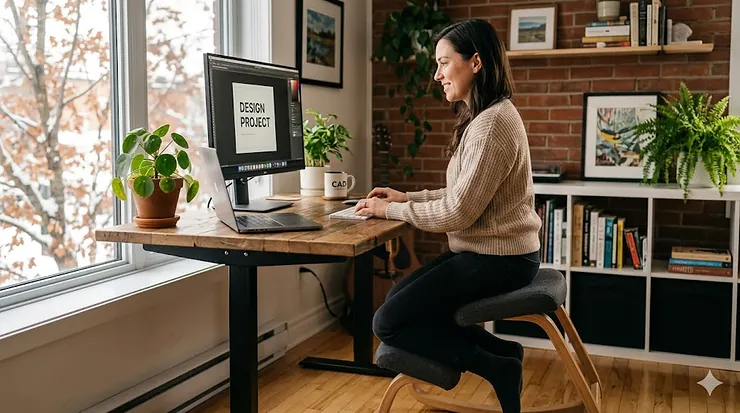
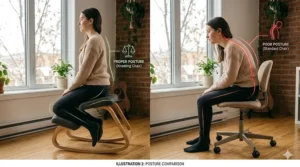
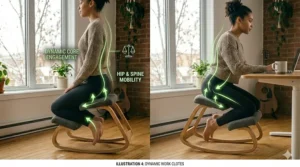
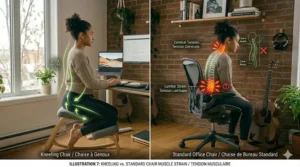
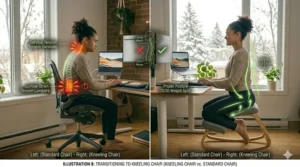
A kneeling chair for posture is a backless (or low-back) seat that tilts your hips forward and shares your body weight between your sitting bones and your shins, instead of putting it all on your lower back. The angle sits somewhere around 60–70° from vertical rather than the usual 90°, which opens up your hip angle and nudges your spine toward its natural standing curve.
If you’ve been Googling this at 2 p.m. on a Tuesday because your lower back is yelling at you through a Zoom call, you’re not alone. Desk-bound back pain is one of the most common reasons Canadians search for alternative seating, and kneeling chairs keep popping up as a fix. They’re not magic, though, and the research on them is more mixed than most product listings let on — something I’ll get into honestly below, with real Amazon.ca models, prices in CAD, and the trade-offs that don’t show up in a five-bullet spec list.
I’ve based this guide on actual products available to Canadian shoppers, not vapourware. Every price below is an approximate range, since Amazon.ca prices shift constantly — check the current price on the product page before you commit. ✅
Quick Comparison Table
| Product | Style | Price Range (CAD) | Best For |
|---|---|---|---|
| VIVO DRAGONN (basic) | Metal, no backrest | $110–$150 | Tight budgets, trial runs |
| VIVO DRAGONN (with back support) | Metal, mesh backrest | $150–$190 | Beginners who want some lumbar contact |
| HOMCOM Ergonomic Kneeling Chair | Rubberwood, rolling casters | $130–$180 | Renters, small home offices |
| Office Star KCM1420 | Metal frame, memory foam | $180–$230 | Long-time office furniture buyers |
| Predawn Adjustable Kneeling Chair | Wood, linen, height-adjustable | $120–$160 | Shorter or taller users needing custom height |
| Sleekform Austin | 20-ply birchwood, rocking | $350–$400 | Daily users wanting durability |
| Varier Variable balans® | Beech plywood, designer | $500–$650 | Long-term investment, design-conscious buyers |
Looking at this lineup, there’s a clear split between the sub-$200 metal-and-foam chairs aimed at “let’s see if I can even tolerate this” buyers, and the $350+ wood-frame chairs built for people who already know kneeling chairs work for them. The middle of the market (HOMCOM, Office Star, Predawn) is where most first-time Canadian buyers should look, since it balances real wood or reinforced metal construction against a price that doesn’t sting if it turns out kneeling chairs aren’t for you.
💬 Just one click — help others make better buying decisions too! 😊
✨ Don’t Miss These Exclusive Deals!
🔍 Take your home office posture to the next level with these carefully selected kneeling chairs. Click on any highlighted product to check current pricing and availability on Amazon.ca. 🇨🇦
Top 7 Kneeling Chairs for Posture: Expert Analysis
1. VIVO DRAGONN Ergonomic Kneeling Chair (Metal Frame)
VIVO DRAGONN built its reputation as the entry point into kneeling chairs, and the basic metal version is still where a lot of curious buyers start. The seat height adjusts roughly between 21 and 31 inches, which covers most desk heights without needing a custom setup, and the metal base supports up to 250 lbs.
What the spec sheet won’t tell you: the all-metal frame transmits more vibration and noise than a wood frame when you shift your weight, and there’s no backrest at all, so this is a “try it for an hour” chair, not an all-day chair, at least not at first. It’s a reasonable way to find out whether your body tolerates the kneeling position before spending $400+ on something nicer.
Buyers on Amazon.ca generally describe an adjustment period of a week or two for their shins and knees, which lines up with what most kneeling chair reviewers report.
- ✅ Lowest entry price in the category
- ✅ Compact footprint, easy to store
- ✅ Casters for easy movement
- ❌ No backrest or back support
- ❌ Metal frame can feel less stable than wood on hard flooring
Price sits around $110–$150 CAD, making it the cheapest legitimate way to test the category.
2. VIVO DRAGONN Kneeling Chair with Back Support
The step-up version from the same line adds a 3-inch mesh-covered backrest and four casters, which changes the calculus considerably. Where the basic model is a “test it out” chair, the back-support version is closer to something you could actually use through a workday, especially during the first month while you’re still building tolerance.
In practice, the backrest doesn’t fully support you the way an office chair does — you can’t lean back hard into it — but it gives your spine somewhere to rest during the moments when active kneeling posture gets tiring, which matters more than people expect during a Canadian winter when shorter daylight hours can make 8-hour desk sessions feel longer.
- ✅ Backrest option most budget kneeling chairs skip
- ✅ Same easy height adjustment as the basic model
- ✅ Rolling casters
- ❌ Backrest is shallow; not a substitute for a full chair back
- ❌ Weight capacity still capped at 250 lbs
Expect to pay in the $150–$190 CAD range.
3. HOMCOM Ergonomic Kneeling Chair
HOMCOM (a furniture line under the Aosom umbrella, which also owns Outsunny and PawHut) makes one of the more solid wood-framed kneeling chairs at a price that doesn’t require a big leap of faith. The rubberwood frame holds up to 265 lbs, and most versions include locking casters — two of the four wheels lock, which matters more than it sounds on hardwood or tile floors common in newer Canadian condos.
What stands out compared to the metal-frame budget chairs: the wood frame absorbs the small rocking motion more naturally, so it feels less like sitting on office equipment and more like sitting on furniture. That’s a real difference if this chair is going to live in a shared living space rather than a dedicated office.
- ✅ Solid rubberwood frame, not particle board
- ✅ Locking casters for stability
- ✅ Multiple colourways to match home décor
- ❌ Assembly required, and instructions are bare-bones
- ❌ No height adjustment on some variants — check the specific listing
Typically priced around $130–$180 CAD on Amazon.ca.
4. Office Star KCM1420 Knee Chair
Office Star Products has been making commercial office seating since 1987, and the KCM1420 reflects that — it’s built more like a piece of office equipment than a home accessory, with a black metal base, dual-wheel carpet casters, and memory foam padding instead of basic moulded foam.
The practical upside of buying from an established commercial brand is parts availability and a more predictable build quality across units — something that matters if you’ve been burned before by inconsistent quality control on lesser-known brands. The downside is the price reflects that brand overhead; you’re paying a premium over visually similar chairs from newer sellers.
- ✅ Established commercial brand with decades of office furniture experience
- ✅ Memory foam holds up better over months of daily use than basic foam
- ✅ Dual-wheel casters rated for carpet
- ❌ Pricier than comparable wood-frame alternatives
- ❌ Some buyers report the knee pad angle doesn’t suit very short or very tall users
Price range runs roughly $180–$230 CAD.
5. Predawn Adjustable Ergonomic Kneeling Chair
Predawn focuses specifically on rocking kneeling chairs with height customization, and this model includes a genuinely useful detail that a lot of competitors skip: an included anti-slip mat to protect flooring, which is a small thing that matters a lot if you’re in a rental and trying to avoid scuff marks on hardwood.
The 3.15-inch foam padding is thicker than most chairs in this price tier, and the linen fabric covering breathes reasonably well, which helps during humid Canadian summers when synthetic foam covers can get uncomfortably warm. This is a strong pick for anyone whose height falls outside the “average” range that a lot of fixed-height chairs are designed around.
- ✅ Height adjustable — better fit for shorter or taller users
- ✅ Thicker-than-average padding
- ✅ Includes floor-protection mat
- ❌ Engineered wood, not solid hardwood
- ❌ Weight capacity varies by listing (check the specific model — some cap at 250 lbs, others 265 lbs)
Generally available for around $120–$160 CAD.
6. Sleekform Austin Ergonomic Kneeling Chair
Sleekform Austin is where the category shifts from “budget test” to “daily-use furniture.” The frame uses 20-ply birchwood with three cross-bars for added rigidity, and the rocking motion feels noticeably smoother and quieter than the metal-frame budget options — a difference you’ll actually feel within the first few sits.
What justifies the price jump here isn’t a single dramatic feature; it’s the accumulation of small things — denser memory foam, a sturdier frame that doesn’t flex under movement, and a stated capacity up to 265 lbs across a wider height range (5’2″ to 6’6″). If you already know you tolerate kneeling chairs well and you’re buying your “real” one, this is a reasonable mid-premium landing spot before jumping to designer pricing.
- ✅ Noticeably sturdier rocking motion than budget chairs
- ✅ Wide user height range
- ✅ Strong customer service reputation as a small business
- ❌ Significant price jump from the budget tier
- ❌ Assembly is more involved given the reinforced frame
Price typically falls in the $350–$400 CAD range.
7. Varier Variable™ balans® (Premium / Designer Pick)
The Varier Variable balans® is the chair that started the category. Designed by Norwegian designer Peter Opsvik in 1979 — alongside the original Balans concept developed with Hans Christian Mengshoel — this is the chair every other kneeling chair on this list is, in some way, imitating. It’s made from beech plywood rather than particleboard or basic pine, and Varier backs the wood components with a multi-year warranty far longer than anything offered on the budget tier.
Is the price jump worth it? Mostly for two reasons: the curved runners genuinely rock more smoothly than anything in the sub-$200 range, and the chair is designed to last years rather than get replaced after one. That said, it’s still a kneeling chair — it won’t suddenly fix discomfort that the basic mechanics of kneeling chairs don’t fix for your particular body, and Varier itself frames this as a chair for “part-day rotation rather than eight straight hours,” not a single all-day solution.
- ✅ Original, patent-pedigreed design from the inventor of the category
- ✅ Long materials warranty
- ✅ Smoothest rocking motion in this comparison
- ❌ Premium price relative to function-equivalent alternatives
- ❌ No backrest — Varier’s own backed model (Thatsit) costs considerably more
Expect to pay roughly $500–$650 CAD for the standard Variable balans®.
Top 7 Products: Detailed Spec Comparison
| Product | Frame Material | Weight Capacity | Height Adjustable | Price Range (CAD) |
|---|---|---|---|---|
| VIVO DRAGONN (basic) | Metal | 250 lbs | Yes | $110–$150 |
| VIVO DRAGONN (back support) | Metal | 250 lbs | Yes | $150–$190 |
| HOMCOM Kneeling Chair | Rubberwood | 265 lbs | Varies by listing | $130–$180 |
| Office Star KCM1420 | Metal | ~250 lbs | Yes (manual) | $180–$230 |
| Predawn Adjustable | Engineered wood | 250–265 lbs | Yes | $120–$160 |
| Sleekform Austin | Birchwood (20-ply) | 265 lbs | Yes | $350–$400 |
| Varier Variable balans® | Beech plywood | Not user-adjustable height | No (fixed-height runners) | $500–$650 |
Two things jump out from this table: weight capacity is fairly consistent across the whole category (around 250–265 lbs), so that’s rarely the deciding factor, and height adjustability is actually more common in the budget tier than the premium tier — the Varier, ironically, comes in a fixed height, so if you’re unusually tall or short, it’s worth measuring against your desk before buying the most expensive option on this list.
Buyer’s Decision Framework: Which Kneeling Chair Fits You
Before scrolling back up to compare specs again, it helps to know what you’re actually optimizing for:
- If you’ve never used a kneeling chair before, choose a budget metal-frame model (VIVO DRAGONN basic or with back support). You want to find out if your knees and shins tolerate the position before spending real money.
- If you already know kneeling chairs work for you and you sit 6+ hours a day, prioritize the Sleekform Austin or Varier Variable balans®. The frame quality difference becomes noticeable with daily heavy use.
- If you’re shorter than 5’4″ or taller than 6’2″, prioritize height-adjustable models — Predawn or either VIVO option — over the Varier, which ships at a fixed height.
- If you’re renting or in a condo with hardwood/tile floors, prioritize models with locking casters (HOMCOM, Office Star) and consider a floor mat regardless of which chair you buy.
- If your goal is mainly back-pain relief rather than active sitting, talk to a physiotherapist or chiropractor before buying anything — kneeling chairs help some people and not others, and the research genuinely supports both outcomes (more on that below).
Real-World Scenarios: Three Canadian Desk Setups
The downtown Toronto condo dweller, working from a 90 cm desk in a 500-square-foot space, usually needs something that folds away from sightlines and won’t scuff engineered hardwood — the HOMCOM with locking casters plus a floor mat is a sensible fit, and it doesn’t dominate a small room visually the way a bulkier office chair does.
The Calgary or Ottawa hybrid worker splitting time between a home office and a corporate desk three days a week often does best easing in with the VIVO DRAGONN basic model at home, since it’s a low-cost way to figure out tolerance before deciding whether to invest in something nicer for the home office specifically.
The Vancouver Island remote worker who’s already tried (and likes) kneeling chairs, and works 8-hour days from a dedicated office, is the textbook buyer for the Sleekform Austin or Varier Variable balans® — daily, long-duration use is exactly where the frame quality difference between tiers actually shows up.
Practical Usage Guide: Getting Used to a Kneeling Chair
Don’t go from zero to eight hours on day one — that’s the single most common mistake new owners make, and it’s also the fastest way to convince yourself a perfectly good chair “doesn’t work.” Start with 20–30 minute sessions, alternating with your regular chair, and build up over two to three weeks.
Check your desk height before you start. Most kneeling chairs sit lower than a standard office chair, so a desk that felt fine before might now leave your wrists bending awkwardly upward — you may need a slightly lower desk or a keyboard tray.
In Canadian winters, dry indoor heating can make wood frames (HOMCOM, Predawn, Sleekform, Varier) creak more than usual as the wood contracts slightly; a light application of furniture wax on visible joints once a season helps, and it’s worth checking that screws on metal-frame models (VIVO, Office Star) haven’t loosened after the first month of use, since metal-on-metal joints can work themselves slightly loose with repeated rocking.
How to Choose a Kneeling Chair for Posture in Canada
- Measure your current desk height first. Kneeling chairs sit lower than office chairs; know your number before shopping.
- Decide if you need a backrest. Pure kneeling chairs (Varier Variable, basic VIVO) have none; back-support versions exist if you want a partial recline option.
- Check the weight capacity against your own weight, not just the chair’s marketing — most cap between 250–265 lbs.
- Confirm casters are locking if you have hardwood, tile, or hardwood-look laminate flooring common in newer Canadian builds.
- Decide your budget tier honestly. If this is a first attempt, don’t start at $500+; the budget tier exists for a reason.
- Read the assembly reviews, not just the comfort reviews — several models in this category have had documented assembly confusion.
- Check Amazon.ca availability and Prime eligibility specifically, since some kneeling chair listings are Amazon.com-only and either don’t ship to Canada or carry significant cross-border shipping costs.
Kneeling Chair vs Regular Office Chair: What the Research Actually Shows
This is the section most kneeling chair articles skip, and it matters. The research on kneeling chairs is genuinely mixed, not uniformly positive. According to Wikipedia’s overview of kneeling chair research, a 1985 study comparing the original Balans chair to conventional chairs found it performed no better, and possibly worse, than a well-designed conventional office chair. A separate 1987 study found support for improved blood circulation, and a 1989 study found kneeling chairs encouraged greater lower-back curvature than straight-back chairs during typing and writing — a mixed but not dismissive picture overall.
The clearest, most balanced framing comes from outside the kneeling-chair industry itself: spine biomechanics researcher Stuart McGill, professor emeritus at the University of Waterloo, told CBC Life that there’s no single perfect posture for everyone — what matters more is alternating positions rather than locking into any one seat, kneeling or otherwise, for hours at a stretch.
The practical takeaway for Canadian buyers: treat a kneeling chair as one tool in a rotation — alternating it with a standard chair or standing — rather than a single fix that replaces good ergonomic habits altogether. The Canadian Centre for Occupational Health and Safety’s own guidance on alternative chairs echoes this, framing kneeling-type seating as one option within a broader strategy of posture variation rather than a standalone solution.
Benefits vs Traditional Alternatives
| Factor | Kneeling Chair | Traditional Office Chair | Best For |
|---|---|---|---|
| Spinal alignment | Opens hip angle, may reduce lumbar slouching | Depends heavily on lumbar adjustment quality | Kneeling chair, for some users |
| All-day comfort | Mixed — many users need breaks after 1–3 hours | Generally better for sustained 8-hour days | Office chair |
| Core engagement | Higher, due to active balance | Minimal | Kneeling chair |
| Cost of entry | $110–$650 CAD | $150–$1,000+ CAD | Comparable, varies by tier |
| Adjustability | Limited (height only, usually) | Extensive (lumbar, armrests, recline, tilt) | Office chair |
The table above makes the trade-off obvious: a kneeling chair wins on active engagement and hip-opening posture, while a proper ergonomic office chair still wins on raw adjustability and all-day sustainability. Most Canadian home-office setups benefit more from owning both and rotating between them than from replacing one entirely with the other — which is exactly what CCOHS’s own ergonomics guidance recommends regardless of which “alternative” seat you’re considering.
Common Mistakes When Buying a Kneeling Chair
- Buying the most expensive option first. Start in the budget tier if you’ve never tried this seating style — there’s a real chance it simply doesn’t suit your body, and you’ll want to know that before spending $500+.
- Ignoring desk height. A kneeling chair that’s wrong for your specific desk height will cause wrist and shoulder strain that has nothing to do with the chair’s quality.
- Skipping the adjustment period and quitting too early. Most reviewers report a two- to three-week tolerance-building window; quitting after one bad afternoon isn’t a fair test.
- Assuming Amazon.com listings ship freely to Canada. Always confirm you’re looking at the Amazon.ca listing specifically, since pricing, shipping timelines, and even product availability can differ from the U.S. site.
- Forgetting flooring compatibility. Locking casters matter more on hardwood and tile than most buyers expect until they’ve scuffed a floor.
Canadian Regulations, Certifications & Bilingual Labelling
Furniture sold in Canada, including kneeling chairs, falls under Canada’s Consumer Packaging and Labelling Act, which generally requires bilingual (English/French) product labelling for goods sold at retail — something worth checking if you’re buying from a smaller third-party seller rather than directly from Amazon.ca’s own fulfillment.
There’s no single mandatory certification specific to kneeling chairs the way there is for, say, electrical appliances (CSA-certified) or children’s products. That said, the CSA Group’s Z412 standard for office ergonomics is the closest Canadian reference point for workplace seating, and it explicitly notes that no single sitting posture — including kneeling — should be maintained for extended periods without variation. If you’re outfitting a registered home office for tax or workplace-safety purposes, it’s worth keeping that standard in mind rather than assuming any single chair purchase “solves” ergonomics on its own.
Long-Term Cost & Maintenance in Canada
Budget metal-frame chairs (VIVO, Office Star) generally need the most ongoing attention — check screws and casters every few months, since repeated rocking motion can loosen fasteners faster than on wood-frame models. Wood-frame chairs (HOMCOM, Predawn, Sleekform, Varier) need less mechanical upkeep but benefit from occasional wood conditioning, especially in homes with forced-air heating that dries out indoor air over a Canadian winter.
On pure cost-per-year, the math tends to favour the mid-tier: a $150 CAD budget chair that needs replacing in two years works out to roughly $75/year, while a $400 CAD Sleekform Austin that lasts five-plus years works out closer to $80/year — similar annual cost, but with a meaningfully better daily experience for the premium option. The Varier, at $500–$650 CAD with a multi-year materials warranty, only pulls ahead financially if you genuinely keep it for the better part of a decade.
Kneeling Chair Benefits and Drawbacks
Benefits: more open hip angle that can ease lower-back slouching for some users, increased lower-body movement and circulation from the rocking motion, smaller footprint than most office chairs, and a lower price floor than premium ergonomic office chairs.
Drawbacks: no back support on most models, a real adjustment period that some users never fully complete, less suitable for full 8-hour days without rotation to another seat, and — per the research cited above — no guarantee it outperforms a well-adjusted conventional chair for your specific body and condition.
Features That Actually Matter (And Those That Don’t)
Actually matters: frame material and joint quality (the difference between a chair that lasts two years versus eight), locking casters if you have hard flooring, and height adjustability if you fall outside an average height range.
Mostly marketing: “meditation chair” framing (it’s the same chair, repositioned), elaborate colour options on budget models (doesn’t affect function), and claims of dramatic posture transformation within days — the honest research timeline for noticeable change is weeks, not days.
FAQ
❓ Is a kneeling chair good for posture?
❓ How long does it take to get used to a kneeling chair?
❓ Can I use a kneeling chair all day at a desk job?
❓ Does Amazon.ca ship kneeling chairs across Canada, including remote areas?
❓ Are kneeling chairs good for short people?
Conclusion
There’s no single “best” kneeling chair for posture — there’s a best one for your height, your budget, your flooring, and how confident you already are that this seating style works for your body. If you’re new to the category, start at the budget tier with the VIVO DRAGONN or Predawn. If you already know kneeling chairs suit you and you sit long hours daily, the Sleekform Austin and Varier Variable balans® are genuine step-ups in frame quality and longevity, not just price.
What matters more than which specific chair you pick is treating it as one part of a posture-variation routine rather than a standalone fix — that’s true whether you’re spending $120 or $650 CAD, and it’s the one piece of advice that shows up consistently across both the manufacturer claims and the independent research.
✨ Don’t Miss These Exclusive Deals!
🔍 Ready to upgrade your home office? Check current pricing and availability on Amazon.ca for any of the seven chairs above. 🇨🇦
Recommended for You
- Balance Ball Chair Benefits: 7 Best Picks for Canadian Offices 2026
- 7 Best Drafting Chairs With Back Support in Canada (2026)
- Best Drafting Chair for Standing Desk in Canada 2026 (Top 7)
Disclaimer: This article contains affiliate links. As an Amazon Associate, I earn from qualifying purchases. If you purchase products through these links, we may earn a small commission at no additional cost to you.
✨ Found this helpful? Share it with your friends! 💬🤗
