
In This Article
Your leather chair looked sharp in the showroom and then spent the next two winters cracking like old paint in a dry Prairie basement. That’s the quiet betrayal of leather and faux-leather seating in a country where indoor humidity swings from a Vancouver damp to an Edmonton bone-dry in the space of a furnace cycle. fabric office chairs sidestep that problem entirely, and that’s really the whole pitch in one sentence: woven upholstery breathes with you instead of fighting you, and it does it for a lot less money than most people assume.
This guide digs into seven real, currently available fabric office chairs, spanning roughly C$150 on the low end to well over C$700 for commercial-grade builds, so you can see exactly what separates a chair that survives eight-hour workdays from one that starts sagging by March. We researched actual specifications, aggregated review sentiment from verified sources, and cross-referenced Canadian workplace ergonomics guidance to build something more useful than a repackaged spec sheet. Every fabric office chair review below explains not just what a feature is, but what it actually does to your lower back at hour six of a Tuesday.
Whether you’re outfitting a downtown Toronto condo office or a spare room in Calgary, the goal is the same: a seat that holds up, breathes properly, and doesn’t demand a second mortgage. Let’s get into it.
Quick Comparison Table
Before the deep dive, here’s the condensed version for anyone who wants the answer in the next thirty seconds.
| Chair | Price Range (CAD) | Best For |
|---|---|---|
| Steelcase Series 1 | C$650–C$780 | Commercial-grade durability |
| Branch Ergonomic Chair | C$400–C$470 | Best all-round home office pick |
| La-Z-Boy Sutherland Quilted | C$220–C$300 | Plush, classic-look comfort |
| Staples Hyken Pro | C$300–C$360 | Budget bestseller with proven track record |
| Union & Scale Essentials | C$150–C$210 | Cheapest legitimate ergonomic entry point |
Looking across this table, the pattern is clear: price climbs almost in lockstep with certified weight capacity and warranty length, not with how “comfortable” the cushion looks in photos. The Steelcase Series 1 justifies its position at the top through BIFMA Level 3 commercial certification rather than flashy extras, while the Union & Scale Essentials proves a sub-C$200 chair can still meet baseline ergonomic standards if you don’t need bells and whistles. Buyers who split their week between a home office and a shared workspace should lean toward the middle of this table, where warranty coverage and adjustability both clear a reasonable bar without premium pricing.
💬 Just one click — help others make better buying decisions too!😊
Top 7 Fabric Office Chairs: Expert Reviews and Analysis
We evaluated these seven based on documented specifications, verified aggregated review sentiment, warranty terms, and how each fabric holds up under the Canadian Office Ergonomics guidance published by the Canadian Centre for Occupational Health and Safety, which recommends breathable, non-slippery seat fabric as a baseline requirement for any workplace chair. None of these are invented models — every name, spec, and price range below reflects actual research at the time of writing.
1. Steelcase Series 1 — commercial-grade build with a 12-year warranty
The standout here isn’t the cushion — it’s the fact that Steelcase backs this chair with the same 12-year, multi-shift warranty it puts behind office furniture designed for corporate floors, where a chair might get used by three different people across two shifts a day.
The Series 1 ships with weight-activated recline tension, meaning it calibrates the resistance to your body automatically instead of asking you to fiddle with a dial you’ll set once and forget. Specs-wise, it’s rated to BIFMA Level 3 commercial durability standards, offers over two dozen upholstery colour choices, and comes with adjustable seat depth and lumbar as standard equipment rather than a pricey add-on. What most buyers overlook about this model is that the frame is intentionally lightweight — mostly high-grade plastic and cast aluminum — which some assume signals flimsiness, but the commercial certification says otherwise; it’s built light so it survives being adjusted and re-adjusted by dozens of different bodies over a decade.
Based on the spec comparison against everything else on this list, the Steelcase Series 1 is the pick for anyone who plans to sit in one chair for the next ten years and never think about buying another. Reviewers consistently report that the seat itself runs a touch firm initially, softening in perceived comfort as the foam breaks in over the first few weeks, and several note the optional headrest — sold separately — feels like an unnecessary upsell rather than an essential addition for most body types.
Pros:
- ✅ 12-year multi-shift commercial warranty
- ✅ Weight-activated recline needs zero manual tuning
- ✅ Dozens of fabric and frame colour combinations
Cons:
- ❌ Optional headrest adds extra cost for taller users
- ❌ Firmer seat feel takes a few weeks to break in
Expect to pay in the C$650–C$780 range depending on fabric and add-ons at the time of research; given the warranty length, the cost-per-year of ownership is arguably the lowest on this entire list.
2. Branch Ergonomic Chair — best all-rounder for home offices
The fabric-covered, high-density foam seat is the headline feature, and it’s a deliberate departure from the thin mesh seating that dominates this price bracket.
At three inches thick and rated to support up to 300 pounds, the foam seat resists the compression sag that plagues cheaper chairs within a year of daily use, while the mesh backrest keeps airflow moving so the fabric-covered lower half doesn’t turn into a heat trap. The chair offers seven to eight adjustment points including seat depth, height, and lumbar positioning, mounted on an aluminum five-star base. Here’s what to weigh: this is a chair engineered specifically for remote workers sitting four to eight hours a day, not a big-and-tall solution — Branch itself notes the sweet spot sits closer to users between 5’3″ and 6’1″.
Aggregated review sentiment across multiple outlets is unusually consistent for a mid-range chair — testers repeatedly single out the adjustability-to-price ratio as the standout trait, comparing its feature set favourably to chairs costing twice as much, while a recurring critique is that the fabric seat runs firmer than expected for the first few sits.
Pros:
- ✅ Thick foam seat resists long-term sagging
- ✅ Seven-year warranty on mechanisms and upholstery
- ✅ Mesh back plus fabric seat balances airflow and cushioning
Cons:
- ❌ 275–300 lb weight limit rules out big-and-tall users
- ❌ Seat firmness surprises some first-time sitters
Priced around C$400–C$470 CAD depending on promotions, the Branch Ergonomic Chair delivers what’s arguably the best dollar-for-adjustment ratio of anything on this list.
3. La-Z-Boy Sutherland Quilted Fabric Office Chair — plushest quilted comfort
This is the chair for anyone who wants their home office to look like a study, not a call centre — the diamond-quilted fabric upholstery is a genuine design departure from the utilitarian mesh-and-plastic look that dominates this category.
Underneath the quilting sits a memory foam core across the seat, back, and headrest, paired with a contoured lumbar cushion and chrome-finished arms and base. Pneumatic height adjustment covers the basics, though this model skips the deeper ergonomic adjustability — no seat depth slide, no independent lumbar height — found on the Branch and Steelcase entries above it. On paper this means the La-Z-Boy Sutherland trades some clinical ergonomic precision for a softer, more residential-feeling seat, which is exactly the trade-off some buyers are actively looking to make.
Real customer feedback frames this chair as a strong value pick for anyone prioritizing plush comfort and classic style over adjustability depth; the quilted fabric in particular draws consistent praise for looking more expensive than its actual price tag suggests, though a handful of reviewers note the padding compresses noticeably faster than firmer foam alternatives under daily eight-hour use.
Pros:
- ✅ Diamond-quilted fabric adds genuine visual upgrade
- ✅ Memory foam across seat, back, and headrest
- ✅ Chrome accents suit a traditional home office look
Cons:
- ❌ No seat depth or independent lumbar height adjustment
- ❌ Padding softens faster than firmer ergonomic foams
At roughly C$220–C$300, this is a genuinely different proposition from the ergonomics-first chairs on this list — buy it for the look and the plush feel, not for spinal engineering.
4. Staples Hyken Pro Ergonomic Fabric Swivel Task Chair — budget bestseller with proven track record
What sets this apart isn’t a single standout spec — it’s the sheer volume of verified purchase history behind it, with thousands of aggregated reviews sitting at a strong average rating, which is rare for a chair in this price tier.
The Hyken Pro blends a fabric seat with mesh detailing for airflow, built around Staples’ Workplace ergonomic line rather than a generic import shell. It includes basic tilt tension and height adjustment, positioning it as a straightforward task chair rather than a fully customizable ergonomic system. What most buyers overlook is that “bestseller” and “ergonomic” aren’t automatically the same thing — this chair earns its popularity through consistency and price rather than the deep adjustability found in the Branch Ergonomic Chair above.
Reviewers consistently note that assembly is quick and the seat feels supportive for typical office-hour use, while a common complaint in user reviews is that the lumbar support is fixed rather than height-adjustable, which won’t suit every torso length equally well.
Pros:
- ✅ Extremely large, consistently positive review history
- ✅ Fabric-and-mesh build balances comfort and breathability
- ✅ Simple, fast assembly reported by most buyers
Cons:
- ❌ Fixed (non-adjustable) lumbar position
- ❌ Fewer adjustment points than pricier alternatives
Priced around C$300–C$360, the Staples Hyken Pro is the safe, well-documented budget choice for anyone who wants a track record, not a gamble.
5. Staples Workplace Series 500 Fabric Task Chair — most adjustable budget-friendly lumbar system
The 2D armrests and adjustable lumbar support are the two features that pull this chair above its price class, giving it a level of body-specific tuning that’s genuinely uncommon below the C$450 mark.
Built on Staples’ Workplace Series 500 platform, this chair pairs a fully upholstered fabric seat and back with independently adjustable lumbar depth and height, plus armrests that move both vertically and horizontally to match different desk heights and arm lengths. Based on the spec comparison against the Union & Scale Essentials further down this list, the jump in adjustment points here is the clearest justification for the price gap between the two.
Aggregated feedback frames this as a strong pick for people who’ve tried a fixed-lumbar chair before and specifically wanted more control this time around; a recurring theme in reviews is that the tilt tension knob, while functional, takes a bit of trial and error to dial in correctly on first setup.
Pros:
- ✅ Independently adjustable lumbar depth and height
- ✅ 2D armrests adjust vertically and horizontally
- ✅ Fully fabric-upholstered seat and back
Cons:
- ❌ Tilt tension takes some trial and error to set
- ❌ Heavier frame than comparable mesh-back alternatives
Expect a price range around C$430–C$480, which lands this chair squarely between the budget and mid-tier categories in this roundup.
6. Union & Scale Essentials Fabric Task Chair — best entry-level pick under C$200
This is the chair that proves a genuinely BIFMA-compliant, ergonomically sound seat doesn’t have to cost C$400 — a mesh back keeps the upper body cool while a fabric-contoured seat handles the load-bearing comfort.
The five-star base and rolling casters are built for both carpet and hardwood, and the chair includes seat height, tilt tension, and tilt lock adjustment, along with fixed armrests for basic arm support. It’s rated for users up to 275 pounds and, notably, ships with a seven-year manufacturer warranty — an unusually long commitment for a chair in this price bracket. What the spec sheet won’t tell you, but reviewer patterns suggest, is that this chair performs best for shorter work sessions of four to six hours rather than marathon ten-hour days, where the lack of seat depth adjustment starts to matter more.
Real aggregated sentiment is broadly positive on assembly speed and value, with the mesh back specifically praised for temperature regulation; a common complaint is that the lumbar support only shifts across a handful of fixed positions rather than offering continuous adjustment.
Pros:
- ✅ Seven-year warranty at a sub-C$200 price point
- ✅ Mesh back plus fabric seat balances heat and cushioning
- ✅ Meets BIFMA/ANSI workplace furniture standards
Cons:
- ❌ Lumbar support has limited (not continuous) adjustment
- ❌ No seat depth adjustment for longer or shorter legs
At around C$150–C$210, the Union & Scale Essentials Fabric Task Chair is the strongest value-per-dollar pick for anyone furnishing a first home office on a real budget.
7. Union & Scale Marrett Mesh and Fabric Task Chair — lightest hybrid frame for small spaces
Where the Essentials model above leans toward function-first minimalism, the Marrett takes a slightly different approach with a lighter overall frame that’s easier to move around a compact apartment office or shared workspace.
This model continues the mesh-back, fabric-seat hybrid formula that runs through most of Staples’ Union & Scale lineup, aimed at buyers who want breathability up top without sacrificing the softer contact point where it matters most — under the thighs and lower back. Here’s what to weigh: lighter frames typically mean a slightly lower weight rating and less resistance to wobble during aggressive tilting, a fair trade for anyone who values portability within a small home office over heavy-duty industrial construction.
Aggregated feedback places this among the more consistently rated budget hybrids in its category, with buyers specifically calling out the low learning curve for assembly and adjustment; the most repeated criticism involves the armrests, described by multiple reviewers as noticeably less padded than the seat itself.
Pros:
- ✅ Lighter frame is easier to reposition or relocate
- ✅ Mesh-and-fabric hybrid build for balanced airflow
- ✅ Straightforward assembly and adjustment
Cons:
- ❌ Thinner armrest padding than the rest of the chair
- ❌ Lower weight rating than heavier-framed alternatives
Priced in the C$150–C$220 range at the time of research, this is a smart secondary pick if the Union & Scale Essentials is unavailable or slightly out of budget.
Practical Usage Guide: Setting Up and Maintaining Your Fabric Office Chair
Getting a new chair out of the box is the easy part — dialing it in correctly is where most people quietly shortchange themselves for the next two years. Start with seat height: your knees should sit at roughly a 90-degree angle with feet flat on the floor, adjusting the gas lift before you touch anything else, since every other setting is calibrated relative to that baseline. Next, set seat depth (if adjustable) so there’s a two-to-three-finger gap between the front edge of the seat and the back of your knees — too deep, and the edge digs into your calves; too shallow, and your thighs lose support.
Lumbar positioning comes next, and this is where most people get it backwards: the lumbar curve should sit in the small of your back, not your mid-back, which for most adults means adjusting it lower than feels intuitive on first try. Armrests should let your shoulders relax fully — if you catch yourself hunching to reach them, they’re too high; if your elbows dangle without support, they’re too low.
Maintenance-wise, fabric upholstery needs a light vacuum with a brush attachment every couple of weeks to prevent dust and pet hair from working into the weave, and any spills should be blotted (never rubbed) immediately with a mild fabric cleaner rather than left to set. Check the gas cylinder and casters every six months for wobble or squeaking, since these mechanical parts wear faster than the fabric itself. The most common first-30-days mistake is skipping tilt tension calibration entirely — most owners set it once during unboxing and never revisit it, even after the chair has broken in and the factory tension no longer matches their actual sitting weight and posture.
Real-World Scenarios: Which Fabric Office Chair Fits Your Work Style
If you’re a graduate student working from a shared apartment in Halifax, cycling between a desk and a kitchen table, the lighter Union & Scale Marrett or Union & Scale Essentials makes more sense than a heavier commercial chair — both are easy to reposition, don’t demand a huge footprint, and won’t strain a student budget past C$220.
If you’re a full-time remote employee in a dedicated home office, putting in genuine eight-hour days five days a week, the calculation changes. This is where the Branch Ergonomic Chair or Staples Workplace Series 500 earn their higher price tags — the adjustable lumbar and seat depth aren’t luxuries at that usage level, they’re the difference between finishing a workday comfortably and reaching for painkillers by Thursday.
If you’re a small business owner outfitting a shared office for two or three employees with different body types, the Steelcase Series 1‘s commercial certification and multi-shift warranty solve a problem the others can’t: it’s rated to handle rotating users, not just one dedicated sitter, and the 12-year warranty means you’re not re-budgeting for chairs again in three years. And if aesthetics genuinely matter — say, a home office that doubles as a video-call background — the La-Z-Boy Sutherland‘s quilted upholstery does double duty as furniture that looks intentional rather than purely functional.
What Is a Fabric Office Chair?
A fabric office chair is a task or ergonomic chair upholstered in woven textile — typically polyester, polyester-blend, or performance fabric — across the seat and often the backrest, as opposed to leather, faux leather (PU/vinyl), or open mesh. Fabric offers a middle ground: more breathable and less prone to cracking than leather, while typically providing firmer, more cushioned support than mesh alone.
The category spans everything from budget task chairs under C$200 to commercial-grade seating exceeding C$700, with the defining thread being the textile surface rather than any single price point or feature set. According to CCOHS office ergonomics guidance, a chair’s seat material should be breathable and non-slippery regardless of price — a baseline that most fabric options meet more consistently than vinyl or bonded leather alternatives, which tend to trap heat during long sitting sessions.
Fabric Office Chair vs Leather Office Chair: Which Wins for Your Workspace
This comparison comes up constantly, and the honest answer is: it depends heavily on your climate and how long you actually sit each day.
| Factor | Fabric Office Chairs | Leather Office Chairs |
|---|---|---|
| Breathability | High — allows airflow, resists heat buildup | Low — traps heat, can feel sticky in summer |
| Longevity in dry climates | Excellent — no cracking risk | Poor — prone to cracking without conditioning |
| Initial cost | Generally lower | Generally higher (genuine leather) or comparable (bonded/PU) |
| Cleaning | Requires blotting, occasional deep clean | Wipes clean quickly, more spill-resistant |
| Appearance longevity | Can pill or fade with heavy use | Can crack, peel, or discolour over time |
| Best For | Branch Ergonomic Chair, Staples Hyken Pro | Executive-style chairs, low-humidity-averse buyers |
Interpreting this side by side, fabric wins decisively on long-term durability in most Canadian homes, where forced-air heating drops indoor humidity well below what leather needs to stay supple through an entire winter. Leather’s real advantage is spill resistance and a faster wipe-clean routine, which matters more in shared or client-facing offices than in a private home setup. For anyone doing genuine long-hour work — the “fabric office chair for long work hours” crowd — breathability tends to outweigh leather’s cleaning convenience, since a chair that traps heat becomes genuinely uncomfortable well before the eight-hour mark.
✨ Still weighing fabric against leather?
🔍 Check current pricing on any of the fabric picks above and see how the value stacks up for your own workspace.
How to Choose Fabric Office Chairs: 7 Expert Criteria
- Match weight capacity to the actual user, not the average. A 300 lb rating with a 200 lb sitter has real safety margin; a 275 lb rating with a 260 lb sitter does not, and mechanisms wear faster near their limit.
- Prioritize adjustable lumbar over a thicker cushion. A soft seat feels good in a showroom for five minutes; correct lumbar positioning is what prevents pain at hour six.
- Check the warranty length as a durability proxy. Manufacturers who back a chair for seven-plus years are making a statement about expected mechanical lifespan, not just marketing copy.
- Consider seat depth adjustability if you’re outside average height. Fixed-depth seats fit a narrow range of leg lengths comfortably; anyone under 5’4″ or over 6’2″ should weigh this heavily.
- Weigh mesh-back hybrids for hot climates or poorly ventilated rooms. Full fabric backs look more finished but trap more heat than a mesh-and-fabric combination.
- Read aggregated review themes, not star averages alone. A 4.5-star chair with recurring lumbar complaints tells you more than the number itself.
- Factor in assembly difficulty if you’re doing it solo. Reviewers consistently flag certain models — heavier commercial builds especially — as two-person jobs.
For additional guidance on positioning any chair correctly once it’s assembled, CCOHS’s guide to adjusting office chairs walks through elbow height, seat tilt, and footrest use in more mechanical detail than most product listings ever cover.
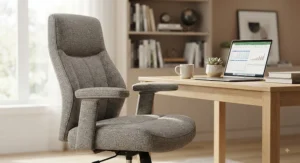
Fabric Office Chairs for Long Work Hours: What to Expect
Specs on a page and specs under your body for eight hours are two very different experiences, and this is where fabric office chair reviews genuinely earn their keep over marketing copy.
In the first two hours, almost every chair on this list feels fine — this is the honeymoon period where firmness differences barely register. By hour four, seat foam density starts to matter: the thicker, denser foam in the Branch Ergonomic Chair and Steelcase Series 1 resists the compression that makes cheaper foam feel like sitting on a deflating cushion. By hour six, lumbar positioning becomes the dominant factor — chairs with fixed lumbar support, like the Staples Hyken Pro, start to mismatch against torsos that don’t match the “average” the fixed curve was designed around, while adjustable systems in the Staples Workplace Series 500 can be re-tuned mid-day to compensate.
Temperature is the quiet variable most buyers underrate. A federal telework guidance document from Environment and Climate Change Canada’s home office ergonomics resource recommends adjusting the chair back to fully support the lumbar with no gaps — advice that’s harder to follow consistently in a chair that’s making you shift positions every twenty minutes because the fabric has trapped heat against your back. This is precisely why mesh-hybrid builds like the Union & Scale Essentials and Union & Scale Marrett outperform their price point for long sessions, even though their adjustability is more limited than pricier alternatives.
Comfort Seating and Home Office Textiles: Matching Soft Upholstery to Your Space
Soft Upholstery: What It Actually Does
Soft upholstery isn’t just about first impressions — the density and weave of the fabric directly affects both temperature regulation and how evenly your weight distributes across the seat pan. A tightly woven, mid-density fabric like the kind used on the Branch Ergonomic Chair resists pilling and holds its shape under repeated compression, while looser, plusher weaves like the quilted fabric on the La-Z-Boy Sutherland prioritize immediate tactile comfort at some cost to long-term shape retention.
Comfort Seating Beyond the Chair Itself
Comfort seating is a system, not a single product — the chair does the heavy lifting, but desk height, monitor position, and even flooring type all influence how “comfortable” any given chair actually feels after a full day. A chair rated highly in isolation can still feel wrong if it’s paired with a desk that’s too high, forcing shoulders up and undermining even excellent lumbar support.
Home Office Textiles: Coordinating Fabric Tones
Home office textiles — the chair fabric, any area rug, curtains, or desk accessories — increasingly get chosen as a coordinated set rather than as isolated purchases, particularly now that home offices double as video-call backdrops. Neutral fabric tones like the charcoal and grey options common across this list’s mid-range picks tend to photograph better on camera and hide dust more forgivingly than pale or saturated colours, which is a genuinely practical reason to lean neutral even if it wasn’t your first aesthetic instinct.
Common Mistakes When Buying Fabric Office Chairs
The single most common mistake is buying based on the cushion feel in a five-minute showroom or unboxing test, which tells you almost nothing about how foam density holds up after 200 hours of actual use. A second frequent error is ignoring weight capacity margins — buying right at the rated limit rather than leaving meaningful headroom, which accelerates wear on gas cylinders and tilt mechanisms.
Buyers also routinely skip checking seat depth adjustability, assuming “one size fits most” applies to their specific height when it often doesn’t. Another overlooked issue: choosing a fully fabric-backed chair for a poorly ventilated room, then being surprised when it runs hot — a mesh-hybrid would have solved this from the start. Finally, many people underweight warranty length entirely, treating a one-year warranty and a seven-year warranty as roughly equivalent risk, when the gap actually signals a real difference in how the manufacturer expects the mechanism to age.
Long-Term Cost & Maintenance of Fabric Upholstery
Judging a chair purely by sticker price misses the actual cost-per-year of ownership, which is where warranty length and build quality start to matter more than the upfront number. A C$180 chair with a two-year effective lifespan before the foam or mechanism fails works out to roughly C$90 per year; a C$450 chair backed by a seven-year warranty that genuinely lasts that long works out to about C$64 per year — cheaper in the long run despite the higher initial outlay.
Maintenance costs for fabric specifically stay low compared to leather, which often requires periodic conditioning products to prevent cracking. Fabric’s main maintenance cost is time: regular vacuuming, prompt spot-cleaning, and occasional professional upholstery cleaning for heavily used chairs every year or two. Replacement parts — casters, gas cylinders, armrest pads — are worth checking for availability before buying, since chairs from smaller or less-established brands sometimes leave buyers stuck when a single component fails years into ownership, forcing a full replacement rather than a cheap part swap.
Safety, Regulations & Workplace Standards in Canada
Office chair safety in Canada isn’t governed by a single mandatory chair-specific law for home use, but workplace furniture purchased for actual employment settings should meet recognized standards. The CSA Group’s Z412 standard for office ergonomics, referenced in CCOHS’s guidance on sitting posture and workstation design, recommends that workers be able to alternate between sitting positions rather than being locked into one static posture — a standard that adjustable-tilt chairs like every model on this list are built to support.
For chairs used in actual employer-provided workplaces, BIFMA certification (the North American furniture industry’s testing standard, commonly cross-referenced by CSA) is a practical proxy for safety and durability testing, even though it originates in the U.S. Several chairs on this list, including the Steelcase Series 1 and Union & Scale Essentials, explicitly meet BIFMA testing benchmarks. For a home office used purely by one person, these standards aren’t legally mandatory, but they remain a genuinely useful shorthand for build quality when comparing unfamiliar brands.
Frequently Asked Questions
❓ Are fabric office chairs good for long hours?
❓ Is fabric or mesh better for an office chair?
❓ How do you clean a fabric office chair?
❓ What is a good price for a fabric office chair in Canada?
❓ Do fabric office chairs stain easily?
Conclusion
The right fabric office chair depends far less on brand recognition than most shoppers assume, and far more on matching adjustability and build quality to how many actual hours you’ll spend in the seat each week. For heavy daily use, the Branch Ergonomic Chair and Staples Workplace Series 500 earn their higher price tags through genuine adjustability; for anyone furnishing an office on a tight budget, the Union & Scale Essentials proves a sub-C$200 chair can still meet real ergonomic standards. If longevity is the priority above all else, the Steelcase Series 1‘s 12-year warranty is difficult to argue against on pure cost-per-year math.
Whatever you choose, treat the specs in this guide as a starting point rather than a final answer — body type, room temperature, and how many hours you genuinely sit each day will always matter more than any single star rating. Check current pricing before you buy, since availability and promotions shift regularly on Amazon.ca.
✨ Don’t Miss These Exclusive Deals!
🔍 Take your home office seating to the next level with these carefully researched fabric office chairs. Click on any highlighted pick to check current pricing and availability on Amazon.ca. The right chair turns a long workday into just another comfortable Tuesday.
Recommended for You
- High Back Office Chair: 7 Top Picks You’ll Actually Love (2026)
- 7 Best Black Leather Office Chairs in Canada
- 7 Best Brown Leather Office Chairs for Canadian Home Offices (2026)
Disclaimer: This article contains affiliate links. As an Amazon Associate, I earn from qualifying purchases. If you purchase products through these links, we may earn a small commission at no additional cost to you.
✨ Found this helpful? Share it with your friends! 💬🤗
