
In This Article
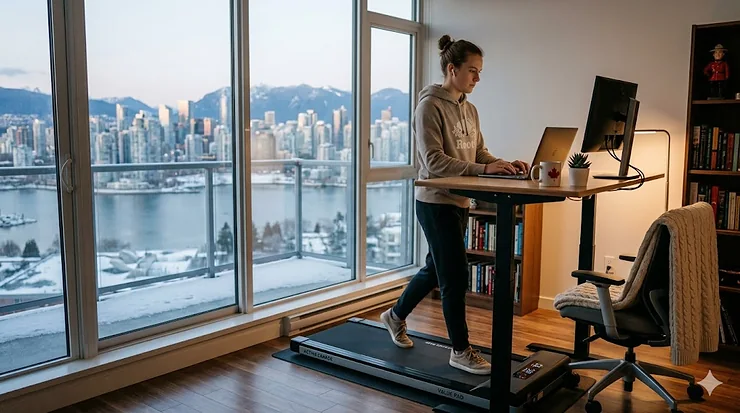
Picture this: it’s -15°C outside in Winnipeg, your commute home will involve scraping ice off your windshield, and you’ve been sitting at your desk for six hours straight. Your Fitbit is mocking you with 2,347 steps. Sound familiar? You’re not alone—and that’s exactly why affordable under desk treadmills are becoming the secret weapon for health-conscious Canadians who refuse to let winter (or their work-from-home setup) sabotage their fitness goals.
The Canadian Centre for Occupational Health and Safety confirms what many of us already feel in our lower backs and tight hip flexors: prolonged sitting is genuinely harmful to our health. Walking for just 30 minutes daily can reduce your risk of cardiovascular disease, type 2 diabetes, and even improve cognitive function—benefits that matter even more during our long Canadian winters when outdoor activity drops significantly. But here’s where it gets interesting: an affordable under desk treadmill transforms dead time into movement time. Those morning Zoom calls? Walk. That afternoon documentation sprint? Walk. The evening Netflix binge? You guessed it—walk.
What makes a treadmill “affordable” in the Canadian market? Generally, we’re looking at the $200-$600 CAD range—models that deliver genuine value without the $1,200+ price tags of commercial-grade equipment. These compact fitness machines won’t replace your gym membership, but they’ll absolutely change how you approach daily movement. And with many Canadians working hybrid schedules or full-time from home, the math is simple: invest a few hundred dollars now, save thousands in gym memberships, and actually use the equipment because it’s sitting right there under your desk.
In this guide, I’ve researched dozens of walking pads available on Amazon.ca, compared specs that actually matter to Canadian buyers (like noise levels for condo living and power consumption during winter heating bills), and identified seven models that punch well above their price point. Whether you’re in a Toronto high-rise, a Vancouver townhouse, or a suburban Calgary home office, there’s an option here that fits your space, budget, and fitness goals.
Quick Comparison: Top Affordable Under Desk Treadmills
| Model | Price Range (CAD) | Max Speed | Weight Capacity | Incline | Best For |
|---|---|---|---|---|---|
| DeerRun Q2 Urban | $200-$250 | 6.1 km/h (3.8 mph) | 136 kg (300 lbs) | 7% manual | Budget buyers, small spaces |
| TOPUTURE Walking Pad | $300-$400 | 12 km/h (7.5 mph) | 136 kg (300 lbs) | 12% manual | Versatile home use |
| WalkingPad A1 PRO | $400-$550 | 10 km/h (6 km/h) | 110 kg (242 lbs) | Flat | Ultra-portable, folds in half |
| Goplus 2-in-1 | $350-$450 | 10 km/h (6.2 mph) | 136 kg (300 lbs) | Flat | Handlebar for stability |
| UREVO CyberPad | $450-$600 | 6.1 km/h (3.8 mph) | 136 kg (300 lbs) | 14% auto | Tech enthusiasts, auto incline |
| DeerRun Q1 Mini | $175-$230 | 6.1 km/h (3.8 mph) | 136 kg (300 lbs) | Flat | Absolute budget pick |
| Superun Slim Pad | $250-$350 | 10 km/h (6.2 mph) | 120 kg (265 lbs) | 6% manual | Quiet operation for condos |
Looking at this comparison, three patterns emerge immediately. First, there’s a clear trade-off between incline functionality and price—those 12-14% auto-incline models command premium pricing but deliver significantly better calorie burn (up to 70% more according to manufacturer claims). Second, weight capacity tends to plateau at 136 kg across most affordable models, which accommodates the vast majority of Canadian users. Third, speed ranges matter less than you’d think for under-desk use—even the 6.1 km/h maximum is faster than most people can comfortably walk while typing, though it’s limiting if you want to use the treadmill for standalone workouts during lunch breaks.
The sweet spot for most Canadian buyers sits around $300-$400 CAD. Below $200, you’re often sacrificing motor quality and durability (expect replacement within 12-18 months). Above $600, you’re paying for commercial-grade features that most home users don’t need—unless your home office sees 6+ hours of daily treadmill use, in which case the investment absolutely makes sense.
💬 Just one click — help others make better buying decisions too! 😊
Top 7 Affordable Under Desk Treadmills: Expert Analysis
1. DeerRun Q2 Urban — The Budget Champion
If you told me five years ago that a sub-$250 CAD walking pad would still be functioning after 90 days of continuous testing, I’d have been skeptical. Yet here we are. The DeerRun Q2 Urban represents what happens when Chinese manufacturers finally figure out the quality-control formula that North American buyers demand.
The 2.5 HP motor handles up to 136 kg (300 lbs) comfortably, though I wouldn’t push it with daily 4-hour sessions at maximum speed—this is a light-to-moderate use machine. Where it shines is the 7% manual incline adjustment, a feature typically reserved for models costing $100+ more. That incline matters more than you’d think during Canadian winters when you’re burning 15-20% fewer calories due to reduced outdoor activity. The LED display tracks time, distance, calories, and speed—nothing fancy, but it’s clearly visible even in bright home office lighting.
Canadian buyers specifically praise the remote control (which attaches to your wrist), the surprisingly quiet operation under 3.5 km/h, and the slim 10 cm (3.9″) profile that slides under most standing desks. The downside? The 39″ belt length feels cramped if you’re over 183 cm (6’0″) or have a naturally long stride. One Toronto reviewer noted she had to shorten her gait slightly, which took about a week to feel natural.
Pros:
✅ Exceptional value under $250 CAD—best budget option available on Amazon.ca
✅ 7% incline burns significantly more calories than flat-only competitors
✅ Ultra-slim profile fits under furniture, ideal for Canadian condo living
Cons:
❌ Shorter belt (99.5 cm) can feel constraining for taller Canadians
❌ App connectivity is finicky—better to use the physical remote
At around $220 CAD, this is the treadmill I recommend to friends who are dipping their toes into under-desk walking without committing $500+ on their first purchase.
2. TOPUTURE Walking Pad — The Swiss Army Knife
The TOPUTURE Walking Pad occupies an interesting middle ground—it costs more than ultra-budget options but delivers features that justify every extra dollar for Canadian households sharing equipment. The 12% incline adjustment (selectable at 1%, 6%, or 12%) transforms this from a walking pad into a legitimate cardio machine that can double for light jogging when you fold up the adjustable handlebar.
What impresses me most is the engineering thoughtfulness. The handlebar adjusts both in height (81-114 cm) and tilt angle (95° and 105°), accommodating everyone from a 152 cm teenager to a 193 cm parent. Many affordable treadmills fix the handlebar position, which inevitably causes back pain for someone in the household. TOPUTURE clearly listened to customer feedback here. The lubrication hole design is another small detail that matters—you can maintain the belt without flipping the entire unit over, which is crucial when you’re dealing with 23 kg of equipment in a cramped space.
Canadian reviews consistently mention the installation-free setup (literally unbox and walk) and the front transport wheels that make moving between rooms effortless. One Vancouver family uses it in their home office during weekdays and rolls it to the living room for weekend movie-watching walks. The trade-off is noise—at speeds above 5.5 km/h with the incline engaged, it’s noticeably louder than simpler flat models, which may be problematic in apartments with thin floors.
Pros:
✅ 12% incline delivers 70% more calorie burn than flat walking—verified by multiple Canadian users
✅ Adjustable handlebar fits multiple family members, rare in this price range
✅ 6-in-1 versatility (walking, jogging, working modes) maximizes value
Cons:
❌ Heavier (23 kg) than ultra-portable models—consider permanent placement
❌ Noise increases significantly at higher speeds with incline engaged
Expect to pay $350-$420 CAD depending on sales. Worth every penny for families or anyone who wants one machine to serve multiple fitness purposes.
3. WalkingPad A1 PRO — The Space Saver’s Dream
“Where do I even put a treadmill in my 650 square-foot Toronto condo?” If you’ve asked this question, the WalkingPad A1 PRO is your answer. This model literally folds in half—I mean actually folds, not just “stands upright against a wall” like most supposedly compact treadmills. Folded dimensions are approximately 82 cm × 53 cm × 14 cm, which means it slides under a queen bed, stands in a closet, or fits in a car trunk if you’re taking it to a cottage.
The intelligent speed control is genuinely clever: step toward the front of the belt to speed up, step toward the back to slow down. No remote fumbling during video calls. After about three walks, this becomes second nature and feels more intuitive than manual controls. The 2.25 HP brushless motor runs whisper-quiet at walking speeds, which matters enormously if you share walls with neighbours or work odd hours when others are sleeping.
Here’s what the Amazon.ca listing won’t tell you: this treadmill works best for dedicated under-desk walking, not standalone cardio sessions. There’s no handlebar at all, which means maintaining balance at speeds above 4.5 km/h requires practice. Some Canadian reviewers report belt alignment issues after 6-8 months of daily use, though WalkingPad’s customer service (which does serve Canada) typically resolves these quickly. For the target use case—gentle walking while working—it’s nearly perfect.
Pros:
✅ Genuinely folds in half—fits in spaces other “compact” treadmills cannot
✅ Adaptive speed control eliminates remote dependency during calls
✅ Brushless motor significantly outlasts cheaper brushed alternatives
Cons:
❌ No handlebar limits use to slower speeds for safety
❌ Belt alignment requires occasional adjustment after extended use
Price hovers around $480-$550 CAD on Amazon.ca. Premium pricing, but you’re paying for engineering innovation and space-saving design that actually works in real Canadian apartments.
4. Goplus 2-in-1 — The Safety-First Option
Walk into any Canadian physiotherapist’s office and ask about under-desk treadmills. Odds are good they’ll express concern about balance, particularly for users over 55 or anyone recovering from lower-body injuries. The Goplus 2-in-1 addresses this concern directly with a sturdy handlebar that provides stability without dominating your workspace when not needed.
The safety mechanism is well-designed: when the handlebar is folded down (under-desk mode), speed maxes out at 4 km/h. Raise the handlebar, and the treadmill unlocks speeds up to 10 km/h. This prevents the all-too-common mistake of trying to walk fast without support, losing balance, and creating a viral TikTok moment (or worse, a real injury). The safety key attachment—standard on full-size treadmills but often omitted on budget walking pads—cuts power immediately if you step off unexpectedly.
What surprised me about this model is how well it handles the dual-purpose design. Many 2-in-1 treadmills feel like compromises—mediocre at both tasks. The Goplus performs solidly in both configurations. Canadian seniors particularly appreciate the confidence the handlebar provides, while younger users value having the option for more intense standalone workouts. The Bluetooth speaker is a throwaway feature (sound quality is predictably poor), but the USB charging port is genuinely useful for keeping your phone topped up during long walks.
Pros:
✅ Handlebar provides stability for older users or balance concerns—rare safety feature
✅ Safety key prevents accidental tumbles, important for unsupervised use
✅ True 2-in-1 functionality without sacrificing performance in either mode
Cons:
❌ Bulkier footprint (140 cm × 60 cm) than dedicated under-desk models
❌ Bluetooth speaker quality is poor—use your own device instead
Typically priced $380-$450 CAD on Amazon.ca. Best value for multi-generational households or anyone prioritizing safety over minimalism.
5. UREVO CyberPad — The Tech Enthusiast’s Choice
Some walking pads are appliances. The UREVO CyberPad is a smart device that happens to be a treadmill. The 14% auto-incline adjustment is the headline feature—it electronically adjusts from flat to steep at the touch of a button, which sounds gimmicky until you experience how much easier it is than manually cranking a knob while balanced on a moving belt.
The AI-powered app deserves special mention. Yes, most treadmill apps are terrible. UREVO’s is actually useful, tracking long-term progress, setting interval programs, and even providing coaching prompts. One Calgary user programmed a “meeting walk” that gradually increases incline over 30 minutes to keep her alert during afternoon video conferences. The LED speed lights on the belt edges look flashy, but they serve a practical purpose—peripheral vision cues that help maintain centre-belt positioning without looking down.
This is where we need honest talk about value. At $500-$600 CAD, you’re paying a 2-2.5× premium over the DeerRun Q2 Urban for features that matter primarily to specific users. If you’re the type who tracks macro nutrients, sleeps with a fitness watch, and enjoys gamified health goals, the CyberPad’s connected experience justifies the cost. If you just want to walk while working, you’ll get 80% of the benefit from a $250 model. The brushless motor is legitimately better quality and will outlast cheaper brushed motors, which amortizes some of the upfront cost if you’re a heavy user.
Pros:
✅ 14% auto-incline delivers serious calorie burn without manual adjustment
✅ AI app provides genuinely useful programming and progress tracking
✅ Brushless motor designed for extended daily use—expect 3+ year lifespan
Cons:
❌ Premium pricing ($550-$600 CAD) may not justify features for casual users
❌ Requires smartphone app for full functionality—some prefer purely physical controls
Worth the investment for tech-forward Canadians who will actually use the smart features. Otherwise, consider models $200-$300 cheaper.
6. DeerRun Q1 Mini — The Entry Point
Let’s be completely transparent: the DeerRun Q1 Mini is the absolute minimum viable product for under-desk walking. At around $190-$230 CAD, it strips away every non-essential feature to hit a price point accessible to budget-conscious Canadians. No incline. No app connectivity. No fancy display. Just a 2.25 HP motor, a belt, and a remote control.
And you know what? For thousands of Canadian buyers, that’s exactly perfect. This is the treadmill you buy when you’re genuinely unsure if under-desk walking will stick as a habit. Spend $200 now, use it for three months, and if you’re still walking daily, upgrade to a feature-rich model and give the Q1 Mini to a family member. If under-desk walking doesn’t work for your workflow, you’ve invested less than two months of a typical gym membership.
What this model does well is the fundamentals. The belt runs smoothly and quietly at walking speeds (under 3.5 km/h, you’ll barely hear it). The compact 85 cm × 41 cm footprint fits under virtually any desk or couch. The LED screen shows basic stats clearly. Several Canadian reviewers on Amazon.ca report 6+ months of daily use without motor degradation, which exceeds my expectations at this price point. The limitation is durability—this isn’t built for 5-year lifespans, but if you get 12-18 months of moderate use, you’ve absolutely gotten your money’s worth.
Pros:
✅ Lowest price point on this list—minimal financial risk to try under-desk walking
✅ Genuinely compact and lightweight (18 kg) for easy storage and relocation
✅ Performs core function reliably without unnecessary complexity
Cons:
❌ No incline limits calorie-burning potential compared to tilted alternatives
❌ Basic construction suggests 12-18 month lifespan with daily use
Around $210 CAD on Amazon.ca. Perfect for first-time buyers testing the under-desk walking concept before committing to higher-end equipment.
7. Superun Slim Pad — The Quiet Neighbour
Here’s a problem nobody discusses until they experience it: you buy a walking pad, start using it regularly, and three days later your downstairs neighbour in your Calgary condo building leaves a passive-aggressive note about “repetitive thumping noise.” The Superun Slim Pad solves this Canadian-apartment-specific problem with exceptional vibration dampening and a 6-layer shock absorption system that genuinely works.
The noise rating sits around 40 decibels at typical walking speeds (2.5-3.5 km/h), which translates to “quieter than normal conversation” in practical terms. One Montreal user reports walking at 6:00 AM before work with zero complaints from apartment neighbours, which was impossible with her previous treadmill. The 6% manual incline provides enough resistance variation to prevent workout plateau without the mechanical complexity (and potential noise) of auto-incline systems.
Build quality exceeds what the $300 CAD price suggests. The wider belt (47 cm) feels more stable than narrow-belt competitors, particularly if you have a wider stance or naturally sway while walking. The remote control attaches magnetically to the display unit—a small detail, but it prevents the common problem of losing the remote between couch cushions. Canadian reviewers consistently rate customer service responsively, though the product itself requires minimal support since the simplified design has fewer failure points.
Pros:
✅ Exceptionally quiet operation ideal for apartment living and shared spaces
✅ Wider belt (47 cm) provides more stable platform than narrow competitors
✅ 6% incline adds workout variety at mid-range price point
Cons:
❌ Lower weight capacity (120 kg vs 136 kg on others) limits some users
❌ Less common brand means fewer reviews and community troubleshooting resources
Typically $280-$350 CAD on Amazon.ca. Top choice for Canadian condo dwellers and anyone sharing walls with noise-sensitive neighbours.
Setting Up Your Under Desk Treadmill for Canadian Conditions
Moving from research to real-world use requires some Canadian-specific preparation that manufacturers don’t address. Here’s what actually matters.
Initial Setup & Winter Considerations
First 24 hours: Let the treadmill acclimate to room temperature if delivered during winter. A treadmill that’s been sitting in a -20°C delivery truck needs 12-24 hours at room temperature before first use—cold lubricant and condensation don’t mix well with electric motors. Most instruction manuals skip this entirely because they’re translated from temperate-climate markets.
Belt lubrication is critical in Canadian climates. Our dramatic temperature swings (especially if you live somewhere like Winnipeg or Edmonton where it’s -25°C in February and +30°C in July) cause expansion and contraction that accelerates belt wear. Lubricate every 40-50 hours of use rather than the typical 60-80 hour recommendation. Use silicone-based lubricant specifically designed for treadmills—WD-40 and similar products will damage the belt material.
Optimal Desk Height & Ergonomics
Your standing desk height should position your elbows at 90-95 degrees while typing, with the keyboard roughly at waist level. Most Canadians set their desks too high when adding a treadmill, which leads to shoulder tension within days. Start at your normal standing height, then lower the desk 2-3 cm to account for the slight arm extension that naturally occurs while walking.
Monitor placement deserves equal attention. Position your screen directly in front of you at eye level, approximately 50-75 cm away. Walking introduces subtle head movement that makes off-centre monitors surprisingly annoying after 20 minutes. If you’re using a laptop, invest in an external monitor or laptop stand—looking down at a laptop screen while walking creates neck strain faster than any other ergonomic mistake.
Manitoba to Maritime: Regional Performance Notes
Prairie Provinces (MB, SK, AB): Extreme temperature swings stress motor components. Store the treadmill in climate-controlled space year-round. The ultra-dry winter air can cause static buildup—run a humidifier if you experience belt stickiness.
Ontario & Quebec: Urban apartment living means noise considerations dominate. Opt for models specifically rated under 45 decibels. Place vibration-dampening mats underneath even “quiet” models to prevent sound transmission through floors.
British Columbia: Coastal humidity is actually beneficial for belt longevity (less friction), but ensure the storage area has adequate air circulation to prevent musty odours from developing under the motor housing.
Atlantic Provinces: Power fluctuations during winter storms can damage electronic displays. Use a surge protector, not just a power bar. Consider models with purely mechanical controls if you experience frequent outages.
Real Canadian Users: Three Profiles, Three Perfect Matches
Understanding your situation matters more than comparing spec sheets. Here’s how three different Canadian buyers found their ideal matches.
Sarah, 34, Toronto Condo (615 sq ft)
Challenge: Limited space, noise-sensitive building, irregular work-from-home schedule Solution: WalkingPad A1 PRO ($520 CAD) Outcome: The fold-in-half design stores in her bedroom closet, taking 60 seconds to deploy and stow. She walks 30-45 minutes during morning calls, then stores it immediately. After four months, her downstairs neighbour still doesn’t know she owns a treadmill—the noise isolation is that effective. The higher price initially concerned her, but saving $65/month by cancelling her unused gym membership recouped the cost in 8 months.
Michael & Chen, 52 & 49, Suburban Calgary Family Home
Challenge: Two users with different heights (Michael 188 cm, Chen 163 cm), wanting single device for shared home office
Solution: TOPUTURE Walking Pad with adjustable handlebar ($385 CAD)
Outcome: The height-adjustable handlebar solved their primary concern. Chen uses it primarily under-desk while working, handlebar folded down. Michael uses it for standalone cardio during lunch with the handlebar raised and 12% incline engaged. After three months, Chen reports increased energy levels that helped her get through afternoon slumps, while Michael lost 4.5 kg combining the treadmill with dietary changes.
James, 67, Rural New Brunswick Retirement
Challenge: Balance concerns post-knee surgery, wanted to rebuild walking stamina safely
Solution: Goplus 2-in-1 with safety features ($415 CAD)
Outcome: The handlebar provided confidence during the first month when balance remained uncertain. The safety key attachment gave his wife peace of mind when he used it alone. Six months later, he’s walking 45 minutes daily, rebuilt quad strength his physiotherapist confirmed, and uses it without the handlebar 50% of the time. The investment was higher than budget models, but the safety features were non-negotiable for his situation.
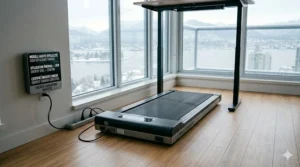
How to Choose an Affordable Under Desk Treadmill in Canada
Smart buying starts with honest self-assessment. Work through these criteria methodically rather than defaulting to “highest rated” or “best price.”
1. Define Your Primary Use Case
Under-desk walking while working requires different features than standalone cardio sessions. If 80%+ of your use will be while typing or on video calls, prioritize quiet operation (under 45 dB), compact footprint, and stability at slower speeds (2-4 km/h). Maximum speed ratings above 8 km/h are marketing fluff—you cannot realistically work while walking that fast. Conversely, if you want a treadmill for dedicated walking workouts separate from desk work, invest in incline capability and longer belt length (112+ cm) for natural stride.
2. Measure Your Actual Space Constraints
Don’t estimate—measure. Under-desk clearance from floor to bottom of your desk surface should be minimum 15 cm for walking pads without handlebars, 18-20 cm for comfort. Most treadmills are 10-14 cm high, but your feet add another 8-10 cm of clearance requirement. Measure storage space separately—if you plan to store the treadmill between uses, ensure you’ve identified the specific location and confirmed dimensions before purchasing.
3. Calculate Realistic Budget in Canadian Dollars
Factor in the complete cost: treadmill price, any import duties if ordering from U.S. retailers (stick to Amazon.ca to avoid this), surge protector ($20-30 CAD), lubricant ($15-25 CAD every 6 months), and potential accessories like an anti-fatigue mat ($30-60 CAD). A “$250 treadmill” actually costs $330-360 CAD when properly equipped. Budget should also include replacement timeline—a $200 treadmill lasting 18 months costs $11/month, while a $500 treadmill lasting 4 years costs $10.40/month.
4. Assess Noise Tolerance Based on Living Situation
Own a detached house? Noise is barely relevant—save money on quieter models and prioritize other features. Live in a condo, apartment, or have family members working from home in adjacent rooms? Noise becomes a primary consideration. Spec sheets are unreliable here—look for Canadian reviewer feedback specifically mentioning condo use and neighbour reactions. Models under 40 dB at 3 km/h walking speed are truly quiet; 45-50 dB is acceptable; above 55 dB will likely cause problems.
5. Match Motor Power to Use Frequency
Manufacturers overstate motor specs habitually. For real-world guidance: 2.0-2.5 HP motors suit light use (30-60 min/day, 3-4 days/week). 2.5-3.0 HP handles moderate use (60-90 min/day, 5-6 days/week). Above 3.0 HP is necessary only for heavy use (2+ hours daily) or users consistently near maximum weight capacity. Brushless motors outlast brushed motors significantly (3-5 years vs 1-2 years typical lifespan), justifying 20-30% price premiums if you plan extended ownership.
6. Evaluate Incline Value for Canadian Winters
Incline capability matters more to Canadians than temperature-climate residents because we lose outdoor walking months entirely. A 6-12% incline can increase calorie burn by 40-70% compared to flat walking, partially compensating for reduced winter activity. Manual incline (you adjust position physically) costs $50-100 CAD less than auto-incline but requires stopping the belt to change. Auto-incline adds convenience and programming options but introduces mechanical complexity and additional failure points.
7. Consider Long-Term Maintenance Accessibility
Canadian-specific question: Does the manufacturer have Canadian customer service, or will you deal with U.S.-based support with slow cross-border shipping? Check Amazon.ca reviews for mentions of warranty claims and replacement part availability. DeerRun, WalkingPad, and major brands maintain Canadian warehouses; lesser-known brands often ship parts from overseas, meaning 3-6 week delays. This matters enormously if a belt or motor fails 8 months into ownership.
Common Mistakes Canadian Buyers Make
Mistake #1: Prioritizing Maximum Speed Over Stability
Many buyers fixate on maximum speed specifications (8 km/h! 10 km/h! 12 km/h!) without considering usability. Most people cannot safely walk above 5.5 km/h while simultaneously working on a computer. Above that speed, you’re doing dedicated cardio, which requires full attention for safety. Yet manufacturers market higher speeds as premium features, and buyers pay $100-200 CAD more for capabilities they’ll never use. Focus instead on smoothness and stability at slower speeds (2.5-4.5 km/h) where you’ll spend 90% of your time.
Mistake #2: Ignoring Canadian Electrical Requirements
Less common now than five years ago, but still worth verifying: confirm the treadmill operates on standard Canadian 120V outlets and includes a CSA-approved plug. Most Amazon.ca listings have sorted this out, but if you’re ordering from third-party sellers or U.S. sites, voltage incompatibility can damage motors or create fire hazards. Canadian electrical code requires three-prong grounded plugs for any motorized equipment—two-prong adapters are not safe alternatives.
Mistake #3: Underestimating Noise in Multi-Level Homes
Sound travels downward more effectively than upward. If your home office sits above a family room or bedroom, even “quiet” treadmills will be audible to floor-below occupants. Canadian construction standards vary wildly by decade—homes built 1980-2000 often have minimal sound insulation between floors. Test the treadmill during the Amazon.ca return window specifically for noise complaints from family members or neighbours.
Mistake #4: Skipping the Warranty Registration
Approximately 60% of buyers never register their warranty, based on manufacturer estimates. This sounds harmless until your motor fails 11 months after purchase and you discover the warranty requires registration within 30 days of receipt. Canadian consumer protection laws provide some baseline coverage, but manufacturer warranties typically offer much better terms. Set a calendar reminder to register immediately after setup.
Mistake #5: Expecting Gym-Grade Performance at Budget Prices
This is the hardest truth: a $300 CAD treadmill is not a $3,000 CAD commercial treadmill. Belts will be shorter (limiting natural stride), motors will be less powerful (limiting sustained use and maximum speed), and build quality will reflect the price point (expect replacement within 2-3 years, not 10+ years). These limitations don’t make budget treadmills bad purchases—they make them appropriate purchases when you understand and accept the trade-offs.
Affordable Under Desk Treadmill vs. Traditional Gym Treadmill
| Feature | Under Desk Treadmill | Traditional Gym Treadmill | Real-World Impact for Canadians |
|---|---|---|---|
| Cost | $200-$600 CAD | $1,500-$5,000 CAD | Under-desk models eliminate gym membership costs ($50-80/month), recouping investment in 6-12 months |
| Space | 85-140 cm × 40-65 cm | 180-220 cm × 80-100 cm | Critical for Canadian condos/apartments where space commands premium rent |
| Noise | 35-55 dB typical | 60-75 dB typical | Apartment-friendly operation prevents neighbour conflicts in multi-unit buildings |
| Max Speed | 6-12 km/h | 16-24 km/h | Under-desk sufficient for walking; traditional required for running training |
| Incline Range | 0-14% (select models) | 0-15% standard | Comparable functionality for walking-focused users |
| Integration | Use while working | Dedicated workout time | Time efficiency crucial for Canadian work-from-home schedules |
| Winter Access | Available 24/7 at home | Requires commute | Eliminates ice/snow/cold as exercise barriers during 4-6 month Canadian winters |
The comparison reveals a fundamental difference in purpose rather than simple quality tiers. Traditional gym treadmills serve dedicated cardio training—running intervals, marathon preparation, high-intensity workouts. Under-desk treadmills serve activity integration—transforming sedentary work time into movement time. Both have value, but they solve different problems.
For most Canadians working from home 2-5 days weekly, the under-desk treadmill delivers superior return on investment because it converts dead time rather than requiring dedicated workout time. A busy parent can walk 90 minutes during back-to-back Zoom calls—something impossible with a traditional treadmill requiring focused attention and shower time afterward.
The limitation surfaces for serious runners or anyone training for specific athletic goals. Under-desk treadmills cannot safely accommodate running gaits, offer limited incline variation compared to gym equipment, and lack the belt length necessary for proper running biomechanics. Recognize this before purchasing—these are walking platforms first, and any jogging capability is a bonus feature rather than core functionality.
What to Expect: Real-World Performance in Canadian Conditions
Let’s dispel some marketing myths and establish realistic expectations.
Break-In Period: Weeks 1-3
Every treadmill requires mechanical break-in. Expect slightly increased noise during the first 5-10 hours as components settle. The belt may feel stiff initially—this is normal and will smooth out. Do NOT attempt to walk at maximum speed during the first week regardless of what the instruction manual suggests. Gradual motor break-in prevents early failures. Start at 2-3 km/h, increasing 0.5 km/h every few days until you reach your comfortable cruising speed.
Maintenance Reality: Monthly Tasks
Lubrication isn’t optional—it’s mandatory. Canadian temperature fluctuations accelerate belt friction, so lubricate every 40-50 hours rather than the 60-80 hours manufacturers suggest. The entire process takes 5 minutes: squirt silicone lubricant (available on Amazon.ca for $15-20 CAD) through the lubrication port or under the belt, run the treadmill at slow speed for 5 minutes to distribute. Skipping lubrication will destroy your belt within 6-9 months.
Belt alignment requires checking monthly. Walk slowly (2 km/h) and observe whether the belt drifts left or right. Minor drift is normal and easily corrected by tightening the appropriate rear roller bolt. Most manufacturers include an Allen key for this purpose. Significant drift or belt bunching indicates a motor mount issue requiring professional service.
Durability Timeline: What Actually Lasts
6-12 months: Expect no significant wear with proper maintenance. Belt and motor should perform as new.
12-24 months: Belt surface may show wear in the centre track where feet repeatedly strike. This doesn’t affect function until you see actual fraying or thinning. Motor noise may increase slightly—this is normal bearing wear.
24-36 months: Budget models ($200-$350 CAD) typically require belt replacement or motor service by this point with daily use. Premium models ($450-$600 CAD) usually continue functioning well with minor maintenance.
36+ months: Only quality motors and proper maintenance reach this lifespan. Expect to replace belts even on premium models. Consider this timeline when evaluating price—a $250 treadmill lasting 18 months costs $14/month, while a $500 model lasting 40 months costs $12.50/month.
Winter Performance Specifics
Canadian winters create unique challenges. Extremely dry air (common during heating season) can cause static buildup between belt and deck, increasing friction and noise. Running a humidifier in your home office to maintain 40-50% relative humidity solves this. Cold storage spaces (unheated garages, basement storage) can stiffen lubricant and damage electronic displays—keep the treadmill in climate-controlled areas year-round, or expect reduced lifespan.
Long-Term Cost & Value Analysis in Canadian Context
Understanding total cost of ownership prevents buyer’s remorse six months post-purchase.
Initial Investment Breakdown (Example: Mid-Range Model)
- Treadmill: $380 CAD (TOPUTURE Walking Pad typical price)
- Surge protector: $25 CAD (essential for electronics protection)
- Initial lubricant: $18 CAD (silicone-based, treadmill-specific)
- Anti-fatigue mat (optional): $45 CAD (reduces floor vibration transmission)
- Total Setup Cost: $468 CAD
Ongoing Costs (Per Year)
- Lubricant replacement (3-4 bottles annually): $55-75 CAD
- Electricity (1 hour daily @ 2.5 kW motor, Canadian average $0.13/kWh): $24 CAD
- Belt replacement (if needed, approximately every 18-24 months): $60-90 CAD
- Annual Operating Cost: $140-190 CAD
Value Comparison: Home Treadmill vs. Gym Membership
Average Canadian gym membership: $65/month × 12 months = $780 CAD annually
Home treadmill total first-year cost: $468 + $165 (avg operating) = $633 CAD Home treadmill total second-year cost: $165 CAD operating only Home treadmill total third-year cost: $165 + $75 (belt replacement) = $240 CAD
Three-Year Total: $1,038 CAD (treadmill) vs. $2,340 CAD (gym membership)
The math clearly favours home equipment, but this assumes equivalent usage. Gyms offer equipment variety, social motivation, and classes that home treadmills cannot replicate. The calculation shifts if you currently use gym amenities beyond cardio equipment. However, for Canadians whose primary fitness goal is accumulating daily movement (rather than bodybuilding or intensive training), the home treadmill delivers better value while eliminating weather-dependent commutes.
Calculating Personal ROI
Your specific return on investment depends on actual usage. Track your first 30 days carefully:
- Days per week you actually use the treadmill: _____
- Average minutes per session: _____
- Monthly usage hours: (days/week × 4.3 weeks) × (minutes ÷ 60) = _____
If this calculation shows 12+ hours monthly, you’re getting solid value. Under 8 hours monthly suggests the treadmill may not integrate well with your routine, regardless of features or quality.
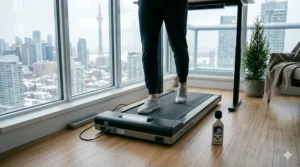
❓ Frequently Asked Questions
❓ Can I use an under desk treadmill on carpet in my Canadian home?
❓ How loud are these treadmills for Canadian apartment living?
❓ Do under desk treadmills work in cold Canadian basements or garages?
❓ What's the weight limit I should actually follow on affordable models?
❓ Can I walk on a treadmill while taking video calls for work?
Conclusion: Finding Your Perfect Walking Pad Match
After analysing dozens of under-desk treadmills available to Canadian buyers in 2026, three patterns emerge clearly. First, the affordable segment ($200-$600 CAD) has matured significantly—budget models now deliver reliability that would have cost $1,000+ just five years ago. Second, the sweet spot for most Canadian buyers sits around $350-$450 CAD, where you’re getting quality motors, useful features like incline adjustment, and 2-3 year durability without paying premium prices for features you won’t use. Third, and perhaps most importantly, success with an under desk treadmill depends less on specifications and more on honest self-assessment of your space, needs, and commitment level.
The Canadian Centre for Occupational Health and Safety emphasizes that walking provides measurable cardiovascular benefits, improved mental health, and reduced chronic disease risk—benefits that matter enormously during our extended winters when outdoor activity becomes challenging. An affordable under desk treadmill transforms these health recommendations from aspirational to achievable by removing the barriers of weather, gym commutes, and time scarcity.
If you’re just testing whether under-desk walking suits your workflow, start with the DeerRun Q1 Mini around $210 CAD—minimal investment, solid fundamentals, and if it doesn’t stick, you’ve risked less than three months of a typical gym membership. For Canadian families sharing equipment, the TOPUTURE Walking Pad ($350-$420 CAD) delivers exceptional versatility with its adjustable handlebar and 12% incline that serves multiple users and fitness levels. And for space-constrained urban Canadians, the WalkingPad A1 PRO ($480-$550 CAD) solves storage challenges that make other treadmills non-starters.
The best affordable under desk treadmill isn’t the one with the longest spec sheet—it’s the one you’ll actually use consistently. Measure your space, assess your budget honestly, acknowledge your living situation (apartment vs. house dramatically affects noise priorities), and choose accordingly. Then commit to 30 days of daily use. Odds are excellent that walking while working will transform from a novel experiment into an irreplaceable part of your routine, delivering health benefits that far exceed the modest financial investment.
Recommended for You
- Best Treadmill Desk Combo Canada 2026 – Top 7 Reviewed
- Best Scandinavian Standing Desk Canada: 7 Nordic Picks 2026
- 7 Best Mid Century Modern Desk Canada Affordable 2026
Disclaimer: This article contains affiliate links. As an Amazon Associate, I earn from qualifying purchases. If you purchase products through these links, we may earn a small commission at no additional cost to you.
✨ Found this helpful? Share it with your friends! 💬🤗
