
In This Article
Paper refuses to die. It hides in tax folders, signed leases, warranty slips and that one drawer nobody dares open. If you run a home office or a small business in Canada, you know the feeling, and you know a cardboard box won’t cut it. A metal filing cabinet is still the toughest, most secure home for those documents. In 2026 the range runs from compact lockable two-drawer units to commercial workhorses that outlive the office they sit in.

This guide cuts through the marketing noise. You’ll get seven real models compared, plain-English explanations of steel gauge thickness, powder coat vs paint finish and weight capacity, and the practical advice a product listing never gives you. Availability on Amazon.ca shifts by seller, so confirm stock and specs on the listing before you buy.
What Is a Metal Filing Cabinet?
A metal filing cabinet is a drawered storage unit, usually built from cold-rolled steel, that holds hanging folders upright and typically locks to protect sensitive records. Most filing cabinets are either vertical (drawers slide front to back) or lateral (wide, shallow drawers that slide out sideways). Steel gauge, finish quality and drawer-slide design decide whether yours lasts two years or twenty.
Why a Steel Filing Cabinet Beats the Alternatives
A steel filing cabinet resists dents, doesn’t swell in a damp basement, and holds its square shape when loaded. Wood and fabric units look friendlier, but they sag, warp or tear under the weight of real paper. Steel also takes a lock properly, which matters when the drawer holds payroll, client files or medical forms.
Here’s the catch. “Steel” on a listing tells you almost nothing. A 0.8 mm home-office drawer and a commercial 1.2 mm body are both “steel.” The sections below show you how to tell them apart, and the table that follows shows where each of the seven picks lands.
Metal Filing Cabinet Comparison: Top 7 at a Glance
Prices below are approximate ranges in Canadian dollars at the time of research. They move constantly, so check current price before you commit.
| Product | Layout | Drawers | Standout Trait | Approx. Price Range | Best For |
|---|---|---|---|---|---|
| INTERGREAT 2-Drawer Lateral File Cabinet | Lateral | 2 | Lockable powder-coated steel on a budget | C$150–C$250 | Starter home offices |
| Approgreent 2-Drawer Lateral File Cabinet | Lateral | 2 | Rated capacity near 100 kg, silent slides | C$180–C$300 | Heavy paper loads at home |
| Letaya 2-Drawer Steel Lateral File Cabinet | Lateral | 2 | Interlock anti-tip, ball-bearing slides | C$180–C$300 | Value-minded buyers |
| BYNSOE 4-Drawer Vertical File Cabinet | Vertical | 4 | Anti-tilt, tall and narrow | C$180–C$320 | Tight floor space |
| MIIIKO 4-Drawer Vertical File Cabinet | Vertical | 4 | High capacity, small footprint | C$180–C$320 | Growing archives |
| Lorell Fortress 4-Drawer Vertical File Cabinet | Vertical | 4 | Commercial build, removable-core lock | C$500–C$750 | Busy shared offices |
| HON Brigade 600 Lateral 4-Drawer File Cabinet | Lateral | 4 | Wide 107 cm commercial frame | C$900+ | Professional workspaces |
Looking at the table, the two-drawer lateral models cluster in the same price band, so the real choice is between slide quality, capacity and lock design rather than cost. The two budget four-drawer verticals trade width for height, which is the smarter play when floor space is scarce. The Lorell Fortress 4-Drawer Vertical File Cabinet and HON Brigade 600 Lateral 4-Drawer File Cabinet cost two to four times more, and that premium buys commercial construction and longevity rather than extra features.
💬 Just one click — help others make better buying decisions too!😊
Top 7 Metal Filing Cabinets: Expert Analysis
1. INTERGREAT 2-Drawer Lateral File Cabinet — cheapest way into lockable steel
If you want a lockable metal filing cabinet without a lockable price, the INTERGREAT 2-Drawer Lateral File Cabinet is where the budget conversation starts. It’s a black powder-coated steel lateral unit sold with a locking mechanism and a simple assembly design, sized for letter, legal and A4 hanging files.
A lateral layout means shallow drawers that spread files across the width. You see everything at a glance and don’t have to dig front to back. For a small home office, that’s often easier on the hands than a deep vertical drawer. The powder-coated finish is the other quiet win, because it resists chips better than a thin painted coat.
My take, based on the spec comparison: this is a good first cabinet for tax paperwork, household records and light business files. It isn’t the one to pick if you’ll cram a decade of client folders into it. Review roundups describe it as budget-friendly with secure storage and no premium frills. I couldn’t verify detailed review counts, so judge fit from the listing’s own reviews.
Pros:
- ✅ Locking drawers at an entry-level price
- ✅ Powder-coated steel resists everyday chips
- ✅ Simple assembly suits first-time builders
Cons:
- ❌ Basic slides lack premium smoothness
- ❌ Two drawers cap your total storage
Expect roughly C$150–C$250; check current price. Verdict: excellent value for light-to-moderate paper loads.

2. Approgreent 2-Drawer Lateral File Cabinet — silent slides and serious load rating
The Approgreent 2-Drawer Lateral File Cabinet is the heavy lifter of the budget class. Listings cite a 220 lb (about 100 kg) capacity, silent drawer slides, a dual-key lock and an anti-tip lock. Several 2026 roundups name it their top lateral pick.
That capacity figure is the interesting part. A fully loaded letter-size drawer weighs far less than 50 kg, so a 100 kg rating suggests the manufacturer is leaving real headroom. Silent slides matter more than they sound, too. If your cabinet sits in a shared room or a bedroom-office, a drawer that glides without the metal-on-metal shriek earns its keep daily.
The anti-tip lock deserves a mention. It stops you from opening two drawers at once, which is how loaded cabinets pitch forward. Reviewers in roundups consistently praise the quiet operation, though I couldn’t verify individual review counts, so read the current listing.
Pros:
- ✅ Rated capacity near 100 kg
- ✅ Silent slides suit shared spaces
- ✅ Anti-tip lock adds real safety
Cons:
- ❌ Alloy-steel build may feel lighter than commercial units
- ❌ Lateral width needs wall space
Roughly C$180–C$300 range. Verdict: strong value if weight capacity is your top priority.
3. Letaya 2-Drawer Steel Lateral File Cabinet — interlock safety with ball-bearing glide
The Letaya 2-Drawer Steel Lateral File Cabinet gets pitched as the “commercial feel at a home-office price” option, and the spec sheet backs part of that. It’s all-steel, cold-rolled, powder-coated for rust resistance, and fitted with a built-in interlock anti-tip system and ball-bearing full-suspension drawers.
Ball-bearing slides are the upgrade that you’ll notice in week one. Cheap rollers wobble under load; ball bearings track straight and fully extend, so you can reach files at the back without craning. Full extension also helps if you use hanging folders on rails.
One roundup notes more than 1,600 customer reviews, which gives this model a bigger sample than most budget rivals. That doesn’t guarantee quality, but a large review pool makes recurring defects easier to spot before you buy. On paper, this is the most balanced of the three lateral models: the interlock is safer than a simple lock, and the slide quality is better than the cheapest options.
Pros:
- ✅ Cold-rolled steel with powder-coated finish
- ✅ Ball-bearing full-extension drawers
- ✅ Interlock prevents multi-drawer tipping
Cons:
- ❌ Only two drawers of storage
- ❌ Assembly takes patience and time
Roughly C$180–C$300 range. Verdict: the best-balanced budget steel filing cabinet of the group.
4. BYNSOE 4-Drawer Vertical File Cabinet — tall, narrow and anti-tilt
When the floor space is tiny but the paperwork pile isn’t, the BYNSOE 4-Drawer Vertical File Cabinet answers with height. It’s a steel vertical unit with an anti-tilt mechanism, a lock and compatibility with letter, legal and A4 hanging files.
Vertical cabinets pull front to back, so you need clear floor in front of the drawers rather than wall width beside them. In practice that means a narrow footprint that slides into a corner or alongside a desk. Four drawers in that slim frame gives you a lot of paper per square metre of floor.
Roundups call it a strong pick for home offices where the cabinet stays put and mostly letter-size paperwork lives inside. The lock, slides and finish reportedly exceed expectations at the price. What the spec sheet won’t tell you is how it handles a heavily loaded top drawer. With any tall unit, load the bottom drawers first so the weight sits low.
Pros:
- ✅ Four drawers in a slim footprint
- ✅ Anti-tilt design improves stability
- ✅ Lock included for private records
Cons:
- ❌ Needs deep clearance in front
- ❌ Heavier loads strain light-gauge frames
Roughly C$180–C$320 range. Verdict: smart choice for compact offices that need volume.
5. MIIIKO 4-Drawer Vertical File Cabinet — serious capacity without the floor space
The MIIIKO 4-Drawer Vertical File Cabinet lands near the top of one 2026 home-office roundup, which called it the best bet for serious filing capacity without sacrificing floor space. It’s a black four-drawer vertical metal filing cabinet with a locking mechanism.
Think of it as the BYNSOE 4-Drawer Vertical File Cabinet‘s closest competitor. The pairing is useful because it forces an honest question: which details matter to you? Look at lock type, handle design and whether the drawers include hanging rails. Those small choices change daily use more than the headline specs.
The one recurring caution in coverage is assembly. Reviewers note the instructions could be clearer for first-time builders, so set aside an hour, lay out the panels and read the diagram twice before tightening anything. Once built, a cabinet that size is a solid base for years of records, provided you don’t over-stuff the top drawer.
Pros:
- ✅ High capacity in a narrow frame
- ✅ Locking drawers protect sensitive files
- ✅ Top-ranked in a 2026 home-office roundup
Cons:
- ❌ Assembly instructions could be clearer
- ❌ Taller units demand level flooring
Roughly C$180–C$320 range. Verdict: great if you want volume and can handle a patient build.
6. Lorell Fortress 4-Drawer Vertical File Cabinet — commercial-grade workhorse
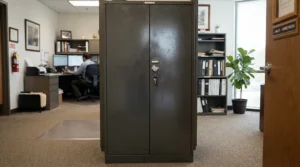
This is the model you buy once. The Lorell Fortress 4-Drawer Vertical File Cabinet (legal version measures 46 × 67 × 132 cm, or 18 × 26.5 × 52 in) is a commercial-grade heavy-gauge steel unit with ball-bearing suspension, a core-removable lock, adjustable wire followers and label holders on every drawer.
The detail that matters most: high-sided drawers accept legal-size hanging folders without extra hangrails. That’s fewer parts to snap or sag. The core-removable lock also means a lost key doesn’t turn into a replacement cabinet; a locksmith or facilities team can swap the core. Listings also show ANSI/BIFMA compliance and recycled content of about 28% on one letter version, a sign of a build aimed at offices that actually spec furniture.
The trade-off is cost and bulk. It’s heavier, deeper and pricier than every budget pick above. For a busy shared office or a business that files daily, that bulk is exactly what you’re paying for. Review samples on retail listings were small when I checked, so lean on the manufacturer’s specification rather than crowd opinion.
Pros:
- ✅ Commercial heavy-gauge steel construction
- ✅ Core-removable lock simplifies key loss
- ✅ Legal-ready drawers without extra rails
Cons:
- ❌ Pricey versus budget alternatives
- ❌ Heavy and deep, so placement matters
Typically C$500–C$750 range. Verdict: the premium pick for durability-first buyers.
7. HON Brigade 600 Lateral 4-Drawer File Cabinet — wide commercial frame
The HON Brigade 600 Lateral 4-Drawer File Cabinet is the professional lateral option, listed in a 107 × 46 cm (42 × 18 in) configuration across black, putty and light grey finishes. It belongs to the HON commercial family, a name that shows up constantly in office-supply catalogues.
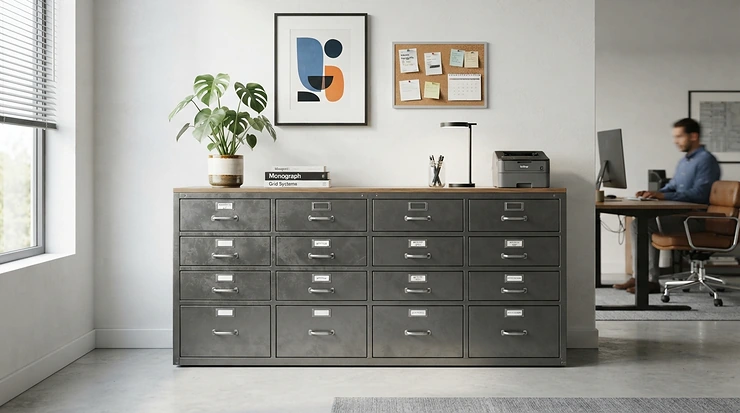
A 107 cm width makes this cabinet half furniture, half storage wall. Lateral four-drawer units like this often serve as credenzas or room dividers, with a surface on top for a printer or plants. Remember the clearance rule, though: lateral cabinets need roughly 90–107 cm of open floor in front for comfortable use.
I couldn’t confirm per-drawer capacity or exact steel gauge from the listings I reviewed, so treat both as questions for the HON spec sheet before purchase. Availability through Amazon.ca also varies, so check the seller. If those specs check out, this is the long-haul cabinet for law offices, clinics and accounting firms.
Pros:
- ✅ Wide lateral layout shows everything
- ✅ Multiple professional colour options
- ✅ Doubles as a credenza surface
Cons:
- ❌ Highest price of the seven
- ❌ Needs generous floor clearance
Typically C$900+ range, often more. Verdict: worth it only if you file heavily and want furniture that lasts decades.
✨ Ready to Upgrade Your Filing Setup?
🔍 Take your paperwork from chaos to calm with these carefully selected options. Click on any highlighted product name to check current pricing and availability. A well-chosen steel cabinet means your records stay safe, findable and ready when you need them!
How to Choose a Metal Filing Cabinet
Follow these seven steps and you’ll avoid most buyer’s remorse:
- Measure the space first, including drawer clearance. A vertical cabinet needs open floor in front; a lateral one needs about 90–107 cm. A cabinet that fits the wall but blocks the door is a very expensive coat rack.
- Choose vertical or lateral. Vertical saves floor width and holds more per square metre. Lateral shows files at a glance and works as a credenza.
- Check the steel gauge. Thicker steel (lower gauge number) resists dents and sagging. See the gauge section below.
- Look for a powder-coated finish. It resists chips and corrosion better than basic paint.
- Inspect the drawer slides. Ball-bearing, full-extension slides handle load and last longer than basic rollers.
- Confirm weight capacity and an anti-tip system. An interlock that opens one drawer at a time is a genuine safety feature.
- Match the lock to your risk. A basic cam lock deters casual snooping. For payroll or client files, a removable-core or higher-security lock is worth the extra.
This list is your filter. If a listing won’t tell you gauge, finish or capacity, treat that silence as a data point.
Steel Gauge Thickness: What the Numbers Really Mean
Steel gauge thickness works backwards: a lower number means thicker steel. That counterintuitive rule trips up a lot of buyers. An 18-gauge panel is noticeably stiffer than a 22-gauge one, and that stiffness decides whether drawers still glide after five years of loading.
| Gauge | Thickness (mm) | Thickness (in) | Typical Use | Best For |
|---|---|---|---|---|
| 16 | 1.52 | 0.0598 | Premium commercial | High-security, heavy daily use |
| 18 | 1.21 | 0.0478 | Commercial cabinet body | Busy shared offices |
| 20 | 0.91 | 0.0359 | General office filing | Everyday business use |
| 22 | about 0.76 | about 0.030 | Light commercial or consumer | Personal workstation filing |
Vendor guidance generally treats 18- to 20-gauge as the commercial standard for cabinet bodies and 22-gauge or thinner as light-duty or residential grade. Some budget listings quote thickness in millimetres instead. A 0.8 mm mobile cabinet, for instance, sits close to 22-gauge.
Reading the table, the jump from 22- to 18-gauge adds roughly 60% more steel thickness. That’s the difference between a cabinet that shrugs off a bump and one that dimples. If you only file occasionally, a 20- or 22-gauge steel filing cabinet is perfectly adequate. If drawers open dozens of times a day, pay for 18-gauge. Because many budget listings omit gauge entirely, ask the seller or check the manufacturer’s spec sheet.
Powder Coat vs Paint Finish: What Actually Lasts
The finish is the cabinet’s armour, and the powder coat vs paint finish debate has a fairly clear winner. Powder coating applies dry pigmented powder electrostatically, then bakes it into a hard shell. Liquid paint is sprayed and dries, often in thinner layers.
Typical powder coat thickness runs about 2.5 to 6 mils (roughly 0.06–0.15 mm), while paint is usually 1 to 2 mils per coat (about 0.025–0.05 mm). Thicker, baked-on powder resists chipping, scratching and fading better, and it doesn’t drip or run during application. It also uses no solvents, so it’s generally low in volatile organic compounds.
Paint isn’t useless. It offers a wider colour range, and you can touch up chips with a small brush. Powder coat is harder to repair at home. For a powder-coated filing cabinet, keep a small tin of matching enamel for the odd scrape.
Practically, that means a powder-coated filing cabinet is the safer buy for garages, basements and busy offices where bumps and humidity are routine. Look for the phrase in the listing. If a seller only says “painted,” assume a thinner, less forgiving coat.
Weight Capacity: How Much Can a Metal Filing Cabinet Hold?
Weight capacity is the spec sellers love to inflate and buyers love to ignore. Start with the arithmetic: a 500-sheet ream of standard bond paper weighs about 2.3 kg (5 lb) and stands roughly 5 cm tall. A 60 cm deep drawer packed with reams could carry around 27 kg of paper, folders not included.
So a four-drawer cabinet fully stuffed can pass 100 kg of contents. Compare that with the Approgreent 2-Drawer Lateral File Cabinet‘s stated 220 lb (about 100 kg) capacity and you see why headroom matters. Per-drawer ratings and total-cabinet ratings are different numbers; check which one the listing quotes.
Three practical rules follow from the physics:
- Load bottom drawers first. It lowers the centre of gravity and reduces tipping.
- Never open two drawers at once. An interlock, like the one on the Letaya 2-Drawer Steel Lateral File Cabinet, enforces this.
- Leave 10–15% headroom. Slides wear faster at their limit.
A thin-gauge cabinet may state a big number but flex long before it reaches it. Pair the capacity claim with gauge and slide type for a truthful picture.
Metal Filing Cabinet vs Wood and Fabric Alternatives
| Factor | Metal | Wood / Engineered Wood | Fabric / Plastic | Best For |
|---|---|---|---|---|
| Durability under load | High | Medium; can sag | Low | Heavy paper storage |
| Lockable security | Strong | Moderate | Weak or none | Sensitive records |
| Moisture tolerance | Good with powder coat | Poor in damp spaces | Fair | Basements, garages |
| Appearance | Utilitarian to modern | Warm, furniture-like | Light, casual | Living-space offices |
| Typical lifespan | Many years | Moderate | Short | Long-term filing |
The table makes the trade-off plain. Wood wins on warmth, fabric on price and portability, but metal is the only category that scores well on load, security and moisture at once. If your cabinet lives in a living room and holds a few folders, wood might be fine. If it guards business records or sits near a damp wall, a steel filing cabinet is the safer investment. Hybrid designs exist, such as steel frames with wood-look tops, though be careful: some “metal” listings use wooden shelving and mostly fabric drawers.
Durable Metal File Cabinet for Office: Matching the Build to the Workplace
A durable metal file cabinet for office use isn’t a single product; it’s a match between workload and build. Think of three tiers.
Light use (a few openings a day): Budget lateral units like the INTERGREAT 2-Drawer Lateral File Cabinet handle household and sole-proprietor paperwork well.
Moderate use (daily access, one or two users): The Letaya 2-Drawer Steel Lateral File Cabinet and BYNSOE 4-Drawer Vertical File Cabinet fit small teams, thanks to better slides or higher capacity.
Heavy use (shared, constant access): Here the Lorell Fortress 4-Drawer Vertical File Cabinet and HON Brigade 600 Lateral 4-Drawer File Cabinet earn their premium. Commercial-grade steel, sturdier slides and replaceable lock cores stand up to years of slamming drawers.
The honest rule: buy for your busiest year, not your quietest. A durable metal file cabinet for office life is cheaper over a decade than replacing a flimsy one twice.

Practical Setup and Maintenance Guide
A good cabinet can still be ruined by a bad first week. Follow this sequence:
- Assemble on a flat floor. Hand-tighten every screw first, then do a final snug pass. Overtightening early racks the frame.
- Level it. Slip a thin shim under any short corner until drawers stay put when released.
- Load bottom up. Heaviest files go low.
- Use hanging folders properly. Space them so the follower or divider holds files upright.
- Test the lock before you fill it. Store the spare key somewhere other than the cabinet, which sounds obvious until you’re locked out.
For maintenance, every three months wipe the slides with a dry cloth and apply a thin film of light machine oil or silicone lubricant to the ball-bearing tracks. Skip heavy grease; it collects dust and turns into grit. Touch up chips on a powder coat with matching enamel before rust forms. In your first 30 days, the common mistakes are over-stuffing the top drawer, ignoring wobble and forgetting the interlock exists.
Real-World Scenarios: Which Metal Filing Cabinet Fits Which Person?
The freelancer in a spare bedroom. She files invoices, contracts and tax receipts, about 4–5 cm of new paper each month, in a quiet room. The Approgreent 2-Drawer Lateral File Cabinet fits: silent slides and ample capacity, with a modest budget. If she later hires an accountant, the records fit in two drawers with room to grow.
The home-based consultant with limited floor space. He has a 90 cm alcove and years of client files. The BYNSOE 4-Drawer Vertical File Cabinet or MIIIKO 4-Drawer Vertical File Cabinet gives four drawers in a slim footprint. He should load carefully and keep the front clear.
The small accounting practice. Four staff, daily access, and CRA expecting six years of records. That volume and traffic point to the Lorell Fortress 4-Drawer Vertical File Cabinet, or the HON Brigade 600 Lateral 4-Drawer File Cabinet if there’s wall space. The removable-core lock suits an office where keys change hands.
Notice the pattern: budget isn’t the first question. Volume, frequency and floor space are.
Common Problems and Their Fixes
Problem: Drawers stick or scrape. Usually the frame is out of square. Loosen the corner bolts, level the base, then retighten. Lubricate the slides afterward.
Problem: The cabinet tilts forward. You’ve loaded the top first or opened two drawers. Rebalance with heavy files low, and choose a model with an interlock.
Problem: Rust spots near the floor. Moisture. Lift the cabinet off bare concrete with a plastic mat, wipe condensation, and touch up chips with enamel. A powder-coated filing cabinet resists this far better than a thin painted one.
Problem: Files slump in half-empty drawers. Use adjustable followers or dividers to keep folders upright.
Problem: Lost key. Order a replacement lock set from the seller, or on a commercial unit have the core swapped.
Problem: Too much paper. Scan what you can. If you rely on digital copies, the CRA’s electronic record-keeping guidance explains what makes a scanned record acceptable, including that records stored on foreign servers aren’t considered kept in Canada.
Records, Safety and Canadian Considerations
For most Canadians, the cabinet is really about the CRA. As a general rule, individuals should keep income tax records for at least six years, and businesses must keep books and records at their place of business or residence in Canada unless the CRA gives written permission otherwise. A lockable cabinet at your home or office satisfies the “where” part of that rule neatly.
If you’d like to destroy records early, you generally need written permission from the CRA first. Plan storage around that six-year horizon: a two-drawer cabinet fills up faster than you’d expect once receipts, statements and T-slips accumulate.
On safety, remember two limits. First, a standard steel filing cabinet is not a fireproof safe, and it won’t protect originals like passports or birth certificates from fire. Second, tip-over is a real hazard with loaded units, so anti-tip interlocks and a level floor aren’t optional. If you’re outfitting a workplace, check provincial occupational health requirements and any lease or insurance conditions.
Common Mistakes When Buying a Metal Filing Cabinet
Buying on drawer count alone. Four flimsy drawers often hold less usable paper than two solid ones.
Ignoring gauge and finish. If the listing won’t state them, assume the minimum. Steel gauge thickness and a powder coat are the two cheapest durability checks you have.
Forgetting clearance. Measure the open-drawer footprint, not just the cabinet.
Skipping the lock check. Many entry-level locks are deterrents, not security. If privacy matters, plan around that.
Assuming Amazon listings are accurate. Dimensions, “heavy-duty” claims and capacity numbers vary by seller. Cross-check against the manufacturer when you can.
Overbuying or underbuying. A commercial cabinet in a closet is wasted money; a thin cabinet in a busy office is a repeat purchase. Match the build to the workload.

FAQ
❓ How much does a metal filing cabinet cost in Canada?
❓ Is a metal filing cabinet fireproof?
❓ Can I use a steel filing cabinet in a damp basement or garage?
❓ Can I touch up or repaint a metal filing cabinet?
❓ How heavy is a metal filing cabinet?
Conclusion
A metal filing cabinet is one of those purchases you notice only when it’s wrong. A good one disappears into your routine: the drawers glide, the lock turns, the files stay upright and nothing tips. A bad one rattles, sags and eventually gets replaced.
The practical takeaway is simple. For light home-office use, the INTERGREAT 2-Drawer Lateral File Cabinet, Approgreent 2-Drawer Lateral File Cabinet and Letaya 2-Drawer Steel Lateral File Cabinet deliver lockable, powder-coated steel at friendly prices, with the Approgreent 2-Drawer Lateral File Cabinet leading on capacity and the Letaya 2-Drawer Steel Lateral File Cabinet on balanced build. When floor space is tight, the BYNSOE 4-Drawer Vertical File Cabinet and MIIIKO 4-Drawer Vertical File Cabinet stack storage upward. And for busy, shared workplaces, the Lorell Fortress 4-Drawer Vertical File Cabinet and HON Brigade 600 Lateral 4-Drawer File Cabinet justify their premium with commercial construction.
Before you click, check three things: steel gauge, powder-coated finish and weight capacity. Those three details separate a steel filing cabinet that lasts from one that merely looks the part. Measure your space, count your paper, and buy for your busiest year.
Recommended for You
- Narrow Vertical Filing Cabinet For Small Spaces: 7 Best Picks (2026)
- Mobile Filing Cabinet On Wheels: 7 Best Picks For Canada 2026
- Wooden Filing Cabinet That Looks Like Furniture: 7 Best Picks 2026
Disclaimer: This article contains affiliate links. As an Amazon Associate, I earn from qualifying purchases. If you purchase products through these links, we may earn a small commission at no additional cost to you.
✨ Found this helpful? Share it with your friends! 💬🤗
