
In This Article
Around hour six, your office chair stops being furniture and starts being an argument. The seat that felt fine at 9 a.m. now has opinions about your tailbone, and your hips are filing formal complaints. Replacing the chair is the dramatic fix. Memory foam office chair cushions are the quiet one. They cost a fraction of a new chair, and they move easily from the home office to the boardroom to the car.

The material has a better origin story than most desk accessories. Memory foam was developed in 1966 under a NASA Ames Research Center contract to make aircraft seating safer. Wikipedia’s overview of memory foam explains why it behaves the way it does. It is a polyurethane with added chemistry that makes it slow to rebound, so it moulds to you instead of pushing back. That slow squish is exactly what you want on a long Tuesday.
Here is what this guide does, and what it doesn’t. It compares seven real, widely sold cushions using spec sheets, published editorial testing, and aggregated customer-review sentiment. It is not a lab, and it won’t invent hands-on stories. What it offers is honest analysis: what each number means for your body, which cushion suits which desk, and where the marketing runs ahead of the foam.
We’ll also dig into contouring foam technology, pressure point relief, the memory foam cushion vs gel cushion office chair debate, and the ergonomic accessories that make any cushion work harder. One Canadian wrinkle gets its own airtime too: foam gets firm in a cold basement office in January.
Quick Comparison: 7 Memory Foam Office Chair Cushions at a Glance
Here is the whole field on one screen. Sizes are approximate and converted from published listings, and prices are ranges, so check current price on Amazon.ca before you buy.
| Product | Foam Type | Approx. Size (cm) | Price Range (CAD) | Best For |
|---|---|---|---|---|
| Everlasting Comfort Memory Foam Seat Cushion | Pure memory foam, U-shaped | Several sizes, check listing | C$40–C$65 | Everyday value |
| ComfiLife Gel Enhanced Seat Cushion | High-density foam + gel layer | 44 × 35 × 7 | C$55–C$80 | Warm offices |
| Cushion Lab Pressure Relief Seat Cushion | Extra-dense charcoal-infused foam | 46 × 39 × 10 | C$85–C$120 | Tailbone sensitivity |
| Sutera Seat Cushion | Bamboo charcoal-infused foam | 45 × 41 × 11 | C$55–C$85 | Thick lift, cooling |
| Aylio Seat Cushion | High-density foam, U-shaped | 46 × 36 × 6 | C$55–C$75 | Softer feel, no slipping |
| Qutool Orthopedic Seat Cushion and Lumbar Support | Memory foam two-piece set | 46 × 36 × 8 (seat) | C$35–C$55 | Budget seat-plus-back |
| TravelMate Extra-Large Memory Foam Seat Cushion | Memory foam, extra-large | 48 × 43 × 8 | C$45–C$75 | Wide chairs |
Looking at the comparison above, the ComfiLife Gel Enhanced Seat Cushion is the most balanced pick for most people, and the Qutool set is the cheapest way to cover both seat and lower back. If your chair is wider than average, the TravelMate is the only one here built for that. Anyone chasing maximum tailbone offloading should budget for the Cushion Lab, but should also check that their chair’s height range can handle its thickness.
💬 Just one click — help others make better buying decisions too!😊
Top 7 Memory Foam Office Chair Cushions: Expert Analysis
Each pick below gets the same treatment: what the specs mean in practice, who it suits, what aggregated reviews say, and whether the price makes sense.
1. Everlasting Comfort Memory Foam Seat Cushion — most-reviewed all-round value pick
Popularity isn’t proof of quality, but third-party roundups tally more than 127,000 ratings and a 4.4-star average on the US listing. That tells you this cushion survives contact with real desks.
It is pure memory foam, with no gel layer, in a U-shaped design that leaves a gap under the tailbone. On paper, that means the deepest, most personalized contour you’ll find at this price. The cutout lets your coccyx hover instead of press. The tradeoff is thermal, since pure foam has nothing actively moving heat away.
Based on the spec comparison, this suits people who want one dependable cushion to rotate between the office chair and the car seat. Roundup testers report it stayed put on a smooth chair surface all day, which matters because a sliding cushion is a useless one. A common complaint about pure foam in user reviews is warmth in long sessions. Canadian review counts will be smaller than the US figures, so scan the Amazon.ca listing too.
Pros:
- ✅ Pure foam gives a deep, personal contour
- ✅ U-shaped cutout offloads the tailbone
- ✅ Huge review base across several sizes
Cons:
- ❌ No gel layer, so it runs warmer
- ❌ Fit varies by size, so measure first
Expect roughly C$40–C$65 at the time of research, which makes it strong value for a first foam cushion.
2. ComfiLife Gel Enhanced Seat Cushion — gel layer over firm, supportive foam
If memory foam is the sensible sweater, this is the same sweater with a vent in it. The gel layer on top is designed to take the edge off heat buildup.
Popular Science’s editors named it best overall. Published specs list about 44 × 35 × 7 cm (17.5 × 13.7 × 2.8 in) of high-density foam with a velour cover, a carry handle, a grippy underside and a washable zip-off cover. Seven centimetres of thickness lifts you a little, so check that your chair still lets your feet rest flat.
The editorial verdict is also honest about the catch. The reviewer found it firmer than expected at first and needed a few sittings to adjust. Firm is not a flaw, though. It suits heavier users and anyone who sinks through softer foam to the chair pan. Roundups also cite a 4.4-star average from more than 108,000 reviews, though those are third-party tallies.
Pros:
- ✅ Gel layer helps manage heat
- ✅ Carry handle and washable cover
- ✅ Grippy bottom resists sliding
Cons:
- ❌ Firm feel needs a short adjustment
- ❌ Lighter users may find it too stiff
Plan on roughly C$55–C$80. For most desks, that is the best balance of comfort and price here.
3. Cushion Lab Pressure Relief Seat Cushion — premium extra-dense, charcoal-infused foam
Think of this as the cushion that treats sitting as an engineering problem. The brand’s proprietary charcoal-infused memory foam is marketed as odour-resistant, extra-dense and ergonomist-shaped.
Retailer listings put it at about 46 × 39 × 10 cm (18 × 15.5 × 4 in), which is notably tall. Reviewed.com’s editorial testing found the foam held up over a month, giving pushback while cradling. It also flagged the height as best suited to adjustable chairs, and said a matching lumbar pillow would likely deliver the full relief.
Here is what the spec sheet won’t tell you. Ten centimetres of lift can push your knees above your hips on a fixed-height chair, and that can undo the benefit. Customer reviews on retailer pages lean toward tailbone relief during long desk hours, with an occasional note that it is too large for a car seat.
Pros:
- ✅ Dense foam resists flattening
- ✅ Strong tailbone offloading
- ✅ Grippy base stays put
Cons:
- ❌ Tall profile needs an adjustable chair
- ❌ Premium price
Expect roughly C$85–C$120. It’s worth it only if standard cushions haven’t solved your tailbone problem.
4. Sutera Seat Cushion — thickest pick with bamboo charcoal cooling
Where most cushions whisper, the Sutera announces itself at 11 cm (4.3 in) deep. Popular Science named it best cooling, thanks to a bamboo charcoal-infused foam designed to keep heat from pooling.
At about 45 × 41 × 11 cm, it has a generous footprint, with rubber grips underneath and a machine-washable cover. The thickness elevates both hips and thighs, so the editor suggests lowering the chair to keep your feet on the floor. That is a real adjustment, not fine print.
The editorial tester found it stiff enough at first that their legs ached, then grew to appreciate the support, and it hadn’t sagged with continued use. That is one reviewer’s experience rather than aggregated sentiment, so treat it as a flag, not a guarantee. I couldn’t verify a large pool of customer reviews, which is itself information. Anyone who dislikes firm seats should look at softer picks.
Pros:
- ✅ Deep foam gives serious lift
- ✅ Bamboo charcoal aids heat management
- ✅ Rubber grips and washable cover
Cons:
- ❌ Stiff at first, may ache initially
- ❌ Too tall for fixed-height chairs
Plan on roughly C$55–C$85, comparable to the ComfiLife.
5. Aylio Seat Cushion — softer U-shape with a micro-grip base
Not everyone wants a plank. The Aylio leans soft, and Popular Science’s editor named it best non-slip bottom.
Published specs list about 46 × 36 × 6 cm (18 × 14 × 2.5 in) of high-density foam in a U-shape. That design relieves pressure on the coccyx, and the editor links it to less numbness on long sits. The velvet cover doesn’t trap heat, and it comes with a handle and removable washable cover.
The same editor has used one since 2020, and there was no break-in period. Treat that as a durability data point from one tester, not a lab result. The tradeoff is that heavier users may bottom out through soft foam, and anyone needing firm support for a spine condition should look elsewhere. For lighter to average builds in cool offices, it is one of the friendlier options. Softer foam also tolerates a cold room better than dense foam does.
Pros:
- ✅ Comfortable from day one
- ✅ Non-slip micro-grip base
- ✅ Washable cover with handle
Cons:
- ❌ May feel too soft for heavier users
- ❌ Thinner profile than premium picks
Expect roughly C$55–C$75, fair for the comfort and grip you get.

6. Qutool Orthopedic Memory Foam Seat Cushion and Lumbar Support — two-piece budget set
Two cushions for one price is the whole pitch, and it mostly works. Popular Science’s editors named it best budget because it pairs a seat cushion with a strap-on lumbar pillow.
Specs list a seat cushion around 46 × 36 × 8 cm (18 × 14 × 3 in) and a lumbar pillow around 36 × 33 × 10 cm (14 × 13 × 4 in). Both have velvet covers that zip off for machine washing. The lumbar pillow has two straps for securing it to the backrest.
Here is the catch. If your chair already has an adjustable lumbar feature, the extra pillow can sit awkwardly, as the editorial review notes. If your chair has a flat back, the set fits much better. I couldn’t verify enough independent customer reviews to summarize them, so judge it on the editorial notes and return policy. For a spare chair or a first experiment, the economics are hard to beat.
Pros:
- ✅ Seat and lumbar pillow together
- ✅ Washable covers on both pieces
- ✅ Lowest price in this lineup
Cons:
- ❌ Lumbar pillow clashes with built-in lumbar
- ❌ Less proven than bigger-name cushions
Expect roughly C$35–C$55. It is a smart budget entry point.
7. TravelMate Extra-Large Memory Foam Seat Cushion — built for wide chairs
Most cushions assume a standard seat. This one doesn’t. Listing details put it at about 48 × 43 × 8 cm (19 × 17 × 3 in), with a non-slip base and a washable, breathable cover.
The extra width solves a real problem. A cushion narrower than your seat tends to shift and leave gaps at the edges, which defeats the point. If you have a wide gaming chair, a broad-seated executive chair, or simply a wider frame, this footprint gives you full coverage. At 8 cm thick, it is mid-range in height.
Honesty note: I couldn’t verify enough independent customer reviews or editorial testing to summarize sentiment for this model, so I’m not going to invent any. Check the Amazon.ca listing for current ratings and recent complaints before committing. The sizing logic is sound, but real-world comfort is unconfirmed.
Pros:
- ✅ Extra-large footprint for wide chairs
- ✅ Non-slip base per listing
- ✅ Washable, breathable cover
Cons:
- ❌ Limited independent review verification
- ❌ Too big for compact chairs
Expect roughly C$45–C$75. It is a niche pick, but a useful one if standard sizes leave gaps.
What Are Memory Foam Office Chair Cushions?
Memory foam office chair cushions are removable seat pads made from viscoelastic polyurethane foam that softens with body heat, moulds to the shape of your hips and thighs, and slowly springs back when you stand. They sit on top of an existing chair to spread body weight, reduce pressure on the tailbone, and add a little height or posture support.
They come in a few shapes. Flat slabs are the simplest. U-shaped or cutout designs, like the Aylio and Everlasting Comfort, leave space under the coccyx. Tall, sculpted cushions, like the Cushion Lab and Sutera, add lift and contour. Some, like the Qutool, bundle a lumbar pillow for the backrest.
What they aren’t is a cure-all. A cushion upgrades a chair’s surface, not its geometry. If your seat height, seat depth and backrest are wrong, foam can’t fix that. We’ll come back to this in the usage guide.
How to Choose Memory Foam Office Chair Cushions
Start with the chair, not the cushion. The Canadian Centre for Occupational Health and Safety makes the case in its ergonomic chair fact sheet: one chair does not fit everyone, so match the equipment to the person. The same logic applies to cushions. Work through these six steps in order:
- Measure your seat. Note the width and depth of your chair pan. A cushion that is too narrow will creep and slide, as a chiropractor quoted by Popular Science points out.
- Pick firmness for your body. A Toronto chiropractor in the same piece suggests medium firmness as a balanced starting point. Firmer suits heavier users or spinal conditions, while softer suits lighter builds.
- Respect your seat height. A thick cushion lifts you, so confirm your feet still rest flat. If they don’t, lower the chair or add a footrest.
- Decide on heat management. Gel layers, charcoal infusions and ventilated covers all help. Pure foam runs warmest.
- Check grip and cover. A non-slip base and a washable cover are the two features you’ll appreciate every single week.
- Plan for your back. If your chair lacks lumbar support, consider a set or a separate pillow, as in the Qutool.
Contouring Foam Technology: What’s Happening Inside the Cushion
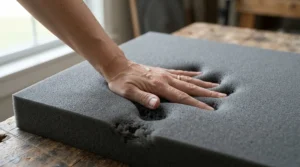
Contouring foam technology sounds like a marketing phrase, but the physics is real. Memory foam is viscoelastic, meaning it flows slowly under load and then recovers slowly when you stand. Its open-cell structure shifts under pressure instead of simply compressing, and that is what lets it cradle you.
Temperature is the hidden variable. Wikipedia notes that the effects are temperature-dependent, so the range where foam behaves properly is limited. In plain terms, warm foam softens and moulds, while cold foam stays stubborn. A cushion that feels perfect in a heated office can feel like a brick in a 16°C basement until your body warms it.
Density matters too. Denser foam resists flattening longer, which is why premium cushions like the Cushion Lab advertise extra-dense foam. Gel layers and charcoal infusions don’t change the contouring so much as they manage heat. Cutouts and U-shapes change where the contour does its work, shifting pressure off the tailbone. When you see a cushion’s tech claims, ask which of those three jobs it is doing.
Pressure Point Relief: What to Realistically Expect
Pressure point relief is the headline benefit, so let’s be precise. When you sit, most of your weight lands on two bony points, your sit bones, plus your tailbone if you slouch. A contouring cushion spreads that load over a bigger area, and a cutout takes the tailbone out of contact entirely.
What it won’t do is rewrite your posture. A University of Waterloo thesis on the biomechanics of prolonged sitting tested chair features like lumbar support and forward seat-pan tilt. Those features shifted pelvic and spinal posture, but chair conditions had minimal impact on seat pressure variables. It also found that forward tilt without proper back support likely increased pain for some people. The takeaway is worth underlining: be cautious with wedge-style cushions that tip you forward.
Pressure relief also isn’t a licence to sit forever. Researchers generally treat unbroken sitting beyond about 30 minutes as prolonged, and Popular Science’s editors recommend standing and walking at least every half hour. If pain persists, see a health professional rather than shopping your way out of it.
Memory Foam Cushion vs Gel Cushion Office Chair: Which Wins?
The memory foam cushion vs gel cushion office chair question comes down to heat, contour and budget. Here is the short version:
| Type | Contour | Heat | Price Tier | Best For |
|---|---|---|---|---|
| Memory foam | Deep, personalized | Warmer | Budget to mid | Everlasting Comfort, Aylio |
| Gel-enhanced foam | Deep, with a cooling layer | Moderate | Mid | ComfiLife, Sutera |
| Gel/polymer grid | Springy, supportive | Coolest | Premium | Hot offices, larger chairs |
| Basic polyfoam pad | Minimal | Moderate | Cheapest | Occasional use |
Looking at the table, pure memory foam wins on contour per dollar, while gel and grid designs win on temperature. The ComfiLife sits in the useful middle, with foam’s contour plus a gel layer’s cooling. Gel grid cushions deliver the coolest sit, but premium models can run well above C$150, so they only make sense if heat is your dominant complaint.
Experts quoted by Popular Science frame it similarly. One chiropractor notes that memory foam can retain heat and may sag over time, while gel and silicone designs have cells that aid circulation. A Toronto colleague adds that gel-infused cushions help dissipate heat during prolonged sitting. My rule of thumb: if you run warm, go gel-enhanced; if you run cool or work in a chilly room, plain memory foam is perfectly good.
Memory Foam Cushion for Back Support Office Chair
A seat cushion supports your seat, not your spine. Treat these as two separate jobs. If a memory foam cushion for back support office chair use is your goal, you need a plan for the backrest too.
Start with whether your chair has adjustable lumbar support. If it does, a bundled pillow like the Qutool lumbar piece may fight with it, as the editorial review warns. If your chair has a flat or unsupportive back, a lumbar pillow or the paired approach recommended for the Cushion Lab makes more sense.
Shape matters too. Popular Science’s chiropractor source suggests that most people do fine with a flat cushion, while contoured shapes suit those with herniated discs or degenerative arthritis. For degenerative conditions, he suggests firmer support is better. The ComfiLife and Sutera fit that firmer profile, while the Aylio suits those who prefer softness.
Finally, protect your pelvis. Raising the seat with a thick cushion can tilt your hips, so check that your lower back still touches the backrest. Back pain that lingers or spreads deserves a clinician, not just a cushion.

Ergonomic Accessories That Make Your Cushion Work Harder
A cushion is a team player. These ergonomic accessories multiply its value:
- Footrest. If a thick cushion like the Sutera or Cushion Lab lifts you, a footrest keeps your feet supported without lowering the chair.
- Lumbar support. Pair a seat cushion with a lumbar pillow if your backrest is flat.
- Monitor riser. Seat height changes your eye line, so raise the screen to match.
- Sit-stand option. CCOHS covers sit/stand desks among its office ergonomics fact sheets, and alternating posture beats any single perfect posture.
- Wrist rest and keyboard setup. Fixing the chair while ignoring your keyboard just moves the strain upward.
Think of the cushion as the foundation, not the house. The best result comes from layering two or three accessories, not buying five.
Practical Usage Guide: Setting Up Your Cushion in the First 30 Days
Most people drop the cushion on the seat and hope. Do this instead.
Day 1: Set the foundation. Place the cushion all the way back, so your hips touch the backrest. Adjust the chair so your feet rest flat with knees near a right angle, and leave a small gap, roughly two to three fingers wide, between the seat edge and the backs of your knees. CCOHS has a clear walkthrough on how to adjust office chairs.
Week 1: Expect a break-in. Firmer foam like the ComfiLife and Sutera may feel stiff initially, and new foam can carry a faint smell that usually fades within days.
Weeks 2–4: Build the routine. Stand every 30 minutes. Wash removable covers in cold water, as Popular Science advises for several models. Wipe the foam core rather than soaking it.
Common first-month mistakes:
- Buying too thick and forgetting to lower the chair.
- Placing the cushion forward of the backrest.
- Ignoring slippage, which means the base grip or size is wrong.
- Giving up on firm foam before it warms to your body.
Real-World Scenarios: Matching Cushions to Real Desks
These are hypothetical profiles, built from the specs and review themes above.
Scenario 1: The basement remote worker. An 8-hour day, a 16°C room and a C$60 budget. Dense foam stays firm in the cold, so the softer Aylio is the friendlier match, with a thin lumbar roll added later.
Scenario 2: The hybrid commuter. Three days in the office, two at home, plus a car seat. Portability and a handle matter most, so the ComfiLife or Everlasting Comfort fits. Both are versatile and sized for multiple surfaces.
Scenario 3: The wide-chair gamer. Long sessions in an oversized chair where standard cushions leave gaps. The TravelMate extra-large footprint is the sensible start, assuming current reviews check out.
Scenario 4: The tailbone-sensitive desk worker. Daily discomfort that standard cushions haven’t fixed. Budget for the Cushion Lab, confirm the chair’s height range, and consider the pairing its reviewers suggest.
✨ Don’t Miss These Carefully Chosen Picks!
🔍 Take your seating comfort to the next level with these researched cushions. Click on any highlighted product name to check current pricing and availability. These upgrades can help you build a desk setup you’ll actually enjoy sitting at!
Long-Term Cost & Maintenance: What a Cushion Really Costs You
Sticker price misleads. What matters is cost per workday. The figures below are illustrative planning estimates, not lifespan guarantees. Foam does sag over time, so the longer a cushion holds its shape, the cheaper it becomes.
| Tier | Example | Price Range | Planning Lifespan | Approx. Cost per Workday |
|---|---|---|---|---|
| Budget | Qutool set | C$35–C$55 | ~1 year (250 days) | ~C$0.14–C$0.22 |
| Mid | ComfiLife, Aylio | C$55–C$80 | ~2 years (500 days) | ~C$0.11–C$0.16 |
| Premium | Cushion Lab | C$85–C$120 | ~3 years (750 days) | ~C$0.11–C$0.16 |
Looking at the table, premium cushions only beat budget on cost per day if they genuinely last longer, so the dense foam has to earn its price. Mid-range cushions like the ComfiLife are the safest long-term bet. Even the priciest option costs pennies per day, which is cheap next to chronic discomfort.
Maintenance is simple. Wash removable covers in cold water, spot-clean the foam, air it out, and replace the cushion when it stays compressed after you stand. Rotating between two cushions can extend both lives.
FAQ
❓ How thick should memory foam office chair cushions be?
❓ Do memory foam office chair cushions go flat over time?
❓ Do memory foam cushions get hard in a cold room?
❓ Why does my cushion keep sliding on a leather or mesh chair?
❓ Can a seat cushion replace an ergonomic chair?
Conclusion
Memory foam office chair cushions won’t turn a bad chair into a throne, but they can make a decent chair far kinder over an eight-hour day. The pattern in this guide is simple. Pick for your chair and body first, then for heat and budget.
For most desks, the ComfiLife Gel Enhanced Seat Cushion is the balanced choice. Everlasting Comfort is the value pick with the deepest review pool, and Aylio suits softer tastes and cooler rooms. The Qutool set covers seat and back on a tight budget. The Sutera and Cushion Lab are for people who need thickness or maximum tailbone offloading, and the TravelMate is for wide chairs.
Pair your cushion with good chair adjustment and regular movement, and it will repay you daily. Prices and availability change, so check current price on Amazon.ca before buying.
✨ Ready to give your desk chair the upgrade it deserves?
🪑 Click any highlighted product above to check current pricing and availability, and pick the cushion that fits your chair, your body and your budget!
Recommended for You
- Coccyx Cushions Under $40 CAD: 7 Best Budget Picks For 2026
- Coccyx Cushion vs Regular Seat Cushion: 7 Picks Tested (2026)
- 7 Best Lumbar Support Cushions In Canada 2026
Disclaimer: This article contains affiliate links. As an Amazon Associate, I earn from qualifying purchases. If you purchase products through these links, we may earn a small commission at no additional cost to you.
✨ Found this helpful? Share it with your friends! 💬🤗
