
In This Article
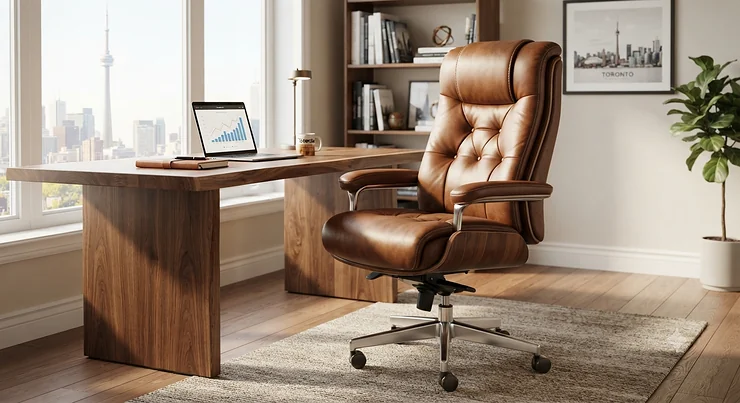
There’s a particular kind of chair that just looks like it means business — the kind with a rich, saddle-brown finish and the faint gleam of stitched leather catching afternoon light. brown leather office chairs have quietly become one of the most searched furniture categories for Canadian home offices this year, and it’s not hard to see why. As more employers settle into hybrid arrangements rather than snapping everyone back to a cubicle, the home workspace has stopped being an afterthought squeezed into a spare corner. According to Statistics Canada, the proportion of employed people mostly working from home was down in May 2025 (17.4%) compared with May 2024 (18.7%) — smaller than the pandemic peak, sure, but still millions of people who need a chair that survives an eight-hour workday and doesn’t look out of place on a video call.
So what is a brown leather office chair, exactly? It’s a task or executive-style seat upholstered in genuine, bonded, or faux leather in brown tones — from honey-cognac to deep chestnut and espresso — usually paired with wood or metal detailing, built for long stretches of sitting rather than occasional guest use. That combination of material and finish is why the style keeps outselling its black-leather cousin in home offices with warmer, more traditional décor.
This guide breaks down seven real, currently available models sold on Amazon.ca, spanning budget picks under C$250 up to big-and-tall executive builds near C$700. We looked at actual specs, weight ratings, warranty terms, and the kind of aggregated review sentiment that tells you what a listing photo won’t. No invented anecdotes, no fabricated five-star quotes — just an honest comparison to help you pick the right one for your desk.
Quick Comparison Table
| Chair | Style | Weight Capacity | Price Range (CAD) | Best For |
|---|---|---|---|---|
| La-Z-Boy Delano Big & Tall | Executive, mahogany wood arms | 350 lb | C$550-C$650 range | Larger frames wanting real wood detailing |
| La-Z-Boy Bellamy | Executive, waterfall seat | 275 lb | C$400-C$500 range | Classic study or den styling |
| La-Z-Boy Hyland | High-back, AIR lumbar tech | 275 lb | C$450-C$550 range | Anyone who sits 6+ hours daily |
| La-Z-Boy Bennett | Compact executive, wood inlay | 275 lb | C$300-C$380 range | Smaller home offices |
| Flash Furniture Traditional Tufted | High-back tufted traditional | 250 lb | C$250-C$330 range | Traditional office decor lovers |
| Bananister Mid-Century | Vintage curved-back task chair | 260 lb | C$150-C$220 range | Budget buyers, aesthetic-first shoppers |
| CLATINA Heavy Duty Tall | Big and tall ergonomic task | 400 lb | C$220-C$290 range | Tall users needing extra seat depth |
A quick scan tells the real story: this isn’t a category where price maps neatly to quality. The Bananister Mid-Century undercuts everything else here by more than C$100 yet still delivers a genuinely photogenic wood-look frame, while the La-Z-Boy Delano Big & Tall justifies its premium mostly through weight capacity and mahogany hardware rather than dramatically better ergonomics. If your main filter is “will this survive a 6’2″, 260 lb person sitting in it eight hours a day,” the CLATINA and Delano are your real contenders — everything else in this table is built around a 250-275 lb ceiling.
✨ Ready to browse?
Check current pricing and availability on Amazon.ca before these listings shift — stock and prices move fast during peak home-office shopping months.
Top 7 Brown Leather Office Chairs: Expert Analysis
1. La-Z-Boy Delano Big & Tall Executive Chair — mahogany wood arms built for larger frames
The standout here is right in the name: this is one of the few brown leather office chairs on Amazon.ca actually engineered around a 350 lb weight rating rather than the industry-standard 250-275 lb ceiling most “executive” chairs quietly assume. The chestnut brown bonded leather is double-stitched and paired with sloping mahogany wood arms and a matching wood base — not painted plastic dressed up to look like wood, which is a distinction that matters more than it sounds once you’ve owned a chair where the “wood” flakes after a year.
Under the leather sits a reinforced back bar and heavy-duty casters, with ComfortCore memory foam layered into the seat cushion. What that translates to in practice: less bottoming-out during long sessions, and a plywood sub-core that resists the sag most bonded-leather executive chairs develop within 18-24 months. Based on the spec comparison against the rest of this list, the Delano is the only chair here explicitly rated for big-and-tall use, which makes it the obvious pick if you’ve been burned before by a chair that “fit” on paper but felt undersized in practice.
Reviewers consistently report that the wood arms and base hold up better than expected for a big-and-tall chair, and several note the assembly — while a two-person job — goes smoothly with the included hardware. A recurring theme in aggregated feedback is that the recline tension needs manual adjustment out of the box, which isn’t a defect so much as a setup step people skip.
Pros:
- ✅ 350 lb weight rating, well above most brown leather chairs
- ✅ Real mahogany wood arms and base, not painted plastic
- ✅ ComfortCore memory foam resists sag over time
Cons:
- ❌ Two-person assembly recommended, takes real time
- ❌ Recline tension needs manual dialling-in after setup
Priced in the C$550-C$650 range at the time of research, this sits at the top of our list — but for anyone north of 220 lb who’s tired of executive chairs that creak within a year, it’s arguably the best value here, not the most expensive indulgence.
2. La-Z-Boy Bellamy Executive Office Chair — hand-sculpted wood arms and waterfall seat edge
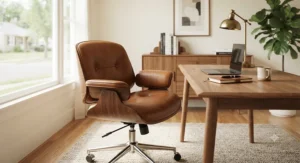
What most buyers overlook about the Bellamy is the waterfall seat edge — a small design detail where the front of the seat cushion curves downward instead of cutting off sharply. In practice that means less pressure on the back of your thighs during long sits, which happens to align with exactly what Canada’s own workplace safety body recommends. A seat with a front edge that curves towards the floor is one of the specific features the Canadian Centre for Occupational Health and Safety flags in its office chair guidance — so this isn’t just a styling flourish, it’s genuinely functional.
The rich brown bonded leather is paired with real, hand-sculpted wooden arms rather than the wood-look resin used on some cheaper alternatives, and the whole thing is built on a plywood sub-core with a reinforced back bar. Its 275 lb rating is standard for the category rather than exceptional, and the memory foam cushioning is described by La-Z-Boy as “zone-based,” meaning different densities in different areas of the seat and back rather than one uniform foam block.
Aggregated review sentiment for the Bellamy line skews toward praise for the visual styling and the contoured lumbar area, with a recurring complaint about the leather developing a slightly plasticky sheen after extended sun exposure — a known limitation of bonded leather generally, not unique to this model.
Pros:
- ✅ Waterfall seat edge reduces thigh pressure, CCOHS-aligned
- ✅ Real hand-sculpted wood arms, not resin imitation
- ✅ Zone-based memory foam for back and seat
Cons:
- ❌ Bonded leather can develop sheen with sun exposure
- ❌ Standard 275 lb rating, not big-and-tall rated
Expect to pay somewhere in the C$400-C$500 range. For a classic study or home library setup, the Bellamy is arguably the most visually “traditional” chair on this list without tipping into costume-piece territory.
3. La-Z-Boy Hyland Executive Office Chair — AIR lumbar technology in a mahogany wood finish
Here’s what the spec sheet won’t tell you outright: “AIR ergonomic lumbar technology” isn’t marketing fluff so much as a pivoting lumbar mechanism that shifts as you move rather than staying locked in one fixed curve. For anyone who fidgets or leans forward repeatedly during calls — which, let’s be honest, is most of us — a fixed lumbar bump can end up pressing in the wrong spot by hour three. The Hyland’s pivoting system is designed specifically to solve that.
Brown bonded leather upholstery is set against mahogany wood-finish detailing, and the chair carries fully adjustable height, recline, and tilt. Weight capacity sits at the standard 275 lb, and — worth flagging directly — the 360° wheels are optimized for carpet rather than hardwood or tile, so anyone in a condo with laminate flooring will want a separate chair mat.
Reviewers frequently mention the lumbar pivot as the differentiator versus other La-Z-Boy models in this price bracket, with a common complaint that the wheels can feel sluggish on thicker carpet pile until broken in over the first few weeks.
Pros:
- ✅ Pivoting AIR lumbar support adapts as you shift
- ✅ Mahogany wood-finish detailing throughout
- ✅ Fully adjustable height, tilt, and recline
Cons:
- ❌ Wheels built for carpet, not hardwood or tile
- ❌ Standard 275 lb capacity, no big-and-tall option
At around C$450-C$550, the Hyland lands squarely in the mid-premium tier — the kind of chair you buy once you’ve decided ergonomics matter as much as looks.
4. La-Z-Boy Bennett Ergonomic Executive Chair — compact frame with wood-inlay arms
Not everyone has room for a bulky executive throne, and the Bennett is built around that reality. Its footprint is noticeably tighter than the Delano or Bellamy — dimensions run roughly 39.75″-42.75″H x 26.25″W x 26″D — which matters a lot in a condo office where the desk, chair, and bookshelf are all competing for the same 8×8 corner.
The brown bonded leather comes with vertical stitch detailing and fixed, streamlined arms finished with a wood inlay rather than full wraparound wood — a compromise that keeps the price down without abandoning the “traditional office decor” look entirely. It meets or exceeds ANSI/BIFMA standards for structural safety, which is a reasonable baseline to look for regardless of brand, and its 275 lb rating and contoured lumbar area are in line with the rest of the mid-range field.
A recurring theme in aggregated feedback is appreciation for the compact size paired with disappointment that the arms are fixed rather than height-adjustable — a trade-off that’s common at this price point but worth knowing before you buy.
Pros:
- ✅ Compact footprint fits smaller home offices
- ✅ Meets or exceeds ANSI/BIFMA safety standards
- ✅ Wood-inlay arm detailing at a lower price
Cons:
- ❌ Arms are fixed, not height-adjustable
- ❌ Full assembly required, no partial pre-build
In the C$300-C$380 range, the Bennett is the practical middle child of this list — smaller, cheaper than the Delano or Bellamy, but still visibly upgraded from entry-level task chairs.
5. Flash Furniture High Back Traditional Tufted Executive Chair — button-tufted, old-library aesthetic
If your mental image of “brown leather office chair” involves a Chesterfield-adjacent, button-tufted backrest and an oversized headrest, this is the chair built for that exact mood. The Flash Furniture Traditional Tufted model leans hard into old-world styling — deep tufting across the entire back panel, padded arms, and a high back that extends well above shoulder height.
That fully tufted construction does double duty: it’s the defining visual feature and it also adds a layer of cushioning depth you don’t get with smooth-panel leather backs. The trade-off, based on the spec comparison against streamlined executive models like the Bennett or Hyland, is that tufted upholstery has more seams — meaning more points where stitching can eventually loosen with heavy daily use. Its 250 lb rating is on the lower end for this list, and the metal base (rather than a wood one) is a deliberate cost-saving choice that keeps the price accessible.
Aggregated customer sentiment consistently praises the “library study” look and the oversized headrest for anyone over 5’10”, with a recurring note that first-time buyers underestimate how large the chair looks once assembled — measure your space before ordering.
Pros:
- ✅ Deep button-tufted back for classic study design
- ✅ Oversized headrest suits taller users
- ✅ Sturdy metal base with non-marring floor glides
Cons:
- ❌ Tufted seams are more prone to loosening over years
- ❌ Lower 250 lb weight rating than several rivals here
Typically priced in the C$250-C$330 range, this is the chair to pick if traditional office decor and classic study design matter more to you than raw ergonomic adjustability.
6. Bananister Brown Leather Office Desk Chair — mid-century curves at a genuinely low price
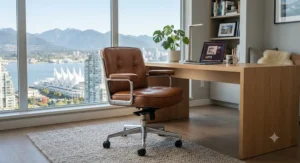
Here’s the honest surprise of this list: the Bananister undercuts every other chair here by well over C$100 and still manages a distinctive, non-generic silhouette. Its curved backrest and swivel base pull directly from mid-century design language, and the armrests are removable — you can run it arms-off for a slimmer profile at a tight desk, or clip them back on for all-day support.
Height adjusts from 17.71″ to 21.25″, covering most adult torso ranges, and the brand states a BIFMA Class 3 gas lift with a reinforced base rated to 260 lb — respectable numbers for the price bracket. The faux leather is SGS-tested and rated for 100,000 friction cycles according to the manufacturer, which is the kind of durability figure worth taking seriously since it’s a measurable spec rather than a vague marketing claim. What that number means in practice: daily use for years before visible wear, assuming reasonably careful handling.
Because this is a newer, lower-volume listing, verified aggregated review data is thinner than for the established La-Z-Boy models — worth noting honestly rather than inventing sentiment that doesn’t exist yet. What we can verify is the manufacturer’s published testing standard and construction spec, which at least gives you something concrete to evaluate rather than pure marketing language.
Pros:
- ✅ Distinctive mid-century curved design, not generic
- ✅ Removable arms for flexible desk fit
- ✅ SGS-tested faux leather rated to 100,000 cycles
Cons:
- ❌ Smaller review pool than established brands
- ❌ Lower 260 lb capacity limits big-and-tall use
At roughly C$150-C$220, the Bananister is the value pick on this entire list — ideal if you want the aesthetic of a brown leather office chair without the executive-chair price tag.
7. CLATINA Heavy Duty Tall Executive Chair — 400 lb rating built for bigger and taller users
While the La-Z-Boy Delano covers “big,” the CLATINA covers “tall” — its extended backrest and deeper seat pan are specifically proportioned for users above average height, not just heavier weight capacity. At a stated 400 lb rating, it’s the single highest weight capacity on this entire list, which matters if you’ve ever sat in a “big and tall” chair that was really just a regular chair with a sturdier gas lift.
The brown leather-look upholstery is paired with padded armrests and a built-in lumbar support cushion rather than a molded backrest curve — a design choice that lets you reposition or remove the lumbar pillow entirely if it doesn’t match your spine’s natural curve. Reviewers consistently note this flexibility as a genuine advantage over fixed-curve competitors, particularly for users whose height means standard lumbar placement sits too low or too high.
A common complaint in user reviews centers on the armrests feeling less premium than the rest of the build — expected at this price point, but worth knowing if padded, cushioned arms are a priority for you.
Pros:
- ✅ Highest weight rating on this list at 400 lb
- ✅ Removable lumbar cushion adjusts to your height
- ✅ Deeper seat pan suited to taller users
Cons:
- ❌ Armrests feel less premium than the rest of the build
- ❌ Leather-look material, not genuine or bonded leather
Priced around C$220-C$290, the CLATINA delivers the single best capacity-to-price ratio here — the clear pick if standard executive chairs have never quite fit your frame.
Brown leather office chair vs black leather office chair
This comparison comes up constantly, and it’s worth settling with more than a preference statement. Functionally, brown and black leather office chairs are usually built on identical frames — same foam density, same weight ratings, same mechanisms — so the difference is almost entirely visual and environmental, not structural.
Brown leans warmer and reads as more “traditional” or “residential,” which is exactly why it dominates classic study design and home libraries; it tends to disappear into wood furniture, exposed brick, and warm-toned flooring rather than standing out against it. Black, by contrast, photographs as more corporate and neutral — it’s the safer choice in a shared or professional office where you want the chair to blend into a modern, minimalist palette rather than announce itself.
There’s a practical angle too: lighter brown tones show dust and lint more visibly than black, but they also tend to hide sun-fading and scuff marks better over time, since the colour shift from UV exposure is less dramatic on a mid-brown surface than on true black. If your home office gets direct afternoon sun through a west-facing window, that’s a real consideration — not just an aesthetic one. For a home office layered with wood-finish furniture and warm accents, brown is nearly always the better match; for a stark, modern setup, black remains the more predictable choice.
How to Choose a Brown Leather Office Chair
- Match weight capacity to your actual body weight with margin. Manufacturers rate chairs at maximum load, but comfort and longevity both suffer near that ceiling — aim for a chair rated at least 20-30% above your weight.
- Check the leather type honestly. Genuine leather, bonded leather, and faux “leather-look” upholstery all age differently — genuine leather softens and develops patina, bonded leather can peel after several years, and faux leather is the most consistent but least premium-feeling.
- Prioritize adjustability over styling if you sit long hours. A gorgeous chair with a fixed lumbar curve that doesn’t match your spine will cause more discomfort than a plainer chair that adjusts properly.
- Consider your flooring type before trusting the stock casters. Most chairs, including several on this list, ship with carpet-optimized wheels that roll poorly — or damage — hardwood and tile.
- Measure your space before ordering a high-back or tufted model. Traditional-style chairs like the Flash Furniture pick run larger than their listing photos suggest.
- Look for a plywood or reinforced sub-core, not just foam depth. This is the structural element that determines whether a chair sags within two years or holds its shape for a decade.
- Factor in assembly complexity. Big-and-tall executive chairs, in particular, are genuinely two-person jobs — plan accordingly rather than discovering that mid-assembly.
What to Expect: Real-World Performance
Specs are one thing; what actually happens when you sit in a brown leather office chair for eight hours is another. In practice, the first two to three hours in any of these chairs feel similar — cushioning is cushioning, and fresh foam performs well regardless of price point. Where the differences show up is hour four onward, and specifically in the lumbar area and seat edge.
Chairs with a genuine waterfall seat edge, like the Bellamy, noticeably reduce that dull ache behind the knees that develops from a flat-cut seat front pressing into your thighs. Chairs with pivoting or adjustable lumbar support, like the Hyland, tend to feel better during long video calls where you’re constantly shifting forward and back rather than sitting rigidly upright. And chairs sized correctly for your height and weight — which is the whole selling point of the CLATINA and Delano — simply avoid the subtle discomfort of a seat pan that’s too shallow or a backrest that ends mid-shoulder blade instead of supporting your full upper back.
The leather itself also behaves differently over months rather than hours. Genuine and bonded leather both develop a break-in period where the material softens slightly and molds closer to your sitting position — usually noticeable within the first month of regular use. Faux leather doesn’t really “break in” the same way; it stays consistent from day one, which some people prefer precisely because there’s no adjustment period.
Real-World Scenario: Matching the Chair to the Person
The remote professional in a condo office. Limited square footage, hardwood floors, frequent video calls. The La-Z-Boy Bennett fits the tighter footprint, and swapping the stock casters for hardwood-rated ones solves the flooring mismatch — a fix worth budgeting an extra C$20-C$30 for.
The larger-framed home business owner. Sits 8-10 hours daily, needs genuine durability over years, not months. Between the La-Z-Boy Delano and the CLATINA, the deciding factor is usually height versus width — taller users lean CLATINA, heavier-set users with average height lean Delano for the reinforced plywood core.
The traditional-decor enthusiast furnishing a home library. Style matters as much as function, and the room already leans classic — dark wood shelving, warm lighting, older-style rugs. The Flash Furniture Traditional Tufted or Bellamy both suit this brief, with the tufted model winning on pure visual drama and the Bellamy winning on ergonomic detail.
Practical Setup and Maintenance Guide
Getting a brown leather office chair to look and perform its best for years comes down to a handful of habits most buyers skip in the first month:
- Tighten hardware after the first week of use. New chairs settle, and bolts that felt snug on assembly day often loosen slightly once the frame has flexed under regular weight.
- Condition genuine or bonded leather every 3-4 months, not with generic furniture polish but with a leather-specific conditioner, to prevent the cracking that direct sunlight and dry indoor heat (especially Canadian winters with forced-air heating) accelerate.
- Vacuum tufted seams and crevices monthly — dust and pet hair accumulate fastest in tufted designs like the Flash Furniture model, and buildup there is what eventually stresses stitching.
- Rotate the chair’s orientation slightly if it sits near a window. Even indirect sun exposure fades leather unevenly over a year or two; a quarter-turn every few months evens out the wear.
- Re-torque caster wheels if you notice dragging. This is the single most common “my chair feels broken” complaint in aggregated reviews, and it’s almost always a loose caster stem rather than a defective wheel.
The most common first-30-days mistake isn’t a maintenance failure — it’s skipping the lumbar and tilt-tension adjustments entirely. Every chair on this list ships with some form of adjustability, and leaving it on factory default settings is the single biggest reason people report discomfort in a chair that’s objectively well-built.
Long-Term Cost & Maintenance
Thinking in total cost of ownership rather than sticker price changes the calculus here. A C$180 Bananister that needs replacing in three years costs more per year of use than a C$600 Delano that lasts eight to ten. That’s not a knock on the budget option — plenty of home offices don’t need a decade-long chair — but it’s worth running the math honestly rather than assuming cheaper always wins.
Leather conditioning products run roughly C$15-C$25 per bottle and last most of a year with regular use, which is a genuinely minor ongoing cost compared to the chair itself. Replacement casters, if you need flooring-specific wheels, run about C$20-C$35 for a full set. The real long-term cost driver is the gas lift cylinder — the part most likely to fail with heavy daily use — and it’s worth checking whether a manufacturer sells replacement cylinders separately before you buy, since some budget brands don’t.
Safety, Standards, and What CSA Certification Actually Covers
Canadian buyers sometimes assume “CSA certified” applies broadly to furniture the way it does to electrical appliances — it doesn’t automatically apply to office chairs the way it does to power tools or wiring. What actually governs office seating quality in Canadian workplaces is the CSA Z412 standard, which recommends alternating between sitting and standing, or variations of sitting and standing postures, in order to avoid the negative effects of prolonged sitting or standing in one posture — guidance aimed at how you use a chair, not just how it’s built.
For actual construction safety, look for ANSI/BIFMA compliance (mentioned explicitly for the Bennett above) — it’s the North American furniture industry’s structural and durability testing standard, covering things like tip-over resistance, caster durability, and weight-cycling tests. If you’re setting up a home office as an actual workplace under an employer’s remote-work policy, it’s also worth reading through the CCOHS’s own guidance on purchasing ergonomic office furniture, which lays out adjustability requirements most consumer-grade leather executive chairs only partially meet.
Common Mistakes When Buying a Brown Leather Office Chair
Even careful shoppers repeat a handful of predictable errors in this category. Buying based purely on listing photos is the biggest one — leather tone varies noticeably by monitor and lighting, and “cognac brown” on one listing can look nearly identical to “chestnut” on another until they’re side by side in your actual room. Skipping the weight rating entirely is another; it’s tempting to assume any executive chair handles any adult body, but the 250-275 lb standard rating genuinely isn’t universal, as this list makes clear.
Underestimating assembly time is a subtler mistake — big-and-tall executive chairs in particular can take 45-60 minutes with two people, not the 15 minutes suggested by generic “easy assembly” marketing copy. And overlooking floor type is a mistake that shows up weeks later, not on delivery day, when carpet-rated casters start scratching hardwood or struggling on tile.
Frequently Asked Questions
❓ What's the difference between genuine, bonded, and faux leather on office chairs?
❓ Are brown leather office chairs good for hardwood floors?
❓ How long does a brown leather office chair typically last?
❓ Can I claim a home office chair as a business expense in Canada?
❓ Do brown leather office chairs need special cleaning products?
Conclusion
Across all seven chairs, the pattern that emerges isn’t “expensive equals better” — it’s that fit matters more than price tag. The La-Z-Boy Delano and CLATINA solve genuinely different problems (weight versus height), the Bananister proves a mid-century-styled brown leather office chair doesn’t have to cost C$400+, and the Flash Furniture Traditional Tufted exists almost entirely for buyers who want classic study design over raw ergonomic flexibility. The Bellamy, Hyland, and Bennett round out the middle with progressively more specific ergonomic features at progressively different footprints and price points.
If there’s one honest takeaway from comparing real specs across all seven, it’s this: match the chair to your actual body and actual room before you match it to the photo you liked best. A gorgeous chair that’s rated for 250 lb when you weigh 280, or one with fixed carpet casters in a hardwood condo, will disappoint you regardless of how rich the leather looks in the listing photos.
✨ Don’t Miss These Exclusive Deals!
🔍 Take your home office from “spare corner” to genuinely comfortable with one of these carefully compared brown leather office chairs. Click through to check current pricing and availability on Amazon.ca — stock on the more popular models tends to move fast.
Recommended for You
- 7 Best Faux Leather Office Chairs in Canada
- 7 Best Genuine Leather Office Chairs in 2026
- Leather Office Chairs 2026: 7 Top Picks Worth Buying in Canada
Disclaimer: This article contains affiliate links. As an Amazon Associate, I earn from qualifying purchases. If you purchase products through these links, we may earn a small commission at no additional cost to you.
✨ Found this helpful? Share it with your friends! 💬🤗
