
In This Article
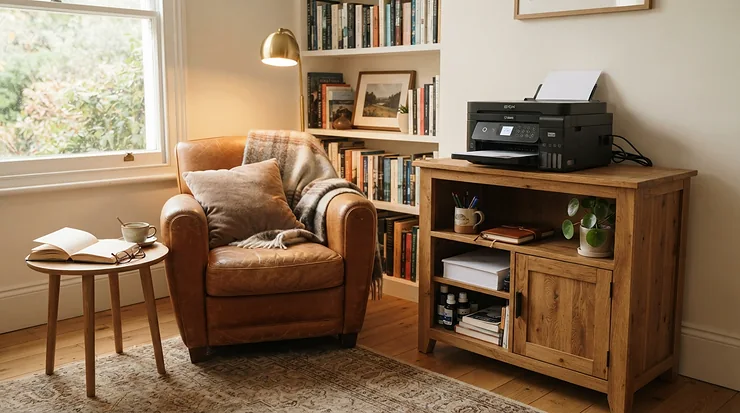
A 2 drawer filing cabinet for home office use is a compact steel or wood storage unit with two file drawers, built to hold hanging folders of tax slips, contracts, warranties and records. Most sit 62-76 cm (24-30 in) high, so they slide under a desk or double as a side table. In plain terms, it’s the smallest cabinet that still behaves like a real filing system.
Yes, you can scan everything. Plenty of us do. But paper keeps showing up anyway: the T4 in the mail, the furnace warranty, the lease you signed in 2019 and now can’t find. A filing cabinet remains the plainest answer to “where did I put that?”, and the two-drawer format is the sweet spot. Wikipedia notes that the two-drawer file is mostly sold for use alongside a desk, which tells you everything about its job.
So why does buying one feel harder than it should? Because the listings blur four decisions together: vertical or lateral, letter or legal, how far the drawers slide out, and whether the thing can tip. Get those right and the brand barely matters. Get them wrong and you own a very expensive paper-weight with a squeaky drawer.
This guide sorts through seven real models, from budget to premium, using published specs and the sentiment found in real customer reviews. Along the way we’ll cover the 2 drawer file cabinet letter size question, the compact two drawer filing cabinet options for tiny rooms, and why full-extension drawer slides and an anti-tip interlock system deserve more of your attention than the colour does. Prices below are approximate ranges in Canadian dollars; check current price and amazon.ca availability before you buy.
Quick Comparison: 7 Cabinets at a Glance
Here’s the shortlist before we go deep. Sizes are shown in centimetres first, with inches in brackets.
| Product | Style & Size (H × W × D) | Standout | Approx. Price (CAD) | Best For |
|---|---|---|---|---|
| Space Solutions 18″ 2 Drawer | Vertical, 68 × 36 × 46 cm (26.7 × 14.25 × 18 in) | Fully welded, ships assembled | Under C$150 | Space Solutions 18″ 2 Drawer: first-time buyers on a budget |
| VASAGLE CUSTOS UOFC040B16 | Rolling, 70 × 40 × 42 cm (27.6 × 15.7 × 16.5 in) | Casters plus printer-top | Under C$200 | VASAGLE CUSTOS: tight rooms, renters |
| NuSparc SOHO 2 Drawer | Vertical, 62 × 36 × 46 cm (24.5 × 14.2 × 18 in) | Locking, glide suspension | C$150-C$250 | NuSparc SOHO: light, steady daily filing |
| Bestar Standard 2-Drawer Lateral | Lateral, letter and legal | Crafted in Canada | C$250-C$400 | Bestar Standard: buyers who want legal-size and a local brand |
| Bush Furniture Cabot 2-Drawer Lateral | Lateral, 76 × 79 × 50 cm (30 × 31.26 × 19.57 in) | Looks like furniture | C$350-C$450 | Bush Cabot: living-room-adjacent offices |
| HON Brigade 2-Drawer Mobile Vertical | Pedestal, 71 × 38 × 58 cm (28 × 15 × 23 in) | Ball-bearing steel build | Around C$700 | HON Brigade Mobile: heavy daily use |
| HON Brigade 600 Series 2-Drawer Lateral | Lateral, 72 × 107 × 49 cm (28.38 × 42 × 19.25 in) | Interlock plus counterweight | Around C$1,000 | HON Brigade 600: long-term, high-capacity setups |
Look at the price column first, then the “Best For” column. The Space Solutions 18″ 2 Drawer and VASAGLE CUSTOS win on pure affordability, but only the HON Brigade 600 explicitly advertises both an interlock and a counterweight. If you have kids or pets around, that gap matters more than the C$800 difference suggests. The middle three, NuSparc SOHO, Bestar Standard and Bush Cabot, are where most home offices should be shopping.
💬 Just one click — help others make better buying decisions too!😊
Top 7 Picks: 2 Drawer Filing Cabinet for Home Office, Analyzed
1. Space Solutions 18″ 2 Drawer — cheapest way into proper hanging files
The Space Solutions 18″ 2 Drawer is the entry ticket. It measures 68 × 36 × 46 cm (26.7 × 14.25 × 18 in), arrives welded, and fits under most desks. The brand uses a patented glide suspension with three-quarter drawer extension.
That three-quarter extension is the clever bit and the compromise. Because the drawer never leaves the cabinet fully, the load stays closer to the base, which reduces tipping. The flip side: the back files sit deeper than your fingers can comfortably reach. Based on the spec sheet, this is a “file it and forget it” cabinet for tax paperwork, not a daily workhorse.
Reviewer sentiment on US retailer listings clusters in the high-3s to low-4s out of 5. Buyers tend to say the metal is thinner than old commercial units but still feels solid for the price, and the handle holes line up cleanly. One recurring complaint: a missing key on some orders.
Pros:
- ✅ Ships welded, no assembly drama
- ✅ Three-quarter extension limits tipping
- ✅ Fits under most standard desks
Cons:
- ❌ Thinner steel than commercial cabinets
- ❌ Back of drawer is harder to reach
Expect it to sit under C$150 at the time of research. For occasional filing, that’s strong value.
2. VASAGLE CUSTOS UOFC040B16 — rolling cabinet that doubles as a printer stand
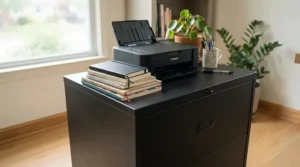
The VASAGLE CUSTOS UOFC040B16 takes a different approach: matte black, 70 × 40 × 42 cm (27.6 × 15.7 × 16.5 in), on casters. It’s designed to slide where you need it, then park under a printer.
Mobility is a double-edged blade here. A rolling cabinet can follow you from desk to dining table, but Health Canada notes that furniture with legs or wheels is more likely to tip. Lock the casters whenever a drawer is open and load the bottom drawer first. For a renter whose “office” is a corner of the spare room, though, this layout is hard to beat.
Editorial roundups published in 2026 repeatedly name VASAGLE rolling cabinets as a pick for tight corners, and a related VASAGLE rolling model averages roughly 4.4-4.5 stars across several thousand reviews on a global retailer listing. I could not verify review volume for this exact model, so treat that as indicative. One roundup also flags a lock-free variant, so confirm the listing says “lock” if security matters.
Pros:
- ✅ Compact footprint with printer-friendly top
- ✅ Casters make it genuinely movable
- ✅ Clean, modern matte black finish
Cons:
- ❌ Lock may not be included on every variant
- ❌ Rolling base needs careful tip-over habits
Plan on under C$200. Verdict: best for renters and small rooms, with a caution on locks.
3. NuSparc SOHO 2 Drawer — steady, locking, no-nonsense steel
The NuSparc SOHO 2 Drawer (14.2 × 18 × 24.5 in, or about 36 × 46 × 62 cm) is a baked-enamel steel cabinet with two locking drawers and glide suspension. The maker’s own wording targets “moderately used documents,” which is refreshingly honest.
Why does that matter? A cabinet pitched at moderate use is built to a sensible cost. The glide suspension keeps drawers smooth, and the lock covers both drawers, so passports, SINs and tax records aren’t left hanging. At 62 cm tall, it slides under a standard 72-76 cm desk without drama.
A 2026 home-office roundup listed it as best overall for most people, mainly because of its review count. That’s an editorial opinion, not a lab result, so read it as “widely bought” rather than “proven best.” Some listings advertise assembly in North America and a pre-assembled build, which cuts setup time.
Pros:
- ✅ Locking drawers protect sensitive records
- ✅ Pre-assembled steel construction
- ✅ Right height to fit under desks
Cons:
- ❌ Not intended for heavy daily filing
- ❌ Interlock not clearly advertised
Expect roughly C$150-C$250. Verdict: the sensible middle for most households.
4. Bestar Standard 2-Drawer Lateral — Canadian-made, legal-size friendly
The Bestar Standard 2-Drawer Lateral is built in Canada from commercial-grade laminated particleboard. Both drawers take letter and legal documents and glide on ball-bearing slides, with one lock for the pair.
Lateral layouts spread wide instead of deep, so the drawers pull out only a short distance. In a narrow hallway office or a bedroom with a bed three feet from the desk, that’s gold. Wood laminate also looks like furniture rather than hardware, so it won’t make your living room feel like a dental clinic.
Expect about an hour for two adults to assemble it with a screwdriver and hammer. The Best Buy Canada listing does not mention an interlock, so ask the seller before assuming one exists. Review volume on Canadian listings varies by retailer, so check the current rating page rather than trusting a number I can’t verify.
Pros:
- ✅ Handles both letter and legal files
- ✅ Ball-bearing slides, single lock
- ✅ Made in Canada
Cons:
- ❌ Needs two people for assembly
- ❌ Interlock not listed
Roughly C$250-C$400 is a fair expectation. Verdict: the pick for patriotic furniture shoppers and legal-size filers.
5. Bush Furniture Cabot 2-Drawer Lateral — passes for a sideboard
The Bush Furniture Cabot 2-Drawer Lateral measures about 76 × 79 × 50 cm (30 × 31.26 × 19.57 in), accepts letter, legal and A4, and is tested to ANSI/SOHO standards according to the maker.
Why choose it? Style. If your home office lives in the dining room, a steel box announces “work” every evening. This cabinet reads as a console, and the lateral top gives you a surface for a lamp, a plant or a router. The trade-off is weight and bulk: it’s wider than any vertical on this list, so measure the wall before you fall in love.
Slide type isn’t stated in the listing I found, so ask the seller whether it uses full-extension hardware. Availability on amazon.ca depends on the seller, so check before planning a delivery date.
Pros:
- ✅ Furniture-grade look for shared rooms
- ✅ Takes letter, legal and A4 folders
- ✅ ANSI/SOHO tested per the maker
Cons:
- ❌ Wide footprint needs wall space
- ❌ Slide details not published
Expect the mid-to-upper C$300s into the C$400s. Verdict: best when looks matter as much as paper.
6. HON Brigade 2-Drawer Mobile Vertical — the sturdy desk-side pedestal
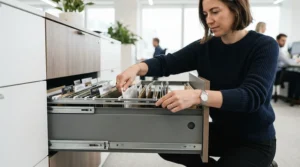
The HON Brigade 2-Drawer Mobile Vertical (71 × 38 × 58 cm, or 28 × 15 × 23 in) is a welded-steel pedestal with ball-bearing suspension and a lock. It arrives assembled apart from the casters, glides and pulls.
Here’s what the spec sheet won’t tell you at a glance: that extra depth, 58 cm versus 46 cm on the budget cabinets, gives you a full-size letter drawer with room to breathe. Hanging folders sit upright and the drawer feels planted. For someone filing daily, say a freelancer or a bookkeeper working from home, the cabinet’s heft is a feature.
Commercial furniture lines like this one are built to be used, not just stored. Reviews on retailer listings are sparse, so the case for it rests more on construction and brand reputation than on a pile of ratings.
Pros:
- ✅ Welded steel with ball-bearing suspension
- ✅ Lockable, nearly fully assembled
- ✅ Deep drawers for comfortable filing
Cons:
- ❌ Costs several times the budget picks
- ❌ Heavy to move once loaded
Plan on around C$700. Verdict: worth it only if you file weekly for years.
7. HON Brigade 600 Series 2-Drawer Lateral — interlock and counterweight built in
The HON Brigade 600 Series 2-Drawer Lateral (HON692LQ) stretches 107 cm (42 in) wide but only 72 cm (28.38 in) tall and 49 cm (19.25 in) deep. It accepts letter or legal hanging folders and carries heavy-duty ball-bearing suspension.
The headline here is safety engineering: a built-in counterweight stabilizes the cabinet when a drawer is open, and a mechanical interlock prevents more than one drawer from opening. The base is enclosed to resist tampering, and two-drawer models fit under desktops 51 cm (20 in) deep. On paper this is the closest thing to “buy once, file for 20 years.”
At that width, front-to-back filing leaves you plenty of capacity, and side-to-side lets you read tabs from your chair. Public review data is thin, so the argument for it is the published specs, not the star count.
Pros:
- ✅ Interlock stops two drawers opening together
- ✅ Counterweight steadies the cabinet
- ✅ Wide lateral drawers hold plenty
Cons:
- ❌ Roughly three to six times the budget picks
- ❌ Needs a 107 cm wall run
Expect around C$1,000. Verdict: a long-term investment for serious record-keepers.
Top 7 Specs and Safety Features Compared
| Product | Orientation | File Size | Drawer Slides | Anti-Tip Note | Approx. Price (CAD) | Best For |
|---|---|---|---|---|---|---|
| Space Solutions 18″ 2 Drawer | Vertical | Letter | Glide suspension, 3/4 extension | Short extension limits tipping | Under C$150 | Space Solutions 18″ 2 Drawer: occasional filing |
| VASAGLE CUSTOS UOFC040B16 | Rolling | Letter and A4 | Not detailed in listing | Lock casters; not stated | Under C$200 | VASAGLE CUSTOS: small rooms |
| NuSparc SOHO 2 Drawer | Vertical | Letter | Glide suspension | Not stated | C$150-C$250 | NuSparc SOHO: steady daily use |
| Bestar Standard 2-Drawer Lateral | Lateral | Letter and legal | Ball bearing | Not stated | C$250-C$400 | Bestar Standard: legal-size filers |
| Bush Furniture Cabot 2-Drawer Lateral | Lateral | Letter, legal, A4 | Not detailed | ANSI/SOHO tested | C$350-C$450 | Bush Cabot: style-first buyers |
| HON Brigade 2-Drawer Mobile Vertical | Pedestal | Letter | Ball bearing | Not stated | Around C$700 | HON Brigade Mobile: heavy use |
| HON Brigade 600 Series 2-Drawer Lateral | Lateral | Letter and legal | Ball bearing | Interlock and counterweight | Around C$1,000 | HON Brigade 600: long-term safety |
Read the “Anti-Tip Note” column twice. Only the HON Brigade 600 spells out both an interlock and a counterweight, while the Space Solutions 18″ 2 Drawer relies on a short drawer travel and the Bush Cabot cites an ANSI/SOHO test without describing the mechanism. If you’re choosing between the NuSparc SOHO and Bestar Standard, the real question is orientation: vertical for deep reach, lateral for a narrow room.
How to Choose a 2 Drawer Filing Cabinet for Home Office
Here’s the short version, in the order that saves the most regret:
- Measure the space first. Include the open-drawer footprint. A fully extended lateral drawer protrudes roughly 46-51 cm (18-20 in), and you need standing room beyond that.
- Pick vertical or lateral. Vertical suits under-desk spots; lateral suits narrow walls and side-to-side tab reading.
- Choose letter or legal. Letter covers nearly everything Canadian households file; legal matters for real-estate and some court paperwork.
- Check the slides. Full-extension drawer slides give complete reach; three-quarter systems trade reach for stability.
- Confirm the lock. A cam lock needs turning; a plunger lock snaps shut. Both secure the whole stack on good models.
- Look for anti-tip features. An interlock, a counterweight or leveling feet beat a plain steel box.
- Match material to the room. Steel is cheaper per kilo of load; laminate suits living areas.
Why this order? Because the cabinet’s footprint and orientation are non-negotiable, while colour and handles are cosmetic. Work from “can it fit?” down to “does it look nice?” and you’ll rarely return it.
2 Drawer File Cabinet Letter Size: Letter vs Legal Drawer Width Explained
Search for a 2 drawer file cabinet letter size and you’ll see “letter” and “letter/legal” listings side by side. They look similar online. They aren’t.
Letter paper is 216 × 279 mm (8.5 × 11 in); legal is 216 × 356 mm (8.5 × 14 in). That 76 mm difference decides whether a legal sheet hangs without folding. In a front-to-back vertical file, a letter cabinet is usually about 38 cm (15 in) wide, while legal vertical models are wider, around 46 cm (18 in) in common commercial lines. That letter vs legal drawer width gap is the practical reason legal cabinets cost more and eat more floor.
In lateral cabinets, the answer shifts. Many lateral units ship with adjustable rails for letter, legal and A4, so the file size becomes a setting rather than a purchase. The Bestar Standard and Bush Cabot both advertise letter and legal capability.
My advice, framed as analysis rather than rule: if you rarely touch legal paperwork, buy letter and save space. If a real-estate lawyer or insurer hands you legal-size originals once a year, consider a lateral with adjustable rails. Canadian offices overwhelmingly work in letter, so A4-only rails on imported models can be a mild mismatch. Check that the listing says “letter” explicitly.
Compact Two Drawer Filing Cabinet: Small-Space Strategies
A compact two drawer filing cabinet is the practical answer to the spare-bedroom-slash-office problem. The footprint matters more than the height: the Space Solutions 18″ 2 Drawer, NuSparc SOHO and VASAGLE CUSTOS all sit near 36-40 cm wide and 42-46 cm deep.
Here’s the part marketing skips. Depth controls drawer capacity. Wikipedia notes that 18-inch-deep vertical files, the home-office tier, typically have two-member suspensions and don’t fully extend. That lines up with the three-quarter extension on the Space Solutions 18″ 2 Drawer. You gain footprint but give up deep reach.
Three habits make a small cabinet work better:
- Put current-year files in the top drawer and archives in the bottom.
- Keep a short pending-folder on top of the desk instead of overloading the drawer.
- Choose a cabinet whose top is flat, so it can hold a printer or lamp.
If your wall run is narrower than 60 cm, the VASAGLE CUSTOS or Space Solutions 18″ 2 Drawer is simply the better shape. If you can spare 107 cm, the HON Brigade 600 gets you more capacity for the same depth. Compact doesn’t mean cramped; it means you chose the footprint on purpose.
Full-Extension Drawer Slides: A Feature That Actually Matters
Full-extension drawer slides let the drawer travel its entire length, so the last folder at the back comes forward into your hand. Three-quarter or two-member systems stop sooner. The difference shows up the day you need a 2019 receipt from the very back.
Wikipedia notes that commercial vertical cabinets typically use a three-member suspension that allows full extension. Commercial lines like the HON Brigade Mobile and HON Brigade 600 use steel ball-bearing suspension, and the Bestar Standard lists ball-bearing slides. By contrast, the Space Solutions 18″ 2 Drawer deliberately stops at three-quarter extension.
Is full extension always better? No. It adds reach but also adds tipping risk, because the load travels further from the base. That’s why the trade-off isn’t “good versus bad” but “reach versus stability.” A cabinet with full-extension drawer slides should ideally also have an interlock, a counterweight or wall anchoring.
Practical test: before buying, ask whether the listing states “full extension” or just “ball bearing.” Ball bearing describes the smoothness, not the travel. One of the retailer listings for a Bush business lateral explicitly claimed full-extension ball-bearing slides and an 88 lb per-drawer capacity, which shows how clearly serious manufacturers state it. If a listing is silent on both, assume less.
Anti-Tip Interlock System: What It Is and Why Canadians Should Care
An anti-tip interlock system is a mechanical latch that allows only one drawer to open at a time. It exists because a loaded drawer can weigh 27-36 kg (60-80 lb), and two open drawers can shift a cabinet’s centre of gravity forward enough to tip it.
Think of it like a seesaw with someone sitting on one end. Open one drawer, the cabinet leans; open two, and it might leave. Commercial furniture guidance describes an interlock as a standard safety feature on quality units, with wall anchoring recommended for taller models.
For Canadians, the stakes are clearer through the lens of Health Canada’s guidance on furniture tip-overs, which notes that models with legs or wheels are more likely to tip and recommends securing furniture to a wall stud. Health Canada also reports that most television tip-over incidents involve children aged one to three, a useful reminder if little climbers share your home.
How to protect yourself:
- Pick a cabinet that advertises an interlock, such as the HON Brigade 600.
- Load the bottom drawer first, heavy files low.
- Lock casters on rolling models like the VASAGLE CUSTOS.
- Use the included wall bracket if one ships with the cabinet.
A two-drawer cabinet is lower and less top-heavy than a four-drawer, but “less” is not “never.”
2 Drawer Filing Cabinet Review: What Reviewers Consistently Say
Any honest 2 drawer filing cabinet review should start with what can and can’t be verified. Star ratings differ by retailer, and a score on a US site doesn’t automatically carry to the Canadian listing. Here’s the aggregated sentiment pattern I found, framed as patterns rather than quotes.
Budget steel cabinets, represented by the Space Solutions 18″ 2 Drawer, tend to earn good-but-not-glowing ratings. Reviewers say they feel adequate for the money, align neatly at assembly, and occasionally arrive missing a key. Rolling units like the VASAGLE CUSTOS get praise for tidy assembly and sturdy drawers once built, with locking front casters noted as a plus.
Premium commercial units like the HON Brigade Mobile and HON Brigade 600 have sparse consumer reviews online, because they’re typically sold to businesses. Their reputation rests on construction detail: welded steel, ball-bearing suspension and a published interlock.
What the spec sheet won’t tell you, but the patterns suggest: complaints are rarely about the paper-holding part. They’re about hardware, meaning keys, handles, wobbly casters and assembly instructions. So when comparing a 2 drawer filing cabinet review, scan for those words. One recurring-style note in budget lines: a cabinet that “only locks one drawer,” so confirm the lock covers both.

2 Drawer vs Alternatives: Do You Need a Cabinet at All?
A cabinet isn’t the only way to hold paper. Before you spend, compare the options honestly.
| Option | Capacity | Security | Footprint | Best For |
|---|---|---|---|---|
| 2 drawer filing cabinet for home office | Moderate (hundreds of folders) | Lockable on many models | Small | Households wanting a real filing system |
| Open file box or crate | Low | None | Tiny | Students, short-term paper |
| 4-drawer vertical cabinet | High | Lockable | Tall, narrow | Home businesses with bulk records |
| Fully digital scans | Unlimited | Depends on backup | None | Minimal paper, tech-comfortable users |
A two-drawer cabinet occupies the middle ground: bigger than a crate, shorter than a four-drawer tower, and secure enough for passports and tax records. A four-drawer cabinet gives more capacity but needs more wall space and, per safety guidance, wall anchoring once cabinets get tall.
Looking at the table, a crate wins on price and mobility but fails on privacy, while digital storage wins on space but still leaves original documents you must keep. For most households, a two-drawer cabinet plus a scanner is the sensible pairing: scan for retrieval, keep the originals that matter in the drawer. If your paper volume fits in 60 cm of shelf, you may not need more.
Setup and Maintenance: Your First 30 Days
You’ve bought the cabinet. Now the real work starts, and it’s easier than it sounds.
Day 1: Place and level. Put it where you can fully open both drawers. Use the leveling feet if the floor is uneven; a cabinet that rocks on a hardwood floor will eventually shed its slides.
Day 1-3: Anchor and lock. If a wall bracket ships with the unit, use it. Test the lock with the drawer open, then closed, then do a trial key swap so you know where the spare is.
Week 1: Build categories. Start with five hanging folders: Taxes, Home, Insurance, Medical, Vehicles. Colour-code if you like. Add sub-folders only when a category exceeds about 20 sheets.
Week 2: Load smart. Heavy files in the bottom drawer, current-year in the top. Don’t pack folders tight; leave 3-5 cm (1-2 in) of slack so you can flip through.
Monthly: Maintain. Wipe the slides with a dry cloth. A drop of light machine oil on ball-bearing slides now and then keeps them quiet, but skip grease on cheap glide suspension, which can attract dust.
Common first-month mistakes: overloading one drawer, filing without labels, ignoring the key until you lose it, and forgetting to leave space for next year’s paper. Do those four things right and the cabinet will outlast the desk beside it.
Real-World Scenarios: Which Cabinet Fits Which Home Office?
Numbers help, but stories help more. Here are three profiles matched to the cabinets above, based on specs and reviewer patterns rather than invented testimonials.
The renter with a spare-bedroom desk. Budget under C$200, footprint under 60 cm, files mostly tax slips and a lease. The VASAGLE CUSTOS or Space Solutions 18″ 2 Drawer fits. Rolling helps when the landlord’s “office” becomes a guest bed on weekends.
The freelancer billing monthly. Daily filing, invoices and contracts, a lock for client documents. The NuSparc SOHO covers the basics, while the HON Brigade Mobile suits someone who truly files every day and wants hardware that won’t flinch.
The family with toddlers. Safety dominates. A rolling cabinet is the riskiest choice here, since wheels increase tip risk. Choose a lateral with an interlock like the HON Brigade 600, or anchor a lower cabinet to the wall. The OECD’s furniture tip-over awareness campaign, co-led by Health Canada, recommends anchoring and buying low, stable furniture with deep bases.
The shared-room worker. If your office is also the dining room, the Bestar Standard or Bush Cabot looks like furniture, not hardware, and the lateral top holds a lamp.
The pattern: pick for your constraint (space, safety, frequency, looks), then confirm the lock and slides.
Long-Term Cost and Record-Keeping: What a Cabinet Really Costs You
Cost-per-use is the right lens. A C$120 cabinet used lightly for ten years is about C$12 a year. A C$700 pedestal that outlives three desks may be cheaper still if you replace the budget unit twice.
Total cost of ownership also includes what you’re storing. The Canada Revenue Agency generally requires you to keep records for six years from the end of the last tax year they relate to, and the CRA’s page on where to keep your records and for how long also says records must be kept at your place of business or residence in Canada unless you receive written permission otherwise. That’s six years of paper for most households, and longer for capital property.
Do the maths on capacity: a single year of household paperwork might fill two to four hanging folders. Six years fits comfortably in one drawer, with the second drawer for current-year and permanent documents (wills, deeds, vehicle ownership).
On value, my read is this: below C$200, you’re buying a decent storage box. Between C$250-C$450, you’re paying for better slides, lock quality or furniture looks. Above C$700, you’re paying for commercial construction and published safety features. Whichever tier you choose, spend a few dollars on proper hanging folders; flimsy ones undo the benefit of a good cabinet faster than anything else.
Frequently Asked Questions
❓ How much does a 2 drawer filing cabinet cost in Canada?
❓ Is a lateral or vertical two drawer cabinet better for a small room?
❓ Do I need a fireproof two drawer filing cabinet at home?
❓ Can a 2 drawer filing cabinet fit under a standard desk?
❓ Are steel or wood filing cabinets better for home use?
Conclusion
A 2 drawer filing cabinet for home office use is one of those purchases that feels boring until it saves you an hour of panic. The seven picks above cover every budget: the Space Solutions 18″ 2 Drawer and VASAGLE CUSTOS for tight, cost-conscious setups; the NuSparc SOHO, Bestar Standard and Bush Cabot for sensible mid-range daily use; and the HON Brigade Mobile and HON Brigade 600 for buyers who file constantly and want committed safety hardware.
If you take only three ideas away, take these. Choose orientation by the room, not the brochure. Treat full-extension drawer slides and an anti-tip interlock system as real features, not cosmetic extras. And pick letter or legal based on the paper you actually handle, not what a listing implies.
Specs and prices shift through 2026, so confirm current availability on amazon.ca, check which colours and locks are included, and read the newest reviews before you click. A good cabinet should quietly disappear into your routine, and that’s the highest compliment office furniture can earn.
✨ Ready to get your paperwork under control?
🗄️ Pick the cabinet that fits your room, your files and your safety needs, then click any highlighted product above to check current pricing and availability. Your future self, hunting for a warranty at 9 p.m., will thank you!
Recommended for You
- Transparent Chair Mats: 7 Ultimate Picks For Canada In 2026
- Carpet Chair Mats: 7 Best Picks That Won’t Slip (2026)
- Hard Floor Chair Mats: 7 Proven Picks For Canada (2026)
Disclaimer: This article contains affiliate links. As an Amazon Associate, I earn from qualifying purchases. If you purchase products through these links, we may earn a small commission at no additional cost to you.
✨ Found this helpful? Share it with your friends! 💬🤗
