
In This Article
Carpet chair mats are rigid, transparent or decorative floor protectors with a gripping underside that keep rolling chair casters from crushing, matting and fraying the carpet pile beneath your desk. They spread the chair’s weight across a wider surface, let wheels glide instead of dig, and stay put thanks to cleats, studs or grippers designed to bite into carpet fibres.
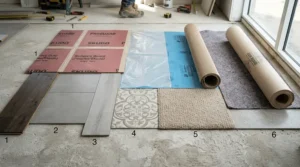
Now the less tidy part. Walk into any Canadian home office with broadloom and you can read the story on the floor: a shiny, flattened oval where the chair lives, ringed by fibres that look like they lost an argument. That patch costs real money to fix. Carpet, as textile historians and flooring references explain, is a pile fabric, and pile is exactly what casters crush.
I can’t tell you I’ve rolled across these mats myself, and I won’t pretend otherwise. What I can do is compare real specs, weigh what buyers consistently report, and tell you where the marketing outruns the physics. This guide covers seven well-known carpet chair mats from budget to premium, the grip technology that decides whether a mat stays put, and how it all plays out in a Canadian winter of boots, slush and dry air. Prices below are approximate CAD ranges at the time of research, so always check current price and availability on amazon.ca.
Quick Comparison Table: Carpet Chair Mats at a Glance
| Product | Best For | Pile Height | Grip Style | Approx. Price Range (CAD) |
|---|---|---|---|---|
| Dimex C511001G | Low pile, clear look | Low pile, up to about 6 mm | Cleated backing | C$60–C$110 |
| Dimex Evolve | Compact desks, modern look | Low pile | Cleated, rounded corners | C$70–C$120 |
| HON Chair Mat for Carpet | Budget buyers | Low to medium | Cleated | C$50–C$100 |
| DoubleCheck Products Chair Mat | Medium pile | Medium | Cleated | C$60–C$110 |
| ES Robbins EverLife | Thick, plush carpet | High pile | Heavy-duty anchoring cleats | C$90–C$170 |
| Floortex Polycarbonate Chair Mat | High pile, long-term durability | Medium to high | Cleated | C$100–C$180 |
| Anji Mountain Rug’d Chair Mat | Style-first home offices | Low pile and hard floors | Textured, woven surface | C$80–C$160 |
Here’s what the table says. Pile height is the single biggest filter: the three low-pile specialists at the top will frustrate you on shag, while the two high-pile options are overkill (and sometimes overpriced) on tight commercial carpet. If your carpet is typical builder-grade low pile, the Dimex C511001G and HON Chair Mat for Carpet cover most households for the least money. Buyers with plush carpet should skip straight to ES Robbins EverLife or the Floortex Polycarbonate Chair Mat, because a mat that is wrong for your pile will creep no matter how good the brand is.
💬 Just one click — help others make better buying decisions too!😊
Top 7 Carpet Chair Mats: Expert Analysis
1. Dimex C511001G — clearest budget-friendly pick for low pile
The standout here is clarity: the clear vinyl lets your carpet colour show through, so the mat reads as a faint shine rather than a plastic slab. It’s designed for low pile carpet up to roughly 6 mm (0.25 in) and carries a lip, meaning the mat extends under the desk where chairs actually travel.
On paper, the cleated backing is what stops creep, and the lip design matters more than people think: without it, you push the chair back and the casters hop onto bare carpet at the mat’s edge. The listing also describes the vinyl as free of BPA and phthalates, which is a useful detail if you’re sensitive to plastic odours in a small room. Based on the spec comparison, this is the sensible default for a typical home office with standard broadloom.
Reviewers on the large US listing consistently praise easy rolling and visible carpet protection, with a few noting a mild new-plastic smell that fades. I couldn’t verify Amazon.ca-specific review counts, so check the live listing.
Pros:
- ✅ Clear vinyl keeps carpet colour visible
- ✅ Lipped shape covers desk-side travel
- ✅ Cleats hold on low pile
Cons:
- ❌ Not suitable for thick or plush carpet
- ❌ Vinyl can show scuffs over several years
Price range: roughly C$60–C$110. Value verdict: the safest buy for standard low pile.

2. Dimex Evolve — rounded corners for compact, modern desks
Where the Dimex C511001G is a traditional rectangle with a lip, the Dimex Evolve uses a modern shape with rounded corners. Those curves aren’t just aesthetic: square corners are what snag vacuum cleaners and catch bare toes, and softer geometry fits better in smaller rooms.
The listing positions it for low pile carpet, and its footprint (around 33 × 44 in, or roughly 84 × 112 cm, on the common size) suits compact desks and kids’ homework corners. That size is a real trade-off. A bigger chair sweep, say a gamer who pivots constantly, will push a gaming chair off the mat, so measure your usual travel before committing.
Review sentiment for this line, based on several buyer guides, leans positive on looks and corner design, with the usual category complaint about edges that can curl in cold rooms until they flatten out. That matters in a basement office in January.
Pros:
- ✅ Rounded corners are gentler on feet and vacuums
- ✅ Compact footprint suits small rooms
- ✅ Clear finish blends with most carpets
Cons:
- ❌ Smaller coverage than 46 × 60 in alternatives
- ❌ Priced above bare-bones options
Price range: roughly C$70–C$120. Value verdict: worth it when aesthetics and tight space matter.
3. HON Chair Mat for Carpet — best budget pick for everyday use
Budget doesn’t have to mean flimsy. The HON Chair Mat for Carpet gets repeatedly named a best-value pick in buyer guides, and the logic is simple: HON is a long-established commercial office furniture brand, so the mat is built for workplace use rather than as a throwaway accessory.
The spec that matters is the cleated underside plus the lipped design, which does the same job as pricier mats on low to medium pile. What you give up is polish: edges and clarity are fine, but not as crystal-clear as the Dimex C511001G, and some buyers notice a slightly more visible texture. What most budget shoppers overlook is that a C$20 saving is gone the first time a creeping mat forces you to re-seat it daily, so match pile height carefully.
Reviewers in this category generally report easy rolling and decent staying power on low pile, while noting mats can feel stiff and curled out of the box. Let it lie flat for a day or two.
Pros:
- ✅ Strong value for the price
- ✅ Commercial-grade brand heritage
- ✅ Lipped design extends desk coverage
Cons:
- ❌ Less optically clear than premium rivals
- ❌ May curl until fully flattened
Price range: roughly C$50–C$100. Value verdict: best bang for the loonie.
4. DoubleCheck Products Chair Mat — a solid fit for medium pile
Medium pile is the carpet type nobody builds products for. It’s too plush for low-pile mats to hold, yet not deep enough to justify heavy-duty high-pile gear. The DoubleCheck Products Chair Mat is specifically pitched at this middle ground, and that’s the whole reason it exists.
The practical meaning: slightly longer, deeper cleats than low-pile mats, so the mat anchors into taller fibres instead of floating on top. If your carpet leaves a visible footprint when you walk on it but isn’t shag, this is your category. Based on the spec comparison, you’d choose it over the budget HON Chair Mat for Carpet if you’ve noticed any slipping or the mat rocking when you stand up.
Buyer reviews in this category tend to praise holding power on thicker carpet, with the occasional note about a visible lip edge. I couldn’t confirm a big review pool, so treat this one as a smart, less-hyped pick.
Pros:
- ✅ Designed around medium pile carpet
- ✅ Deeper grip resists creeping
- ✅ Reasonable price for the category
Cons:
- ❌ Less brand recognition than Dimex or HON
- ❌ May be too aggressive for very low pile
Price range: roughly C$60–C$110. Value verdict: the quiet specialist for in-between carpets.
5. ES Robbins EverLife — heavy-duty anchoring for plush high pile
If your carpet feels like a lawn, the ES Robbins EverLife is the one built for you. It’s marketed for high-pile and extra-thick carpet, where most mats simply sink in and slide.
The spec story is about anchoring. High-pile mats need deep, wide cleats that reach through the fibre to the backing, otherwise the mat floats on top of the pile like a raft. The ES Robbins EverLife addresses that with robust anchor cleats, and the build is designed to resist cracking and yellowing, which is why “EverLife” earns its name on paper. For a family room office with shag or thick-cut carpet, it’s the rare mat that holds without double-sided tape.
Reviewers of heavy-duty mats consistently report better staying power on deep carpet, balanced by complaints about weight and price. Expect a mat you’ll want help lifting.
Pros:
- ✅ Built for extra-thick, plush carpet
- ✅ Heavy-duty anchoring cleats
- ✅ Durable material designed for long life
Cons:
- ❌ Heavy and awkward to move
- ❌ Premium price over low-pile mats
Price range: roughly C$90–C$170. Value verdict: pay up only if your pile demands it.

6. Floortex Polycarbonate Chair Mat — rigid, long-lasting option for deep carpet
Polycarbonate is the premium material tier, and the Floortex Polycarbonate Chair Mat leans on that. Compared with standard vinyl, polycarbonate is stiffer and more resistant to cracking from heavy chairs and sub-zero basements, which matters in Canada where unheated rooms swing cold.
What this means in practice: a stiffer mat resists the dishing and curling you can get with softer plastics, and the clear finish tends to stay clearer for longer. It’s recommended in buyer guides for higher-pile carpet, though check the specific listing for pile limits because Floortex makes multiple models. The caveat is cost. You’re paying for a material that may outlast the carpet itself, so it makes the most sense for permanent home offices, not a rental you’ll leave in two years.
Reviewer sentiment for polycarbonate mats usually celebrates rigidity and clarity, with price as the main sore point.
Pros:
- ✅ Rigid polycarbonate resists cracking
- ✅ Clear finish stays clear longer
- ✅ Suits thicker carpet
Cons:
- ❌ Highest price tier among clear mats
- ❌ Model specs vary, so listings need checking
Price range: roughly C$100–C$180. Value verdict: best for long-term, heavy use.
7. Anji Mountain Rug’d Chair Mat — decorative woven surface for style-first rooms
Not everyone wants a transparent slab. The Anji Mountain Rug’d Chair Mat swaps plastic for a woven polyester surface, so it looks like a rug rather than a protector. That’s a genuinely different product, and it solves a real objection: plenty of people refuse to put plastic in a living-room-adjacent office.
Per the maker’s description, woven polyester suits hard floors and low-pile carpet, which makes it flexible if you rearrange rooms. The texture also muffles caster noise and adds a softer feel underfoot. The trade-off is that rolling is a touch less slick than on a smooth plastic top, and it’s harder to wipe clean after a coffee tragedy.
Reviewer themes for decorative mats typically praise looks and quiet rolling, with notes about slower glide and stain care.
Pros:
- ✅ Looks like a rug, not plastic
- ✅ Quieter rolling than hard plastic
- ✅ Works on hard floors and low pile
Cons:
- ❌ Slower glide than smooth plastic
- ❌ Harder to clean spills
Price range: roughly C$80–C$160. Value verdict: pay for looks and quiet, not raw performance.
Carpet Chair Mat Review: What Buyers Report and What to Weigh
A carpet chair mat review is only useful if you know how to read it. Across buyer guides such as Bob Vila’s carpet chair mat roundup, the same picks surface: Dimex for low pile, HON for budget, and heavy-duty options for plush carpet. That cross-source agreement is a better signal than any single five-star rating.
Three themes recur in aggregated reviews of this category. First, buyers love the rolling: wheels glide instead of dragging, and that is the headline reason people buy. Second, odour and curling are the most-cited gripes, usually in the first week. Third, mismatched pile height is the number one cause of one-star reviews, because a mat rated for low pile will slide on medium carpet.
| Product | Strongest Review Theme | Common Complaint | Best For |
|---|---|---|---|
| Dimex C511001G | Clarity and easy glide | New-plastic smell | Standard low pile |
| Dimex Evolve | Design and size | Small footprint | Compact desks |
| HON Chair Mat for Carpet | Value | Stiffness | Budget buyers |
| ES Robbins EverLife | Holds on thick carpet | Weight | Plush carpet |
| Anji Mountain Rug’d Chair Mat | Looks and quiet | Stain care | Style-first rooms |
Reading the table, review sentiment tracks the buyer’s use case more than the brand. The Dimex C511001G earns praise because people with low pile buy it, while the ES Robbins EverLife earns praise because people with deep carpet finally stop chasing a creeping mat. The takeaway: read the three-star reviews and look for your carpet type, not just the star average.
Carpet Chair Mat vs Hard Floor Chair Mat: Why the Difference Matters
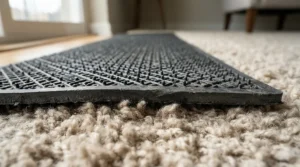
A carpet chair mat vs hard floor chair mat comparison comes down to one thing: the underside. Carpet mats have cleats or studs that dig into fibres. Hard floor mats have smooth or rubberized backs that grip without scratching. Swap them and both fail.
| Feature | Carpet Chair Mat | Hard Floor Chair Mat |
|---|---|---|
| Underside | Cleats or studs | Smooth or rubber backing |
| Surface | Rigid, glide-friendly | Often softer or lipped |
| Risk if misused | Cleats can mark hardwood | Slides and creeps on carpet |
| Typical examples | Dimex C511001G, HON Chair Mat for Carpet | Mats made for hardwood and tile |
| Best For | Broadloom, wall-to-wall | Hardwood, laminate, tile |
Cleats are designed to anchor into carpet fibres and have nothing to grip on wood or tile; on hard surfaces they slide and can mark the finish. The reverse is just as true: a flat-backed mat on carpet will wander across the room. The Anji Mountain Rug’d Chair Mat is the interesting hybrid because it’s built for both low pile and hard floors, which makes it handy if you move between rooms.
If you’re caught between surfaces, buy for the surface that sees the most chair time. The same logic applies to Canadian condos where one room has laminate and the next has carpet: don’t compromise on one mat, buy two.
Carpet Grip Technology: Cleats, Studs and the New Gripper Designs
Carpet grip technology sounds like marketing until you realize it’s the whole game. A mat that doesn’t stay put isn’t protecting anything.
The classic design is cleats: small studs on the underside that penetrate carpet fibres. Deeper, denser cleats suit taller pile, while shallower, rounded ones suit delicate low-pile carpet. Aggressive cleats on delicate carpet can indent or fray fibres, which is why the right match matters. The Staples AnchorBar design, for instance, uses rounded cleats marketed as gentle on carpet and fingers, for low pile up to roughly 9.5 mm (3/8 in) including padding.
Newer designs push this further. The Cleartex TrYlok system uses multi-directional grippers that the maker says offer up to 20 per cent better slide resistance than traditional spike mats on low pile up to 6 mm. That claim is from the manufacturer, so treat it as a promising design rather than a lab-verified fact. The idea, though, is sound: cleats pointing in several directions resist sideways force from any chair movement, not just forward-and-back.
Practical meaning for buyers: if your mat creeps, don’t assume the product is bad. Check pile height first, then cleat depth, then consider a gripper pad. Everything else is noise.
How to Choose Carpet Chair Mats: 7 Steps That Actually Work
- Measure your pile. Press a ruler into the carpet and measure the fibre height. Under about 6 mm is low pile; deeper needs a heavier mat.
- Check padding too. Many mats list limits “including padding,” so your underlay counts toward thickness.
- Match the cleats. Low pile needs shallow, rounded cleats; plush carpet needs deeper anchors.
- Size for your chair’s travel. Measure how far you roll, then add a hand’s width. A 36 × 48 in (about 91 × 122 cm) mat covers most home desks.
- Choose the shape. A lip extends under the desk; a rectangle suits open layouts.
- Pick the material. Vinyl is affordable, polycarbonate is stiffer and longer-lived, and woven polyester suits decorative rooms.
- Check low-emission certification. Some listings note low chemical emissions certification, which is worth having in a closed room.
Do these seven steps in order and a carpet chair mat with grippers or cleats you can trust becomes obvious. Skip step one and you’re guessing.
Easier Chair Rolling: Setup and Your First 30 Days
Easier chair rolling starts with unboxing, not buying. Plastic mats ship rolled, so they arrive curled and cold-stiff, especially in a Canadian winter delivery.
Day one: unroll the mat face-down in a warm room (around 20°C) for 24 hours with books on the corners. Never use a hair dryer or heater to flatten it; heat can warp vinyl.
Placement: centre the mat under the desk so the lip tucks beneath your usual chair position. The chair should be able to move forward fully without a caster dropping onto bare carpet.
First week: check position daily. If it migrates, press down and rotate the mat slightly to reseat cleats into the fibres. Persistent creeping means a pile mismatch, not bad luck.
Optimization tricks: soft rubber chair casters (sometimes called “carpet-safe” or “hard floor” wheels) roll more quietly and lessen wear on any mat. Also, rotate the chair’s position slightly every few weeks to spread wear.
Common mistakes in the first 30 days: vacuuming over the mat edge without lifting it (cleats can catch), dragging the mat to reposition (this stretches carpet loops), and forgetting to lift the mat during deep cleaning, which traps moisture.
If rolling still feels stiff, the issue is usually carpet thickness or an oversized mat. Easier chair rolling comes from a flat, correctly gripped mat that matches your pile, nothing more exotic.
Home Office Carpet Care: Protecting What’s Under the Mat
Home office carpet care is the part nobody mentions at checkout. A mat protects the surface, but a trapped-moisture or dust problem can quietly spoil the carpet beneath it.
Problem 1: Mat marks or indentations. Cleats can press a pattern into soft carpet over months. Solution: lift the mat every two to three weeks, vacuum the area, and let fibres spring back.
Problem 2: Winter slush and moisture. Boots track in wet salt and meltwater, which can sit under a mat and breed odour. Solution: leave footwear at the door and lift the mat monthly so the carpet can dry.
Problem 3: Dust and allergens. Mats can hold fine dust at the edges. Solution: vacuum with a brush attachment and wipe the mat surface with a damp cloth. Public health guidance, such as HealthLinkBC’s indoor air quality file on VOCs, recommends good ventilation when new carpet or other VOC sources enter a home, a sensible habit when you’re unboxing a new mat too.
Problem 4: Static in dry winter air. Plastic mats can add static in low-humidity rooms. Solution: run a humidifier and consider an anti-static spray on the mat surface, not on the carpet.
Problem 5: Fading near windows. Clear mats don’t block sunlight. Solution: rotate the mat and use blinds on sunny days.
Think of the mat as a bodyguard, not a force field. It takes the hits, but you still have to feed the carpet some regular attention.
Real-World Scenarios: Which Mat Fits Which Canadian Household?
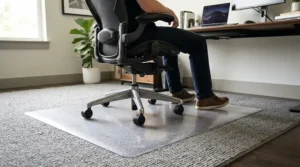
Scenario 1: The remote worker in a Toronto condo. Low-pile builder carpet, small room, eight-hour days. Budget: moderate. Best fit: the Dimex C511001G for clarity and low-pile grip, or the compact Dimex Evolve if floor space is tight. Daily heavy use means choosing a lip so the chair stays on the mat.
Scenario 2: The family in a Calgary basement. Medium-pile carpet, kids doing homework, cold floors in winter. Best fit: the DoubleCheck Products Chair Mat for grip on thicker carpet, with the HON Chair Mat for Carpet as a budget alternative if the pile is lower than expected.
Scenario 3: The gamer in a Halifax rental. Thick carpet, heavy gaming chair, constant swivelling. Best fit: the ES Robbins EverLife or Floortex Polycarbonate Chair Mat. A heavy chair on plush pile will defeat lightweight vinyl, so go rigid and anchored.
Scenario 4: The design-conscious freelancer in Vancouver. Open-plan living room office, wants a rug look. Best fit: the Anji Mountain Rug’d Chair Mat, accepting slower glide in exchange for aesthetics.
Notice the pattern: carpet type and chair weight decide the product, and budget just sets the tier. If you rent, avoid permanent adhesives and pick a mat you can roll up and take with you.
Features That Actually Matter (And Those That Don’t)
Matter:
- Pile-height rating. Non-negotiable. It decides whether the mat stays put.
- Cleat design. Depth and shape matter more than brand.
- Lip and size. A mat that’s too small is a decorative placemat.
- Thickness. A thicker mat resists cracking under heavy chairs, but only helps if the cleats match the carpet.
Don’t matter as much:
- “Crystal clear” claims. All clear mats scuff eventually.
- Fancy edge finishes. Nice to have, irrelevant to performance.
- Lifetime-warranty headlines. Read what the warranty actually covers; it often excludes cracking from normal use.
What the spec sheet won’t tell you, but buyers keep saying, is that a mat’s biggest failure mode is mismatch, not defect. If you remember one thing, make it this: buy for your carpet, not for the product page.
Common Mistakes When Buying Carpet Chair Mats
Mistake 1: Ignoring pile height. The leading cause of creeping and returns. Measure first.
Mistake 2: Buying hard floor mats for carpet. Smooth backs slide. Check the underside.
Mistake 3: Choosing too small a size. If your chair rolls off the edge, the mat can’t protect anything.
Mistake 4: Buying for looks over function. A decorative mat is lovely, but only if your pile and chair weight suit it.
Mistake 5: Skipping the flattening step. Mats shipped rolled need time to lie flat. Impatient buyers blame the product.
Mistake 6: Over-tightening on grip. Overly aggressive cleats on delicate carpet can mark fibres. Gentle matched grip beats brute force.
Mistake 7: Forgetting your underlay. Thick padding changes the effective pile height, so a mat rated “up to 9.5 mm including padding” has less room than you think.
Most of these come down to rushing. Five minutes with a ruler beats a return shipment.
Long-Term Cost and Maintenance: Is a Pricier Mat Worth It?
A cheap mat that fails in two years costs more than a rigid one that lasts a decade. Total cost of ownership is the real maths here.
| Tier | Typical Material | Approx. Price Range (CAD) | Expected Lifespan (general) | Best For |
|---|---|---|---|---|
| Budget | Vinyl (HON Chair Mat for Carpet) | C$50–C$100 | Several years, light to moderate use | Occasional use |
| Mid-range | Vinyl (Dimex C511001G, DoubleCheck Products Chair Mat) | C$60–C$110 | Several years with care | Daily home offices |
| Premium | Polycarbonate (Floortex Polycarbonate Chair Mat, ES Robbins EverLife) | C$90–C$180 | Longest in category | Heavy chairs, plush carpet |
| Decorative | Woven (Anji Mountain Rug’d Chair Mat) | C$80–C$160 | Varies with cleaning | Style-first rooms |
Lifespans are general expectations, not guarantees. The table shows that the jump from budget to mid-range buys you clarity and fit, while the jump to premium buys durability for heavy use. Replacing worn broadloom easily runs into the hundreds of dollars, so even a C$100 mat that protects a carpet for years pays for itself. Maintenance is cheap: wipe the surface, lift and vacuum monthly, and check the cleats for wear.
Safety and Regulations: What Canadians Should Know
There’s no federal “chair mat law,” but a few Canadian considerations deserve attention.
Chemical emissions. New plastics and new carpet can release volatile organic compounds (VOCs). Health Canada’s indoor air contaminants guidance on VOCs explains that VOCs are common in Canadian homes and that some can pose health risks at certain concentrations. Practically, ventilate the room when you unbox a new mat, and look for low-emission certifications such as GREENGUARD Gold where available. Some retail listings, like Staples AnchorBar, state this certification explicitly.
Slip and trip safety. A mat that creeps is a hazard. Rounded corners, flat edges and stable grip reduce tripping risk, especially for kids and older adults.
Workplace context. If you work from home for an employer, check whether your provincial occupational health guidance on workstation setup applies. Ergonomics rules vary by province, so verify locally.
Heated floors and cold rooms. Plastics can warp near heat sources. Keep mats away from floor vents and baseboard heaters in winter.
FAQ: Carpet Chair Mats
❓ What are the best carpet chair mats for thick carpet in Canada?
❓ Do carpet chair mats damage carpet?
❓ How do I stop a carpet chair mat from moving?
❓ Can I use a carpet chair mat on hardwood?
❓ How big should a carpet chair mat be?
Conclusion
Carpet chair mats are one of the rare home-office purchases where boring research pays off. Match your pile height, choose cleats suited to your carpet, size the mat to your chair’s real travel, and the rest is detail. For standard low pile, the Dimex C511001G and HON Chair Mat for Carpet cover the field. For medium pile, the DoubleCheck Products Chair Mat is the quiet specialist. For plush carpet, the ES Robbins EverLife and Floortex Polycarbonate Chair Mat are the sturdy choices. For style, the Anji Mountain Rug’d Chair Mat and the compact Dimex Evolve each solve a different problem.
Remember the Canadian extras: let the mat flatten in a warm room, lift it monthly through slushy winters, and ventilate when unboxing. Do that, and your carpet should outlast your chair.
✨ Ready to protect your floors?
🛒 Check current prices and availability on amazon.ca for the mat that fits your carpet, and give your chair the smooth ride it deserves!
Recommended for You
- Hard Floor Chair Mats: 7 Proven Picks For Canada (2026)
- Office Chair Mats: 7 Best Scratch-Proof Picks In 2026
- Memory Foam Seat Cushions: 7 Best Picks For Canada In 2026
Disclaimer: This article contains affiliate links. As an Amazon Associate, I earn from qualifying purchases. If you purchase products through these links, we may earn a small commission at no additional cost to you.
✨ Found this helpful? Share it with your friends! 💬🤗
